ADKAR Change Management Model: What to Do When You Find the Gap
Key Takeaways
- ADKAR is a diagnostic framework, not an intervention framework. It tells you where individuals are stuck in a change. It does not tell you how to unstick them.
- The biggest failure point is the Desire-to-Ability gap: organizations invest in communication and training while underinvesting in the motivation and practice that make adoption stick.
- Each ADKAR element has a predictable failure pattern. The intervention is never “more of the same.” More emails won’t fix an Awareness gap, and more training won’t fix an Ability gap.
- ADKAR and coaching are complementary, not competing. ADKAR provides the diagnostic structure. Coaching develops the sponsor capability to close the gaps the diagnosis reveals.
- The next time you run an ADKAR assessment and surface a gap, the question is whether your planned response addresses why the element didn’t develop, or just delivers more of what didn’t work.
The change lead had run the ADKAR assessment. The results were clear: Desire lagging across three of four business units. People understood the change. Awareness scores were solid. They could explain what was happening and why. They simply were not motivated to adopt it.
The project team’s response was predictable. More communication. A refreshed FAQ document. An executive video message. A revised incentive structure. All aimed at creating Desire through volume and repetition.
Six months later, the follow-up assessment showed the same Desire gap. Communication had doubled. Motivation had not moved. The diagnosis was precise. The intervention missed entirely because knowing where people were stuck did not change what happened next.
This pattern repeats across ADKAR implementations. Prosci’s framework remains one of the most widely adopted change management models for good reason: it provides clear diagnostic language for individual change readiness. Five elements. A logical sequence. Assessment tools that surface gaps with specificity.
The gap is not in the model. The gap is in what organizations do after the diagnosis. ADKAR tells you the where. It assumes you already know the how. Most don’t. After using ADKAR across enough organizational changes, the pattern becomes unmistakable: the framework diagnoses problems that require human development to solve. That development is exactly what coaching provides.
What ADKAR Actually Measures
ADKAR tracks an individual’s readiness to adopt a specific change. Unlike Kotter’s 8-step model, which operates at the organizational level, ADKAR zooms in on the person. Each of the five elements (Awareness, Desire, Knowledge, Ability, Reinforcement) represents a checkpoint where adoption can stall.
The model’s strength is diagnostic precision. When an initiative stalls, ADKAR can pinpoint whether the issue is comprehension, motivation, skill, or sustainment. Prosci’s research base and certification program have given it widespread credibility among HR and OD leaders.
But diagnosis and intervention are different capabilities. A physician who identifies the disease still needs the skill to treat it. ADKAR identifies where someone is stuck. It does not develop the organizational capability to address why they are stuck. That distinction explains organizations that assess rigorously and still watch adoption stall.
The Five Elements of ADKAR
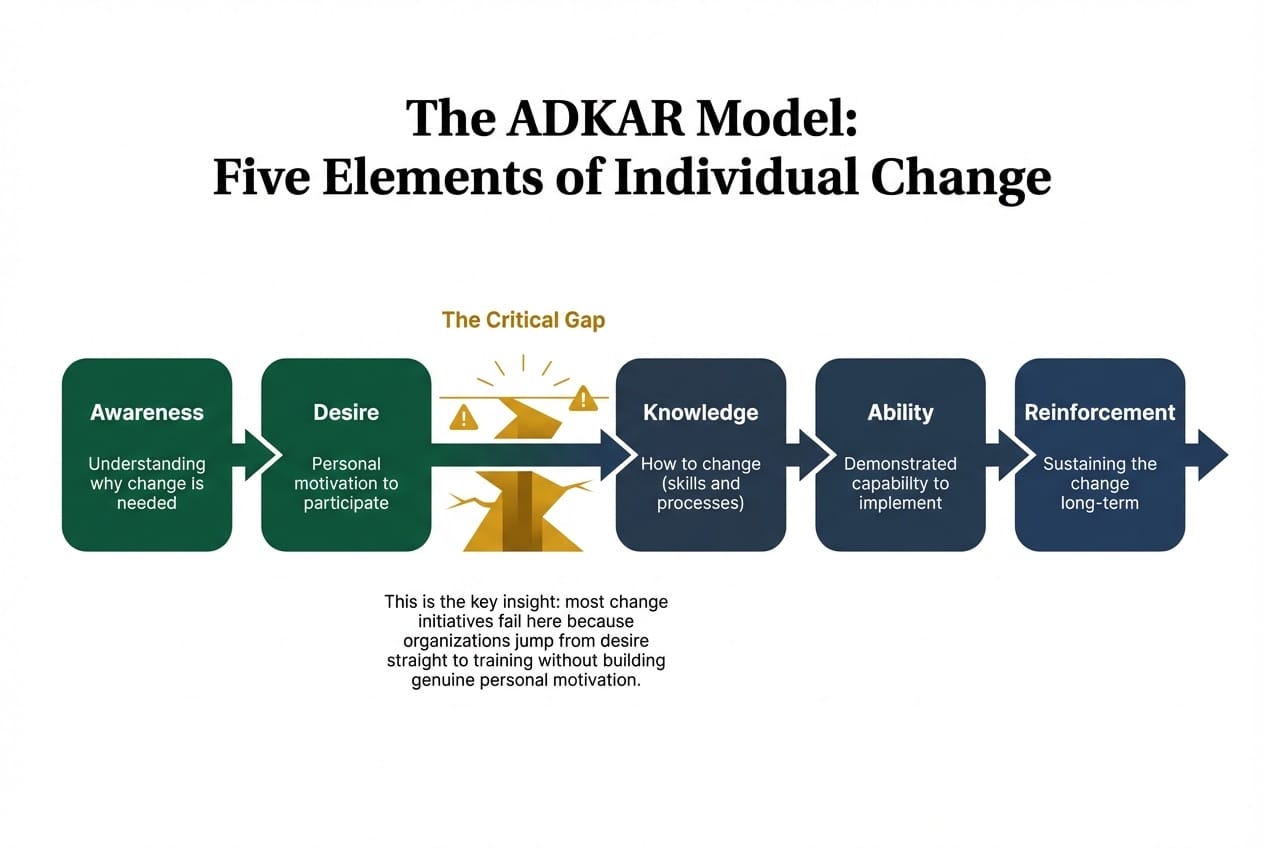
ADKAR tracks an individual’s progression through change. Each element must reach sufficient strength before the next can develop. The sequence matters, though not as rigidly as the model sometimes implies.
A — Awareness of the Need for Change
Awareness means understanding why the change is happening. Not the announcement itself, but the reasoning and business context behind it.
Where it stalls: Leadership equates communication with comprehension. The all-hands meeting where the change is declared, followed by hallway conversations: “But why are we really doing this?” Information was delivered. Context was not. The memo explained what was changing. Nobody explained what problem the current state was creating, why alternative approaches were rejected, or what happens if the organization does nothing.
The coaching intervention: Awareness develops through dialogue, not broadcast. Coaching sponsors to move from presentation to conversation addresses the root cause. When a sponsor can sit with a skeptical team and respond to their actual questions rather than redirect to talking points, Awareness develops. That conversational capability is coached, not trained.
D — Desire to Support the Change
Desire is personal motivation to engage with and participate in the change. It answers “What’s in it for me?” Or more honestly: “What happens to me if I don’t?”
Where it stalls: Awareness and Desire collapse together in practice. People form opinions about a change the instant they hear about it. The neat sequential progression does not match how humans actually process organizational news. The team that understands the change perfectly but has decided to wait it out. They have seen enough initiatives come and go. Their top performers see the change as a threat to exactly what made them successful, and no amount of messaging addresses that underlying trade-off.
The coaching intervention: Desire cannot be manufactured through incentives or mandated through authority. It develops when people feel genuinely involved in shaping how the change affects their work. Coaching helps sponsors have honest conversations about what people are giving up, not just what they are gaining. Acknowledging the real trade-offs builds trust. Trust builds Desire. Skipping to incentives without that foundation builds compliance at best.
K — Knowledge of How to Change
The 95% training completion rate that precedes the 40% adoption rate. Everyone passed the course. Nobody changed how they work. This is the Knowledge gap in action: people know what to do differently but were trained in conditions disconnected from where the new skills must actually be applied. Different system, different pressure, different constraints.
Knowledge means understanding the new behavior, process, or tool. It is the element organizations invest in most heavily because training programs produce measurable outputs: completion certificates, test scores, attendance records. The problem is not that training is unnecessary. The problem is that classroom knowledge does not automatically transfer to workplace behavior.
Coaching helps managers create the bridge between the classroom and the desk: practice opportunities during actual work, feedback during early attempts, and the patience to let people stumble before they get competent. The distinction between “I know” and “I can do” is where Knowledge meets its limit and Ability begins.
A — Ability to Implement New Skills
Ability is demonstrated capability to perform the new way under real conditions. Not in a lab. Not in a training environment. Under the pressure, interruptions, and competing priorities of actual work.
Where it stalls: This is the critical failure point. The CRM implementation where training scores were excellent. The sales team could navigate the new system in a practice environment. Back at their desks with quota pressure and customer calls, they reverted to spreadsheets and the old system within weeks. They had Knowledge. They did not have Ability. The change plan assumed training equals capability. It does not.
The coaching intervention: Ability develops through practice with feedback. Graduated complexity in a psychologically safe environment where early failure is expected, not punished. Coaching creates those conditions: managers learn to provide real-time feedback during the learning curve, teams get permission to be slower before they get faster, and the performance expectations adjust for the transition period. Without this, people revert to the old way the moment pressure spikes.
R — Reinforcement to Sustain the Change
The project team disbands. Sponsor attention migrates to the next initiative. Reinforcement mechanisms designed during the project are not maintained after closure. Six months later, the change that looked successful at 90 days has quietly reverted as old habits reasserted themselves. Nobody was watching. The performance management system still measured compliance with old processes while the new ones went unadopted.
Reinforcement encompasses the mechanisms that make the change stick after initial adoption: recognition, measurement alignment, consequence systems, and leadership behavior that signals the new way is permanent. It is the element most likely to be designed during the project and abandoned after it. Coaching develops the awareness to see when reinforcement is slipping and the discipline to address it. What gets recognized, what gets tolerated, what gets ignored. These are daily leadership decisions that become embedded in how leaders lead, not filed away when the project closes.
Each element can stall a change. But after supporting enough ADKAR implementations, a pattern emerges: the most common failure point is not within a single element. It is in the gap between two of them.
The Desire-to-Ability Gap
Organizations invest heavily in Awareness: communication campaigns, town halls, FAQs, executive messages. They invest in Knowledge: training programs, e-learning modules, documentation, certification courses. These are comfortable investments. They have clear deliverables, measurable completion rates, and visible activity.
Stuck in D-to-A? Stop Scaling Emails and Training
If motivation isn’t moving and capability isn’t sticking under pressure, let’s pinpoint why—and what to do differently—in a free consult.
They underinvest in Desire and Ability. Desire requires uncomfortable conversations about real trade-offs. Ability requires time, patience, and tolerance for decreased productivity during the learning curve. Neither produces a deliverable. Neither fits neatly on a project plan. Both require ongoing human development rather than one-time delivery.
The result: people who understand the change and know what to do differently, but either do not want to do it or cannot execute it under real conditions. The dashboard shows green on Awareness and Knowledge. Hallway conversations tell a different story. Assessment measured exposure, not understanding. It measured course completion, not behavioral capability.
The Desire-to-Ability gap is where most adoptions die. Not because the change plan was wrong. Not because the communication was insufficient. Because the two elements that require genuine human development received the least investment.
Coaching addresses this gap directly. Coaching sponsors to have real conversations about trade-offs builds Desire that communication plans cannot. Coaching managers to create practice environments with real-time feedback builds Ability that training programs alone do not develop. Both continue after the project ends, precisely where Reinforcement lives or dies.
If communication did not create Awareness, more communication will not help. If training did not create Ability, more training will not help. The intervention must address why the element did not develop, not just deliver more of what failed.
Closing ADKAR Gaps
ADKAR diagnosis tells you where someone is stuck. Coaching provides the capability to close the gap. The intervention is never more of the same.
| Element | Gap Signal | Root Cause | Coaching Intervention |
|---|---|---|---|
| Awareness | “I don’t understand why” | Announcement without dialogue | Coach sponsors through conversation, not presentation |
| Desire | “I understand but don’t want to” | Trade-offs unacknowledged | Honest conversations about what people gain and lose |
| Knowledge | “I don’t know how” | Training disconnected from work context | Practice in realistic conditions with feedback |
| Ability | “I know but can’t do” | Knowledge does not equal capability | Graduated complexity, safe failure, real-time coaching |
| Reinforcement | “We tried but reverted” | Project focus without sustainment practice | Leadership behavior change, embedded recognition |
The pattern across all five elements: the gap is rarely informational. People do not lack data. They lack the conditions for development. Awareness requires dialogue, not more emails. Desire requires trust, not incentives. Knowledge requires context, not courses. Ability requires practice, not certification. Reinforcement requires leadership behavior, not policy documents.
In most ADKAR implementations, sponsors run assessments and read dashboards. What they rarely do: personally engage in the conversations that build Desire, create the conditions that develop Ability, or sustain the behaviors that maintain Reinforcement. That is the capability gap change management coaching addresses. Not fixing the model. Developing the people who must execute within it.
ADKAR + Coaching: Faster Adoption
ADKAR provides clear diagnostic language, individual-level change tracking, sequential logic executives can follow, and assessment tools that surface gaps with specificity. What it does not provide: intervention strategies for closing those gaps, sponsor development to execute the interventions, or sustainment capability that outlasts the project timeline.
Coaching fills each of those gaps. Sponsor capability to have difficult conversations develops Desire. Manager capability to create practice environments develops Ability. Leadership behavior change reinforces sustainment after the project team moves on. Ongoing development, not project-bounded support.
This is not replacement. It is complement. Organizations do not choose between ADKAR and coaching any more than they choose between diagnosis and treatment. They need ADKAR for the assessment structure and coaching for the human development that makes the assessment actionable. Framework plus capability. The organizations that invest in both adopt faster and sustain longer than those investing in either alone.
The certification market reflects this reality. Prosci credentials develop diagnostic and methodology capability. ICF coaching credentials develop the human development capability that methodology alone cannot provide. The most effective change practitioners hold both because each addresses a different dimension of what makes change work.
ADKAR vs. Other Change Models
No single model captures the full complexity of organizational change. ADKAR’s strength is individual-level precision. Other frameworks address dimensions ADKAR does not.
| Model | Primary Focus | ADKAR’s Complement |
|---|---|---|
| Kotter’s 8-Step Model | Organizational change architecture | ADKAR maps individual readiness within Kotter’s organizational sequence |
| Lewin’s Change Model | Change dynamics and force fields | Force field analysis surfaces the Desire barriers ADKAR identifies |
| Bridges Transition Model | Psychological transition | Overlaps with ADKAR’s Desire and Reinforcement elements |
Many practitioners combine frameworks: ADKAR for individual adoption tracking, Kotter for organizational sequencing, and a structured process for day-to-day execution. The choice depends on whether the primary challenge is individual readiness, organizational architecture, or both. Most large-scale changes require attention to all three levels.
Where ADKAR is strongest: when individual adoption tracking matters, when training effectiveness needs measurement, when sponsors need diagnostic clarity about where adoption is stalling. Where it is insufficient alone: when organizational-level dynamics are the primary barrier, when political resistance requires stakeholder navigation skills, or when sponsor capability gaps mean the diagnosis cannot translate to intervention. For that last category, the answer is not a different framework. It is coaching for the people running the change.
The next time you run an ADKAR assessment and surface a gap, pause before planning the response. Ask whether the intervention you are about to design is more of what did not work, or something fundamentally different.
If Awareness is low, the answer is not more emails. It is better conversations. If Desire is low, the answer is not incentives. It is honest dialogue about trade-offs. If Ability is low, the answer is not more training. It is practice with feedback under real conditions.
ADKAR’s diagnostic precision is its gift. The intervention that follows is where change succeeds or fails. Between now and your next change initiative, identify which ADKAR element your organization habitually underinvests in. That is where the development work starts. And the coaching conversation.
Your ADKAR Dashboard Is Clear—Now What?
Bring your gap signals (Awareness, Desire, Knowledge, Ability, Reinforcement) to a free consult and map the intervention your change actually needs.
Book a Free Consultation →