AgTech Is Betting on Star Scientists. That’s a Leadership Bet.
Key Takeaways
- Bonsai Robotics is being valued on a marquee technical hire. Its strategy now rides on one person’s leadership, and leadership is the part the headline never tests.
- Technical brilliance and executive leadership are different skill sets. A scientist who can invent is not automatically a leader who can run a function.
- A marquee hire doesn’t fix the leadership team you already have. Add someone high-status to an executive group and authority quietly rearranges itself.
- Executive coaching closes the gap: for the technologist learning to lead through others, for the founder who has to define scope, and for the executives whose ground just shifted.
Bonsai Robotics put out a LinkedIn post about its Chief Science Officer, and it traveled. Gary Bradski, the computer vision researcher behind OpenCV and a contributor to DARPA’s Stanley robot, had picked up the HardTech Award for 2026. TipRanks covered it twice in two days. The framing held steady both times: here is an AgTech company anchoring its strategy on world-class technical leadership, and investors should read that as a competitive edge.
Maybe it is. But notice what’s actually being priced. A company that tells the market “our strategy is high-profile technical leadership” has made a leadership bet and called it a technology bet.
That difference matters, because the risk in a leadership bet is almost never the technology.
Why AI-First Companies Keep Recruiting Marquee Technical Leaders
AgTech and AI companies recruit marquee technical leaders because a named scientist is a strategy statement the market can read. Hiring someone like Bradski tells investors, recruits, and competitors that the company intends to compete on depth. It is a declaration of intent that costs one headline and carries for years.
The pattern is everywhere right now. Bonsai Robotics built its AgTech narrative around Bradski after acquiring farm-ng to push into AI-first machines for complex farm environments. The same week, Business Wire reported WD’s recognition on the 2026 S&P Dow Jones Best in Class Index for leadership in sustainable AI infrastructure. Different companies, same move: put leadership and AI in the same sentence, then let the market do the rest.
The signal works because it compresses a hard-to-verify claim into something legible. You cannot easily evaluate a private AgTech company’s autonomy stack from the outside. You can evaluate whether the person running the science has a track record. Bradski’s does the work for him. OpenCV, the Stanley robot, two decades of computer vision. Investors get a usable proxy for quality.
Where the signal stops working is the part no headline covers. It tells you the person is brilliant. It tells you nothing about whether the person can lead. In a company betting its strategy on technical leadership, those are two separate questions, and they have two separate answers.
The Gap Between Technical Brilliance and Executive Leadership
Technical brilliance proves someone can solve the hardest problems in a domain. Executive leadership asks something different: can they run a function, set a roadmap other people commit to, develop the leaders under them, and decide well when the data runs out? Brilliance is necessary at this level. It is not sufficient.
From “Smartest Answer” to Building Judgment
Coaching helps a new CSO shift from solving to setting roadmaps, developing leaders, and deciding well when the data runs out.
The strongest technologists tend to share a trait. They are the best answer in the room, and everyone knows it. That is exactly what you want in a Chief Science Officer’s research. It becomes a liability the moment the role turns executive.
An executive’s job is to build an organization that produces good answers without them. A science officer at a scaling company spends less time inventing and more time deciding which inventions get resourced, which engineers get stretched, and which bets get killed. That work runs on judgment about people and priorities, not judgment about algorithms. It is part of what changes at the top of the organization, and it catches a lot of brilliant people off guard.
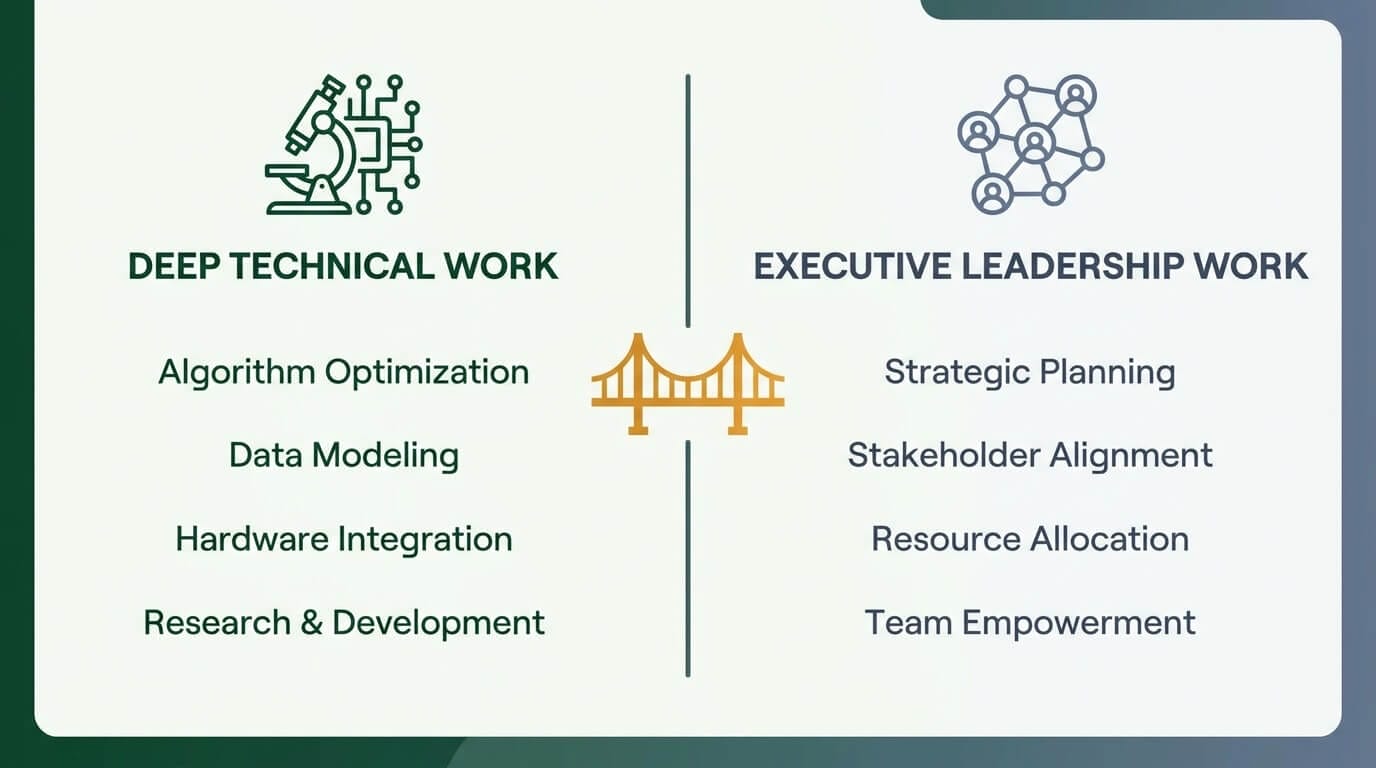
The skills do not transfer on their own, and they sometimes pull against each other. The instinct that makes a great researcher, which is to go deep, get it exactly right, and not ship until it is correct, can stall an executive who has to move a whole portfolio of imperfect bets forward.
None of this means the brilliant hire will fail. Plenty of them make the shift and become excellent executives. It means the shift is real work. A company betting its strategy on that hire should treat the work as part of the bet, not as an afterthought it discovers eighteen months later.
What a Star Hire Doesn’t Solve
A marquee hire does not fix the leadership team already in place. Bring someone high-status into an executive group and authority rearranges itself whether anyone planned it or not. The leaders already there feel it first, and they rarely say so out loud.
Prevent the Quiet Authority Shuffle
A high-status hire can blur decision ownership and trigger resignations. Coaching aligns roles and keeps additive talent from turning into subtractive politics.
Picture the company before the hire. There is a VP of Engineering who has carried the technical vision, made the hard calls, and earned the founder’s trust. Then a celebrated outsider arrives with a bigger title and a reputation that precedes them into every meeting. Nobody changed the VP’s role on paper. Everybody changed it in practice.
This is the integration cost that never makes it into the announcement. The star hire’s reputation is an asset on the investor deck and a complication in the room. Decisions that used to route cleanly through the VP now have an ambiguous second owner. The founder, thrilled with the catch, often misses the quiet renegotiation happening one level down. The deck never shows that part.
Left alone, this resolves badly. The strongest existing leader updates their resume. Or two power centers form, and the organization learns to route around whichever one is in a worse mood that week. Either way, the company paid for additive talent and got subtractive politics.
It does not have to go that way. Avoiding it takes deliberate work, the kind that looks a lot like coaching a leadership team through a major transition, because that is precisely what it is.
Coaching the Technologist Into the Executive Role
Coaching a technologist into an executive role is the senior version of the individual-contributor-to-leader shift. The work is helping a brilliant person stop being the answer and start building judgment in everyone around them. It is harder at the top, because the old habits have been rewarded for longer.
Say you are coaching a newly elevated Chief Science Officer. The technical credibility is not in question. What surfaces in the first few sessions is usually a version of the same theme: the things that made them exceptional are now getting in their way.
They solve problems their team should be solving, because solving is faster and feels good. They hold standards so high that nobody else’s work clears the bar, so everything bottlenecks at them. They manage the founder relationship by being impressive rather than being clear, which works right up until the first real disagreement.
The coaching work is concrete. It is helping them catch the moment they are about to take the answer away from someone who needed to find it. It is building the muscle to lead through other people instead of around them. It is the unglamorous skill of learning to develop executive presence, which here means the ability to be clear, steady, and trusted when the room is uncertain, not the ability to perform confidence.
The technologist already has more raw capability than most people who get handed a leadership playbook. So the coaching does not hand them one. The work is helping them see where their proven strengths have quietly become constraints, and choose differently in the moments that matter. That is what executive coaching for CTOs and science officers actually does.
Coaching the Team Around the Hire
The hire is not the only person who needs support. The founder has to define scope before status defines it for them, and the existing executives need a real forum to renegotiate their roles honestly. Coaching the team around the hire is what turns an announcement into an actual capability.
The founder’s job here is unglamorous and essential: decide, on paper and out loud, what the new leader owns and what they do not. Most founders skip this. They hired a star, so they assume brilliance will sort out the boundaries. It will not. Ambiguity plus status is how you end up with two people quietly believing they run the same function.
Then there is the existing team. The VP of Engineering from the earlier example needs a real conversation, not a reassuring comment in the hallway. What changed? What did not? Where do they still own the call? Executive team coaching gives a leadership group a structured way to have that conversation before resentment hardens into a quieter and far more expensive problem.
This is the work that protects the team you already built. A company can afford to add a marquee leader. It cannot afford to lose three good ones in the eighteen months after, which is the real failure mode when integration is left to chance.
Questions to Ask Before You Make the Bet
Before a founder or CEO anchors strategy on a marquee technical hire, a few honest questions separate a genuine leadership bet from an expensive headline. None of them are about the candidate’s technical record. That part is already obvious, and it is the easy part.
- Has this person led a function, or only led work? Leading brilliant work and leading the people who do the work are different jobs, with different evidence behind them.
- What specifically do they own that someone else used to own? If you cannot answer in one sentence, neither can the team, and the team is the one that has to live with it.
- Who on the current leadership team is most affected, and have you talked to them? If the answer is “not yet,” the integration has already started badly.
- Are you buying capability or buying a signal? Both are legitimate reasons to make the hire. They are not the same purchase, and confusing them is how strategy quietly drifts.
- If this leader needed coaching support to make the executive shift, would you fund it? Or would you treat it as an admission of a bad hire? Your answer tells you whether you understand what you bought.
A marquee technical hire can sharpen an AgTech company’s edge. Bradski may do exactly that for Bonsai Robotics. But the edge comes from leadership working, not from leadership being announced. The companies that get the return are the ones that treat the gap between brilliant and effective as a real piece of work, and resource it like one.
Frequently Asked Questions
Can a brilliant technical leader actually fail as an executive?
Yes, and it usually has nothing to do with their technical ability. The common failure is staying in the role of smartest problem-solver instead of building an organization that solves problems without them. It is a predictable and coachable gap, not a verdict on intelligence.
How is coaching a senior technical leader different from coaching a first-time manager?
The structure is similar, since both involve learning to lead through other people. The difference is altitude and habit. A senior technical leader has been rewarded for individual brilliance for decades, so the instincts run deeper and the stakes of changing them are higher. The work is mostly about noticing when proven strengths have quietly become constraints. New skills are rarely what the leader is missing.
How long does the executive shift take?
There is no fixed timeline, but a meaningful change in how someone leads usually takes months rather than weeks. It tracks real situations: a hard prioritization call, a disagreement with the founder, a team member who needs to be developed rather than rescued. Coaching works on those moments as they happen.
We just made a senior technical hire. How do we brief the existing team?
Directly and specifically. Name what the new leader owns, name what has not changed, and give the affected leaders a real forum to ask questions. Vague reassurance is worse than silence. If roles genuinely overlap, say so and commit to resolving it rather than hoping status sorts it out on its own.
De-Risk the Star Hire Before Politics Start
Book a free consult to map ownership, founder boundaries, and the support your CSO/CTO needs to lead through others.
Book a Free Consultation →