
ICF Credentialing Changes 2026: What Organizations Must Know
The ICF published four credentialing announcements in a single week. A new Mentor Coach Specialization (formerly Mentor Coach Qualification, or MCQ). A Coaching Supervision Qualification. Advanced accreditations for programs that train mentor coaches and supervisors. And the replacement of ACC and PCC performance evaluations with an enhanced mentor coaching requirement.
If you run an internal coaching program, procure external coaching services, or manage coaching as part of your talent development strategy, this isn’t an industry footnote. It’s a structural change to how coaching quality gets measured, maintained, and verified.
Most of the coverage so far has focused on what these changes mean for individual coaches. That’s the wrong lens for organizations. The question isn’t “how does my coach renew their credential?” It’s “how does this change what I should expect from the coaches we invest in - and the systems that support them?”
What ICF Actually Changed
The International Coaching Federation rolled out four interconnected changes to its credentialing ecosystem in April 2026. Each one builds on the others.
The Mentor Coach Specialization (MCS) creates a formal credential for coaches who mentor other coaches. Previously, any PCC or MCC could serve as a mentor coach. Now the ICF is requiring demonstrated competence in mentoring specifically - not just coaching competence at a higher level.
The Coaching Supervision Qualification does the same for coaching supervisors. Supervision - the reflective practice where a coach examines their own coaching with a trained professional - now has its own credential pathway. This separates supervision from mentor coaching, which the industry has often conflated.
Advanced Accreditations extend ICF’s program accreditation model to mentor coaching and supervision training. Organizations that train mentor coaches or supervisors can now seek ICF accreditation for those programs, creating a quality standard at the training provider level. Tandem Coaching has already earned it for mentor coaching - our accredited mentor coach training program holds the ICF Advanced Accreditation in Mentor Coaching (AAMC).
The Enhanced Mentor Coaching Requirement replaces the ACC and PCC performance evaluation. Instead of a one-time recorded session review, coaches pursuing or renewing ACC and PCC credentials will go through a more substantive mentor coaching process. The shift moves credentialing from a point-in-time assessment to an ongoing developmental relationship.
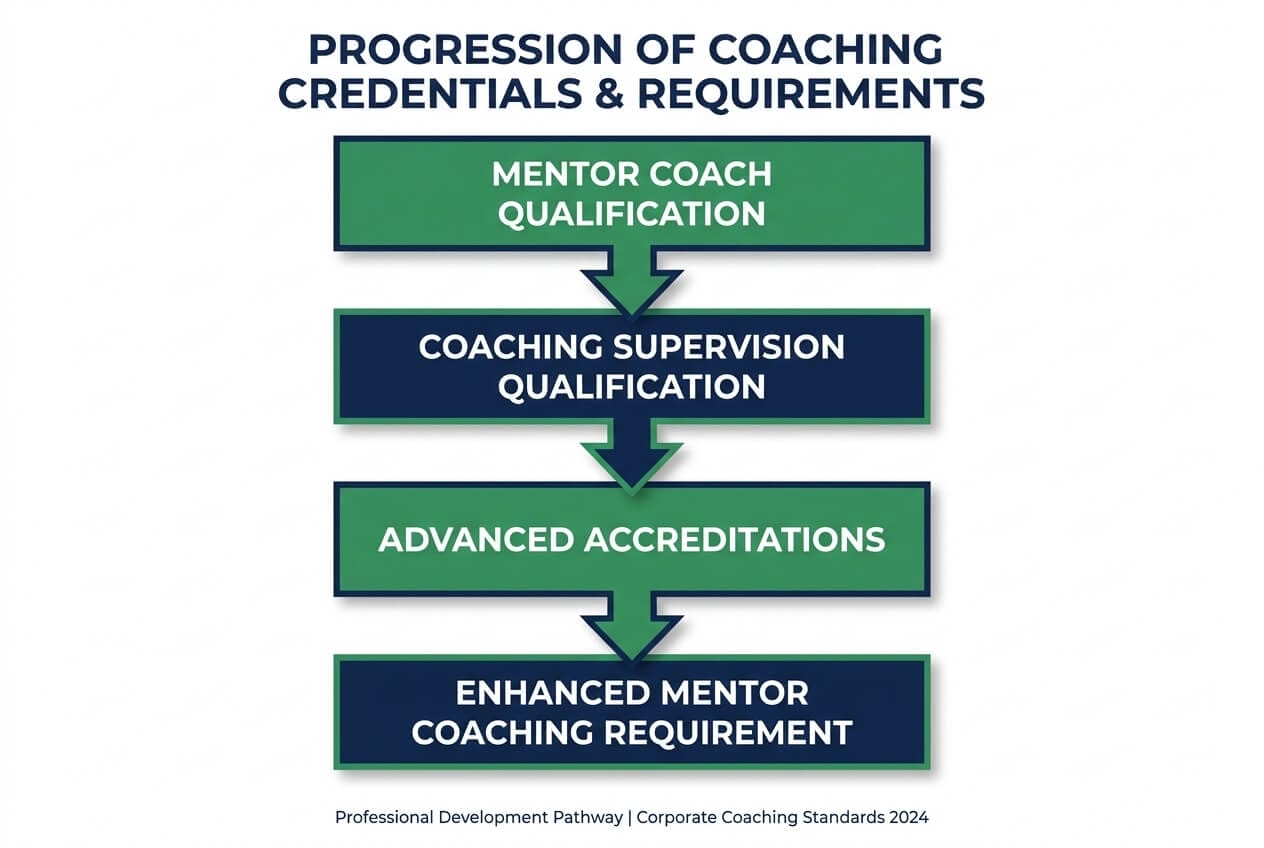
Together, these changes create a credentialing layer on top of credentialing. The ICF isn’t just certifying coaches anymore. It’s certifying the people who develop coaches and the programs that train them.
The Organizational Impact
For organizations that invest in coaching, these changes land in three places.
Need a Stronger Vendor Evaluation Checklist?
We’ll help you translate Mentor Coach Qualification and Supervision Qualification into concrete procurement criteria and contract language.
Your internal coaching bench. If you run an internal coaching program - and most Fortune 500 companies do - your coaches need mentor coaching and may benefit from supervision to maintain their credentials. Under the new standards, the people providing that mentor coaching need to hold the Mentor Coach Specialization. The people providing supervision need the Coaching Supervision Qualification. That’s a new infrastructure requirement. You either build it internally or contract it out.
Your vendor evaluation. When you procure external coaching services, credentialing has always been a checkbox. But the new structure adds depth to what “credentialed” means. A vendor whose coaches receive mentor coaching from qualified mentor coaches, with supervision from qualified supervisors, is operating at a different standard than one that simply verifies its coaches hold ACC or PCC credentials. Your procurement criteria need to reflect that difference.
Your budget. Qualified mentor coaching and qualified supervision aren’t free. If your organization sponsors coach development - paying for training hours, mentor coaching sessions, or supervision - the cost per coach may increase. The trade-off is a more rigorous quality assurance chain. Organizations that already invest in coaching development will absorb this naturally. Organizations that treat credentialing as a one-time onboarding cost will feel the shift.
The timeline matters too. The ICF hasn’t published full transition dates for all four changes, but organizations that wait for enforcement deadlines will find themselves scrambling. The structural adjustments - identifying qualified mentor coaches, establishing supervision relationships, updating vendor contracts - take time to implement.
What This Means for Coaching Quality
The most significant shift is philosophical. Replacing performance evaluations with enhanced mentor coaching moves credentialing from assessment to development.
A performance evaluation is a snapshot. A coach records a session, a trained evaluator scores it against competency markers, and the coach either passes or doesn’t. It tells you whether someone can demonstrate competence in a controlled setting. It doesn’t tell you whether they consistently practice at that level across different clients, contexts, and challenges.
Mentor coaching is a relationship. A qualified mentor coach works with the coach over time, observing patterns, challenging assumptions, and building capability. When this replaces the point-in-time evaluation, the credentialing process itself becomes developmental rather than gatekeeping.
For organizations, this changes the accountability chain. Instead of asking “did our coaches pass their evaluations?” you’re asking “are our coaches in active developmental relationships with qualified mentors?” That’s a harder question to answer with a spreadsheet, but it’s a better indicator of coaching quality.
Coaching supervision adds another dimension. Where mentor coaching focuses on skill development, supervision focuses on the coach’s reflective practice - their awareness of their own patterns, biases, and blind spots. For organizational coaching programs, supervision serves as a quality assurance mechanism that operates below the surface of visible coaching performance. A coach might deliver competent sessions while carrying unexamined assumptions about the organization, the client’s role, or the coaching relationship itself. Supervision catches what performance metrics miss.
How Organizations Should Respond
Four practical steps, in priority order.
Build Mentor Coaching & Supervision Capacity
Whether you build in-house or source externally, we can help you design the infrastructure that supports ongoing coach development.
Audit your current coaching infrastructure. Map your internal coaches’ credential status, their mentor coaching arrangements, and any supervision relationships. Identify gaps: How many of your coaches need mentor coaching for their next renewal? Who’s providing it? Do they hold (or plan to pursue) the new Mentor Coach Specialization? Same questions for supervision.
Update your procurement criteria. If you contract external coaching, add questions to your vendor evaluation. Does the firm provide its coaches with qualified mentor coaching? Does it offer or require coaching supervision? How does it ensure ongoing coach development beyond initial credentialing? Firms that can answer these questions concretely are operating at the standard the ICF is now codifying.
Build or source mentor coaching and supervision capacity. This is the structural investment. You need access to qualified mentor coaches and qualified supervisors - either on staff, through your coaching vendor, or through a dedicated provider. For large internal programs, developing in-house mentor coaches who pursue the new qualification makes sense. For smaller programs, contracting this through an ICF-accredited training provider is more practical.
Start now, not at the deadline. Credential transitions create bottlenecks. The supply of qualified mentor coaches and supervisors will be constrained in the early years. Organizations that establish relationships now - before transition deadlines create urgency - will have better access and more negotiating leverage.
The Bigger Picture
These credentialing changes arrive alongside strong market growth signals. The executive coaching services market continues to expand, with multiple industry analyses projecting significant growth through 2030. Business leadership coaching is attracting institutional investment at rates that would have been difficult to imagine a decade ago.
That’s not a coincidence. As the coaching market grows, so does the need for quality differentiation. When coaching was a niche profession, credentialing served primarily as a barrier to entry. Now that coaching is a multi-billion-dollar industry with thousands of practitioners, credentialing needs to serve a different function: distinguishing developmental quality within an already credentialed population.
The ICF’s move to credential the credentialers is a direct response to scale. And for organizations that invest in coaching, it provides a more granular framework for evaluating the quality of that investment.
Organizations that treat these changes as compliance paperwork will miss the point. The ICF is building an infrastructure for coaching quality that goes deeper than individual credentials. The organizations that engage with that infrastructure - not just check boxes against it - are the ones whose coaching investments will compound.
Align Your Coaching Program with ICF’s New Framework
Let’s review your internal bench, procurement criteria, and budget impacts—so you can respond early and avoid transition bottlenecks.
Book a Free Consultation →