
Accountability Coaching: What It Is and Why It’s Harder Than It Looks
What is accountability coaching and why is it hard?
Accountability coaching supports clients in closing the gap between what they intend to do and what they actually do — not through external pressure, but by building self-knowledge about their own patterns. The hard part: the moment a coach cares more about the client's goals than the client does, it stops being coaching.
“Accountability” in coaching gets used to mean two different things that are actually in tension with each other. There is accountability as a commitment device - the coach holds the client to what they said they would do. And there is accountability as a developmental skill - the client builds the capacity to understand their own relationship with their commitments. These are not the same service and they do not produce the same outcomes.
The first version is what most people picture when they search for accountability coaching. A coach who sends reminders, reviews progress, and notices when things slip. The second version is what professional coaching actually offers - and the gap between those two versions is where the coaching skills behind accountability work become visible.
This article covers both sides. If you are evaluating whether to hire an accountability coach, it describes what the process looks like when done well and what to watch for when it is not. If you are a coach developing your accountability practice, it covers the session mechanics, the failure mode that catches most practitioners, and the trust dynamics that determine whether accountability lands or backfires.
Key Takeaways
- Accountability coaching that focuses on checking commitments without exploring the client's relationship to those commitments is compliance management, not coaching.
- Trust must be established before accountability is effective - reviewing commitments in session two feels different from reviewing them in session six.
- The three-phase accountability session (review, explore, recommit) treats incomplete commitments as information, not as failures to explain.
- Sustainable accountability requires a mindset shift from external discipline to self-knowledge about what your commitments reveal about your actual values.
- Five observable coaching behaviors separate professional accountability coaching from well-intentioned progress checking - and all five are developable skills, not personality traits.
What Accountability Coaching Actually Is
Accountability coaching is a coaching approach focused on supporting clients to follow through on their commitments, build new behavioral patterns, and close the gap between what they intend to do and what they actually do. The reason it requires a skilled coach rather than a calendar reminder: lasting accountability is not about external pressure. It is about alignment between what a client says they want and what they are willing to do to get it.
When those two things are disconnected - and they usually are - no amount of weekly check-ins helps. The client who repeatedly misses the same commitment is not failing at execution. They are revealing something about their priorities, their fears, or their relationship with the goal itself. A coach who can see that distinction is doing accountability coaching. A coach who only sees the missed commitment is doing something else.
What accountability coaching includes: reviewing commitments from previous sessions, exploring what happened with incomplete ones, identifying obstacles, connecting patterns across sessions, and supporting the client in recommitting on terms they actually own.
What it does not include: judgment about incomplete commitments, consequence framing, or the coach caring more about the client's goals than the client does. The moment the coach's investment in the outcome exceeds the client's, the dynamic has shifted from coaching to managing.
The moment the coach cares more about the client’s goals than the client does, it stopped being coaching.
How Accountability Coaching Sessions Work
Accountability coaching sessions follow a three-phase structure that treats commitment review as the starting point for coaching, not as the coaching itself. The phases are review, explore, and recommit. Each one serves a different function in the session.
Phase 1: Review
The session opens with a review of commitments from the previous period. The coach asks what happened - not as an audit, but as data collection. The client describes which commitments they completed, which ones they did not, and what they noticed about the difference. The review phase produces information. It does not produce conclusions.
The distinction matters. A coach who opens with “let’s see how you did this week” has set up an evaluation frame. A coach who opens with “what happened with the commitments you set last time?” has set up an exploration frame. The client responds differently to each one.
Completed commitments deserve the same attention as incomplete ones. The ICF Core Competencies include acknowledging the client’s progress and successes as part of facilitating growth, and the review is the natural place for it. Acknowledgment here is not praise for good behavior. It names what the client did and invites them to notice what made it possible. That answer is often the most useful data in the session, because it shows the client a pattern that already works for them.
Phase 2: Explore
The explore phase is where accountability coaching becomes coaching rather than progress tracking. The coach and client examine what the incomplete commitments reveal. Not why the client failed to do them - that question leads to justification. Instead: what does the pattern tell us about what the client actually values, what obstacles they did not anticipate, or where the commitment did not fit their real circumstances? Knowing when to shift from tracking to exploring is exactly the kind of judgment call our coaching tools course works through.
The GROW model structures accountability sessions effectively here. The commitment review functions as a new Reality phase. The client's stated goal may still be accurate, or the exploration may surface that the goal needs revision. The recommitment that follows is a new Will phase, grounded in what the exploration revealed. Coaches who understand GROW as a living structure rather than a linear sequence find accountability sessions more productive because they recognize the cycling-back pattern as the session working, not the session failing.
This phase connects directly to ICF Competency 8: Facilitates Client Growth, which asks the coach to partner with the client “to design goals, actions and accountability measures that integrate and expand new learning.” The word “learning” is not incidental. The accountability framework the ICF envisions is developmental, not a checking mechanism. Coaches training in ICF ACC programs learn this distinction early, though its implications become clearer with practice.
Phase 3: Recommit
The client - not the coach - sets the next commitment. This is a non-negotiable element of accountability coaching. A coach who suggests a lighter commitment to make the client feel better after an incomplete week has taken ownership of something that belongs to the client. A coach who lets the client sit with the discomfort of choosing their own next step is doing something harder and more useful.
The recommitment should be specific enough that both parties will know whether it was completed, and owned enough by the client that reviewing it next session feels like conversation, not performance evaluation.
Two more decisions belong to the client before the session closes. The first is how they will keep track of the commitment until the next session: a calendar note, a line in a journal at the end of each day, a visible tracker on the desk. The method should fit how the client already works, not the coach’s preference. A tracking method the client would not have chosen is one they will not use.
The second is what could get in the way. “What might stop you, and what will you do if it does?” turns a likely obstacle into a problem the client has already thought through, so a missed day does not quietly become a missed week. Both moves come straight from ICF Competency 8: the client designs their own methods of accountability, and the coach invites them to consider the resources, support and potential barriers involved in moving forward.
When Accountability Coaching Becomes Compliance Management
This is the failure mode that most separates skilled accountability coaching from its imitation. It is common, well-intentioned, and difficult to recognize from inside the session.
Consider this scenario. Session two. The coach reviews the three commitments from session one. The client completed one, partially completed another, left the third untouched. The coach, believing they are modeling accountability, notes which ones were not completed and asks why. The client explains - schedule conflict, unexpected priority, ran out of energy. The coach, still modeling accountability, asks what will be different next week. The client agrees to try again.
Nothing in this sequence is coaching. It is compliance management with a coaching label. The coach reviewed, the client reported, and the session produced a renewed commitment without any exploration of what the incomplete commitments actually meant.
The coaching version of that same session looks different. The coach notices that two of three commitments were incomplete and gets curious about the client's experience - not the client's explanations. “You set three things last week. One got done. What was different about that one?” Or: “You said you would do X. You did not. What is true for you about that?” These questions treat incomplete commitments as data, not as problems to solve.
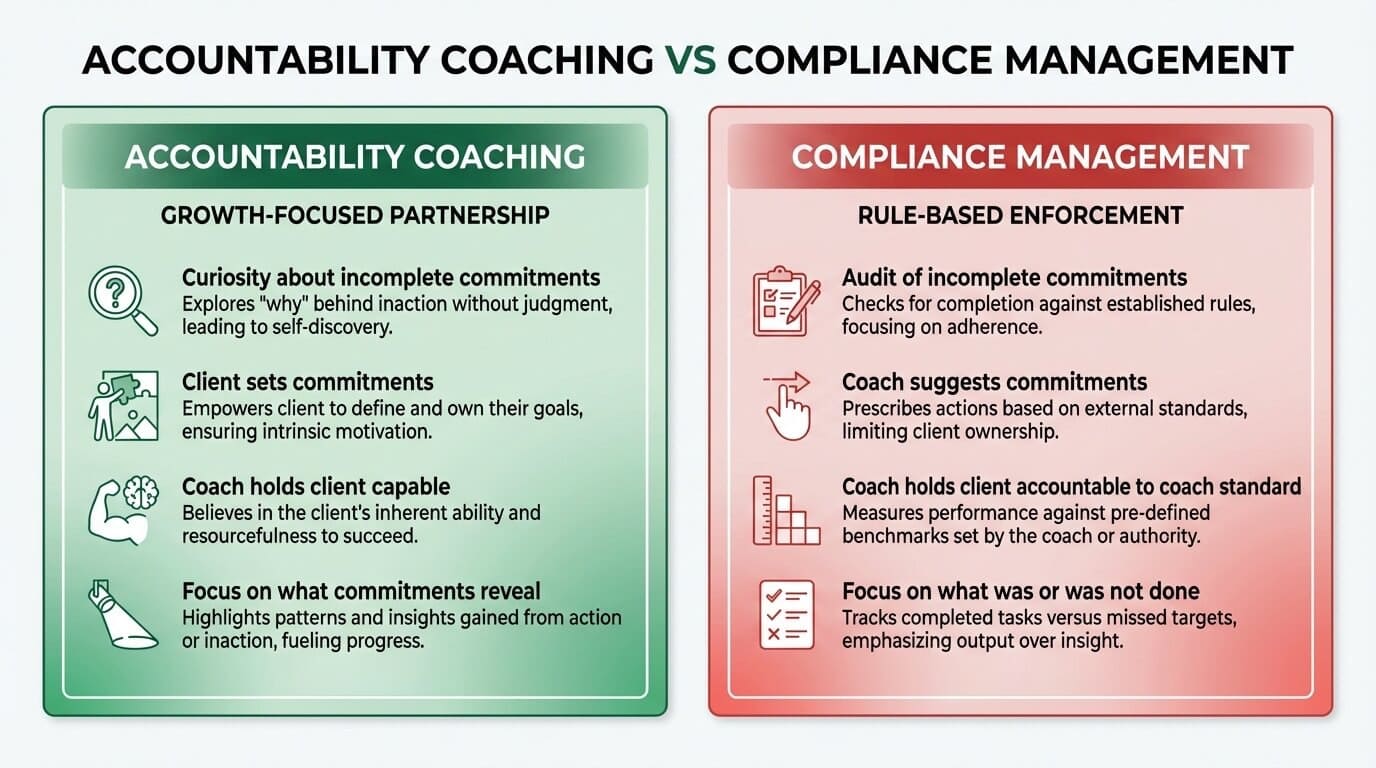
The difference is in the coach's stance. A compliance manager asks “why didn't you do this?” and the client defends. An accountability coach asks “what happened for you with this commitment?” and the client discovers. One produces explanations. The other produces self-knowledge. Over six sessions, that distinction compounds into fundamentally different outcomes.
The ICF competency model is explicit on this point: Competency 8 asks the coach to promote client autonomy in the coaching process. The coach holds the client capable. Not accountable to the coach's standard. Not answerable to the coach's timeline. Capable of understanding their own patterns and making their own choices about what to do with that understanding.
When Accountability Coaching Works: Trust Comes First
Accountability without trust is not coaching. It is management. And the trust must be established before accountability works - not the other way around.
A client who does not trust that the coach is genuinely on their side will respond to commitment reviews in one of two ways. They will comply performatively - saying what they think the coach wants to hear, agreeing to commitments they have no intention of keeping, reporting success that is partially fabricated. Or they will withdraw - showing up to sessions but not bringing the real obstacles, the real fears, the real reasons things are not getting done.
Both responses look like coaching from the outside. The sessions have structure. Commitments get set and reviewed. Progress appears to happen. But the client is performing accountability rather than practicing it, and the coach cannot tell the difference because the trust is not deep enough for honest reporting.
This is why the timing of accountability matters. Reviewing commitments in session two, when the client is still calibrating whether to trust the coach, feels different from reviewing commitments in session six, after the relationship has been tested. The same words - “what happened with the commitment you set last week?” - land differently depending on how much trust is underneath them.
Coaches who front-load accountability in the first two sessions, before the relationship has developed, often find that clients are compliant but not engaged. The accountability structure is present. The coaching is not. Building trust first - through genuine curiosity, through demonstrating that the coach will not judge incomplete commitments - creates the conditions where accountability becomes a coaching tool rather than a management tool.
Reviewing commitments in session two feels like a test. Reviewing commitments in session six feels like a conversation. Same words, different trust underneath.
What Coaches Do in Accountability Sessions
Five specific coaching behaviors separate professional accountability coaching from well-intentioned progress checking. These are observable, developable skills - not personality traits or natural gifts.
Develop These Five Behaviors with ICF Training
Tandem's ACC program builds these accountability coaching competencies through structured practice with MCC-level mentors and real client sessions.
1. Ask about the client's experience, not just their actions. When a commitment is incomplete, the standard question is “what happened?” The coaching question is “what was your experience of not completing this?” The first asks for a report. The second asks for self-awareness. A client who says “I ran out of time” has given you logistics. A client who says “I kept putting it off and I'm not sure why” has given you something to coach.
2. Notice commitment language. Clients reveal their relationship to obligation through specific phrases. “I should have” signals guilt without ownership. “I meant to” signals intention without execution. “I just couldn't” signals helplessness that may or may not be accurate. A coach who hears these phrases as information rather than reports can reflect them back: “You said 'I should have.' What does that tell you about how you're holding this commitment?”
3. Do not rescue the client from discomfort. When a client has not completed commitments and feels bad about it, coaches often rush to reassurance. “That's okay, let's set something more realistic.” The impulse is kind. The effect is that the client never sits with the discomfort long enough to learn from it. Sitting with a client in the space between what they committed to and what they did - without fixing it, without minimizing it - is one of the harder coaching skills. It is also one of the most productive.
4. Connect the commitment review to stated goals. A client who committed to three actions but completed none might not have an execution problem. They might have a goal problem. The commitments they are not completing may be telling them that the goal they articulated does not match what they actually want. The coach's job is to notice that pattern and name it - not to generate better action plans for the same misaligned goal.
5. Let the client set the next commitment. This is the simplest behavior and the one most often violated. Coaches suggest, soften, and steer. “Maybe just focus on one thing this week?” The recommitment belongs to the client. If they set something ambitious after a week of incomplete commitments, the coach's role is to reflect that choice, not to manage it.
What Results to Expect from Accountability Coaching
Accountability coaching works when the client genuinely wants to change a behavior and is willing to be honest about what is in the way. It does not require perfection. It requires honesty.
Clients who engage in professional accountability coaching over three to six months typically report a decreased gap between intention and action - not because someone is watching them, but because they understand their own patterns better. They describe better awareness of why they commit to things they do not follow through on. They report more conscious decision-making about what to take on in the first place.
Accountability coaching does not work when the client is going through the motions. When the desired change belongs to someone else's agenda - a boss who wants them to be more organized, a spouse who wants them to exercise - the accountability structure becomes performative. The client completes commitments to satisfy the coach rather than because the commitments reflect their own priorities.
It also does not work when the pattern is rooted in something requiring therapeutic support - clinical anxiety, depression, or trauma responses presenting as procrastination or avoidance. A skilled accountability coach recognizes the boundary between coaching and therapy and refers when the situation calls for it. This is not a limitation of the approach. It is a sign the approach is practiced with integrity.
Mindset Shifts That Make Accountability Sustainable
Sustainable accountability often requires a shift at the belief level, not just the behavioral level. Clients who see accountability as something imposed on them from outside - a structure to comply with, a person to answer to - are harder to coach than clients who see accountability as a form of self-knowledge.
The coaching move that creates this shift is deceptively simple. Instead of asking “what will you do this week?” the coach asks “what do you want to be true about yourself in relation to this goal?” The first question produces a task list. The second produces identity-level reflection. A client who commits to three actions because they want to be someone who follows through is operating from a different place than a client who commits to three actions because the coach asked them to set goals.
The mindset shifts that make accountability sustainable are not separate from the accountability work itself. They emerge through it. A client who has spent six sessions exploring why they commit to things they do not complete will know more about their own patterns than any motivational framework could teach them. That self-knowledge is the lasting product of accountability coaching - more durable than any specific habit change, because it applies to every commitment the client makes afterward.
The client who arrives wanting help staying on track may leave with something more useful: knowing why they commit to things they never intended to finish.
This is where accountability coaching intersects with deeper developmental work. The client who arrives wanting help staying on track may leave with something more fundamental: an honest understanding of how they relate to their own commitments, and the ability to use that understanding going forward without a coach in the room.
Frequently Asked Questions
What is an accountability coach?
An accountability coach is a trained professional who supports clients in following through on their commitments and understanding the patterns that get in the way. Unlike an accountability partner or a productivity app, a professional accountability coach uses specific coaching skills - curiosity about incomplete commitments, observation of language patterns, and structured session frameworks - to help clients develop their own capacity for follow-through.
How is accountability coaching different from regular coaching?
Accountability coaching focuses specifically on the gap between intention and action. While all professional coaching includes some element of accountability (ICF Competency 8 explicitly mentions it), accountability coaching makes it the central focus. Sessions are structured around commitment review, pattern exploration, and recommitment rather than primarily on insight, strategy, or decision-making.
What happens in an accountability coaching session?
A typical session follows three phases. The coach and client review commitments from the previous session - not as an audit but as information. They explore what the completed and incomplete commitments reveal about the client's priorities, obstacles, and relationship with their goals. Then the client sets new commitments for the next period. The session length is usually 45-60 minutes, and engagements typically run 3-6 months depending on the client's goals and progress.
How long does accountability coaching take to show results?
Most clients notice behavioral shifts within 4-6 sessions, though the timeline varies based on the depth of the pattern being addressed. A client working on a straightforward habit change may see progress faster than a client whose follow-through issues connect to deeper beliefs about capability or worthiness. The more honest the client is during sessions, the faster the patterns become visible.
Is accountability coaching the same as having an accountability partner?
No. An accountability partner checks in on progress. An accountability coach explores the patterns underneath the progress. A partner asks “did you do it?” A coach asks “what happened for you with that commitment?” The difference is not just in the question - it is in what the coach does with the answer. A trained coach recognizes language patterns, connects incomplete commitments to larger themes, and helps the client develop self-knowledge rather than dependence on external reminders.
Before your next accountability coaching session - whether you are the coach or the client - ask one question. Is this session exploring the client's relationship with their commitments, or is it checking whether the commitments got done? The answer tells you whether what is happening in the room is coaching or management. And if you are a coach building this skill, try one thing in your next session: when a client reports an incomplete commitment, resist the first question that comes to mind. Wait. Let the second question come. The first one is almost always about the commitment. The second one is almost always about the client.
Learn Accountability Coaching the Right Way
60+ training hours, mentor coaching, and supervision included. Everything ICF requires for your Associate Certified Coach credential - including the accountability skills covered in this article.
See ACC Program Details →