Coaching Models Compared: When Each One Works (and Fails)
When should I use each coaching model?
Match the model to the presenting issue. GROW and OSCAR serve clear performance gaps. CLEAR serves relational and interpersonal challenges. Co-Active and Narrative serve identity shifts and life transitions. Solution-Focused serves clients trapped in problem analysis loops. OSCAR specifically fits organizational coaching because its Review phase maps to performance cycles.
The GROW model has four letters. CLEAR has five. OSCAR has five. Co-Active has eleven if you count the hyphen. What none of them have in common is a guarantee that your coaching session will go well.
Coaching models are architectures. They organize when you use each skill, in what sequence, and to what end. They do not tell you how to listen, what to ask, or when to stay quiet. That is the work of the coaching skills each model develops - and models without skills are empty scaffolding.
The confusion starts early in training. A coach learns GROW, runs a few sessions inside it, and concludes they have a methodology. What they have is a sequence. Methodology comes from understanding why the sequence exists, where it breaks down, and when to abandon it for something that fits the client in front of you.
This article compares six coaching models. For each one: what it does, where it works, where it fails, and which ICF competencies it exercises. No ranking. The goal is to help you match the model to the situation, because no single model handles every coaching conversation well.
Compare the architecture, not the acronym
Match a coaching model to the conversation
Choose the issue in front of the client, then make six trade-offs explicit. The workbench compares GROW, CLEAR, OSCAR, Co-Active, Solution-Focused, and Narrative coaching with the same visible formula.
Interactive prompts, results, and the emailed comparison are currently available in English.
How this tool works Method and limitations
This free coaching-model workbench compares six common models against the presenting issue and the structural trade-offs a coach wants to emphasize.
The reader chooses a presenting issue and assigns a low, moderate, high, or decisive weight to issue fit, session structure, relational depth, accountability and review, identity and story work, and near-term momentum. Each 1 through 4 weight is multiplied by a visible article-grounded model rating from 0 through 3. All six model profiles and every contribution remain visible.
This is a structured reflection on six broad model profiles, not a prescription for a client, a substitute for contracting and coaching judgment, a measure of coaching quality, or an ICF credential-readiness assessment. Models describe conversational architecture; they do not create competent coaching by themselves.
Sources and article evidence reviewed: Coaching models compared: article evidence · GROW model practitioner guide · ICF Core Competencies
Prefer to compare without the workbench?
Name the presenting issue, then rank six considerations: fit to that issue, desired session structure, relational depth, accountability and review, identity or story work, and the need for near-term momentum. Compare every model against the same considerations and keep the model as a working hypothesis rather than a prescription.
7 quick questions · No email required
Key Takeaways
- Coaching models provide session structure, not session quality - the skill underneath determines outcomes
- GROW, CLEAR, OSCAR, Co-Active, solution-focused, and narrative coaching each have a specific best use case and a specific limitation
- The most common model failure is treating any model as a linear checklist rather than a responsive structure
- Different models exercise different ICF Core Competencies - knowing which ones helps you develop targeted skills
- Model flexibility - the ability to shift structures mid-session based on client need - is a distinct professional skill, not a personality trait
What Common Coaching Models Actually Do
A coaching model - or coaching framework, the terms travel together - structures the conversation. It tells the coach: start here, move through these phases, and close there. GROW says start with the goal. CLEAR says start with the contract. Narrative coaching says start with the story. Each starting point shapes everything that follows.
What a model does not do is produce good coaching. A coach who follows GROW mechanically - goal, reality, options, will, done - can run a perfectly structured session that changes nothing. The model held. The coaching didn't.
This is the distinction that matters: models create structure, skills create substance. A powerful question inside GROW's Reality phase is not powerful because the model placed it there. It is powerful because the coach listened to something the client said, noticed what was underneath it, and asked a question that opened the thing the client had not examined yet. That same distinction, structure versus substance, is the starting point of our ICF Core Competency course on choosing and sequencing tools.
ICF Core Competency 8 - Facilitates Client Growth - describes the coach's ability to "transform learning and insight into action." Every model in this article attempts to structure that competency into a repeatable session arc. Some do it by front-loading goals. Others by front-loading relationships. The competency is the same. The architecture varies.
The practical consequence: learning one model deeply teaches you how session structure works. Learning multiple models teaches you that structure is a choice.
A coaching model without coaching skill is a filing system for an empty cabinet.
GROW Coaching Model: The One Everyone Learns First
GROW maps a coaching session into four phases: Goal (what the client wants from this session), Reality (what is actually happening now), Options (what the client could do), and Will (what the client commits to doing). John Whitmore formalized it in the 1990s, and it became the default entry point for coach training worldwide.
The problem is how it gets taught. Most coaches learn GROW as a linear sequence. Follow the letters, cover all four, close the session. This produces what I call the checklist trap - the coach moves through phases because the model says to, not because the client's process calls for it.
Say you're coaching a director who arrives at a session wanting to "get better at delegation." That's the Goal. You move to Reality: what delegation looks like now, what's working, what's not. Fifteen minutes into Reality, the director says something revealing - "I just don't trust that they'll do it the way it needs to be done." That statement reframes the entire session. The issue isn't delegation. It's trust. The Goal was wrong.
A coach in the checklist trap hears that statement and keeps moving toward Options because the model says Options comes next. A coach who understands GROW as a structure rather than a sequence cycles back to Goal. The client just told you the real goal. Cycling back is not a detour. It is the session working the way GROW is designed to work.
Best use case: Performance coaching, skill development, and any session where the client can articulate a concrete goal. GROW is strongest when the issue is task-oriented and the client has some clarity about what they want.
Limitation: When the client cannot name a goal - when the issue is relational, emotional, or identity-based - GROW's Goal phase can pressure the client into premature specificity. "What would you like to get from this session?" is the right question for the wrong moment.
GROW exercises ICF Competency 7 (Evokes Awareness) primarily in the Reality and Options phases, where the coach's questions help the client see patterns they had not noticed. For a GROW model in full practitioner depth, including cycling patterns and resistance indicators, see the dedicated article.
The checklist trap is not a flaw in GROW. It is a flaw in how coaches use certainty as a substitute for presence.
CLEAR: Relationship Before Results
Peter Hawkins developed the CLEAR model as a five-phase structure: Contracting, Listening, Exploring, Action, and Review. Where GROW starts with the goal, CLEAR starts with the relationship. The Contracting phase asks: what does the client need from this conversation, and what kind of partnership will serve that?
This is not a minor sequencing difference. When a client's issue is relational - "my relationship with my board is deteriorating" - starting with Goal can produce a premature, surface-level target. The client says they want "better board communication." That is not a goal. That is a symptom described as a goal because the model asked for one.
CLEAR's Contracting phase gives the relationship dimension space before any goal is defined. The coach and client negotiate what this session is for, how they will work together on it, and what kind of support the client is looking for. Contracting surfaces that before the session commits to a direction.
The Listening phase is more than information gathering. It is where the coach listens for what the client is not saying - the assumptions, the emotional weight, the thing underneath the presenting issue. This maps directly to ICF Competency 6 (Listens Actively) and the PCC markers that measure whether a coach "explores beyond what the client says."
Best use case: Relationship-focused coaching, trust repair, leadership challenges involving interpersonal dynamics, and any session where the client's issue has emotional complexity that needs space before it can be structured.
Limitation: CLEAR takes time. The Contracting and Listening phases, done properly, can consume half a session. In organizational coaching where sessions are 30-45 minutes and stakeholders expect measurable outcomes, CLEAR's front-loaded relational work can feel like it is not getting to the point. That connects to ICF Competency 4 (Cultivates Trust and Safety) - the very thing CLEAR prioritizes can feel at odds with time-bound organizational realities.
OSCAR: Performance and Accountability
OSCAR stands for Outcome, Situation, Choices, Actions, and Review. It shares DNA with GROW but adds two refinements: it distinguishes between Outcome (what success looks like long-term) and the session's immediate focus, and it builds in a Review phase that GROW leaves implicit.
The Outcome phase asks the client to describe their desired end state before examining the current Situation. By clarifying what success looks like first, the coach and client create a reference point that anchors the rest of the conversation. When Choices multiply, the Outcome narrows them.
OSCAR works well in performance and development coaching - contexts where there is an observable gap between current state and desired state, and the coaching engagement has a defined timeline. Organizational coaches use OSCAR frequently because it maps cleanly onto performance review cycles and quarterly objectives.
Best use case: Performance coaching, development conversations, and any engagement where the coaching has defined success criteria.
Limitation: OSCAR's Outcome phase can fail when the client's desired outcome is vague. "I want to be a more strategic leader" is not an Outcome in OSCAR terms - it is a direction without a destination. If the coach accepts a vague Outcome and proceeds to Situation, the entire session floats. Nothing the client identifies in Choices or Actions connects back to a clear enough target. When the client cannot articulate an Outcome, the coach needs to either spend significant time in the Outcome phase or switch to a model that does not require one.
This model exercises ICF Competency 7 (Evokes Awareness) in its Situation and Choices phases. The Review phase is the model's built-in mechanism for Competency 8 (Facilitates Client Growth) - it asks the client to evaluate their own learning and next steps.
Co-Active Coaching: Being Over Doing
The Co-Active model, developed by the Coaches Training Institute (now Co-Active Training Institute), is built on a different premise than GROW, CLEAR, or OSCAR. Where those models structure what the coach does during a session, Co-Active structures who the coach is. Its four cornerstones - the client is naturally creative, resourceful, and whole; the focus is on the whole person; the coach dances in the moment; the relationship is designed - prioritize the coaching relationship and the coach's stance over any session sequence.
This makes Co-Active harder to describe as a step-by-step model, because it is not one. It is closer to a coaching philosophy with embedded skills. The "designed alliance" cornerstone asks the coach and client to explicitly co-create the terms of their relationship - not just for this session but the ongoing engagement.
Co-Active's emphasis on the whole person means sessions can range across professional performance, personal values, and identity questions within a single conversation. The coach follows energy and resonance rather than a predetermined structure. This produces sessions that reach depths GROW and OSCAR are not designed for - and it requires considerably more skill to do well.
Best use case: Identity and transition coaching, values-based leadership development, and any engagement where the client's issue is not a performance gap but a question about who they are becoming. For coaches exploring which models support transformational work, Co-Active provides a strong foundation.
Limitation: Co-Active requires significant training investment and ongoing supervised practice. The "dance in the moment" cornerstone, if attempted without deep competency in ICF Competency 5 (Maintains Presence) and Competency 8 (Facilitates Client Growth), can produce sessions that feel exploratory but lack direction. The model's philosophical framing can obscure the concrete skills underneath it - a coach who says they "dance in the moment" may or may not be describing an actual observable behavior.
Solution-Focused Coaching: Skip the Root Cause
Solution-focused coaching inverts the typical diagnostic approach. Instead of exploring why the problem exists, it asks: when has the problem been absent, and what was different then? The model has four core moves: the miracle question ("If you woke up tomorrow and this problem was solved, what would be different?"), exception finding (identifying times the problem didn't occur), scaling (locating current state on a 1-10 continuum), and coping questions (acknowledging what the client is already doing well).
The philosophical stance is deliberate: spending time on problem analysis does not reliably produce solutions. A client stuck in "why does this keep happening" often breaks loose when the coach redirects toward what is already working and what a small next step might look like.
Best use case: Clients trapped in problem saturation, early-stage coaching where quick momentum matters, and situations where root cause analysis has been done (in therapy, in consulting, in the client's own reflection) and has not produced change. Solution-focused coaching is fast.
Limitation: Speed is the strength and the constraint. Solution-focused coaching can feel shallow when the client's issue has genuine structural or emotional roots that need examination before a solution is useful. A client dealing with a pattern of conflict with direct reports may find that scaling and exception-finding produce a temporary shift without addressing the underlying dynamic. The model works when the client is ready for action. It is less effective when the client is stuck on something they have not yet understood.
Narrative Coaching: Story as Medium
Narrative coaching treats the client's story - how they describe their situation, their role in it, and what it means - as the primary material. The coach helps the client examine the story they are telling, notice what it includes and excludes, and construct a different story that opens new possibilities for action.
The three core moves are externalizing (separating the person from the problem - "the anxiety" rather than "my anxiety"), re-authoring (finding moments in the client's history that contradict the dominant story), and witnessing (having the client articulate their new narrative to someone who can reflect it back).
Narrative coaching produces a different kind of change than goal-focused models. A leader who describes herself as "someone who avoids conflict" may discover, through re-authoring, several instances where she confronted difficult situations directly. The dominant story was incomplete, and the new story enables behavior the old one foreclosed.
Best use case: Clients experiencing identity shifts, leaders redefining their role after organizational change, and coaching engagements where the presenting issue is "I keep telling myself the same story about this."
Limitation: Narrative coaching requires continuity across sessions. The re-authoring process cannot be completed in a single conversation. It requires tracking the client's story over time and returning to key moments across multiple sessions. In short-term engagements (3-6 sessions), narrative coaching may not have enough runway.
How to Choose Among the Types of Coaching Models
The selection question is not "which model is best?" The selection question is: what does this client need from this conversation, and which architecture serves that need? For coaches working on leadership development rather than a single session topic, the Hersey-Blanchard Situational Leadership model adds a diagnostic layer that session-level models do not provide: it maps the client’s readiness level so the coach can calibrate how directive or supportive to be across the engagement.
A coach who only uses GROW will produce good sessions for performance-oriented clients and constrained sessions for clients dealing with identity or relationship issues. A coach who only uses Co-Active will go deep with clients who need exploration and may frustrate clients who arrived with a specific problem and want structured support.
The practical answer: how to choose between coaching frameworks comes down to matching the model to the client's presenting issue.
| Issue Type | Recommended Model | Why |
|---|---|---|
| Clear goal, performance gap | GROW or OSCAR | Structured progression from current state to target state |
| Relational or interpersonal | CLEAR | Front-loads relationship dynamics before defining goals |
| Identity or life transition | Co-Active or Narrative | Holds the whole person, not just the presenting issue |
| Stuck in analysis loops | Solution-Focused | Redirects from why to what's working and what's next |
| Organizational performance | OSCAR | Built-in Review phase maps to organizational cycles |
The table is a starting point, not a prescription. Most experienced coaches develop a primary model and learn two or three others well enough to shift when the session demands it. The shift is not mechanical - a coach does not announce "we're switching to CLEAR now." The shift is in the coach's attention: what are you listening for, what kind of question serves this moment, and what structure helps the client move?
Developing model flexibility is a specific skill. An ICF ACC program typically teaches one or two models in depth. Beyond ACC, coaches who want range need continued practice and supervision across multiple models.
For a deeper treatment of how to select frameworks based on coaching context, the coaching frameworks comparison covers meta-selection logic beyond individual model descriptions.
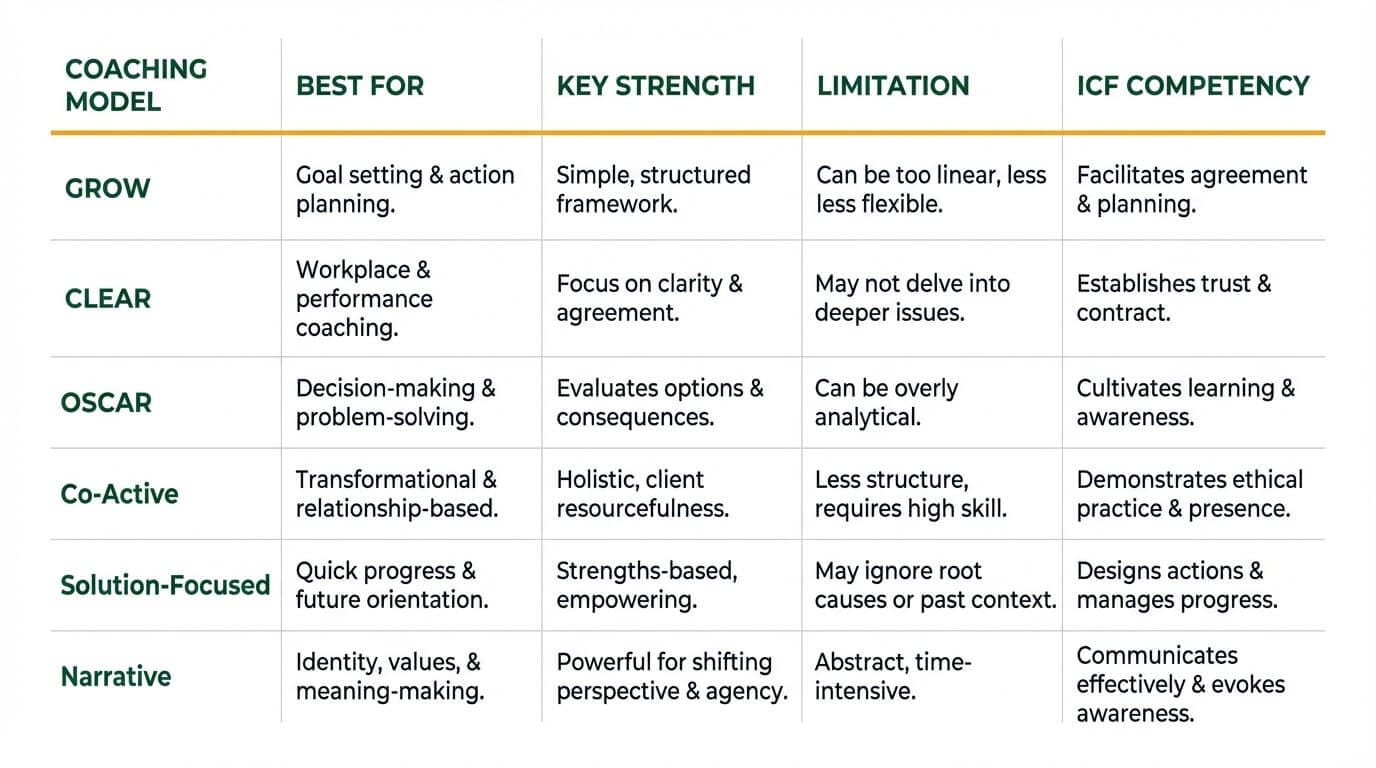
The model is only one layer of effective coaching. Your coaching style, the coaching process you contract with the coachee, and the coaching techniques you use inside each phase matter more than the acronym. In workplace coaching and leadership coaching engagements, the coach might blend approaches: active listening from Co-Active, the problem-solving orientation of the OSKAR model (the solution-focused cousin of OSCAR), GROW's discipline of helping clients set goals that are genuinely achievable. A mentor can show you that blending in action; a good ICF coaching certification program teaches it deliberately.
Frequently Asked Questions
What are the five stages of the CLEAR coaching model?
The CLEAR coaching model moves through five stages: Contracting, Listening, Exploring, Action, and Review. Developed by Peter Hawkins, it front-loads the relationship - coach and client agree on what the session is for before any goal is set, then close by reviewing what the conversation actually changed.
Can you combine coaching models in a single session?
Experienced coaches do this regularly, though not by consciously switching between named models. A coach trained in multiple models draws on different structural instincts depending on what the client presents. A session might begin with CLEAR's contracting approach, shift to GROW-style questioning when a concrete goal emerges, and use solution-focused techniques when the client gets stuck. The models inform the coach's repertoire. They do not dictate the session.
Which coaching model is best for beginners?
GROW. Its four-phase structure is intuitive, widely taught, and provides enough scaffolding for a new coach to run a complete session without losing the thread. The limitation - the checklist trap - becomes apparent only after the coach has used GROW enough to recognize when the model constrains the session. That recognition is itself a developmental milestone. Master GROW until it is automatic, then add a second model for contexts GROW does not serve well.
Do ICF assessors look for specific coaching models?
No. ICF credential assessments evaluate competency behaviors, not model adherence. An assessor is looking at whether the coach listens actively, evokes awareness, facilitates growth - not whether the coach used GROW or CLEAR or any named model. A coach can pass a PCC assessment without following any recognizable model, as long as the competencies are visible in the session. The model is the coach's internal map. The assessor sees the techniques that sit inside these models, not the map itself.
How many coaching models should a coach learn?
One deeply, then two or three for range. The mistake is surface-level familiarity with many models and automaticity with none. A coach who can describe all six models in this article but has only practiced GROW in real sessions has knowledge of six and competence in one. Start with the one your training taught. Use it until you can feel where it serves and where it constrains. Then learn a second model that covers one of those constraints.
The best model for your next session is the one you can forget you are using.
Pick one model from this comparison. Use it exclusively for your next five coaching sessions. At the end of each session, write one sentence: where did the model serve the conversation, and where did it constrain it? After five sessions, you will have more useful data about model selection than any article can provide - including this one.
Learn Your First Model Properly
60+ training hours with structured model practice, mentor coaching, and supervision. Build the foundation that makes model flexibility possible.
See ACC Program Details →