
Coaching Tools That Actually Work: Method vs. Presence
Key Takeaways
- Collecting coaching tools and actually integrating them are two different skills - most coach training programs only teach the first
- The best coaching tools work because they capture the client’s own language, not the coach’s framework preferences
- After 20+ years of practice, experienced coaches consistently report moving away from structured models toward presence-driven coaching
- Coaching techniques transfer directly into non-coaching contexts like meeting facilitation - the coaching mindset matters more than the coaching session
The Tool Collector’s Trap
Coach training programs have a predictable side effect: graduates who own twelve coaching frameworks and can execute zero of them under pressure.
When the Script Disappears, What Do You Do?
Get support turning GROW/CLEAR and other models into integrated skill—so you can coach confidently when the client doesn’t follow the template.
This isn’t a character flaw. It’s a structural problem. Most training environments reward tool acquisition - you learn GROW, CLEAR, the Wheel of Life, and a half-dozen proprietary models. You practice each one in a controlled setting with a willing partner who already knows the exercise. Then you sit across from a real client who doesn’t know the script, and the toolbox feels more like a junk drawer than a resource.
The volume of available coaching tools compounds the problem. A quick scan of any coaching resource site returns hundreds of assessments, worksheets, card decks, conversation frameworks, and visual aids. Each one promises to “deepen your coaching practice.” Few explain how to decide whether you need them in the first place.
Three recent practitioner perspectives cut through this noise in different ways. A visual mapping method that anchors in client language. A set of coaching strategies applied outside the coaching session entirely. And a 20-year career arc that ends not with more tools, but with fewer. Together, they point toward something coach training programs rarely teach explicitly: how to evaluate whether a coaching tool is actually serving the relationship or just making the coach feel prepared.
Choice Mapping: A Framework Worth Examining
Kim DeYoung’s Choice Mapping method starts with five words: “I choose to…” The client completes the sentence, and that sentence becomes the raw material for a visual map built entirely from their own language. No pre-built templates. No coach-imposed categories. Just the client’s words, mapped outward through focused inquiry.
The method was the focus of a recent Choice Mapping interview on choice Magazine’s Beyond the Page podcast (April 2026), where DeYoung walked through the mechanics and the coaching mindset behind them.
A single sentence can reveal more than a 60-minute coaching call - if the coach knows how to work with it.
What makes mapping different from journaling is the visual structure. A journal entry is linear - thought follows thought in sequence. A map branches. It creates spatial relationships between ideas that the client can see, point to, and revise. For coaches, this matters because clients often describe feeling “stuck” or “overwhelmed,” and what they mean is that all their options feel equally weighted. A map externalizes the decision space so the coach and client can examine it together.
DeYoung makes a point that experienced coaches will recognize: the choice a client names at the beginning of a session is often not the real choice. The stated choice is the socially acceptable version, the one the client has already rehearsed. The map reveals what’s underneath - through the language the client uses as they expand the branches, through hesitations and contradictions that become visible when the words are on paper rather than floating in conversation.
For coaches in training, the early maps serve as benchmarks. You can return to a client’s first map three sessions later and track how their language has shifted - which branches grew, which ones they stopped mentioning, where new options appeared that weren’t visible before. This creates a tangible record of progress that coaching conversations alone don’t capture.
The discipline behind the method is worth examining alongside other executive coaching tools. Choice Mapping resists the coach’s impulse to fix, organize, or steer. The map belongs to the client. The coach holds the inquiry. When those roles stay clean, the tool works. When the coach starts editing the client’s language or suggesting branches, it stops being coaching and starts being consulting.
Coaching Techniques Beyond the Session
Julie Johnson MCC runs a column called “Heart to Heart with Julie” for the Coaching Tools Company, and her March 2026 piece on meeting facilitation tips makes an argument that coaching practitioners should take seriously: coaching techniques don’t belong exclusively in coaching sessions.
Johnson’s scenario is a young project manager facilitating meetings with experienced professionals who outrank her in domain knowledge. The project manager’s job isn’t to be the expert - it’s to keep communication moving so the actual experts can collaborate effectively. If you swap “project manager” for “coach,” the dynamic is identical.
The coaching competencies that transfer most directly to facilitation are the ones ICF frames as foundational: active listening, powerful questions, and maintaining presence without needing to control the outcome. Johnson translates these into practical facilitation moves - asking for clarification before assuming agreement, testing whether silence means consensus or confusion, keeping the conversation anchored in what needs to happen next rather than what went wrong last time.
For coaches in training, this reframe matters. If you think of coaching tools as things you use during a 60-minute session with a paying client, you’re undervaluing what you’re learning. The same coaching strategies that create space for a client to think also create space for a cross-functional team to solve a problem. The skill set is the same. The context is different.
Johnson’s piece also highlights a reality that coach training often glosses over: communication is the actual work of project management. Not the Gantt chart. Not the status report. The ability to hold a room of people with competing priorities and help them reach a decision they can act on. Coaches already practice this. The question is whether they recognize it as transferable.
Twenty Years of Letting Go
Julia Bauer has been coaching for over 20 years. In a recent profile on the Coaching Tools Company site (March 2026), she described how her practice has changed - and the direction of that change says something important about the relationship between coaches and their tools.
Early in her career, Bauer followed structured coaching models closely. The frameworks gave her a container for the conversation, a sense of knowing where she was in the process, and confidence that she was “doing it right.” Trained in positive psychology coaching, she built her practice on strengths-based approaches with clear structure.
Over two decades, something shifted. Bauer moved from following models to trusting her own presence and focusing entirely on the client in front of her. Her coaching became more natural, more flexible, less reliant on any single framework. She didn’t abandon her training - she absorbed it so completely that the structure became invisible.
This arc is worth paying attention to because it tracks what experienced coaches consistently report. The tools that matter early in a coaching career are not the same ones that matter later. Early on, frameworks provide necessary scaffolding. They give new coaches something to hold onto when the conversation goes somewhere unexpected. But the scaffolding is not the building. At some point, the coach has to trust the coaching mindset more than the coaching model.
Bauer’s evolution also challenges the assumption that coaching development is primarily about adding skills. Sometimes it’s about subtracting - removing the reflexive reach for a framework, letting the client lead, staying present when the silence stretches longer than feels comfortable.
What Makes a Coaching Tool Actually Work
These three perspectives - DeYoung’s Choice Mapping, Johnson’s facilitation approach, Bauer’s 20-year evolution - come from different corners of the coaching world but converge on the same set of principles. If you work through the ICF coaching competencies and the PCC markers that assessors look for, you’ll find the same principles embedded there.
The tool must serve the relationship, not the coach’s comfort
Choice Mapping works because it forces the coach to stay in the client’s language. The map isn’t a coach’s tool applied to the client - it’s the client’s thinking made visible with the coach’s support. Johnson’s facilitation tips work because they position the facilitator as a process holder, not an authority. Bauer’s evolution works because she stopped needing the framework to feel confident.
In each case, the coaching tool or technique becomes effective at the exact point where the practitioner stops needing it for their own security and starts using it purely for the client’s benefit.
Client language is more diagnostic than coach frameworks
DeYoung’s Choice Mapping method captures the client’s exact words because those words contain information that paraphrasing destroys. When a client says “I should take the promotion,” the word “should” tells the coach everything about where the real tension sits. A framework that translates this into “career growth opportunity” has already lost the signal.
Bauer arrived at a similar insight through a different route: the more she trusted the client’s own process, the less she needed her models to interpret what she was hearing. Johnson’s facilitation approach echoes this - she coaches project managers to listen for what people actually say in meetings, not what the agenda says they should be discussing.
Coaching presence is not the absence of structure - it’s the integration of it
New coaches sometimes hear “be present” and think it means abandoning structure entirely. Bauer’s career argues the opposite. Twenty years of working with structured coaching models trained her ability to hold presence. She didn’t skip the structure - she went through it so thoroughly that it became part of how she listens, asks, and waits.
DeYoung’s Choice Mapping is itself a structure - a deliberate, repeatable visual method. But within that structure, the coach’s job is to stay curious, follow the client’s thread, and resist steering. Structure and presence are not opposites. The best coaching tools embed presence into their design.
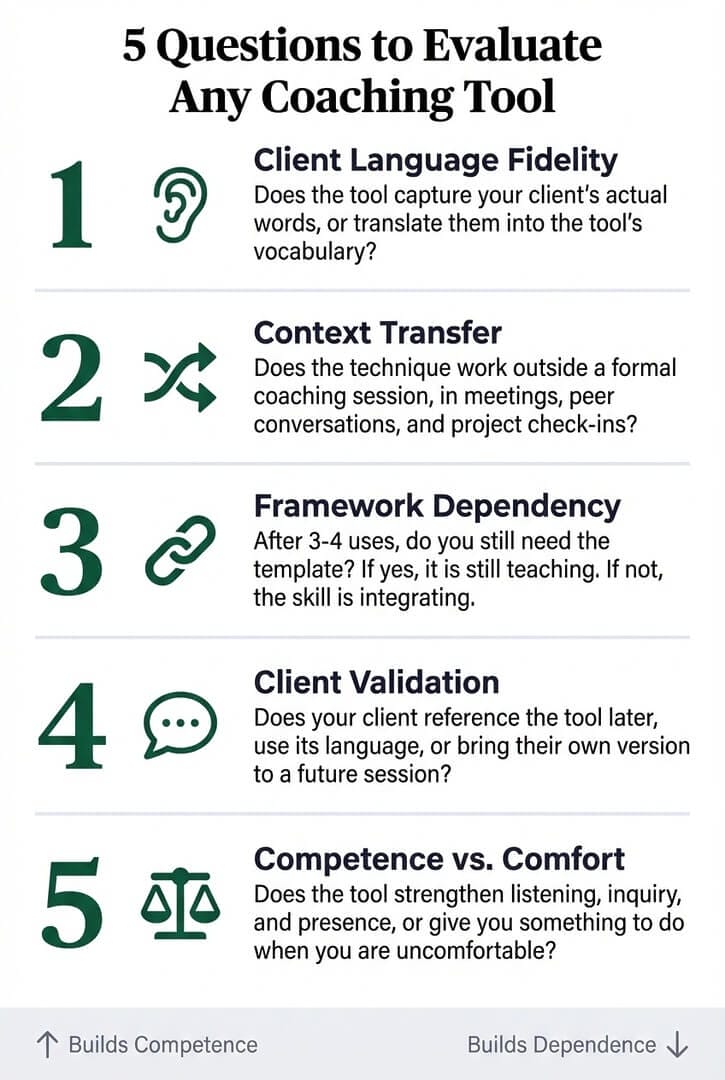
The Practitioner’s Checklist
If you’re a coach or coach-in-training looking at a growing collection of tools and wondering which ones deserve your time, here’s a concrete evaluation framework you can apply this week.
Pressure-Test Your Coaching Presence
Use your checklist to spot tool dependence, then strengthen the competencies behind it: listening, powerful questions, and staying present in silence.
Test for client language fidelity. Use the tool in your next session and review the output afterward. Does it capture the client’s actual words, or does it translate their thinking into the tool’s vocabulary? If it’s the second, the tool may be creating distance between you and the client’s real experience.
Try it outside a coaching session. Use the technique in a team meeting, a peer conversation, or a project check-in. If the core skill transfers, it’s teaching you something about coaching itself - not just about the tool. If it only works in a formal coaching context, it may be more ritual than skill.
Track your dependency on the framework. After using a tool three or four times, notice whether you still need the template or guide to execute it. If you do, the tool is still teaching you. If you don’t, the skill has started to integrate. Both states are fine - but knowing where you are matters for your development.
Ask your client whether the tool helped. Not in the moment - afterward. Clients are polite during sessions. They’ll do the exercise because you asked. The real test is whether they reference it later, use the language from it, or bring their own version of it to a future session.
Evaluate the tool against your coaching competencies. Does it strengthen your ability to listen, ask, or stay present? Or does it give you something to do when you’re uncomfortable with not knowing what to do? The first builds competence. The second builds dependence.
Frequently Asked Questions
What are the most effective coaching tools for new coaches?
The most effective tools for new coaches are ones that build foundational coaching competencies rather than substituting for them. Visual frameworks like Choice Mapping train active listening because they require capturing the client’s exact language. Structured coaching models like GROW or CLEAR provide conversational scaffolding while you develop the presence to handle unscripted moments. The key measure isn’t which tool is “best” - it’s whether the tool is training a skill you’ll retain when you stop using the tool itself.
How do coaching techniques differ from consulting techniques?
The core difference is who holds the expertise. Consulting techniques position the practitioner as the expert who diagnoses and prescribes. Coaching techniques position the client as the expert on their own situation, with the coach holding the process. In practice, this means a consultant might analyze a client’s meeting problem and recommend a facilitation framework. A coach using the same framework would ask the client what they notice about their meetings, what they’ve already tried, and what outcome they actually want - then offer the framework as a tool the client can adopt or adapt.
When should a coach use a structured framework vs. open inquiry?
Structured frameworks are most useful when the client needs help organizing complexity - multiple competing options, unclear priorities, or a decision with many variables. Visual tools like Choice Mapping or decision matrices give the client a way to see what they’re working with. Open inquiry works better when the client needs to discover something they haven’t articulated yet - underlying values, unexamined assumptions, or emotions driving a decision. Experienced coaches report that over time, the boundary between structure and open inquiry becomes less rigid. The coach learns to introduce just enough structure to hold the conversation without constraining it.
Stop Collecting Tools. Start Integrating Skills.
If your toolbox feels like a junk drawer in real sessions, let’s map what to keep, what to drop, and what to practice until it’s yours.
Book a Free Consultation →