
You Have the Title but Not the Room
How do I lead with the title but no authority?
The title got you into the org chart, not the room. The gap is currency mismatch: your career trained you to spend one currency, the room trades in another. Stop optimizing for the title. Identify what the room above you actually values, narrative, coalition, quantified proof, and start spending that instead.
You got the title. Director. Maybe VP. Your boss said the right things. Your team reports to you. Your name is on the org chart in the place it’s supposed to be.
And then there’s a meeting. You hear about it afterward, or you see the calendar invite go to someone else, or you’re in the room but nobody asks you a question. The title moved. The room didn’t. You are inside the org chart and outside the conversation.
The worst part isn’t being excluded. The worst part is you can’t name what you’re being excluded from. Because it looks different depending on where you came from.
You have the title but not the room. And the distance between the two is specific to the career that built you.
Key Takeaways
- The influence gap at director and VP level is not generic. It manifests differently depending on which function shaped you. Finance directors are excluded from narrative conversations. Technology directors from political ones. Legal directors from strategic ones.
- The people above you navigated the same gap through years of trial and error. They can’t explain the rules because the patterns their careers installed feel like intelligence, not training.
- Every leadership room has a dominant language. Your influence gap is the distance between the currency your career trained you to spend and the currency the room trades in.
- Generic influence advice treats every function’s gap as the same problem. It is not. The work required to close each one is as specific as the career that created it.
- A coach who understands how your function shapes the gap changes the conversation from “how do I get in the room” to “what would I need to bring once I’m there.”
The Room Has Rules Nobody Wrote Down
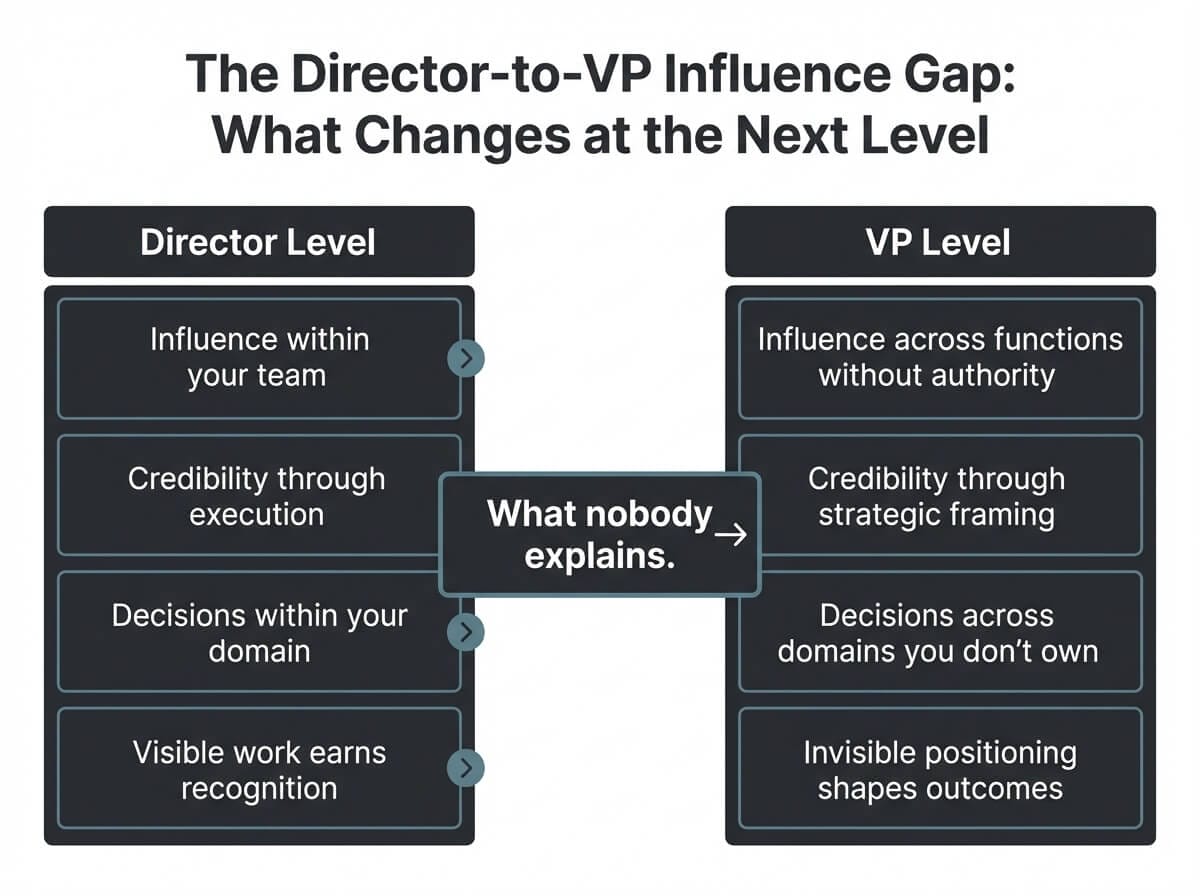
At director and VP level, the game shifts. Execution and team output still matter, but the real currency is cross-functional influence, upward management, and strategic translation. The room you’re trying to enter has its own language. A default evidence standard. A way of evaluating whether someone belongs. Your function trained you in one language. The room often speaks another.
The gap between your language and theirs is the influence gap. And it is not generic.
For finance directors, the exclusion is from narrative conversations. You bring data. You bring rigor. You bring forty slides that prove the point. And the room makes the decision based on a story someone else told in three sentences. You aren’t excluded because your analysis is wrong. You’re excluded because the room’s decision currency is narrative, and your career never trained you to lead with story. You built the model. You ran the scenarios. You stress-tested the assumptions. And someone across the table offered a vision of what the numbers could mean, told it in ninety seconds, and the room leaned forward. You keep winning arguments nobody asked you to have.
For technology directors, the exclusion is from political conversations. You see the system clearly. You can architect a solution that is obviously, demonstrably better. And it doesn’t get adopted. The conversation that determined the outcome happened in a room where technical excellence wasn’t the currency. Relationships and coalitions were. You keep presenting architecture when the room wants alignment. The frustration isn’t that your solution was wrong. It’s that “right” was never the criteria.
For legal directors, the exclusion is from strategic conversations. Your career trained you to identify every risk, map every exposure, draft the memo that protects the organization. And the room stops inviting you to the conversation where the strategy gets set. By the time it reaches you, the decision is already made and your job is to make it defensible. The room experiences your thoroughness as friction. Nobody told you the new level requires you to show the pathway through the risk, not just the risk itself.
For HR directors, the exclusion is from budget conversations. You built trust. People come to you. You understand the organization at a relational level nobody else does. And when the discussion turns to resource allocation, headcount, or strategic investment, the room treats your perspective as a nice-to-have. Not because your people insight is wrong. Because the room’s power structure gives budget authority to functions that inherited strategic standing. Your function must build it from the relationship up, every time.
For operations directors, the exclusion is from vision conversations. You know how things actually work. You know what’s possible, what’s fragile, what will break if the strategy changes. And the room treats your input as implementation detail. The distinction the room makes is between “running things” and “deciding things.” Your career placed you firmly on the running side.
For marketing directors, the exclusion is from credibility conversations. You see the market. You read the audience. You know what resonates. And the room questions whether your insight counts as evidence. Your currency is narrative and creative intuition. The dominant evidence standard in most leadership rooms is quantitative. You keep bringing market sense when the room demands proof.
The influence gap is not about working harder, speaking louder, or being more political. It is the distance between the currency your career trained you to spend and the currency the room above you trades in. That distance is specific to your function.
The People Above You Can’t See the Rules Either
Your boss navigated this same gap. They figured out, eventually, how to get heard in the room above them. But they cannot explain what they did differently. The adjustment happened gradually, below conscious awareness. The finance leader who learned to lead with narrative doesn’t think “I stopped leading with data.” They think “I got better at communicating.” The technology leader who learned to build coalitions before presenting solutions doesn’t think “I stopped optimizing for technical elegance.” They think “I got more strategic.”
Name the Gap Before It Names You
If you’re sensing there’s something you’re missing but can’t identify it, that’s exactly what a first conversation is for. We start by mapping what the room requires—specifically, for your function, at your level.
The pattern shift is invisible to the person who made it.
So they give you the feedback they got. “Build your executive presence.” “Be more strategic.” “Get more visibility.” These phrases describe the symptom, not the cause. They can see that you’re operating at the wrong frequency. Bringing precision to a narrative conversation, or technical solutions to a political one, or risk analysis to a strategy discussion. They cannot see that the frequency mismatch is specific to your function. So the feedback stays vague, you try harder at the same frequency, and the gap persists.
“Build your executive presence” is the feedback equivalent of “be taller.” It describes where you need to arrive without explaining how your specific starting point determines the route.
Leadership development programs teach influence skills, stakeholder management, executive communication. All useful. None of them explain that the influence gap manifests differently depending on which function shaped you. The finance director who takes an executive communication course learns to present differently. But the real gap isn’t presentation skill. It’s that the default structuring logic the career installed—build the model, show the data, prove the point—is mismatched with the room’s decision logic: tell me the story, give me your judgment, help me feel confident. No communication course addresses that mismatch because no communication course knows which career the participant is carrying.
The same is true for every function. The operations director who takes a strategic thinking course learns frameworks. But the real gap is that ten years of optimizing systems trained her to protect what works, and the room above her needs someone willing to dismantle what works in service of what’s next. The HR director who takes an executive presence workshop learns to project authority. But the real gap is that his function sits in a position where strategic standing must be constructed from scratch, not inherited. No workshop addresses structural position.
The Specific Conversation You’re Missing
Every leadership team has a center of gravity. A dominant functional voice that shapes what counts as a good argument, what evidence is trusted, and which contributions get amplified. On a technology-dominant team, data and systems thinking are the default. On a finance-dominant team, quantified justification is the price of entry. On a marketing-dominant team, narrative momentum carries the day.
Your influence gap is shaped by the distance between your career’s language and the room’s dominant one. Here is what that distance looks like by function:
| Function | How You’re Excluded | What You’re Not Hearing | The Room’s Language |
|---|---|---|---|
| Technology | Solutions get overridden by less elegant but better-sponsored alternatives | “We need alignment before we need architecture” | Coalition and sponsorship |
| Finance | Analysis gets acknowledged then bypassed for a simpler narrative | “Give us your judgment, not your model” | Story and conviction |
| Legal | Invited after the strategy is set, asked to make it defensible | “Show us the path through the risk, not just the risk” | Speed and enablement |
| HR | People insight treated as supplementary to budget decisions | “Quantify the organizational cost or it won’t land” | Numbers and resource allocation |
| Operations | Implementation knowledge dismissed as constraint thinking | “We need ambition before we need feasibility” | Vision and possibility |
| Marketing | Market intuition questioned until it can be proved with data | “Show us the evidence, not just the signal” | Quantified proof |
The pattern is consistent: you bring what your career trained you to bring. The room values something adjacent but different. And the gap between the two is where your influence disappears.
The finance director on a narrative-dominant team has the answer and can prove it. The room doesn’t want proof. It wants conviction. The technology director on a relationship-dominant team has the superior solution. The room doesn’t evaluate solutions on technical merit. It evaluates them on who is sponsoring them. The legal director on a speed-dominant team has the thorough risk assessment. The room experiences thoroughness as delay. The HR director on a metrics-dominant team has the organizational insight that would save the restructuring from collapsing six months later. The room wants numbers. The operations director on a vision-dominant team knows what’s actually possible. The room doesn’t want to hear about constraints. The marketing director on a proof-dominant team can feel the market shifting. The room wants validated evidence, not intuition.
Same title. Six different rooms. Six different kinds of silence.
What Changes When Your Coach Gets This
Consider a finance director who tells her coach “I keep getting left out of key decisions.” A generic coach hears an influence problem and works on the obvious levers: how to build relationships with senior leaders, how to get invited to meetings, how to increase visibility.
See How Tandem Coaches Differently
Our approach doesn’t start with assessments. It starts with understanding what the next level actually requires—and what your current formation gives you versus what it doesn’t.
A coach who understands what a career in finance actually installs hears something different. “You’re being excluded from narrative conversations. The room above you makes decisions based on story and judgment. You keep bringing data and models because that’s what your career trained you to trust. The exclusion isn’t about your relationships or your visibility. It’s about the currency mismatch between what you bring and what the room trades in. The question isn’t how to get in the room. It’s what you’d need to bring once you’re there.”
That reframe shifts the work from tactical—networking, visibility, self-promotion—to structural: understanding the specific distance between what her career built and what the room requires. The finance director doesn’t need to be louder. She needs to lead with judgment instead of proof. And that shift, for someone whose entire career rewarded being right about the numbers, feels genuinely dangerous. That tension is the coaching territory. Not influence tactics.
The difference between generic coaching and coaching that understands how your function shapes the gap: one works on how to get into the room. The other works on what your career would need to release for the room to shift once you’re there.
Or consider an HR director who tells his coach “nobody takes my function seriously at the leadership table.” A generic coach works on executive presence: how to speak with more authority, how to present data to support people initiatives, how to frame HR as a strategic function.
A coach who understands the structural position hears the real pattern. “Finance inherited strategic standing from the numbers. Technology inherited it from building the product. Your function must construct that standing from scratch, relationship by relationship. The frustration isn’t that you lack strategic thinking. It’s that your function’s position in the power structure requires you to build the credibility that other functions receive by default. The question isn’t ‘how do I sound more strategic?’ It’s ‘how do I translate the organizational insight only I can see into language the room already trusts?’”
The HR director goes quiet. Because the problem was never his executive presence. The problem was structural: his function doesn’t arrive at the leadership table with the same inherited authority that finance and technology carry. Naming that shifts the work from performing authority to building a translation layer between what he sees and what the room can hear.
The influence gap closes not when you learn to speak louder but when you learn to spend a currency the room already trusts.
The patterns in this article connect to several related dynamics across careers and levels: when expertise stops opening doors at the director level, how influence-based success looks different from expertise-based, and what influence requires when you have no authority.
The Room You’re Actually Trying to Enter
The influence gap is not a verdict. It is a distance. Between what your career trained you to bring and what the room above you needs to hear. That distance is specific to your function. The finance director’s gap is different from the technology director’s gap is different from the HR director’s gap. Generic influence advice treats them all the same. They are not the same.
The people above you aren’t withholding the playbook. They navigated this through years of trial and error without understanding what shifted. The feedback they give you—“build your presence,” “be more strategic,” “get more visibility”—describes where you need to arrive without naming the specific distance your career created.
And the work required to close that distance is as specific as the promotion that changed the game. Not more networking. Not more visibility. Not a better slide deck. The ability to see the currency your career installed, understand when the old currency stops buying standing, and learn to spend the one the room above you trades in.
If that distinction matters to you, if you’ve been doing everything right and the room still hasn’t shifted, a conversation with someone who understands the specific gap your function created is a different experience from another leadership program that treats every director’s transition the same.
Frequently Asked Questions
Why does feedback like 'build your executive presence' rarely help directors close the influence gap?
Because that feedback describes where you need to arrive without naming the specific distance your career created. The people giving it navigated the same gap through years of trial and error, but the shift happened below conscious awareness. They think they 'got more strategic,' not that they stopped leading with data or technical solutions. The feedback stays vague, you work harder at the same frequency, and the gap persists.
How does the influence gap look different across functions?
The gap is specific to the currency your career trained you to spend versus the currency the room above you trades in. Finance directors keep winning arguments with data in rooms that make decisions on narrative and conviction. Technology directors keep presenting architecture to rooms that evaluate solutions on coalition and sponsorship rather than technical merit. Legal directors get invited after the strategy is set because thoroughness reads as friction in speed-dominant rooms. HR directors watch organizational insight get treated as supplementary until it can be quantified.
What does coaching that understands the influence gap actually address?
It shifts the question from 'how do I get into the room' to 'what would my career need to release for the room to shift once I'm there.' A finance director doesn't need more visibility. She needs to lead with judgment rather than proof, and for someone whose entire career rewarded being right about the numbers, that feels genuinely dangerous. That tension between what the career installed and what the room requires is the coaching territory.
A Conversation About the Room You’re Trying to Enter
A 30-minute call where your coach already understands the director-to-VP transition—what the gap actually is, why it’s invisible from where you’re standing, and what changes when someone names it clearly. No assessment. No intake form.
Book a Free Consultation →