
The Precision Trap: When Financial Rigor Becomes a Leadership Ceiling
How can financial rigor become a leadership ceiling?
Financial rigor becomes a ceiling when the room shifts currency. Precision earns standing as an analyst. Judgment earns it in the boardroom. The CFO still building the analysis personally instead of adding strategic interpretation has brought the wrong currency to the right room. Strength and limitation are the same pattern.
The board meeting ended forty minutes ago. You are on the train home, scrolling through the same forty-slide deck for the third time. Every assumption documented. Every sensitivity tested. Three scenarios with probability weights. The analysis was airtight. And the board went with the CEO’s instinct.
You are not looking for the error. You already know there isn’t one. You are trying to understand how a perfect deck became a liability. How you won the argument on the facts and lost the room on something you can’t quite name. The numbers were right. They have always been right. That used to be enough.
If you have spent fifteen or twenty years in finance and that scene lands in your chest rather than your head, this article is for you. Not because something is wrong with you. Because the patterns your career installed are doing exactly what they were designed to do. And the room changed.
Key Takeaways
- A career in finance doesn’t just teach analytical skills. It installs a specific relationship with precision, evidence, and risk that becomes part of how you define yourself as a professional.
- The rigor that earned your credibility as an analyst is the same thing creating a ceiling in the boardroom. The strength and the limitation are the same pattern.
- The shift from analyst to strategist is not about acquiring “soft skills.” It is about recognizing that the currency that earned your seat has changed, and building on what you already have rather than abandoning it.
- A coach who understands what a finance career does to a person will ask different questions than one working from a generic leadership framework.
What a Career in Finance Installs
You didn’t just learn to be precise. Precision became who you are. Somewhere between your first variance analysis and your hundredth board deck, accuracy fused with self-worth so completely that the two became indistinguishable. When someone says “worry less about the numbers,” they think they are offering practical advice. You hear them challenging your intelligence. Because in your world, the numbers are not a tool you use. They are the reason you are in the room.
Precision is not something you do. It is something you became.
Your career also trained you to read one signal channel with extraordinary fidelity: were the numbers right? Forecast accuracy. Audit outcomes. Budget variance. You can tell within basis points whether your work landed. But there is another channel you were never trained to read: how you are experienced as a collaborator. Whether people seek your input or avoid it. Whether the room leans in when you speak or braces for a forty-minute walkthrough of the model. Your default interpretation when something goes sideways in a meeting: “They don’t understand the data.” It rarely occurs to you that the data is not the problem.
Notice how you process a room. You catch cost implications and margin impact before anyone else speaks. You organize what you hear into scenario models. What counts as evidence: verifiable data, auditable methodology. What doesn’t count: hunches, narratives, the CEO’s gut feeling about market direction. Your career trained you to see what others miss. It also trained you to miss what others see. The emotional undercurrent your analytical precision creates in the people around you sits outside your frame entirely.
And then there is your relationship with risk. Risk, to you, is variance from forecast. Uncertainty is something you manage by making it legible, by modeling it until it becomes a number you can work with. This is not personality. This is the professional adaptation of someone who has been rewarded, for their entire career, for making the unknown quantifiable. When someone asks you to “get comfortable with ambiguity,” they are asking you to let go of the thing that has kept you safe and valued for twenty years. No wonder it feels dangerous.
There is also what finance did to your sense of time. You think in quarters. Monthly close is the heartbeat. Three-to-five-year scenario models sit in the background, but the quarterly reporting cycle anchors everything. You maintain multiple probabilistic futures simultaneously, which is a genuine form of strategic thinking. But the board does not see it that way. What they see is someone who seems fixated on this quarter’s results when they are asking about the next three years. The planning horizon is there. The language you use to express it keeps collapsing into the reporting cadence, and the reporting cadence sounds operational, not strategic.
None of this is a flaw. Every one of these patterns served you. They got you promoted, got you trusted, got you into the room where capital allocation decisions are made. The question is not whether they are strengths. They are. The question is what happens when the room starts asking for something your strengths were never designed to deliver.
Where Precision Becomes a Ceiling
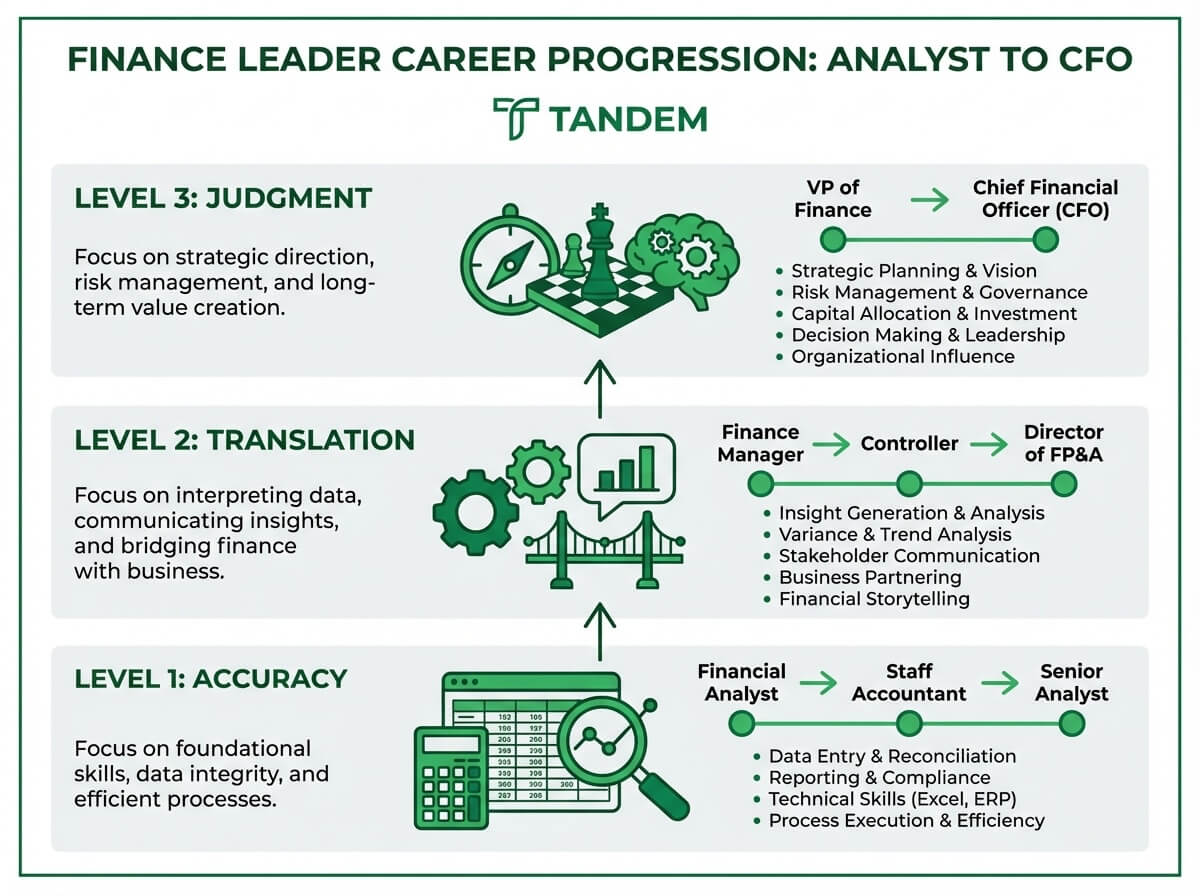
| Career Level | Currency | What Earns Standing | What Gets You Promoted |
|---|---|---|---|
| IC / Manager | Accuracy | Catching errors, reliable models, variance below threshold | Being the person whose numbers are never wrong |
| Director / VP | Translation | Turning data into cross-functional insight, making the numbers mean something to non-finance peers | Enabling decisions beyond your own function |
| C-Suite | Judgment | Capital allocation wisdom, risk appetite framing, strategic narrative about where the business is heading | Shaping the bets the organization makes |
Recognize the Pattern?
If that description landed with uncomfortable precision, that’s what a first conversation feels like too. We start by naming what finance installed—not asking you to abandon it.
Every career level has a currency. As an analyst and early manager, yours was accuracy. You caught errors others missed. You built models that held up under scrutiny. “I see what others miss” was both your reputation and your self-concept. It worked.
At director and VP, the game changed. The currency became translation: turning data into insight for people who do not read spreadsheets. Making the numbers mean something to the CMO, the head of product, the CEO. But you kept leading with the model. You kept presenting forty slides when the room wanted three. You kept defining success as “the forecast was accurate” when the new level defined success as “the forecast changed a decision.” You were spending old currency at a level that traded in something else, and the gap showed up as feedback you couldn’t quite decode: “be more strategic.” This is the moment the old playbook stops working, and nobody hands you a new one.
You kept spending accuracy in a room that had started trading in judgment.
At the C-suite level, the game changes again. The board does not want your analysis. They want your judgment. Capital allocation wisdom. Risk appetite framing. A compelling narrative about where the business is heading and why this bet, not that one. Strategy requires judgment and narrative, both of which feel imprecise and therefore dangerous to someone whose career was built on being right about the numbers. The CFO who still builds the analysis personally rather than trusting the team’s analysis and adding strategic judgment on top has brought the wrong currency to the boardroom. It is the same pattern that traps rising leaders who cannot let go, except at the C-suite level, the cost is not just your time. It is your standing. The deck is perfect. The room has already decided.
Under pressure, the pattern hardens rather than flexes. More decimal places. Longer analysis cycles. Additional validation steps. “The numbers aren’t clean enough yet.” You demand more data across every channel but only read the accuracy channel. You flood your team with requests for backup while ignoring the qualitative signals about trust, influence, and whether people want you in the room. The pattern that defines you amplifies. It looks like leaning into your strengths. It is also the formation-driven overextension that leads to burnout. Until it becomes the thing isolating you from the very peers whose buy-in you need.
The Arguments Nobody Asked You to Win
You keep winning arguments nobody asked you to have. You present irrefutable data to a room that was not having a data conversation. The CEO wanted to know whether the acquisition felt right. You showed them a DCF model with five scenarios. Both of you left dissatisfied.
Your cross-functional peers have stopped bringing you into conversations early. Not because they do not respect you. Because the precision lens turns every exploratory conversation into an audit. The CMO stopped sharing early-stage ideas with you after you responded to their brand investment proposal with a twelve-month attribution analysis. You were right about the attribution gap. And now you are excluded from the strategic conversations where influence actually lives.
This pattern is not about personality. Two finance leaders in different organizations will recognize the same dynamic because the formation itself produces it. It is specific enough to predict, general enough to name, and coachable once understood.
The feedback you keep getting is some version of “be more strategic.” Nobody tells you what that actually means for a finance leader. It does not mean thinking bigger. It means tolerating ambiguity. It means offering judgment when the model cannot give you an answer. It means sitting in a room where 70% certainty is enough to act and not insisting on 95%. It means the most valuable thing you could give the board is not the model itself but your read on what the model implies. And that feels like guessing. Which, in your formation, is the one thing you were never allowed to do.
Your career trained you to see what others miss. It also trained you to miss what others see.
This is not a skill gap. You do not need a presentation workshop or an influence bootcamp. What is happening is structural: the patterns that a career in finance installs are doing exactly what they were trained to do, in a room that has started asking for something different. The precision is not the problem. Your relationship with it is. And that distinction matters, because the path forward is not to become less precise. It is to recognize that precision is the foundation, not the whole building.
What Changes When Your Coach Gets This
Consider a CFO who tells their coach: “I can’t get the executive team to take my recommendations seriously.”
See How Tandem Coaches Differently
Our approach starts with understanding what your career installed. Not personality assessments. Not generic executive presence frameworks. Your financial formation—and where it runs out of road.
A coach working from a generic leadership framework hears an influence problem. They offer techniques: how to structure a persuasive presentation, how to build coalitions before the meeting, how to read the room. Useful, perhaps. But it misses what is happening underneath.
A coach who understands what a career in finance does to a person hears something different. They recognize a specific dynamic: a leader whose analytical depth is the barrier to influence, not the tool for it. The coaching question is not “How could you be more influential?” It is: “You built your career on being the most precise person in the room. What happens when precision alone is not what the room needs from you?”
That question does not teach influence skills. It surfaces the transition that matters: from accuracy to judgment. And it names the identity threat embedded in making that shift. Because for a finance leader, “lead with your judgment instead of your model” is not a minor adjustment. It asks you to offer something that cannot be audited, in a career where everything you have offered has been auditable. The question honors precision as the foundation while opening the possibility that the building needs another floor.
Or consider the moment a coach says: “Could you try leading with the story rather than the data?” The CFO hears: your strength is not enough.
A different coach says: “What would it look like to lead with the insight first and let the data support it, rather than the other way around?” The distinction matters more than it appears to. One asks you to abandon your identity. The other asks you to build on it. Not “tell stories instead of showing data” but “the most valuable thing you could give the board is your judgment about what the model implies, not the model itself.” That reframe does not threaten the precision. It elevates it. The data is still there. It moves from being the argument to being the evidence supporting a bigger argument: your strategic read on what the numbers mean.
The difference between those two coaching approaches is not technique. It is whether the coach understands what fifteen or twenty years in finance actually does to a person.
A coach who gets this will not try to fix your precision. They will help you see it clearly enough to build on it. They will know that “be more strategic” sounds different to a finance leader than it does to anyone else in the room. They will know that when you insist on more data before committing, you are not being rigid. You are requesting the level of evidence your career trained you to require before putting your name on something. The question worth exploring is not “why can’t you just decide?” but “what level of certainty do you actually need here? Is it 95%, or would 70% be enough? What is the cost of waiting for the last 25%?”
And they will know that the path from analysis to judgment is not a skill acquisition. It is a shift in what you allow yourself to offer when the model runs out of answers. That shift is specific to what finance installs. It is not the same transition a technology leader makes, or a legal leader, or an operations leader. Each of those careers creates its own version of the ceiling. Yours is the precision trap. And a coach who can name it without pathologizing it, who can honor what it built while helping you see where it ends, is a coach worth talking to.
The patterns in this article connect to several related dynamics across careers and levels: what the CFO role trains you to measure, why risk means something different in finance, when precision becomes the wrong feedback signal, the CFO who can’t separate precision from identity, and why the CFO and CMO keep disagreeing. For a deeper look at the formation patterns that shape finance leaders and how coaches can prepare for these dynamics, see what coaches should know about CFO formation.
A Different Kind of Conversation
That precision served you. It got you here. It is also the reason the room goes quiet when you talk for more than ninety seconds.
What changes is not the precision itself. It is the relationship you have with it. Whether it is the whole building or the foundation you build on. Whether you are the person who delivers the model or the person whose judgment the model supports. That shift does not require you to become someone different. It requires you to become more of who you already are, in a way the room can actually use.
If you recognized yourself in this article, that recognition is the starting point, not the destination. The patterns your career installed are specific, predictable once understood, and coachable once named. The next step is a conversation with someone who sees those patterns clearly. That conversation is available whenever you are ready for it.
Frequently Asked Questions
Why do CFOs struggle to be seen as strategic despite strong analytical skills?
The currency that earns standing in the C-suite is judgment, which includes risk appetite framing and narrative about where the business is heading. A career in finance trains leaders to lead with precision and evidence, which earned them credibility as analysts and directors. At the C-suite level, the board wants a read on what the model implies, and the model itself becomes secondary. The strength that built the career becomes the ceiling when the room has shifted to a different form of currency.
What does it mean when a CFO keeps 'winning arguments nobody asked for'?
This happens when the precision lens is applied to conversations that were never about data. A CEO asking whether an acquisition 'feels right' is seeking strategic judgment, and presenting five DCF scenarios answers a different question entirely. Over time, cross-functional peers stop bringing CFOs into early-stage conversations because exploratory discussion turns into an audit. The result is exclusion from the informal strategic conversations where organizational influence actually operates.
How is coaching for CFOs different from general executive coaching?
A coach working from a generic leadership framework typically hears an influence problem and offers techniques around persuasion or coalition-building. A coach who understands what a finance career installs recognizes a specific formation: a leader whose analytical depth is functioning as the barrier to influence rather than the tool for it. The coaching work is less about skill acquisition and more about helping the leader see that their precision is the foundation. The building needs another floor built on judgment they are not yet allowing themselves to offer.
A Conversation That Starts Where Finance Shaped You
A 30-minute call where your coach already understands what precision installs and where it creates a ceiling. No assessment. No intake form. Just a conversation that starts where your career actually shaped you.
Book a Free Consultation →