Executive Presence Assessment: How to Measure the Gap
How do I measure my executive presence gap?
Run a 360-degree feedback instrument with presence-specific dimensions, disaggregated by rater group. Cross-rater variance reveals your Context gap. Pair it with Genos EQ to test for an Expression gap or ProfileXT to test for an Authority gap. One instrument produces a score. Two or three produce a diagnosis.
Most executive presence development starts without a measurement. A leader hears vague feedback: “You need more gravitas” or “You don’t project confidence at the senior level.” The leader nods, reads a book, maybe hires a coach. Six months later, nobody can say whether anything changed because nobody measured anything to begin with.
That is the fundamental problem with how organizations approach executive presence. They treat a diagnosable gap as a personality trait and a measurable perception as an opinion. The result is development without a baseline, coaching without a target, and progress without evidence.
Assessment changes the equation. Validated instruments can identify exactly where a leader’s self-perception diverges from stakeholder experience, which dimensions of presence are strong, and which are producing the friction. The question is not whether what executive presence means can be measured. It is which instruments measure which dimensions, and how the data maps to a development plan that targets the right gap.
Key Takeaways
- Self-assessment of executive presence is unreliable. Leaders consistently rate their own presence higher than stakeholders do, and the shape of that gap is itself a diagnostic signal.
- Four validated instruments measure different presence dimensions: Bates ExPI (dedicated EP composite), Genos EQ (emotional expression), ProfileXT (behavioral tendencies), and 360-degree feedback (audience perception split by rater group).
- The ACE framework maps assessment data to three gap types: Expression, Authority, and Context. Identifying the primary gap type determines whether coaching targets visibility, positional authority, or organizational fit.
- No single instrument covers all three gaps. A multi-instrument stack produces a triangulated diagnosis that connects data to a specific coaching plan, not a generic development prescription.
Why Self-Assessment Alone Falls Short
Executive presence is a perception problem, not a self-knowledge problem. A leader can be deeply aware of their own strengths, communication style, and strategic thinking capacity and still have no reliable picture of how others experience them in a room. The gap between self-perception and audience perception is where presence lives, and self-assessment cannot see it.
Is Your Self-Other Gap Telling a Bigger Story?
If your self-ratings don’t match what peers or direct reports see, a consult can help you choose the right instrument and set a baseline that makes progress measurable.
The research backs this up. Eurich’s research on self-awareness found that while 95% of people believe they are self-aware, only 10–15% actually demonstrate it when tested against external data. In the context of executive presence, this means leaders routinely misjudge how their communication skills, body language, and authority register with the people who matter most.
Consider a composite scenario. A vice president self-rates her communication clarity at 4.5 out of 5. She prepares thoroughly for every meeting, speaks precisely, and follows up in writing. Her direct reports rate the same dimension at 3.1. The gap is not about skill. Her communication is strong. The gap is about display: she processes decisions internally before announcing conclusions, so her team never sees her reasoning. They experience directives where she experiences dialogue. Both assessments are honest. Only one reflects what the audience actually sees.
This kind of divergence is diagnostic. When the shape of the self-other gap follows a pattern where the leader rates internal capabilities highly while external audiences rate visible behaviors lower, the perception disconnect points to a specific gap type. A leader who scores well on emotional intelligence assessments but receives low 360 feedback on emotional expression is not lacking awareness. They are lacking visibility. The awareness is there. The display is not.
The leaders who score highest on emotional intelligence are often the ones with the widest expression gaps. Awareness without display is the most common misdiagnosis in presence coaching.
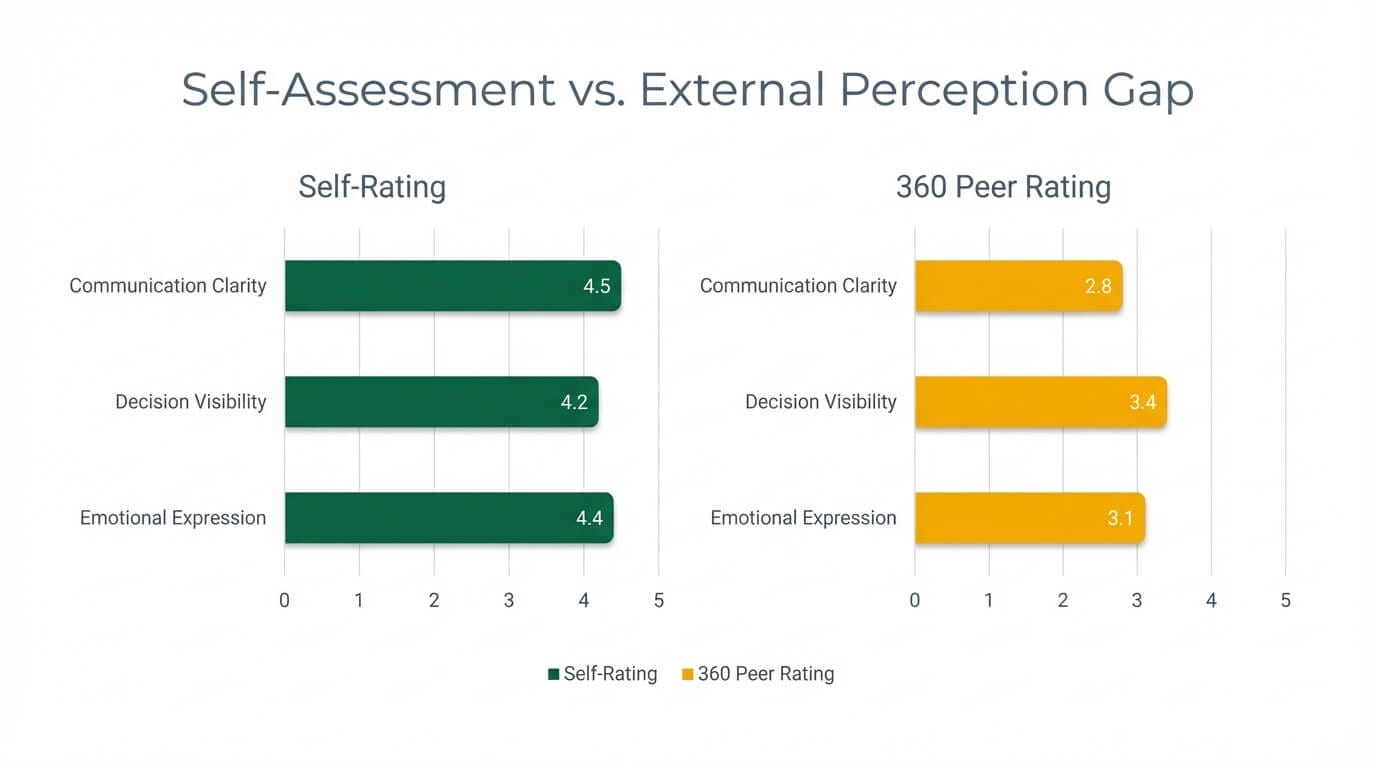
Self-assessment has a second limitation: it cannot detect what an organization’s culture defines as “executive.” A leader may accurately assess their own behavior and still miss that their communication style does not match what this particular organization rewards at the senior level. That is not a self-knowledge problem. It is a context problem, and it requires external data to surface.
The bridge between self-perception and reality is structured feedback from the people who experience the leader’s presence directly. That means validated instruments, not casual conversations.
Instruments That Measure Executive Presence
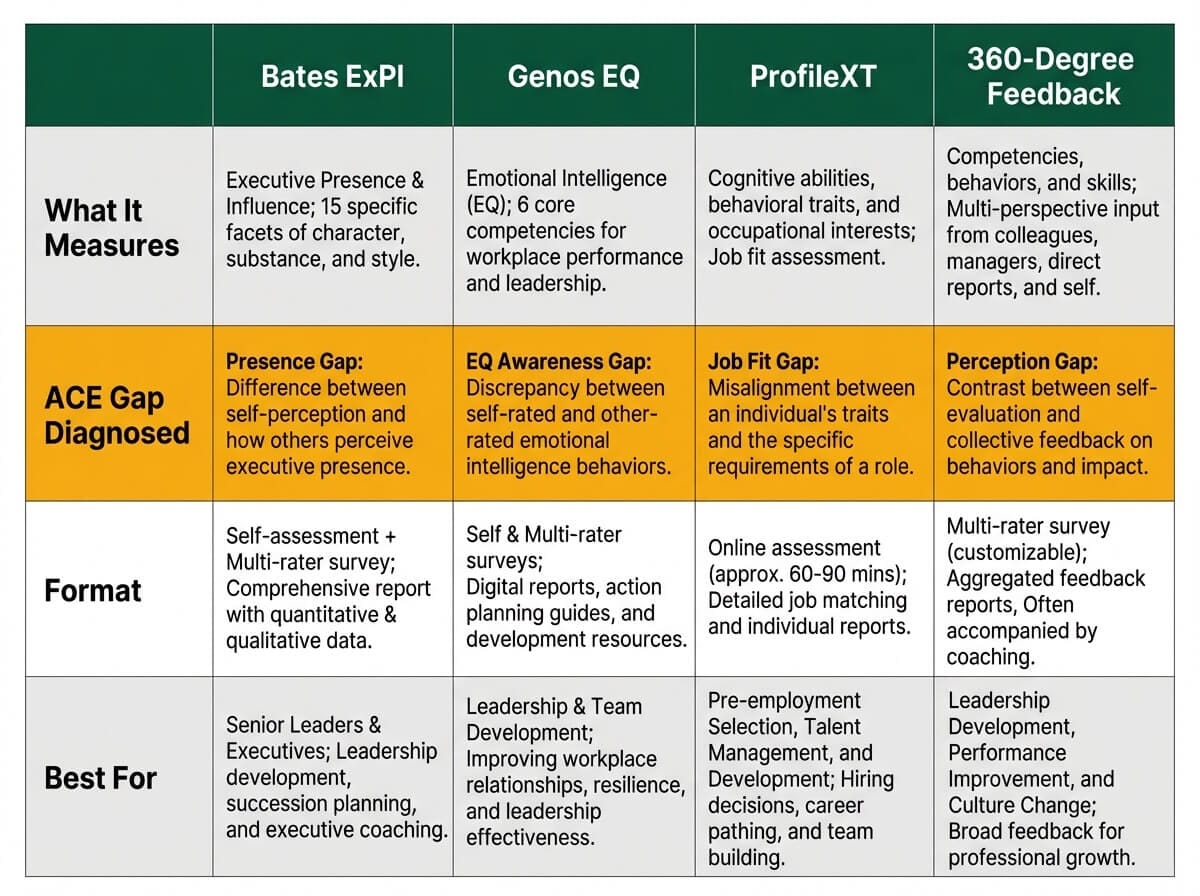
Executive presence is not one thing. It spans how a leader communicates, how they occupy authority, and how their style fits the organizational context. No single instrument captures all of those dimensions. Understanding what each instrument measures, and what it misses, is the first step toward building an assessment approach that actually diagnoses the problem. For a broader look at the field, see our overview of executive coaching assessment tools.
| Instrument | What It Measures | ACE Gap Diagnosed | Format | Limitations |
|---|---|---|---|---|
| Bates ExPI | 15 facets of executive presence across Character, Substance, and Style | Broad (all three, undifferentiated) | 360-based, certified administration | Measures presence as a single construct; does not isolate which gap type is primary |
| Genos EQ | Emotional expression, self-management, emotional awareness, empathy | Expression Gap | Self-report + 360 option | Does not measure organizational context or role-alignment; covers emotional dimensions only |
| ProfileXT | Behavioral tendencies, cognitive patterns, occupational interests | Authority Gap | Individual assessment, norm-referenced | Does not capture audience perception; measures trait patterns, not how they land |
| 360-Degree Feedback | Audience perception across rater groups (peers, direct reports, superiors) | Context Gap (via cross-rater variance) | Multi-rater survey, customizable dimensions | Depends on rater quality; reveals perception but not underlying cause |
The Bates Executive Presence Index is the only instrument designed specifically for executive presence. Developed by Bates Communications, it evaluates 15 facets organized into three dimensions and produces a composite EP profile. It is well-validated and provides a clear snapshot. The limitation is structural: because it measures presence as a unified construct, it tells you where the leader is strong or weak on the ExPI scale but does not distinguish between the three underlying gap types. A leader who scores low on influence could have an authority problem, an expression problem, or a context problem. The ExPI score alone does not differentiate.
Genos emotional intelligence assessments measure dimensions that map directly to the Expression gap. When Genos data shows high self-awareness paired with minimal emotional expression, the finding points to a specific pattern: the leader processes deeply but makes little of that processing visible to others. Direct reports experience detachment where the leader experiences deep engagement. Genos does not measure organizational context or positional authority, so it covers one gap type with precision rather than all three with less resolution.
ProfileXT measures behavioral tendencies and cognitive patterns that map to the Authority gap. If ProfileXT reveals high analytical drive with strong relational orientation but low dominance, the data points to a leader who communicates well but has not claimed positional authority. They are liked but not followed. The coaching plan that emerges from this finding targets organizational positioning, not communication skills. ProfileXT does not capture how others perceive the leader, which is why it pairs with 360 feedback rather than replacing it.
The 360-degree feedback instrument captures what no self-report assessment can: how different audiences actually experience the leader. The diagnostic power is in the disaggregation. When direct reports rate a leader at 4.2 on presence dimensions while senior stakeholders rate the same behaviors at 2.8, the variance itself is the finding. The leader is not inconsistent. Different audiences are applying different templates for what “executive” looks like. That cross-rater pattern is the primary signal for a Context gap, and it only becomes visible when the data is split by rater group.
No single instrument covers all three gaps. That limitation is the argument for a multi-instrument assessment stack. At Tandem, we combine Genos EQ, ProfileXT, and 360-degree feedback to produce a triangulated diagnosis: which gap type is primary, how the data confirms it across multiple instruments, and what the coaching plan should target.
A composite score tells you a leader has a presence problem. A triangulated diagnosis tells you which problem, and that distinction determines whether the coaching engagement produces change or produces paperwork.
How Assessment Data Maps to ACE Gaps
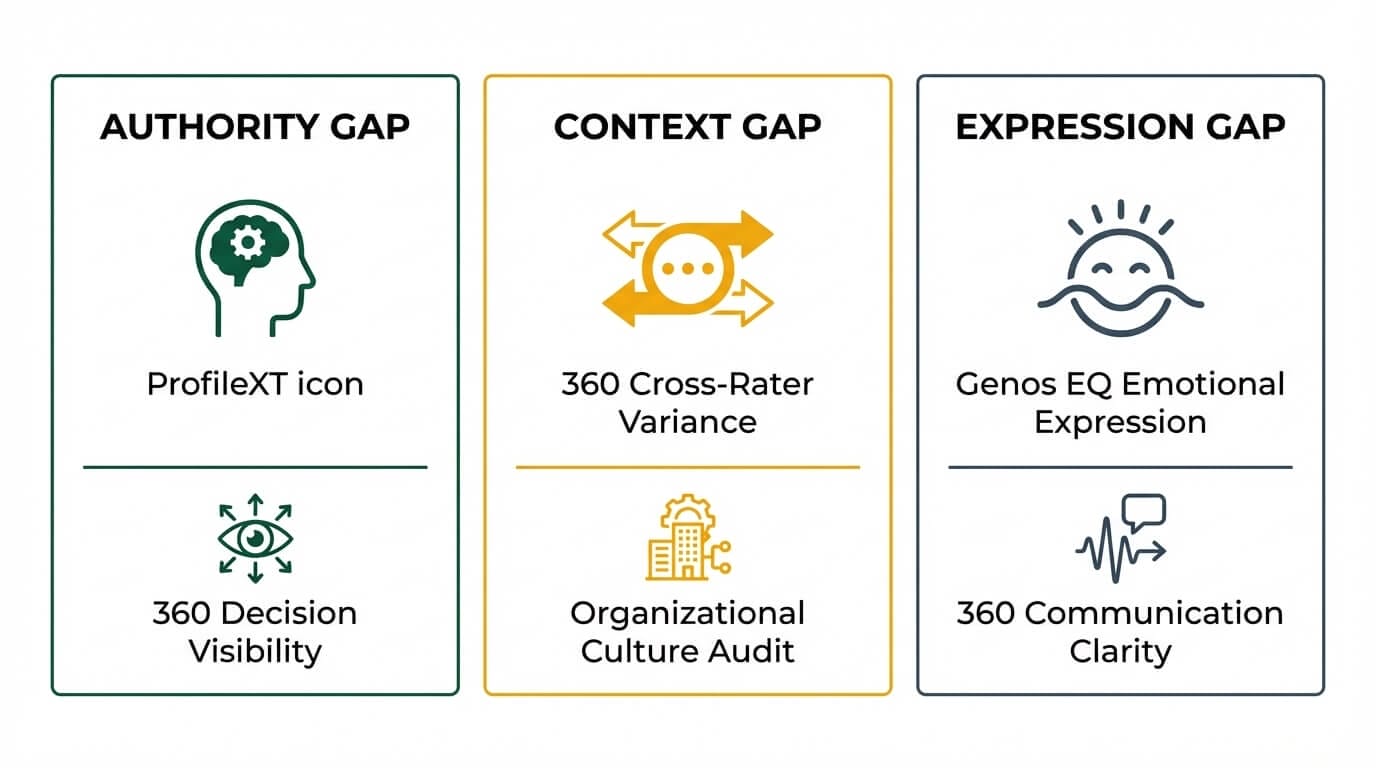
Assessment data becomes useful when it maps to a diagnostic framework. Without that mapping, the data produces a score. With it, the data produces a diagnosis: which gap type is primary, what evidence supports that diagnosis, and what coaching intervention will be most effective. The ACE model, a practitioner-developed framework built from assessment patterns observed across hundreds of coaching engagements, organizes presence gaps into three categories.
Authority Gap Indicators
ProfileXT behavioral data shows a pattern: high relational orientation, strong communication skills, low dominance. The 360 feedback confirms it: strong marks on interpersonal connection but low visibility in decision-making, strategic influence, and organizational positioning. The leader inspires trust one-on-one but does not project confidence in senior leadership forums. The gap is not about competence or even confidence. It is about occupying positional authority: the transition from proving value through contribution to projecting authority through restraint and strategic presence.
Context Gap Indicators
The strongest signal is cross-rater variance in the 360 data. When direct reports rate the leader at 4+ on presence dimensions while peer-level or senior stakeholders rate the same leader at 2-3, the leader is not behaving inconsistently. Different audiences are applying different definitions of what leadership should look like. An organizational audit step, examining what this culture rewards and which leadership styles are systematically valued, surfaces whether the assessment reflects a behavioral gap or a style-context mismatch. This is the dimension most presence models miss entirely.
Expression Gap Indicators
Genos EQ scores reveal the pattern most clearly: high self-awareness, high emotional awareness, minimal emotional expression. The leader knows what they think and feel. The room does not. 360 communication scores are low not because the leader lacks communication skills but because their internal processing never becomes visible. Stakeholders fill the visibility gap with assumptions, usually negative ones. The coaching intervention targets making internal processing observable: narrating reasoning in real time, externalizing reactions rather than editing them, letting the audience see the thinking that produces the conclusion.
Same Data, Three Diagnoses
Here is why the framework matters. Take a leader whose 360 composite score on executive presence is 3.0 out of 5. That score alone tells you almost nothing. Read the data through the Authority gap lens and you see strong emotional intelligence scores but low ratings on influence and strategic thinking visibility. The leader connects well but does not occupy positional power. Read the same data through the Context gap lens and you see high cross-rater variance: direct reports love her, the C-suite does not see “executive” in her style. Read it through the Expression gap lens and you see high Genos self-awareness paired with low external display: she processes everything and shows nothing.
All three readings use the same data. All three produce different coaching plans. Executive presence coaching that does not start with a gap diagnosis defaults to the most visible complaint, which is usually confidence or communication, neither of which may be the actual issue. Assessment without a diagnostic framework produces data. Assessment with ACE produces a plan, including targeted executive presence exercises specific to the identified gap.
Choosing the Right Assessment Approach
The right assessment approach depends on the diagnostic question. An individual leader receiving presence feedback needs a different instrument set than an HR team evaluating a cohort for career advancement or a coaching firm building a baseline for a six-month engagement.
Budget tier 1: Minimum viable. A 360-degree feedback instrument with presence-specific dimensions. This captures audience perception data and, when disaggregated by rater group, can surface Context gap signals. It does not measure the emotional intelligence dimensions that reveal Expression gaps or the behavioral tendency patterns that reveal Authority gaps. For organizations beginning to take presence development seriously, this is the starting point. For organizations measuring leadership development outcomes across a cohort, aggregated 360 data reveals systemic patterns that individual assessments miss.
Budget tier 2: Targeted stack. A 360 paired with one additional instrument chosen based on the presenting complaint. If the feedback suggests the leader “doesn’t show what they’re thinking,” add Genos EQ to test for an Expression gap. If the feedback is about influence and strategic visibility, add ProfileXT to test for an Authority gap. This approach costs less than the full stack while doubling diagnostic precision for the suspected gap type.
Budget tier 3: Full stack. Genos EQ + ProfileXT + 360-degree feedback. This covers all three ACE gap types with dedicated instruments, produces triangulated data, and gives the coach maximum diagnostic resolution. The full stack is the gold standard for individual executive coaching engagements where the investment in coaching is significant and the diagnosis needs to be precise. Leaders developing executive presence through a structured coaching engagement benefit most from this level of diagnostic depth.
Personality assessments alone (MBTI, DiSC, StrengthsFinder) do not measure executive presence. They measure traits, not audience perception. A leader can have ideal personality traits and still produce a significant presence gap because the issue is how those traits translate to observable behavior in context. If your assessment approach relies solely on personality instruments, it will miss the perception dimension entirely.
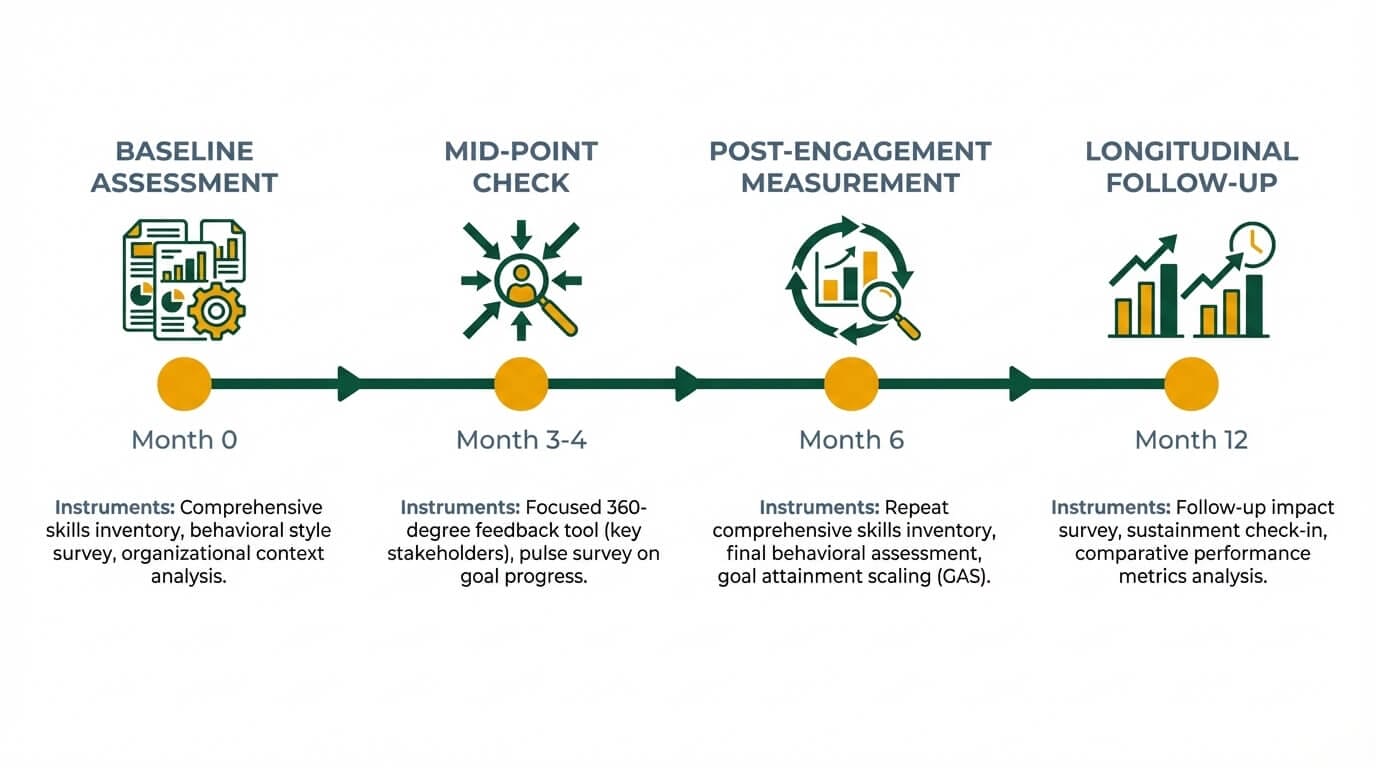
Assessment cadence matters as much as instrument selection. Presence develops over months, and perception changes lag behavioral changes. A baseline assessment before coaching starts establishes the gap. A targeted re-assessment at month 3 or 4, focused on the presenting gap dimension, checks whether behavioral changes are registering with the audience. A full post-engagement measurement at month 6 provides evidence of development. Without this cadence, assessment is a snapshot instead of a measurement methodology. Organizations exploring executive presence training programs should apply the same cadence logic: pre-training baseline, mid-program check, post-program measurement.
Without assessment, presence coaching is intuition-guided. With assessment, it is gap-specific. That is not an incremental improvement. It is a different engagement entirely.
The most common mistake organizations make when commissioning assessments is starting without a diagnostic question. “We want to assess executive presence” is not specific enough. Which gap type is the suspected issue? Which instruments will test that hypothesis? How will the data connect to a coaching or development plan? The ACE framework prevents the “assessment without direction” problem by requiring these questions before the first instrument is administered.
FAQ: Executive Presence Assessment
How is executive presence measured?
Executive presence is measured through validated instruments that capture both self-perception and audience experience. The most common instruments include 360-degree feedback (audience perception across rater groups), the Bates Executive Presence Index (15 EP-specific facets), Genos EQ (emotional expression and awareness), and ProfileXT (behavioral tendencies). Effective measurement uses multiple instruments to triangulate the diagnosis rather than relying on a single composite score.
What is the Bates Executive Presence Index?
The Bates Executive Presence Index (ExPI) is the only assessment instrument designed specifically for executive presence. Developed by Bates Communications, it measures 15 facets organized across three dimensions: Character (authenticity, integrity, concern), Substance (practical wisdom, confidence, composure), and Style (appearance, intentionality, inclusiveness). It requires certified administration and produces a presence profile that identifies strengths and development areas across all 15 facets.
Can you assess executive presence without a formal instrument?
Informal assessment, such as asking trusted colleagues for candid feedback, provides directional signals but lacks the reliability and specificity of validated instruments. The main limitation is that informal feedback tends to confirm existing biases rather than surface blind spots. A structured 360 with presence-specific dimensions is the minimum viable formal assessment and costs less than most leaders expect.
How often should executive presence be reassessed?
For coaching engagements, reassess at three intervals: baseline (before coaching starts), mid-point (month 3 or 4, targeted to the presenting gap), and post-engagement (month 6, full re-assessment). Behavioral change in the leader typically outpaces perception change in the audience, so mid-point checks prevent premature course corrections based on lagging stakeholder perception.
Assessment is not a test. It is a diagnostic. The distinction matters because tests produce pass/fail verdicts while diagnostics produce treatment plans.
A leader who “fails” an executive presence assessment has not failed at all. They have a baseline: specific data showing where their self-perception diverges from stakeholder experience, which instruments confirmed which gap type, and what the coaching plan should target first. That is more than most presence development programs offer before they start spending the budget.
Without assessment, executive presence coaching is intuition-guided. With assessment, the development plan has a baseline, a target gap, an instrument set that tracks progress, and evidence at the six-month mark that something actually changed. The leaders who build lasting influence, who inspire confidence at the senior level, who project authority that matches their role, are not guessing at what to develop. They measured the gap first.
Get a Clear Diagnosis of Your Presence Gap
Bring your feedback, 360 results, or assessment ideas. We’ll help you identify the real gap type and define what “changed” looks like before you invest months in the wrong fix.
Book a Free Consultation →