Systemic Team Coaching: Frameworks, Limits, and Practice
How do you practice systemic team coaching?
Three practices separate systemic coaching from team-level work. Map organizational forces by interviewing stakeholders before the first session. Identify what the incentive structures actually reward: individual survival or collective outcomes. Run at least one session dedicated entirely to the team's external dependencies, not internal dynamics. The system shapes behavior before anyone enters the room.
Most team coaching stays inside the team. Relationships, communication patterns, shared goals. The coach works with what happens in the room. Systemic team coaching changes the boundary. It includes the organizational system the team is embedded in: reporting structures, incentive designs, resource allocation, the cultural norms that shape behavior before anyone walks into a session.
The distinction matters because teams do not exist in isolation. The client is the team, yes, but that team is a single entity nested within a larger system. When the system pushes in one direction and the coaching pushes in another, the system wins. Every time. This dynamic is especially pronounced in team coaching through organizational change. Coaches who work only at the team level repeatedly hit an invisible ceiling. They optimize dynamics inside the room while forces outside the room reset those dynamics between sessions.
Two frameworks give coaches a structured way to see the system: Peter Hawkins' Five Disciplines and David Clutterbuck's PERILL model. Both are useful. Neither is sufficient on its own. And both assume something that frequently isn't true: that the organizational environment will support whatever the coaching produces.
What follows is a practitioner's guide to both models, the organizational reality that limits them, and the concrete practices that make systemic coaching work.
Key Takeaways
- Systemic team coaching expands the boundary from the team itself to the organizational forces that shape the team’s behavior: reporting structures, incentive designs, and resource allocation—the advanced domain covered by the ICF ACTC credential.
- Hawkins’ Five Disciplines map what to examine across a coaching engagement; Clutterbuck’s PERILL model diagnoses where a team is stuck right now. The two frameworks are complementary.
- The environment ceiling (where organizational structures actively contradict coaching goals) is the most common reason team coaching improvements stall.
- When coaching hits the environment ceiling, the conversation with the sponsor matters more than any further session with the team.
What Makes Team Coaching Systemic
Systemic team coaching expands the coaching boundary from the team itself to the organizational forces that shape the team's behavior. Where traditional team coaching practice focuses on internal dynamics, the systemic approach asks: what is the wider system doing to this team, and what is this team doing to the wider system?
The shift requires systems thinking. A team struggling with unclear priorities may look like a communication problem from inside the room. Zoom out, and the real cause is three senior leaders sending competing directives because the organization never resolved a strategic disagreement. The team's confusion is a symptom. The organizational structure is the source. Traditional team coaching would work on how the team communicates about priorities. Systemic coaching asks why the priorities are unclear in the first place and whether the answer lives outside the team. When the team in question is the senior leadership team itself, that systemic lens sits at the center of executive team coaching, where the competing directives often originate from the people in the room.
This is what coaches trained only at the team level miss. They see the conflict, work on communication skills, build trust. The team improves in session. Then members return to an environment where individual performance reviews reward behaviors that contradict the team's agreements. The improvement evaporates. The coach tries harder. The pattern repeats.
Systemic coaching interrupts that cycle by making the surrounding forces visible. It does not fix the organization. It names the relationship between the team and its context so that coaching interventions address causes rather than symptoms. The development challenge shifts from "how does this team work better together" to "how does this team work better together within the system that contains it."
Systemic coaching vs. systemic team coaching
The two terms get used interchangeably, but the distinction is worth holding. Systemic coaching is the broader discipline: coaching that treats the client—whether an individual, a team, or a whole function—as part of a living system rather than an isolated unit. Its defining move is relational. It asks what the wider system is doing to the client, and what the client is doing to the system. Systemic team coaching is that same discipline applied to an intact team, where the client is the team as a single entity nested inside the organization.
The difference is the unit of analysis, not the philosophy. A coach can work systemically with one leader by mapping the stakeholders, incentives, and reporting lines that shape that leader’s choices. Widen the lens to a team and the same discipline tracks how the team’s internal agreements collide with the forces outside its boundary. Everything that follows—Hawkins’ Five Disciplines, Clutterbuck’s PERILL model, the environment ceiling—is systemic coaching scaled to the team. If you want to build that unit-of-analysis shift into practice, our systemic coaching course for team coaches works through it with executive-team cases.
Hawkins’ Five Disciplines of Team Coaching
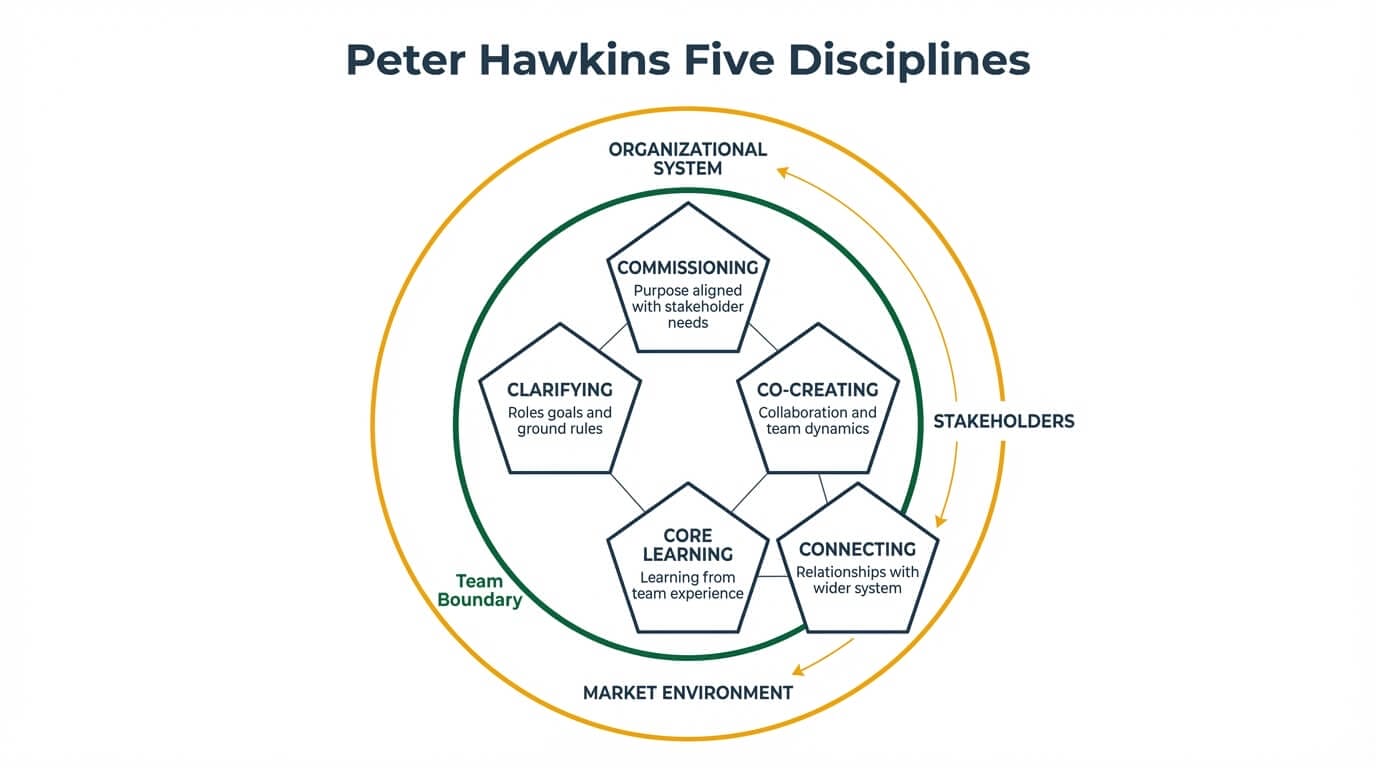
Professor Peter Hawkins developed the Five Disciplines model—set out in his book Leadership Team Coaching—to give coaches a structured approach to systemic team coaching. It is the most widely taught systemic team coaching model, and it identifies five areas of practice: three focused inside the team, and two that bridge the team to its wider system.
Commissioning
The engagement begins before the first team session. Commissioning is the work between the coach and the sponsor: clarifying what the organization actually needs from this team and what the coaching is expected to change. The failure mode is common and expensive. Without explicit commissioning, the coach ends up helping the team pursue goals the sponsor never authorized. Three months later, the sponsor questions the value because the outcomes don't match unstated expectations. Every stalled engagement we've seen traces back to weak commissioning.
Clarifying
Clarifying is the team's internal alignment work. Purpose, roles, operating agreements, decision-making processes. Teams often skip this because it feels obvious. It is not obvious. Ask five members of a leadership team to describe the team's primary purpose, and you will get five different answers delivered with equal confidence. Clarifying surfaces that gap before it produces months of misdirected effort.
Co-creating
How the team actually works together in real time. Co-creating addresses collaboration patterns, the quality of dialogue, how conflict is handled, whether people bring their actual thinking into the room or perform polite agreement while withholding their real concerns. This is the discipline most coaches recognize because it matches traditional team coaching. The difference in a systemic frame is that co-creating is one discipline of five, not the whole engagement.
Connecting
Connecting is the discipline that makes the model systemic. It examines the team's relationships with stakeholders, other teams, customers, and the broader organizational environment. Most coaches skip Connecting because it requires going outside the team boundary, which feels like overstepping. Teams resist it too. Looking inward at communication and trust feels safer than examining dependencies the team cannot unilaterally control. But the team's performance is shaped by these external relationships whether anyone examines them or not.
Core Learning
The team's capacity to learn from its own experience. Core Learning fails when teams repeat experiments without reflecting on what happened. They try something, it doesn't work, they try the same thing harder. The learning process requires the organizational system to support reflection. In environments where speed is valued above all else, teams rarely pause long enough to extract learning from their experience.
The Five Disciplines are a structural model. They tell you what to examine. What they do not tell you is how to respond when a discipline reveals dysfunction. That gap is where coaching skill matters more than framework knowledge.
The Five Disciplines tell you what to examine. They do not tell you what to do when a discipline reveals dysfunction. That gap is where coaching skill matters more than framework knowledge.
Coaches usually absorb the Five Disciplines through supervised practice, not self-study. Reading the model takes an afternoon; using it under pressure—when a team is deflecting, the sponsor is impatient, and Connecting means a conversation nobody wants to have—is the part that takes reps. That is why formal systemic team coaching training pairs the model with observed practice hours rather than treating it as a reading assignment.
The PERILL Model
David Clutterbuck’s PERILL model provides a diagnostic frame for identifying where a team is stuck and why. The model maps six dimensions of team functioning (Productivity, Empowerment, Relationships, Inter-group Relations, Learning, and Leadership), giving coaches a structured way to move from vague observations to specific, actionable diagnoses.
Learn System Coaching
Tandem’s ACTC program teaches the systemic lens—not just intact teams, but business partners, departments, and cross-functional cohorts.
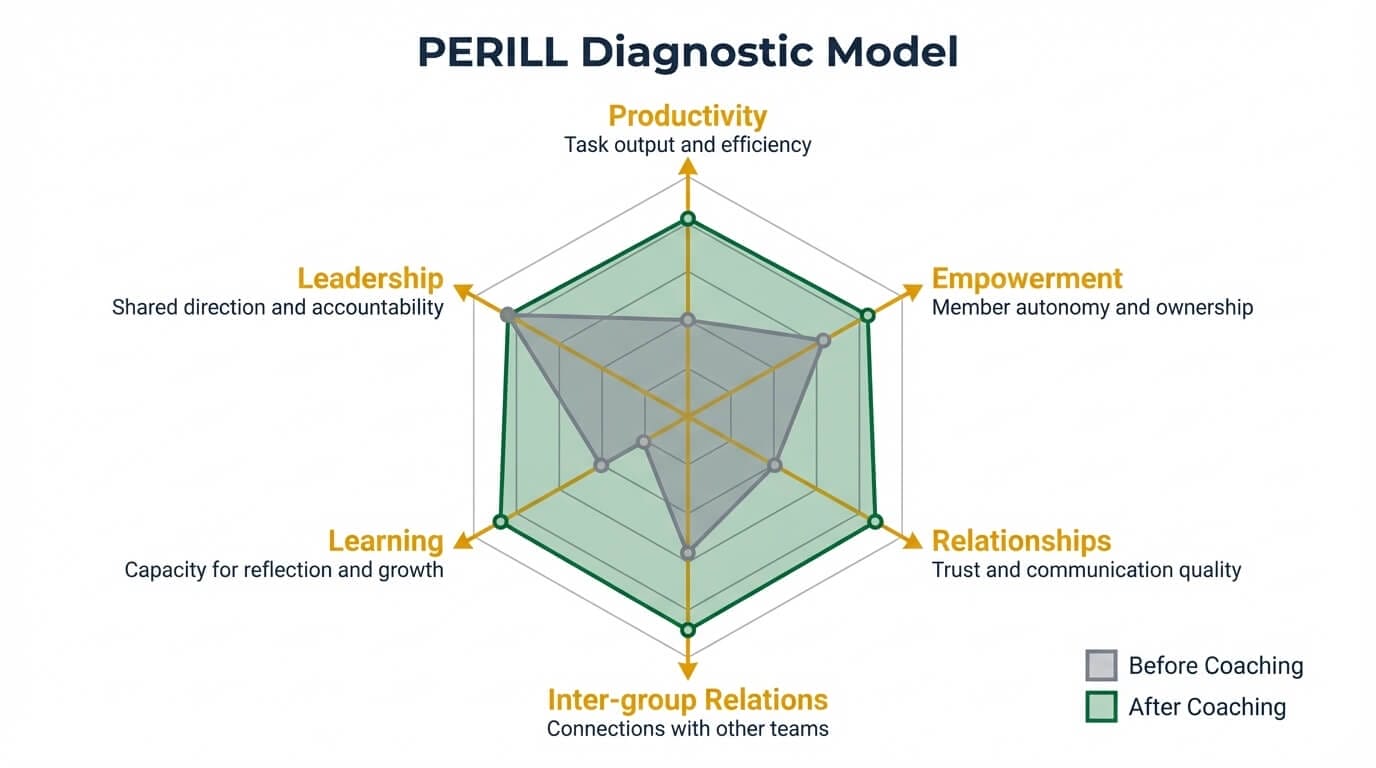
Productivity measures task output and efficiency. A team that delivers reliably but cannot adapt when requirements shift has a Productivity score that masks deeper problems. Empowerment asks whether members have genuine autonomy and ownership or whether decisions flow through a single point of control. Relationships examines trust and communication quality within the team. These three dimensions are internal.
The diagnostic becomes systemic with the remaining three. Inter-group Relations looks at the team's connections with other teams, departments, and external stakeholders. This is consistently the most revealing dimension because teams rarely examine their own external dependencies. A team that functions well internally but fails to deliver often has an Inter-group Relations problem no one has named. Learning assesses the team's capacity for reflection and growth. When a team cannot learn from its own experience, it repeats the same experiments expecting different results. Leadership examines whether direction and accountability are shared or concentrated. A team where leadership sits with one person faces a different challenge than a team where leadership is so diffused that no one takes responsibility for difficult decisions.
The model is useful because it surfaces which dimension the team is stuck in. A coach using PERILL can move past vague observations ("the team isn't working well") to specific diagnoses ("the team's Empowerment and Inter-group Relations scores suggest members lack autonomy internally and the team is isolated externally"). The specificity changes the coaching conversation.
Where Hawkins' Five Disciplines provide a structural model (what to examine across the full coaching engagement), PERILL provides a diagnostic snapshot (where the team is stuck right now). A coach might use the Five Disciplines to design an engagement and PERILL to assess progress within it. The two frameworks are complementary, not competing. Hawkins answers "what should I attend to?" Clutterbuck answers "where is this team blocked today?"
What PERILL does not tell you is what to do once you have identified the stuck dimension. The gap between diagnosis and intervention is where coaching experience matters more than framework fluency. The coach partners with the team to determine what the diagnostic reveals and what the team wants to do about it. The coach does not prescribe the solution.
The Organizational Environment Ceiling
Both Hawkins’ Five Disciplines and Clutterbuck’s PERILL model assume the organizational environment will support whatever changes the coaching produces. That assumption fails regularly. The environment ceiling is the point where coaching progress stalls not because the team resists change, but because organizational structures actively contradict the coaching goals.
Organizations refer teams for coaching because something is not working. Collaboration is weak, delivery is inconsistent, conflict is unproductive. The coaching begins. The team improves its communication, clarifies its goals, builds trust among members. Then the improvement stalls. Not because the team resisted change, but because the organizational system actively contradicts the coaching goals.
You see the ceiling in the room when the team keeps circling the same issues session after session. They name the problem clearly. They know what needs to change. But the change requires something outside their authority. A conversation with leadership about how the organizational structure contradicts what the coaching is trying to build. That conversation with the sponsor may matter more than any session with the team.
The pattern is specific and recognizable. Individual performance reviews reward solo contributions. Promotion structures make managers compete for the same resources. Bonus systems tie compensation to individual metrics, not team outcomes. What matters for each person's survival is pleasing their boss, and therefore they cannot be fully dedicated to the team's success. The team knows this. They name it clearly in session. But changing it requires something outside their control.
When the coaching hits this wall, the conversation with the sponsor may matter more than any further session with the team. The coach is not there to fix the organizational system. The coach is there to make visible what the system is doing to the team and to partner with the sponsor on whether the organization is willing to address it. When the answer is no, the coaching has reached its ceiling. Naming that ceiling honestly is more valuable than pretending more sessions will overcome structural barriers that exist by organizational design, not by accident.
Naming the environment ceiling honestly is more valuable than pretending more sessions will overcome structural barriers that exist by organizational design, not by accident.
This is the systemic dimension that team-level-only coaching misses entirely. The challenge does not originate within the team. It originates in the business environment the team operates in. Understanding how organizational integration shapes coaching outcomes changes how a coach approaches every engagement. Organizations considering team coaching for organizations need to examine their own structures before expecting the team to change.
Systemic Coaching vs. Team-Level Coaching
Systemic team coaching and team-level coaching are not competing approaches. They address different scopes. Team-level coaching works within the team boundary: relationships, communication, shared agreements, collective performance. Systemic coaching includes the team's relationship with its environment: stakeholders, organizational structures, inter-team dependencies, the forces that shape behavior before anyone enters the coaching room.
Team-level coaching is sufficient when the team's challenges originate within the team and the organization provides a supportive environment. The team needs better communication. The team needs to resolve a trust breakdown. The team needs shared goals. These are real problems with team-level solutions. A skilled coach working at the team level can produce genuine, lasting improvements when the organizational context supports the work and the challenges are genuinely internal.
Systemic coaching becomes necessary when team-level interventions plateau. Three signals indicate the shift is needed. First, the team keeps circling the same issues session after session despite genuine effort. Second, the problems the team names require changes outside their control: resource allocation, reporting structures, incentive designs. Third, the team improves during sessions but reverts between them because the environment resets their progress.
The decision to go systemic often comes mid-engagement, not at intake. The team improves its communication, clarifies its goals, builds trust. Then hits a wall. The wall is almost always organizational: the incentive structure contradicts the team's goals, the reporting lines create competing loyalties, the sponsor's expectations are misaligned with what the team can deliver given its constraints. At that point, coaching the team harder does not help. The coach needs to zoom out and work with the system that contains the team.
At that point, coaching the team harder does not help. The coach needs to zoom out and work with the system that contains the team.
Some coaches assess for environmental factors during contracting. They ask the sponsor: what organizational structures might work against this team's goals? The ICF team coaching competencies include systems awareness for exactly this reason. The competency framework recognizes that effective team coaching requires seeing beyond the team boundary.
Applying a Systemic Lens in Practice
Three practices distinguish coaches who work systemically from those who stay at team level: mapping organizational forces before the engagement begins, identifying the incentive structures that shape team behavior, and dedicating at least one session to the team’s relationship with its wider system.
Map the forces before coaching begins. Interview stakeholders outside the team before the first session. Talk to the sponsor, adjacent team leaders, the people who control resources and priorities. The goal is to understand what the organizational system is doing to this team before you start working with the team itself. Most coaches skip this step because the team is the stated client. But coaching leadership teams without understanding the system they operate within is coaching in a vacuum.
Identify the incentive structures. Ask: what gets rewarded in this organization? Individual achievement or collective outcomes? Who controls promotions, bonuses, and resource allocation? If the answers reveal that individual survival takes priority over team success, you have found the environment ceiling before it finds you. Name it to the sponsor early rather than discovering it three months into the engagement.
Ask the sponsor one question before the engagement starts: “If this team changes how it works together, will the organization’s incentive and reporting structures support that change?” The answer reveals the environment ceiling before you hit it.
Include at least one connecting conversation per engagement. Dedicate a session to the team examining its relationship with the wider system. Not internal dynamics. External dependencies. Who are the key stakeholder groups this team must serve? What do those stakeholders actually need versus what the team assumes they need? What other teams does this team depend on, and how healthy are those relationships? This is where Hawkins' Connecting discipline and Clutterbuck's Inter-group Relations dimension converge in practice.
Tandem's approach to team coaching training covers system coaching broadly. Not just intact teams, but business partners, departments, cross-functional cohorts. The systemic lens is not an advanced technique added after mastering team-level coaching. It is what separates coaching that produces temporary improvement from coaching that produces lasting change.
Systemic team coaching is not a methodology. It is a way of seeing. The frameworks give you structure: Hawkins' Five Disciplines map what to examine, PERILL identifies where the team is stuck. The environment ceiling shows where coaching reaches its limits and organizational change must begin. But the real shift is perceptual.
Once you see the organizational system acting on the team, you cannot unsee it. The patterns become visible everywhere: in the team's recurring frustrations, in the gap between what they agree to in session and what happens between sessions, in the sponsor's expectations that assume coaching can fix what organizational design created. The question stops being whether to adopt a systemic lens and becomes whether you can afford not to, given that the system is already shaping your coaching outcomes whether you name it or not.
Build Your Systemic Coaching Practice
ACC, PCC, and ACTC programs with training, mentoring, and supervision included. The systemic lens starts with the right credential foundation.
View Programs & Pricing →