
When NOT to Use Team Coaching: 3 Conditions That Predict Failure
Team coaching won’t fix a team that doesn’t want to change. It won’t overcome an organizational structure that rewards individual competition over team collaboration. And it won’t replace the management decisions that created the dysfunction in the first place.
Most coaching providers won’t tell you that. Their websites list benefits, testimonials, and engagement CTAs. This article does something different: it names the specific conditions where team coaching fails, recommends alternatives when it’s not the right tool, and identifies three requirements that must exist for coaching to succeed.
Team coaching is not the right intervention when:
- The team doesn’t want coaching and perceives it as punishment
- The organizational environment contradicts the coaching goals
- The problem calls for facilitation, consulting, or conflict resolution rather than coaching
If your situation appears in the first three sections below, team coaching is probably not your answer right now, and knowing that early saves months of misaligned expectations. If it doesn’t, you can move forward with confidence because you’ve evaluated the risks that no other coaching provider will name for you.
Key Takeaways
- Team coaching fails most often when the team perceives it as punishment, not partnership. Willingness cannot be mandated.
- Organizational incentive structures that reward individual survival over collaboration create a ceiling no coach can break through.
- Facilitation, consulting, training, and conflict resolution each solve problems that coaching is not designed to address. Matching the intervention to the actual need prevents months of wasted effort.
- Three conditions must exist before coaching begins: shared purpose, willingness to be challenged, and an organizational environment that won’t undermine the outcomes.
When the Team Doesn’t Want Coaching
The most common team coaching failure starts with a well-intentioned manager. The manager identifies a performance problem. The manager hires a team coach. The manager assigns the team to “be coached.” The team perceives coaching as judgment — or worse, punishment.
“Just because a manager says ‘go coach that team’ doesn’t mean that team is ready for coaching,” says Cherie Silas, MCC. “If they feel like they’re being punished by getting a coach, you’re not going to be able to do anything.”
The behavioral patterns in forced coaching are consistent and recognizable within the first two sessions. Teams attend but don’t engage. They answer questions with what they think the coach wants to hear. They produce surface-level agreements in the room: commitments to new communication norms, action items for better feedback loops, that dissolve within days. Some team members comply visibly while resisting privately: nodding, taking notes, agreeing to next steps, then reverting to established patterns the moment the session door closes.
In more adversarial dynamics, the team directs frustration at the coach instead of examining their own patterns. The coach becomes the problem. “Why are we doing this?” replaces any genuine exploration of team dynamics. Individual members start building cases for why coaching is a waste of time, gathering evidence from each session to support a conclusion they reached before the first meeting.
The underlying issue isn’t the team’s capability or even their interpersonal challenges. It’s the absence of willingness. Team coaching requires the team, not just the sponsor, to have a reason and desire to change how they work together. Without that willingness, every coaching technique becomes an imposition rather than an invitation. The process that should feel like partnership feels like compliance.
When a team resists coaching, the effective intervention isn’t more coaching or better coaching. It’s a conversation with the sponsor. Why do they believe coaching is the answer? What have they observed that led them here? What outcome do they actually need? That sponsor conversation, helping a leader understand the difference between mandating behavior change and creating conditions for it, may be the most valuable coaching in the entire engagement. Sometimes the work isn’t coaching the team. It’s coaching the leader who hired you.
Sometimes the work isn’t coaching the team. It’s coaching the leader who hired you.
When the System Works Against Coaching
The deepest reason team coaching fails has nothing to do with the team and everything to do with the organization surrounding it. When the business environment contradicts what coaching aims to build, the coaching hits a ceiling that no amount of skill, trust, or effort can break through.
The pattern plays out the same way across industries. An organization says it wants team collaboration. The leadership talks about breaking down silos and working together. Meanwhile, individual performance reviews rank team members against each other. Competing managers pull team members in different directions based on separate departmental goals. Promotion and bonus structures reward individual survival over collective success. The organizational system sends one message while the coaching sessions send another.
“What is important for their survival is pleasing their boss,” explains Alex Kudinov, MCC. “And therefore they can’t be dedicated to the team’s success because they’ve got to worry about their individual success.”
Consider a leadership team whose organization promotes cross-functional collaboration in its values statement but evaluates each leader exclusively on their department’s individual metrics. The coaching sessions produce genuine insights about interdependence. Leaders leave the room energized about shared goals and aligned priorities. Then they return to a system that penalizes the very collaboration they just committed to. Within weeks, individual priorities override team agreements. Not because the leaders lack commitment, but because the incentive structure makes team-first behavior a career risk.
This structural mismatch is often invisible from outside the organization and from above it. A team that looks “stuck” or “resistant to change” may actually be making rational decisions given their incentive structure. The team hasn’t failed. The system has contradicted the goal.
Understanding how coaching integrates with organizational systems helps coaches recognize when the environment is the barrier, not the team. When a coach recognizes this pattern, the professional response isn’t “let’s try harder.” It’s naming the structural barrier to the sponsor. That conversation shifts the frame from “fix the team” to “examine the system.” Sometimes the sponsor already knows: they were hoping coaching would work despite the structural contradiction. Naming it honestly gives them permission to address the real problem.
When the real barrier is organizational structure and incentive design, change management coaching may be the more effective starting point, addressing the environmental conditions before introducing team coaching into a system that can actually support it.
When Another Intervention Fits Better
Not every team challenge is a coaching problem. Coaching works when a team needs to examine its own patterns, build shared awareness, and generate its own solutions for sustained change. When the team needs something else, a different professional intervention serves them better, often faster and at lower cost.
| What the Team Needs | Right Intervention | Why Not Coaching |
|---|---|---|
| A decision made, not explored | Facilitation | Coaching helps teams think; facilitation helps teams decide |
| Expert diagnosis and recommendations | Consulting | Coaching partners with teams rather than prescribing solutions |
| Specific technical skill development | Training | Coaching develops self-awareness, not technical competency |
| Mediation of personal conflict | Conflict resolution | Coaching addresses team dynamics, not individual disputes |
| Sustained pattern change in how the team works together | Team coaching | This is where coaching fits: ongoing process, not a one-time fix |
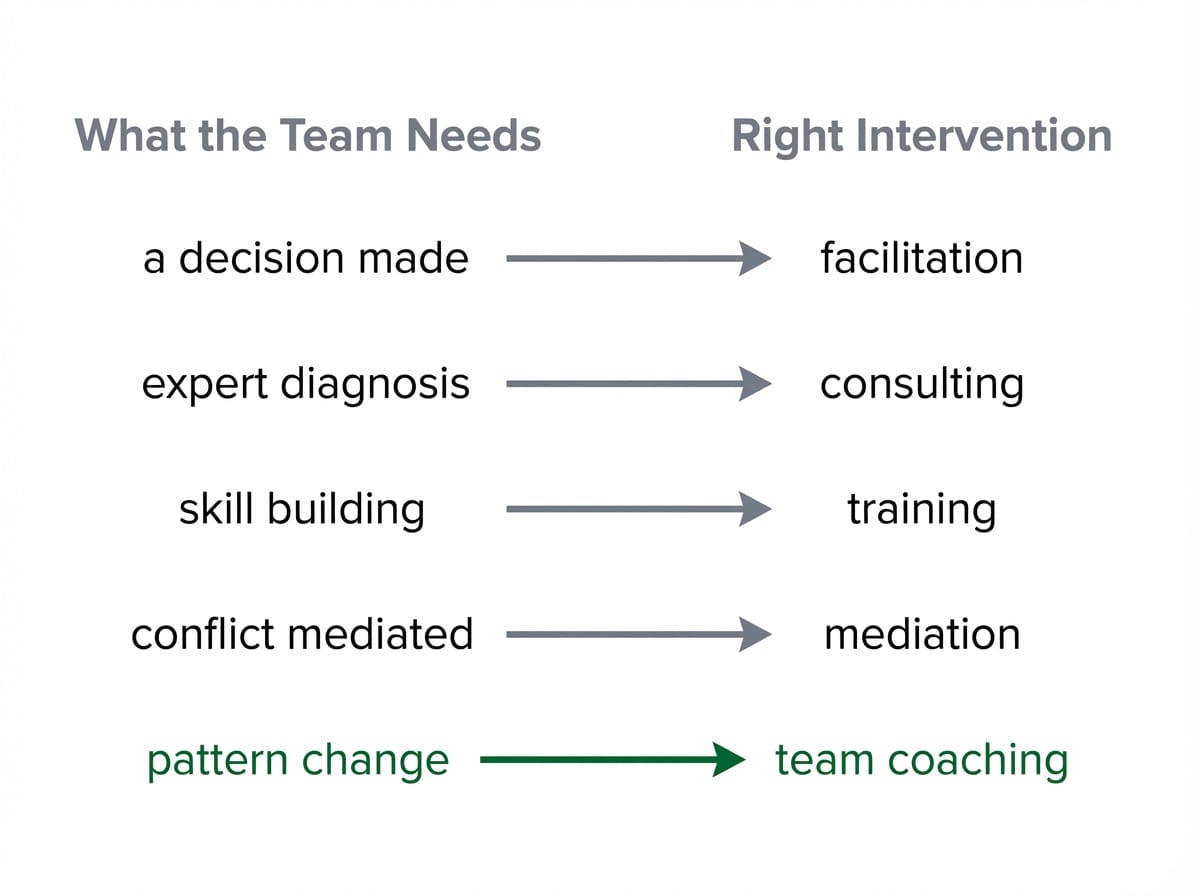
The distinction matters for practical reasons. A software delivery team that keeps missing deadlines because of unclear requirements doesn’t need a coaching process to explore their feelings about deadlines. They need a consultant to analyze the handoff process and recommend a structural fix. An executive team gridlocked on a strategic direction doesn’t need six sessions of self-discovery. They need a skilled facilitator to structure the decision and the authority figure to commit.
Understanding the difference between coaching and consulting isn’t academic. It’s the difference between investing in the right solution and spending three months on the wrong one. When leadership team coaching engagements reveal that the real need is a strategic decision or an expert diagnosis, recommending the right tool is the professional response.
None of these alternatives are lesser interventions. Facilitation, consulting, training, and conflict resolution each serve a specific function that coaching is not designed to fill. The question for organizational buyers isn’t “should we invest in team coaching?” It’s “what does our team actually need right now?” A coaching provider who helps you answer that question honestly, even when the answer points away from their own service, is the one you can trust with the recommendation.
A coaching provider who helps you answer that question honestly, even when the answer points away from their own service, is the one you can trust.
Three Conditions Team Coaching Requires
When the right conditions exist, team coaching produces measurable changes in how teams communicate, make decisions, and deliver results together. Three conditions must be present for coaching to work.
- Shared purpose. The group is an intact team with interdependent work and a common goal, not a collection of individuals who happen to report to the same manager. If team members don’t need each other to succeed, there’s no team dynamic to coach. The coach works with the team as a single entity, and that entity needs to exist before coaching begins.
- Willingness to be challenged. The team itself, not just the sponsor who hired the coach, is open to examining how it works. This means accepting that current patterns, communication habits, and decision-making processes may be part of the problem. Willingness doesn’t require enthusiasm. It requires honesty and a genuine interest in change.
- A supportive organizational environment. The system surrounding the team doesn’t punish the changes coaching produces. Leadership actively supports the coaching process rather than contradicting it. Incentive structures allow team-level collaboration to coexist with individual accountability. The organization creates space for the team to experiment with new approaches without penalizing the learning curve.
When all three conditions exist, the team coaching approach works because the team has something worth coaching toward, the willingness to examine its own dynamics, and an environment that won’t undermine the outcomes. Teams with these conditions in place consistently develop stronger communication, clearer decision-making processes, and more effective ways of navigating conflict.
The common failure patterns in team coaching trace back to one or more of these conditions being absent. When any one condition is absent, the engagement is compromised. Not because coaching failed, but because the conditions weren’t right for coaching to work. A team with shared purpose and willingness but a hostile organizational environment will produce insights it cannot act on. A team in a supportive environment but without willingness will go through the motions. A group without shared purpose isn’t a team yet, and coaching a team that doesn’t exist produces nothing.
If you recognize all three conditions in your organization, explore whether team coaching fits your specific situation. The evaluation itself takes less time than a failed engagement, and the clarity it provides is worth the conversation regardless of the outcome.
Knowing when not to use team coaching is itself a coaching competency.
For organizational leaders evaluating team coaching: the provider who names these limitations before the engagement is the one making a recommendation in your interest, not theirs. That honesty is a stronger trust signal than any testimonial or case study. If your team’s challenges match the patterns described in the first three sections, address those conditions first. If they don’t, you can invest in coaching with the confidence that the conditions for success are in place.
For practitioners evaluating whether to accept an engagement: recognizing when coaching isn’t the right tool prevents the most damaging failure mode in our profession — a coaching engagement that makes the team feel like they failed when the system was the problem all along. The willingness to say “this isn’t a coaching problem” is what separates a skilled practitioner from a vendor selling hours.
Not Sure If Team Coaching Fits?
The evaluation conversation itself is worth having. Talk through your team’s situation with an MCC-credentialed coach who will tell you honestly whether coaching is the right intervention.
Book a Free Evaluation Call →