

Why Letting Go Feels Like Losing Control
Delegation feels like handing your reputation to someone who doesn’t care about it as much as you do.
Because for your entire career, your name on the work was the guarantee. The model with your initials on it was the one that was right. The architecture you designed was the one that scaled. The brief you drafted was the one that held up in court. Now you’re supposed to hand that to someone else and trust that it’ll be good enough. Not as good as yours. Just good enough.
And every cell in your body is screaming that “good enough” is how careers end.
You’ve read the delegation books. You’ve taken the course. You’ve probably built a delegation matrix at some point and pinned it above your desk where it mocked you quietly for three weeks before you buried it under a stack of the work you pulled back. The problem was never that you didn’t understand delegation. The problem is that nobody told you what delegation actually costs, or why that cost is specific to the career that got you here.
Key Takeaways
- Delegation is not a skill problem. It is a grief problem. You are mourning the loss of the thing that made you feel competent, and the grief is specific to what your career rewarded you for.
- What delegation costs a technology leader (craft) is fundamentally different from what it costs a finance leader (certainty), an operations leader (reliability), or a legal leader (protection). Same challenge, different loss.
- The “competence trap,” pulling work back because it makes you feel capable again, is not weakness. It is your career doing exactly what it trained you to do: seek the signal it taught you to read.
- A coach who understands the patterns your career installed approaches delegation differently from one who hands you a framework. The question is not “what can you hand off?” It is “what happens in your body when your team makes a decision you wouldn’t have made?”
What Delegation Actually Costs You
Every piece of delegation advice in the market treats it as a skill gap. Learn the framework. Build the matrix. Trust your team. Let go of control.
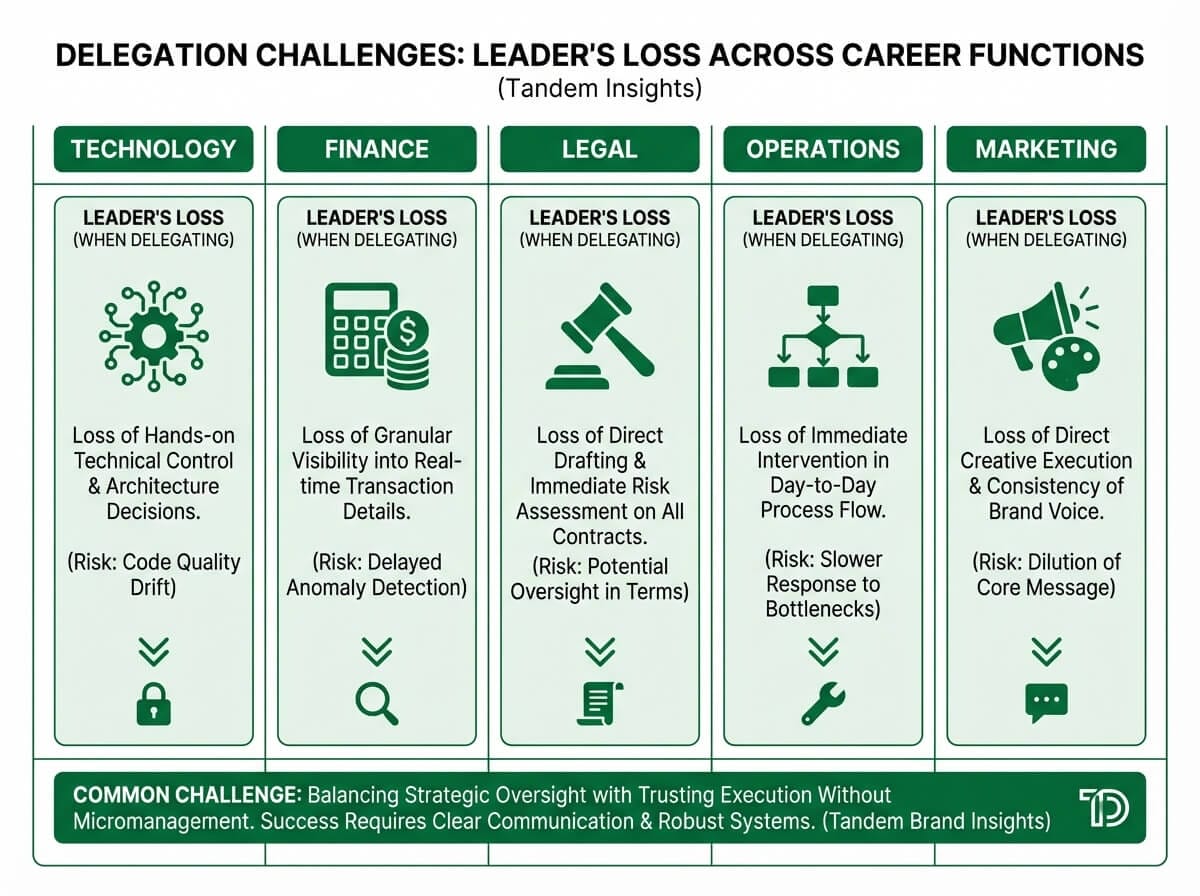
None of it explains why delegation feels fundamentally different depending on where you came from. Letting go of the code is not the same experience as letting go of the numbers. Letting go of the risk memo is not the same experience as letting go of the process. Each costs something specific. And that specificity is the key to understanding why you keep pulling the work back despite knowing better.
| Function | What You’re Letting Go Of | Why It Hurts | What Replaces It |
|---|---|---|---|
| Technology | The code, the build, the elegant solution | Identity is fused with what you ship | Architecting how others build |
| Finance | Certainty, precision, the right answer | Accuracy is how you earn trust | Trusting others’ analysis, adding judgment on top |
| Legal | Control over risk assessment | Your job was preventing harm | Setting the framework others use to assess risk |
| Operations | Reliability, the system working | Success was invisible excellence | Designing systems others operate |
| Marketing | The creative, the campaign, the narrative | Your portfolio is your identity | Curating and directing creative vision |
If you came up through technology, what you’re losing is craft. You’re watching someone use your tools wrong. Not catastrophically. Just differently. They made an architecture decision you wouldn’t have made. Not wrong, exactly. But your hands itch to refactor it. You review the pull request at 11pm, telling yourself you’re “supporting the team,” and by midnight you’ve rewritten two architecture docs and quietly fixed a performance issue nobody else noticed. Building isn’t just what you do. It’s who you are. “I am what I’ve shipped” is the sentence running underneath every career decision you’ve made. Delegating the build feels like delegating your identity. And the thing that makes it particularly cruel: technical execution gave you clean, immediate feedback. It works or it doesn’t. Ship or don’t ship. The new work, developing others, influencing the roadmap, building through people, gives you slow, uncertain feedback about things you can’t directly control. You keep going back to the code because the code tells you, clearly and immediately, that you’re still good at something.
If you came up through finance, what you’re losing is certainty. You can build a more rigorous model than anyone on your team. You know it. They know it. When you delegate the analysis, you’re not just handing off a task. You’re giving up the specific, verifiable feeling of knowing the numbers are right because you personally checked them. Your career taught you that accuracy is how you earn standing. The forecast that was right. The variance that was caught. The exposure that was identified before it became a problem. Delegation asks you to trust someone else’s precision when precision is the foundation of how you’ve been valued for fifteen years. And the model that comes back from your team isn’t wrong, but it’s not right the way yours would have been right. There’s a gap between “directionally accurate” and “bulletproof,” and your body lives in that gap like it’s a wound.
If you came up through operations, what you’re losing is reliability. If you don’t check the process yourself, something might break. And when things break in operations, it’s loud and public. Nobody sends an email congratulating the COO for a quarter where nothing went wrong. But the quarter where the supply chain fails? That’s the one that gets a postmortem with your name on it. Your career trained you to succeed by making things run, and it also trained you to catalog, with photographic precision, every way a system can fail when nobody’s watching. Delegation means trusting that the system holds without your hands on the controls. Your formation knows exactly how naive that trust is.
If you came up through legal, what you’re losing is protection. Every risk memo you didn’t write personally is a risk memo that might miss something. Not because your team is careless. Because your career trained you to find the problem before it finds the organization. Thoroughness isn’t a skill for you. It’s a professional obligation fused with identity. Delegation means trusting that someone else’s analysis is thorough enough when you’ve built a career on being the person whose thoroughness was never in question. The thing you’re delegating isn’t a task. It’s the gatekeeper function that defines your value. And if something gets through that you would have caught? That doesn’t feel like a delegation learning moment. It feels like professional negligence.
This is not a list of “delegation challenges by role.” It’s a pattern. The reason you can’t delegate has nothing to do with your delegation skills. It has everything to do with what your career taught you to value, and the grief of releasing that.
The Grief Nobody Talks About
Delegation is not a skill problem. It’s a grief problem.
Ready to Name What You’re Actually Protecting?
If that grief felt familiar, a first conversation can start exactly there. Not with frameworks. Not with delegation matrices. With what your career trained you to hold onto—and what it costs to hold on.
You are mourning the loss of the thing that made you feel competent. The clarity of personally verified work. The immediate feedback of “it works” or “the numbers tie.” The specific satisfaction of a brief that holds or a process that runs clean. Delegation replaces all of that with something slower, less clear, and less personally rewarding. You’re trading the thing you’re excellent at for something you can’t yet measure yourself by.
You’re not struggling with control. You’re grieving certainty.
And here’s where the grief gets reinforced. You keep pulling work back because the moment you do, you feel competent again. The model you built personally: right. The code you reviewed line-by-line: clean. The risk memo you drafted yourself: complete. Each time you take the work back, you get a hit of the old currency, the familiar feeling of being the person who does the thing well. And each time, you make delegation harder the next time. It’s not weakness. It’s your career doing exactly what it was designed to do: seek the signal it was trained to read.
The body keeps score of your career. The tightness in your chest when your direct report presents a model you would have built differently. The restlessness in your hands when you watch a junior engineer make an architecture choice that offends your sense of craft. The low hum of anxiety on the days you don’t check the system yourself. Those aren’t personality flaws. They’re physical evidence of an identity that earned you every promotion you’ve received. And that identity does not want to die quietly.
The people above you figured this out, mostly. Years of trial and error, and they can’t quite articulate what shifted because the pattern is invisible to the person inside it. They’ll tell you “just trust your team” the way someone who learned to swim at four tells you “just relax in the water.” The advice is technically correct and practically useless because it doesn’t address what’s actually happening underneath: an identity shift that feels like losing the only evidence that you belong in the room.
The Signals You’re Missing While You’re Doing Their Work
While you’re personally building the model, reviewing the code, drafting the memo, checking the process, you’re missing the signals that your level demands you read.
The visibility cost. Every hour you spend on work your team should do is an hour you’re invisible to the people who determine your next move. Your cross-functional peers don’t see you when you’re heads-down in a spreadsheet at 11pm. Your boss doesn’t see you when you’re reviewing pull requests instead of attending the leadership offsite. You’re spending old currency in a room that trades in a new one. And nobody is buying what you’re selling.
The development cost. Your team isn’t growing because you keep intercepting the work. The leads you promoted need to make decisions you wouldn’t have made, and learn from the outcome. Every time you override them, you spend your technical credibility (or your precision credibility, or your thoroughness credibility) while depleting the trust your team needs to develop judgment. You’re protecting the work and stunting the people.
The signal you’re not reading. Your career attuned you to one feedback channel: the quality of the output. Was the model right? Did the code ship clean? Did the system hold? But at your level, there’s a channel you’re not tuned to: do people seek your strategic perspective, or have they learned to route around you because you’re always in the weeds? That question has an answer. You may not want to hear it. But it is the signal your level requires you to read, and you cannot read it while you are doing the work that trained you to read a different one.
The thing that made you credible is the thing making you invisible.
What Changes When Your Coach Gets This
A generic coach hears “I can’t delegate” and provides a delegation matrix: urgent/important, what to keep, what to hand off, how to follow up. You nod, take the framework, and revert to old behavior within a week. Not because the framework was wrong. Because the framework was operating at the wrong level.
See How Tandem Coaches Differently
Our approach starts with understanding what your career installed and what delegation actually threatens. Not generic delegation skills training. The grief underneath it—and what becomes possible when you can finally name it.
Consider a technology VP who brings this same challenge to a coach who understands what a career in engineering actually does to a person. The coach doesn’t start with a delegation matrix. They ask: “When you watch your team make an architecture decision you wouldn’t have made, what happens in your body?”
Not: “How do you feel about delegating?” The body question bypasses the intellectual justification (“I just have high standards”) and surfaces the actual experience: the tightness, the reflex to intervene, the physical discomfort of watching someone build the thing differently than you would build it. Then the coach names what’s happening: “That’s the builder in you. Technical execution gives you clean, immediate feedback. Delegation gives you slow, uncertain feedback about someone else’s judgment. You’re not struggling with control. You’re grieving certainty.”
That naming changes the conversation. The VP stops trying to execute a delegation framework and starts exploring what it would mean to find a new source of competence, one calibrated to the level they’re actually at. Not “stop building” but “what would it look like to be the architect of how others build?”
Or consider a finance director who keeps rebuilding her team’s models because they miss things. A generic coach suggests better quality-control processes. A coach who understands what a career in finance installs hears the same thing and recognizes the pattern: “You can build a more rigorous model than anyone on your team. That precision has defined your value for your entire career. What would it mean if the most valuable thing you could offer wasn’t the model itself but your judgment about what the model implies?”
The reframe is not about letting go of quality. It’s about expanding what counts as quality at the new level. The model is still important. But your judgment about its implications, where to invest, what the risk exposure actually means, which scenario the board should be paying attention to, is worth more than the model itself. And you cannot offer that judgment while you’re still building the model.
Next time you catch yourself reviewing work your team already finished, notice what happens in your body. The tightness, the itch to fix it, the relief when you take it back. That physical response is not weakness. It is your formation reasserting itself. Naming it is the first step toward choosing differently.
The difference between those two coaching approaches is not about technique. It is about whether the coach understands what your career installed and what it costs to release. One approach gives you a tool. The other helps you see why you keep putting the tool down.
The patterns in this article connect to several related dynamics across careers and levels: when doing it yourself stops being the right currency, the execution strength that becomes a delegation trap, and the doer identity that survives every promotion.
This connects to a related perspective: the tactical side of delegation after understanding the formation.
What You’re Actually Letting Go Of
Delegation isn’t about trusting your team more. It’s about trusting yourself in a role that doesn’t reward what the old role rewarded.
The precision, the building, the thoroughness, the reliability—those aren’t going anywhere. They’re the foundation. The question is whether you can build something new on top of them: a version of your leadership that’s measured by what your team produces, not what you produce personally.
Delegation is not a skill problem. It is a grief problem—and the grief is specific to the career that got you here.
That shift doesn’t happen through a framework. It happens when someone helps you see what letting go actually costs you, and what staying is costing you more.
If that distinction matters to you, if you’ve read the delegation books and done the courses and still feel the pull to take the work back, the next conversation is not about delegation. It’s about the career that made delegation feel like loss. And that conversation goes better with a coach who understands what your specific career built and where it might be holding you in place.
A Conversation That Starts With the Real Cost
A 30-minute call where your coach already understands why letting go feels like losing yourself. No assessment. No intake form. Just a conversation that names what your career trained you to protect.
Book a Free Consultation →