Team Coaching vs. Group Coaching: The Distinction That Matters
Group coaching: twelve marketing directors in a room, each working on their own leadership challenge, learning from each other’s questions. Team coaching: the marketing leadership team in a room, working on their challenge—the one they share, the one that exists in the spaces between them.
Same room. Same profession. Completely different coaching engagements. The distinction matters because choosing the wrong one produces a polite, productive-feeling experience that changes nothing in the organization or for the individual. The right choice changes how people work together or how individuals grow, depending on what the situation actually needs.
The simplest test: who is the client? If the client is the team as a single entity, you need team coaching. If the client is each individual person in the room, you need group coaching. Most of the market blurs this line. This article draws it.
The Core Distinction
Team coaching and group coaching differ in one fundamental way: who the coaching serves. In team coaching, the client is the team itself—the relationships, the shared purpose, the dynamics between people who must do interdependent work. In group coaching, the client is each individual participant, and the group is the learning environment where that individual development happens.
Think of it this way. Team coaching is coaching a marriage. The coach works with the relationship: the patterns, the communication, the things both people avoid saying. Group coaching is coaching twelve people who are all in different marriages, in the same room. Each person works on their own relationship, and the value comes from hearing how others handle similar challenges.
The confusion between them is structural. Many coaching providers offer one modality and call it both names. A coach trained in individual coaching often defaults to working with each person separately, even when seated with an intact team. The sessions feel productive. Everyone participates. But the team’s collective behavior between sessions stays the same, because nobody coached the system between them.
The recognition usually comes when a coach notices their instinct is to have individual conversations with each person in the room. Ask one person a question, get an answer, move to the next. The group is polite. Nothing changes between meetings. The coach has become the pivot point when the whole purpose of team coaching is for the team to develop its own capacity to handle challenges without the coach present.
The client is the team or the relationship that makes those people a team. It is a single entity. It is a multi-person single client.
Many coaches entering team coaching training have this recognition in the first few weeks. They realize that what they had been calling “team coaching” was actually group coaching, coaching individuals in a team setting. The distinction is not a judgment. Both are valuable. But the methodology, the focus, and the impact on the organization are fundamentally different.
Once you see the client identity distinction, you cannot unsee it. A leadership team sharing a P&L and coordinating strategy needs coaching that treats them as one system. A cohort of directors from different business units, each facing their own leadership challenges, needs coaching that treats each person as the client. Different purpose, different approach, different outcomes.
Key Takeaways
- The client identity test decides everything: team coaching serves the team as one entity; group coaching serves each individual.
- In team coaching, the real signal is changed behavior in meetings the coach never attends.
- Group coaching drives individual growth through peer learning across different business contexts.
- Collective performance needs team coaching; individual growth with peer support needs group coaching.
- System coaching holds both—the skill is knowing which modality the moment requires.
What Team Coaching Looks Like
In team coaching, an intact team works on a shared challenge across multiple sessions. The coach observes the system: how members communicate, what the team avoids, where collaboration breaks down between people. Questions go to the team as an entity: “What is this team avoiding right now?” not “Sarah, what do you think?”
The physical shift is the first thing you notice. Early in an engagement, team members orient toward the coach. Eye contact goes to the coach after every statement, as if seeking validation. The energy moves hub-and-spoke. When the coaching starts working, members turn toward each other. Someone responds directly to a colleague without checking with the coach first. The conversation accelerates because it is no longer mediated through one person.
The coach stands outside the circle, not at the center. They step in as needed but are not the focal point. The goal is to help the team develop its own ability to surface conflict, make decisions, and hold each other accountable without the coach present. When team members report changed behavior in meetings the coach never attends, that is the real signal. The team has internalized the coaching, not just performed for the coach.
Duration matters. Team coaching runs months, sometimes a year, with the same team. The team designs its own experiments between sessions: new ways of running meetings, different decision processes, explicit agreements about working together differently. The coach holds the space for those experiments to succeed or fail. Sometimes the team reverts to old patterns. That reversion is not failure. It is learning. The team feels the cost of the old way and recommits to the new one on its own terms.
The performance change shows up in the business, not just in coaching sessions. Strategy meetings become productive. Communication patterns shift. Decisions stop stalling. Collaboration improves because the team has done the work of understanding what gets in its way. These are not individual skills improvements. They are changes in how the team operates as an organizational unit.
What Group Coaching Looks Like
In group coaching, individuals from different teams or organizations come together around a common development theme. Each participant brings their own goals. A marketing VP works on executive presence. An engineering director works on having difficult conversations. A COO works on delegation. The group is the environment, not the client.
The coach works with individuals while the group learns through observation. When one participant describes a challenge, others recognize their own version of it. A finance leader hears how a product leader handled resistance from their board, and something clicks. This cross-pollination of insights across different contexts is where group coaching earns its value. Peer learning does what no single coach-client relationship can: it provides multiple perspectives from people facing similar professional challenges in different settings.
Sessions typically run as a cohort program, six to twelve sessions with the same participants. Then the group disbands and new cohorts form. Each person tracks their own personal growth over the program. The coach facilitates the learning process and ensures each participant gets focused attention, but the group dynamic is a tool for individual development, not the subject of the coaching itself.
The environment creates something no one-on-one coaching can replicate: a room full of people facing similar challenges in different business contexts. A leader struggling with feedback learns not just from the coach but from watching a peer handle the same issue with a completely different approach. That shared learning environment is what makes group coaching effective for professional development at scale.
The support between participants is genuine. People help each other, share resources, and hold each other accountable to individual goals. But when the cohort ends, participants take their skills back to their own teams, their own organizations, their own contexts. The group was the vehicle. Personal and professional development was the destination.
When Each Is the Right Choice
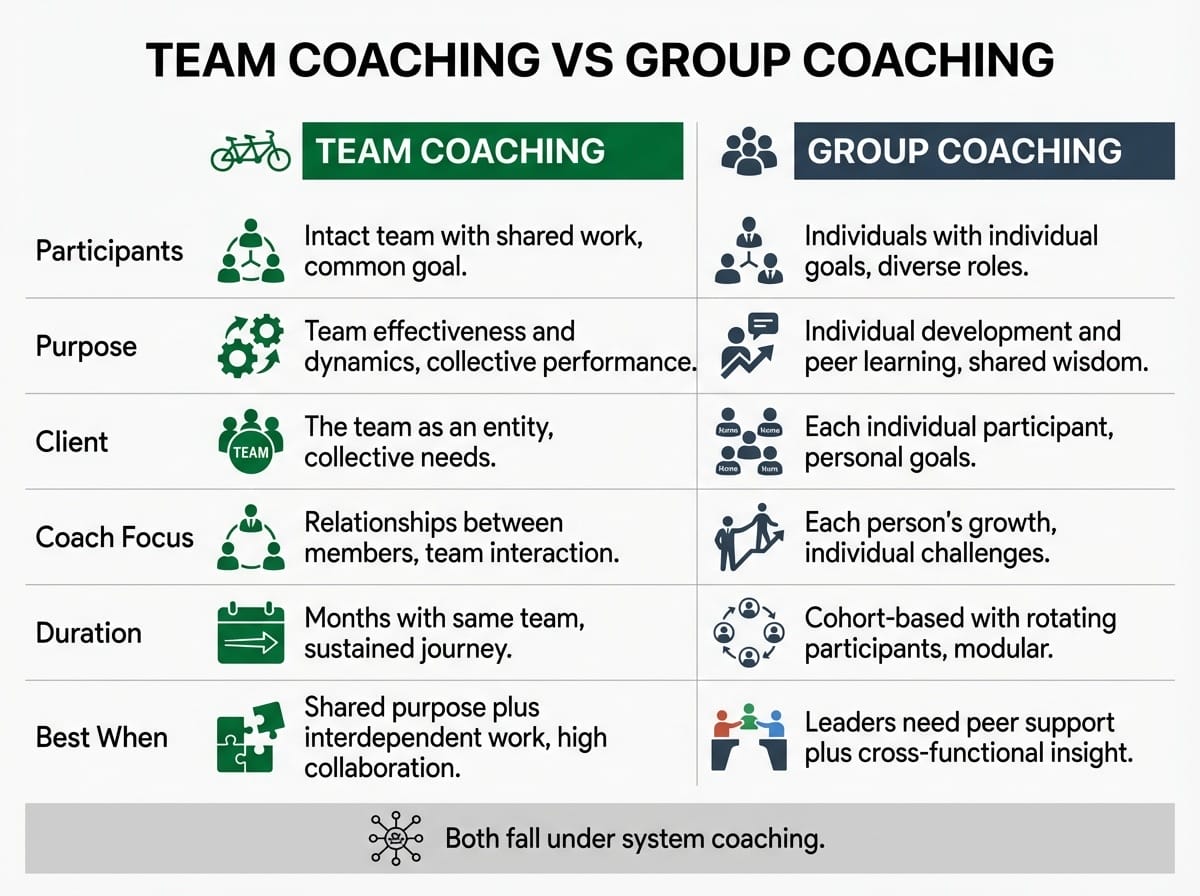
The right modality depends on who needs to change and what kind of change matters. Team coaching fits when an intact team needs to improve how it functions as a unit. Group coaching fits when individuals need development and would benefit from learning alongside peers. Neither is universally better. The table below maps the key differences.
| Factor | Team Coaching | Group Coaching |
|---|---|---|
| Participants | Intact team with shared, interdependent work | Individuals with individual goals |
| Purpose | Team effectiveness and dynamics | Individual development and peer learning |
| Client | The team as an entity | Each individual participant |
| Coach Focus | Relationships between members | Each person’s growth |
| Duration | Months-long engagement with the same team | Cohort-based with rotating participants |
| Best When | Team has a shared purpose and interdependent work | Leaders need peer support and cross-functional insight |
You can develop every leader on the team and still have a team that cannot lead together.
The gray areas are where coaching judgment matters most. A leadership team where each member also has specific individual development needs might benefit from both modalities in sequence. An organization often starts with group coaching for individual leaders and then realizes the leadership team itself still struggles with the same dynamics. The individuals improved, but the system between them did not change. That is when the conversation shifts from “our leaders need development” to “our leadership team needs to work differently together.”
The reverse happens less often but is real. A team coaching engagement surfaces that one member has a development need the team setting cannot address. Executive presence, for example, benefits more from individual attention in a group coaching cohort than from the team focusing on its collective dynamics. The presenting need shifts from “our team” to “this person,” and the coaching modality should shift with it.
Neither modality is better. The impact depends entirely on matching the format to the need. When the need is collective performance, choose team coaching. When the need is individual growth with peer support, choose group coaching. When you are not sure, apply the client test from the table above.
If you are sorting out another common confusion, team coaching versus facilitation, the distinction is different but equally important.
System Coaching: The Frame That Holds Both
System coaching recognizes that every coaching engagement involves a system. An intact team is one type of system. A peer cohort is another. A pair of business partners is a third. The ICF team coaching competencies apply across these system types because the core skills transfer: reading dynamics, evoking collective awareness, holding space for the system to do its own work.
Stay in the Loop
Coaching insights and strategies delivered periodically to your inbox.
This is why Tandem’s ACTC program covers system coaching rather than treating team coaching and group coaching as separate disciplines. Real-world coaching does not respect the textbook boundary. A coach working with a department of forty people needs to know when to coach the leadership team as an entity, when to coach managers as individuals in a group setting, and when to change between those modes mid-engagement. Sometimes both happen in the same engagement. The judgment to recognize which modality serves the moment, and to shift between them, is what separates a credentialed coach from someone running group exercises.
For practitioners already coaching groups inside your organization, the system coaching frame provides structure for what you may already be doing intuitively. It helps you name what you are doing, choose the right approach for each engagement, and develop the skills to move between modalities as the situation demands. Tandem’s ACTC program builds this into a recognized credential pathway.
Ask yourself before every engagement: is the client the relationship between these people, or each person individually? The answer determines your methodology, your questions, and what success looks like.
Both are valuable. Both require coaching skill. The question is whether you are coaching individuals who share a room or a system that shares a purpose.
ACTC Team Coaching — $2,499
ICF-accredited team coaching certification. Learn to facilitate team dynamics, group coaching, and organizational development.
See ACTC Details →