Team Coaching vs Facilitation: The Distinction That Changes Your Practice
The facilitator runs the meeting. The team coach helps the team learn to run its own meetings.
Team coaching develops the team’s capacity to function without external support. Facilitation produces a specific outcome within a specific session. One builds capability over time; the other delivers a result right now. Both are valuable. The difference is not about skill level or hierarchy. It is about orientation: process versus development.
That distinction matters if you are an agile coach, a Scrum Master, or an experienced facilitator wondering whether what you do in team sessions qualifies as team coaching. For many practitioners, the answer is more uncomfortable than expected.
Key Takeaways
- Facilitation produces a session deliverable; team coaching develops the team’s capacity to produce its own results without external support.
- The dependency trap is invisible—when every facilitated session feels productive, nobody notices the team still can’t hold a difficult conversation without the facilitator in the room.
- Team coaching treats the team as a single client. The coach works from outside the circle so the team talks to each other, not through the coach.
- Two self-assessment questions reveal the truth: Who is the team looking at during the session? When you leave the room, does the conversation continue or stop?
The Core Distinction
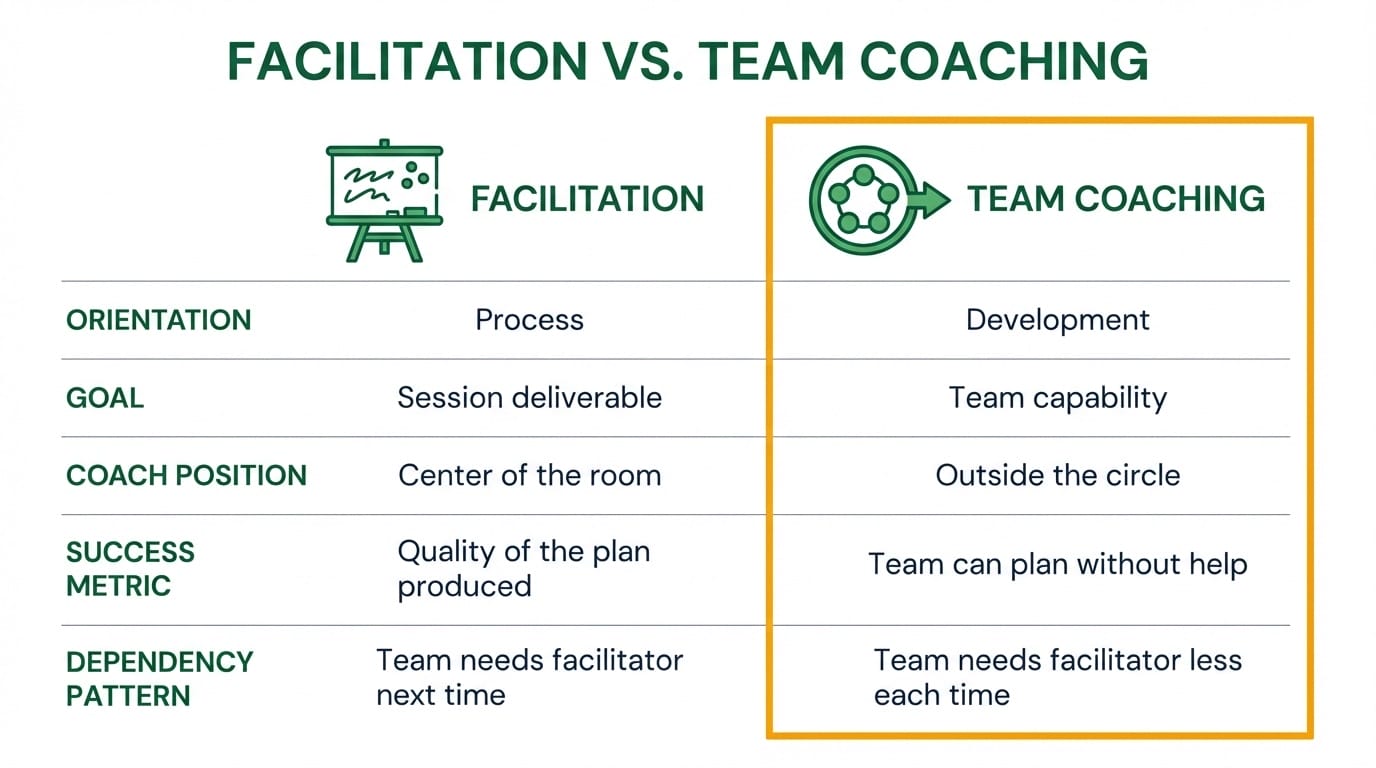
Facilitation is process-oriented: it manages agenda, time, and participation to produce a session deliverable. Team coaching is development-oriented: it builds the team’s ability to manage its own process without relying on someone else to structure the conversation. The ICF competency framework formalizes this difference.
A facilitator holds the role of process expert. They design the meeting structure, keep the group on track, balance voices, and drive toward a decision or plan. When the session ends, the team has its deliverable: a prioritized backlog, a conflict resolution, a strategic direction. The facilitator’s work is done.
A team coach holds a fundamentally different role. The coach works with the coaching discipline to help the team examine its own patterns, not just complete its current task. The goal is not a better meeting but a better team. Coaching asks whether the team can achieve what it needs to achieve without someone else designing the conversation for them.
This is not a spectrum with facilitation on one end and coaching on the other. They are different orientations applied to the same room. A facilitator designs a process that produces a result. A coach develops the team’s capacity to design its own processes and produce its own results. Both require skill. Both serve legitimate needs. But they aim at different outcomes, and confusing them leads to work that looks like coaching but produces only facilitation results.
The difference shows up in the question each practitioner asks before walking into the room. The facilitator asks: What does this team need to produce today? The coach asks: What does this team need to learn about itself?
What Facilitation Does Well
Facilitation shines when a team needs a specific outcome from a specific session. A skilled facilitator brings techniques that help groups make decisions, resolve disagreements, and produce work products they could not have produced on their own in unstructured conversation.
Consider the contexts where facilitation is the right tool. Sprint retrospectives that need to surface patterns in delivery. PI planning sessions where 80 people must coordinate across teams. Design sprints that compress weeks of exploration into five days. Strategic offsites where the executive group must walk out with a prioritized plan. In each case, the facilitator’s skills are exactly what the situation demands: structure, time management, participation balance, and the ability to drive a group toward a concrete deliverable.
Facilitation also works well for specific challenges that benefit from external process support. Conflict mediation that needs a neutral third party. Decision-making sessions where the team is stuck. Workshops that require collaboration across members who do not usually work together. These are high-value applications of facilitation skills, and experienced facilitators do them well.
None of this is small. Organizations that invest in effective facilitation get real results from their meetings, their planning sessions, and their workshops. The goals facilitation sets out to achieve are legitimate and worth achieving.
Where Facilitation Falls Short
Facilitation reaches its limit when the team becomes dependent on the facilitator to have productive conversations. When the facilitator leaves the room and the team reverts to its default patterns, the facilitation worked for the session but did not change the team.
A pattern shows up often in agile environments. A team has run 50 retrospectives with a facilitator. The action items are solid. The process is smooth. But the team still cannot have a difficult conversation without the facilitator present. When someone needs to name an interpersonal conflict or challenge a senior member’s decision, they wait for the next facilitated session rather than addressing it directly.
This is not a failure of facilitation. The facilitator did exactly what facilitation does: managed the process and produced outcomes. The problem is that facilitation addresses the presenting issue each time without developing the team’s capacity to address issues on its own. The retrospective surfaces action items but not behavioral change. The meeting produces a plan but not the learning that would make the next meeting unnecessary.
The dependency trap is subtle because the sessions keep working. Progress keeps happening. But the team’s development plateaus. Without the facilitator, the quality of conversation drops. Members avoid the topics that matter most. The team that needed a facilitator for its first retrospective still needs one for its fiftieth.
The dependency is also invisible to the team. They experience each facilitated session as productive. They do not notice what they are not doing between sessions: they are not initiating the hard conversations, not challenging assumptions without a structured prompt, not building the muscle of self-directed dialogue. The absence of development looks like stability.
When every facilitated session feels productive, nobody notices what the team isn’t doing between sessions. The absence of development looks like stability.
This is the gap that how coaching actually works fills. Coaching does not replace facilitation. It addresses the underlying dynamic that facilitation, by design, leaves untouched.
What Team Coaching Adds
Team coaching works with the team as a single entity. The client is not each individual team member but the relationship between them. The system that makes those people a team is the client. This is the paradigm shift that separates coaching from facilitation at a structural level.
In practice, the shift is observable. A facilitator stands at the center of the room. The group looks at the facilitator, responds to the facilitator’s questions, and routes their contributions through the facilitator’s process. A team coach operates from outside the circle. The goal is for team members to talk to each other, not to the coach. The coach steps in only as needed, but they are not the pivot point.
You can see the difference in what happens between sessions. After facilitation, the team has a deliverable: a plan, a set of decisions, a prioritized backlog. After coaching, the team has new capability. They can hold a difficult conversation that previously required external support. They can notice their own patterns mid-meeting rather than needing someone else to point them out. The collaboration improves not because someone structured it well but because the team learned to structure it themselves.
Development happens in the space between sessions. The team tries new approaches, observes their own dynamics, and returns with insights the coach did not predict or prescribe. Performance changes because the team changes, not because the meeting format changed.
The coach’s experience of this work is different from the facilitator’s experience too. A facilitator who runs a great workshop walks out energized by what the group accomplished. A coach who watches a team hold its first honest conversation without external support walks out knowing the team just crossed a threshold. That crossing is not something the coach produced. The team produced it. The coach held the space where it became possible.
For practitioners making this transition, the path from facilitation to coaching requires more than learning new techniques. It requires changing where you stand, literally and metaphorically. You move from the center to the outside of the circle and allow the team to do the work you previously did for them.
When the Lines Blur
Team coaches sometimes facilitate, and facilitators sometimes coach. A team coach might shift into facilitation mode for a scheduling decision. A facilitator might ask a coaching question when the group is stuck in a recurring dynamic. The question is not whether you ever cross the line but which side of it you live on.
An agile coach who facilitates 90% of their time and coaches 10% is a facilitator who occasionally coaches. They are not a team coach. Calling the role “team coaching” because 10% of the work involves coaching questions does not change the orientation of the other 90%.
The question is not whether you ever cross the line between facilitating and coaching. It’s which side of it you live on.
This is where the ICF competency framework becomes useful as more than a credentialing tool. It provides an objective dividing line. The competencies describe specific coaching behaviors: establishing and maintaining agreements with the team (not for the team), evoking awareness of team patterns (not solving team problems), and supporting the team in designing its own actions (not facilitating action-planning sessions). A practitioner who reads those competencies and recognizes their daily practice is likely coaching. A practitioner who reads them and thinks “I do some of that sometimes” is likely facilitating with coaching moments.
Two self-assessment questions cut through the ambiguity. First: who is the team looking at during the session? If they are looking at you, you are facilitating. If they are talking to each other, you may be coaching. Second: when you leave the room, does the conversation continue or stop? If it stops, the team still depends on you for the quality of its dialogue. That is facilitation, regardless of what you call it.
The distinction between team and group coaching is another key distinction worth examining if these boundaries interest you.
Closing the Gap
If you are an agile coach or Scrum Master reading this and recognizing that your practice sits on the facilitation side of the line, that recognition is not a criticism. It is a starting point, and it puts you ahead of practitioners who have never examined the distinction at all.
You already have skills that transfer directly: reading team dynamics, naming what is happening in the room, designing structured conversations, and navigating professional conflict. What you are likely missing is the development orientation—the ICF coaching competencies that shift your role from process expert to the person who helps the team become its own process expert. The team-as-entity paradigm and the discipline of staying outside the circle do not come naturally to practitioners trained to lead from the front.
The hardest part of the transition is not learning new skills. It is unlearning the instinct to be the center of the conversation. Agile coaches and Scrum Masters are trained to lead sessions, drive outcomes, and ensure the group reaches its goal. Team coaching requires releasing that control and trusting the team to find its own way through. That shift in orientation is what professional training addresses.
The PCC+ACTC pathway bridges facilitation and coaching without asking you to abandon what you already do well. It adds a coaching framework on top of your existing skills. AND, not OR.
The question that matters is not whether you are a facilitator or a coach right now. It is whether the teams you work with can have a difficult conversation without you in the room. If the answer is no, you know where the development edge is.
Ready to Move From the Center to the Outside of the Circle?
Tandem’s ICF-accredited programs help agile coaches and facilitators build the development orientation this article describes. Training, mentoring, and supervision included.
View Programs & Pricing →