Team Coaching from the Inside: A Guide for Internal Coaches
The external coach arrives, coaches, and leaves. They have structural distance from the team’s daily friction, the political undercurrents, the decisions that keep people up at night. They can observe the system from outside because they are not part of it.
You don’t have that luxury.
You sit at the same table as the team you coach. You argued about a technical decision with one of them yesterday. You know the reorganization is coming because you were in the leadership meeting. And in 20 minutes, you’re walking into a coaching session with these same people.
This is not a limitation to work around. It is a fundamentally different coaching context, one that requires strategies most team coaching models never address.
Key Takeaways
- Internal team coaching isn’t a lesser version of external coaching — it’s a different discipline that demands strategies most coaching models don’t address.
- The challenge isn’t proximity to the team; it’s entanglement — individual relationships, organizational knowledge, and personal stakes that don’t disappear when you put on your coaching hat.
- Verbal contracting at every session isn’t rigidity for its own sake. Rigidity at the boundary creates freedom inside the coaching space.
- When the organizational system contradicts the coaching goals, naming it to the sponsor often matters more than the sessions with the team.
- The internal coach’s real advantage isn’t access — it’s sustained presence across the full cycle of learning, including the reversion that external coaches never see.
The Internal Coach’s Dilemma
Most team coaching literature assumes the coach is external. The coach enters the organization, builds a coaching relationship, conducts sessions, and eventually exits. The team experiences coaching as a bounded event: something that happens in a room for 90 minutes every other week. The rest of their working life continues without the coach present.
Internal team coaches operate in a completely different reality. You attend the team’s daily standup. You have a stake in the quarterly review. You report to the same VP. You see dysfunction between sessions: the passive-aggressive Slack messages, the hallway conversations after difficult meetings, the way someone’s energy shifts when a particular topic comes up. You carry all of this into the coaching room.
The challenge is not proximity. It is entanglement. In what team coaching involves, the coach treats the team as a single entity, a multi-person single client. The team is the client, not the individuals on it. For the internal coach, this principle creates an immediate tension: you have individual relationships with every member of your client.
You know Maria is frustrated because she told you over coffee. You know James is job-hunting because you saw his LinkedIn activity. You have your own opinions about whether the team’s current project approach will succeed. None of this knowledge goes away when you put on your coaching hat.
This is why internal team coaching resists clean frameworks. The boundaries between coaching and managing, between observing and participating, between knowing and withholding — none of them come pre-drawn. External coaches build the coaching relationship from scratch. Internal coaches must carve it out from an existing web of relationships, politics, and shared history. That requires a different set of strategies, and a level of self-awareness that most coaching training does not prepare you for.
Four Dual-Role Tensions
Every internal coach navigates at least four tensions simultaneously: coach vs. colleague, coach vs. stakeholder, coach vs. political actor, and coach vs. authority figure. Each one pulls you out of coaching mode in a different direction, and recognizing which pull you are feeling at any given moment is the core discipline of internal team coaching.
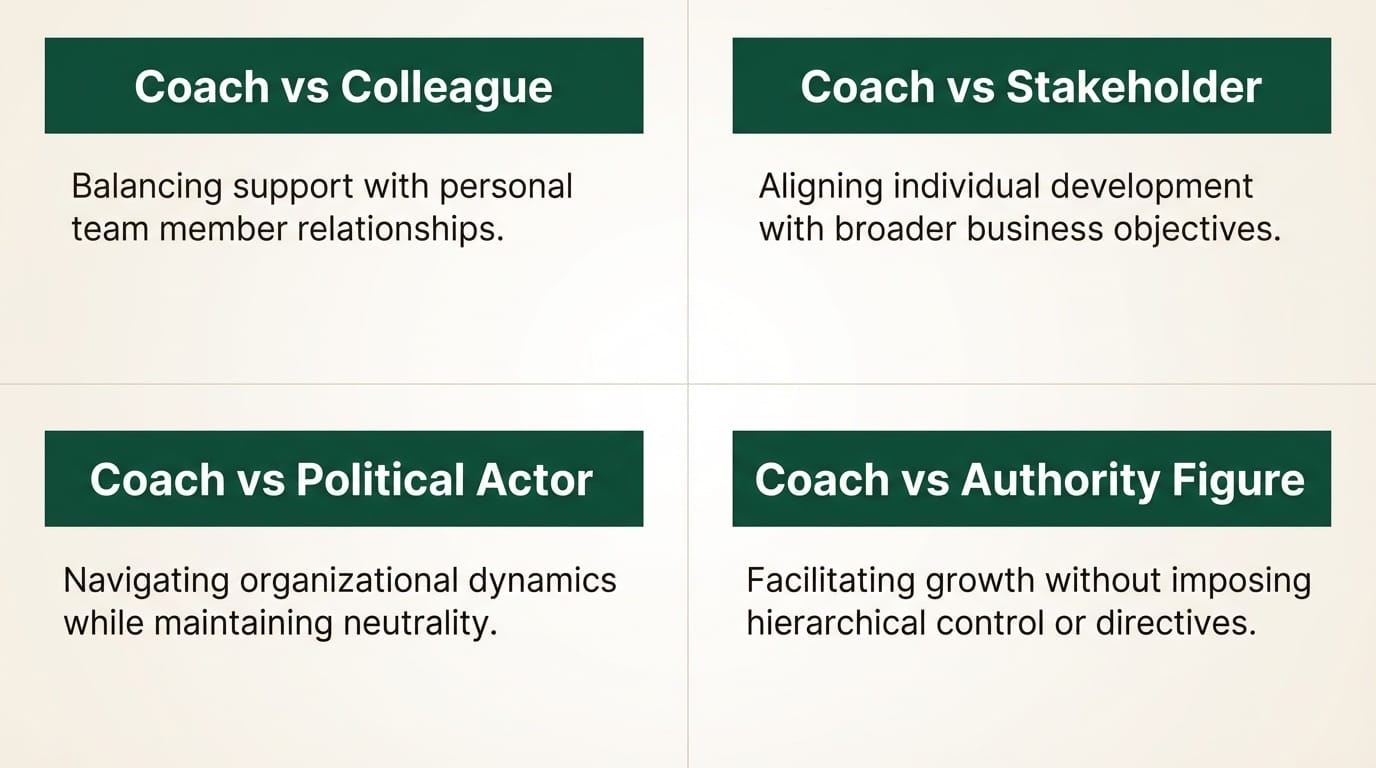
Coach vs. colleague. The person who was pushing back on your technical recommendation yesterday is sitting in your coaching session today. You have opinions about their work because their work affects yours. The temptation is to use the coaching space to advance your perspective. The moment you do, you are no longer coaching. You are advocating.
Coach vs. stakeholder. You have your own needs from this team’s performance. If they miss their deadline, it affects your project. If their quality drops, it creates rework for your team. Coaching requires holding the team’s agenda, not yours. When you are a stakeholder in their outcomes, neutrality requires constant discipline.
Coach vs. political actor. You know things. You know about the upcoming budget cuts, the executive who is unhappy with this team’s output, the reorganization being planned two levels above. External coaches don’t carry this burden. You do, and you cannot unsee it. The question becomes: what do you bring into the coaching space and what do you leave outside?
Coach vs. authority figure. If you hold any positional authority, even informally, the team will filter what they say. They will tell you what they think you want to hear, not what is actually happening. This is the failure pattern internal coaches face most frequently: becoming the focal point that everyone directs their attention toward, rather than stepping outside the circle so the team talks to each other.
Each of these tensions pulls you toward a different role: advocate, stakeholder, informant, authority. The coaching discipline is recognizing which pull you are feeling and choosing not to follow it.
The core skill is maintaining a coaching mindset under organizational pressure. Not just in the session, but in the 23 hours between sessions when you are living inside the system you are trying to coach.
Setting Boundaries from Inside
Boundaries only work if you name them out loud. The team cannot read your mind about which hat you are wearing. If you rely on a mental switch, telling yourself “now I’m in coaching mode,” the team will not notice the shift. And neither will you.
Verbal contracting at every session. State it explicitly: “For the next 90 minutes, I am in coaching mode. I will not share my views on the technical direction. I will not weigh in on sprint scope. If you ask what I think, I will redirect the question to the team.” This sounds rigid. It is. Rigidity at the boundary creates freedom inside the coaching space.
Physical and temporal separation. Coaching sessions need a distinctly different container than daily work. A different room if possible. A different meeting format, not a modified standup with coaching bolted on. Protected time that does not get squeezed when a deadline approaches. When the container looks different, people behave differently. Both you and the team.
Transparency about confidentiality. State what you will and will not do with what you hear. The team needs to know that what surfaces in the coaching space stays there, that you will not carry their candid observations into your next one-on-one with their manager. This is harder for internal coaches because the team knows you have access to those channels. Name it.
Boundaries only hold if you enforce them consistently. One moment of sharing your opinion in coaching mode, one slip into colleague behavior during a session, and the team recalibrates. They will test the boundary. Your consistency is the answer.
The methodology behind effective boundary-setting in how to coach a team applies here with one critical adaptation: internal coaches must design the boundary into every interaction, not just the initial contracting conversation. And working with a coaching supervision professional can help you maintain those boundaries when organizational pressures build.
Navigating Organizational Politics
The internal coach knows who is about to be reorganized, whose budget is being cut, which executive is unhappy with the team’s output. External coaches do not carry this knowledge. The question is not whether you will encounter political information. It is what you do with it.
Two principles hold in almost every situation:
Coach what the team brings, not what you know. If the team raises a concern about organizational direction, coach them through it. If you know something they don’t and they haven’t raised it, you do not introduce that information into the coaching space. Your role is to coach what surfaces, not to seed the agenda with insider knowledge.
Organizational decisions go through the sponsor, not the coach. If you know about a decision that will materially affect the team, the right move is not to break confidentiality. It is to go to the sponsor and say: “The team needs to hear about this. You should communicate it, not me.” The sponsor relationship is where organizational politics get managed. The coaching space stays clean.
There is a third scenario that is less obvious but more corrosive: when you carry organizational frustrations into the coaching space without realizing it. You are angry about the budget decision. You disagree with the executive sponsor’s priorities. You watched a team member get passed over for promotion unfairly. These feelings do not vanish because you are in coaching mode. They leak through your questions, your tone, what you choose to explore and what you leave alone. Supervision helps here. Having someone outside the system who can ask you: what are you carrying into this room that belongs somewhere else?
Where this principle breaks down is when the organization itself contradicts the coaching goals. The company says it wants collaboration, but performance reviews are individual. The leadership team talks about empowerment, but every decision still routes through one person. The team is being coached toward outcomes that the organizational system actively undermines.
You see all of this because you are inside the system. You cannot coach it away. You can name it. To the sponsor, to the leadership, to whoever holds the organizational levers. Sometimes the conversation about the environment matters more than the sessions with the team. This is where embedding coaching in the wider organizational system becomes essential.
When Internal Coaching Works Best
Internal coaching is not a consolation prize for organizations that cannot afford an external coach. It is the right choice in specific contexts where proximity creates advantages that no external engagement can replicate: sustained observational access, trust built through shared experience, and a coaching presence that spans months rather than sessions.
ACTC Team Coaching — $2,499
ICF-accredited team coaching certification. Learn to facilitate team dynamics, group coaching, and organizational development.
You see what no external coach can. External coaches see the team for 90 minutes every other week in a structured session. You see them in the daily standup, in the hallway after a difficult meeting, in the way they interact with their manager at the all-hands. That observational data, how the team behaves when nobody is “coaching” them, is something external coaches would pay for.
You build trust faster with skeptical teams. Teams that have been burned by external consultants, assessed, diagnosed, advised, and left unchanged, are skeptical of anyone arriving from outside. The internal coach is going through the same reorganization, the same budget pressures, the same leadership changes. That shared experience builds a kind of trust that external coaching rapport, however skilfully built, cannot fully replicate.
You provide sustained presence. Some learning takes time, more time than a 6-session coaching engagement allows. A team might try a new approach, succeed for months, then revert to old patterns under pressure. An external coach might not be present for that regression. The internal coach is. They can be with the team as it experiences the pain of reverting and makes its own decision to return to what worked. That kind of learning, the conviction that comes from choosing the better path voluntarily, requires a coaching presence that spans months, not sessions.
The best internal coaching happens when an organization is building a coaching culture, not hiring a coaching intervention. Sustained developmental support beats episodic crisis response.
Formalizing Your Practice
Internal coaches often work without the structures that support external coaches: no coaching supervision, no peer network beyond their organization, no external benchmark for their practice. The ACTC credential gives internal coaches three things they typically lack: external validation, a competency framework to develop against, and a community of practice beyond their own organization.
ACTC Team Coaching — $2,499
ICF-accredited team coaching certification. Learn to facilitate team dynamics, group coaching, and organizational development.
External validation that your coaching practice meets a recognized standard, not just your manager’s assessment of whether the team seems happier.
A competency framework to develop against. Instead of intuiting what good team coaching looks like, you have the ICF team coaching competencies as a development map.
A community of practice beyond your organization. Internal coaches are structurally isolated. The ACTC community connects you with coaches who navigate the same tensions in different organizational contexts.
The PCC+ACTC combination is especially valuable if you coach both individuals and teams, which most internal coaches do. Tandem’s ACTC program integrates both credentials into one pathway.
If you are already coaching teams internally without formal training, you are doing harder work than most certified external coaches. You are navigating dual roles, managing confidentiality in a fishbowl, and maintaining neutrality inside a system that is anything but neutral. That work deserves a structured foundation.
The question to sit with: how are you managing the boundary between coaching and everything else right now? If the answer is mostly by instinct, a formalized framework and an external community might be what turns a well-intentioned practice into a sustainable one.
ACTC Team Coaching — $2,499
ICF-accredited team coaching certification. Learn to facilitate team dynamics, group coaching, and organizational development.
See ACTC Program Details →