“Strategic thinking” appears in every senior job posting, every leadership competency model, every 360 assessment. It is the capability that organizations say they value most in their leaders. And yet: ask ten senior leaders to define it precisely and you will get ten different answers.
That vagueness is the problem. Not the capability itself – the way it gets discussed. Strategic thinking has a concrete meaning. It is a distinct cognitive mode from tactical execution. Most leadership advice conflates the two, which makes the skill harder to develop, not easier.
This article provides a working definition of strategic thinking for leaders – one that distinguishes it from strategic planning, from visionary thinking, and from “big-picture” leadership. It maps what builds the capability, what blocks it at a structural level, and what it looks like at different stages of a leadership career. If you have already received this as feedback and want the practitioner-level diagnosis, start there.
Key Takeaways
Strategic thinking is outcome-oriented reasoning – not what you do and how, but why you do it, who benefits, and what the implications are
Three practical components define it: time horizon management, system awareness, and problem framing before problem solving
Formation-level pulls – expert identity, trained time horizon, and information filter – make strategic thinking hard to develop even for capable leaders
Development requires formation-aware approaches, not just behavioral habits like “block time for strategy”
What Strategic Thinking Is (and Isn’t)
The simplest distinction: tactical thinking is about activity. Strategic thinking is about outcomes. Not what you do and how you do it, but why you do it, who benefits from it, and what the implications are. A leader operating tactically asks, “What is the right answer to this problem?” A leader operating strategically asks, “Are we solving the right problem – and for whom?”
Both modes are necessary. They are not the same skill. And the difference between them is not one of scope or seniority – it is a fundamentally different orientation toward the work.
What strategic thinking is not. It is not strategic planning – the process of developing plans, setting goals, and allocating resources. You can run a thorough strategic planning cycle while thinking entirely tactically throughout. It is not visionary thinking – generating ideas about what the future could look like. Visioning is an input to strategy, not strategy itself. And it is not big-picture thinking – the ability to step back from details. Broad perspective is necessary but not sufficient. A leader can see the whole picture and still make every decision reactively.
Three components of strategic thinking in practice:
Time horizon management – operating deliberately at a longer temporal scale than your day-to-day default, making current decisions with 12-18 month consequences held explicitly in mind
System awareness – seeing connections between decisions that appear unrelated from inside any single function, understanding how a call made in finance echoes in product and surfaces in culture
Problem framing – spending time defining which problems actually matter before choosing one to solve, the discipline most often shortcut under operational pressure
What “strategic” looks like in practice varies by function and level. A CFO operating strategically looks different from a CHRO operating strategically – not because the definition changes, but because the domain context shapes how each component manifests. For function-specific grounding, see what strategic means for your function. When the challenge is that a leader keeps solving the wrong problem – right answer, wrong question – the problem framing component is usually what is missing.
Why Strategic Thinking Is the Differentiating Capability at Senior Levels
The nature of the job changes at senior levels in ways that are easy to describe and hard to internalize. The proportion of decisions that are ambiguous, cross-functional, and consequential at long time horizons increases dramatically. Technical and functional expertise – which powered the early and mid-career – becomes a floor, not a ceiling. The differentiating variable becomes the ability to make good judgment calls in conditions of incomplete information, competing priorities, and organizational complexity.
This is where the plateau pattern emerges. Leaders who were exceptional individual contributors and strong functional managers often plateau not because their domain expertise declines, but because their strategic capability did not scale with their role. The same instincts that made them effective at lower levels – speed, precision, operational command – become liabilities when the job requires a fundamentally different mode. It is the strength that got you promoted becoming the constraint on your next chapter.
The organizational cost compounds downward. When senior leaders operate tactically in roles that require strategic thought, the effect cascades. Direct reports fill the strategy vacuum or wait for direction that never comes. Decisions get made at the wrong level. The leader becomes a bottleneck rather than a multiplier – the very pattern leadership development programs are designed to prevent.
The development gap is real. Most formal programs address skill-building at functional or interpersonal levels. Strategic thinking capability – because it is harder to observe, harder to measure, and harder to teach through traditional methods – is chronically underdeveloped. Understanding what executive coaching addresses helps explain why coaching has become the primary development path for this specific capability: it works at the level where the real barriers live.
What Makes Strategic Thinking Hard to Develop
The skills that earned a leader their career – deep functional expertise, speed of execution, precision under pressure, operational command – are the same skills that make strategic thinking hard to access. These are not bad habits to be corrected. They are the trained defaults of a professional formation built over a decade or more. And they do not yield to behavioral interventions because they operate below the level of behavior.
Three formation-level pulls create the difficulty.
The identity pull. Senior leaders do not just have tactical habits – they have tactical identities. The expert self-concept that built the career resists the ambiguity that strategic thinking requires. When a question does not have a clear right answer, when the data is incomplete, when the path forward requires judgment rather than analysis – the default response is to return to what your career has installed: the domain where you are the expert. This is not a character flaw. It is the formation doing exactly what it was designed to do.
The pull shows up most clearly under stress. “I can do it better, faster than you.” It hits so many wrong buttons at once – team disempowerment, failure to recognize that the team has actually surpassed you in execution capability, and the deeper signal that the expert identity is running the show rather than the strategic one.
The time horizon gap. Every functional formation installs a default temporal lens. Technology leaders trained in sprint cycles think in weeks to quarters by default. Finance leaders trained in fiscal years think in quarters to years. Promotion to a role that requires 12-24 month strategic management does not reset that default. The formation’s cadence stays short until it is deliberately worked on. For the full model of how this creates friction, see why strategic vision clashes with instincts.
The information filter. Leaders rewarded for operational excellence develop attentional filters tuned to operational signals. They notice what needs to be fixed, optimized, or resolved. They miss – or actively filter out – the weak signals that matter most at strategic timescales: shifts in competitive landscape, emerging talent patterns, changes in stakeholder sentiment. The filter is invisible to the person using it.
These three pulls do not appear in the competitive literature on strategic thinking. They are the reason generic “think bigger” advice does not stick for experienced leaders. If you have received this as direct feedback, the companion article goes deeper on the mechanism and offers three formation-aware interventions.
How Strategic Thinking Actually Develops
The standard advice – block time for strategy, read more broadly, attend the leadership offsite – addresses context. It changes the information environment or the schedule. It does not touch the formation-level pulls that cause the reversion. Leaders who try these practices find the new behavior holds for a few weeks, then snaps back under pressure. The formation wins.
What actually changes the pattern operates at a different level.
Role-level anchoring. Most leaders have never explicitly named what proportion of their work should be strategic versus tactical at their level. Making this concrete – and tracking the delta week over week – starts the diagnostic. It is harder to stay in tactical mode when you are measuring how much of your time goes there. The formation-aware interventions in the companion article provide the specific audit framework.
Horizon practice. Building a second temporal layer alongside the operational one. Not instead of it – in addition to it. A small set of two or three questions, reviewed weekly, that only become visible at 12-18 month timescales. Where is the industry moving? What capability are we not building? Which relationship will matter in a year that does not seem urgent today? Running two temporal tracks in parallel rather than choosing one.
Problem framing discipline. Before any significant meeting or decision, deliberately spending time on the question behind the question. Not solving the stated problem first. This is a cognitive habit that can be practiced in any setting, starting today.
The coached path is the highest-leverage option for this specific capability – not because the leader lacks ability, but because formation is largely invisible from inside it. A coach who understands how professional formation shapes perception can surface the pull that the leader cannot see. The tactical reversion under pressure, the time horizon snap-back, the information filter that screens out strategic signals – these patterns are easier to name from outside than from within.
The peer path matters too. Mastermind groups, peer advisory networks, and structured peer learning create the cross-functional perspective that organizational silos often prevent. Hearing how leaders in other functions frame the same problem is one of the fastest ways to interrupt the formation’s default pattern. For leaders where the tactical pull shows up most acutely in delegation, see why letting go feels like losing control.
If you are ready to work on this with a coach who understands the formation-level dynamics, executive coaching is designed for exactly this shift.
Strategic Thinking at Different Levels
Strategic thinking is not a single point on a spectrum. It is contextually shaped by level, function, and organizational structure. What counts as strategic for a director is different from what counts as strategic for a CEO – not because the definition changes, but because the scope, stakes, and information environment do.
At the director and VP level, strategic thinking means seeing one to two levels above your current scope. Understanding how your function’s decisions affect adjacent functions. Beginning to manage decisions rather than make them all yourself. The central developmental challenge at this level is the identity shift from expert to generalist – from “I know the answer” to “I frame the question.” When technical credibility stops being enough, the discomfort of that shift is what most leaders feel first.
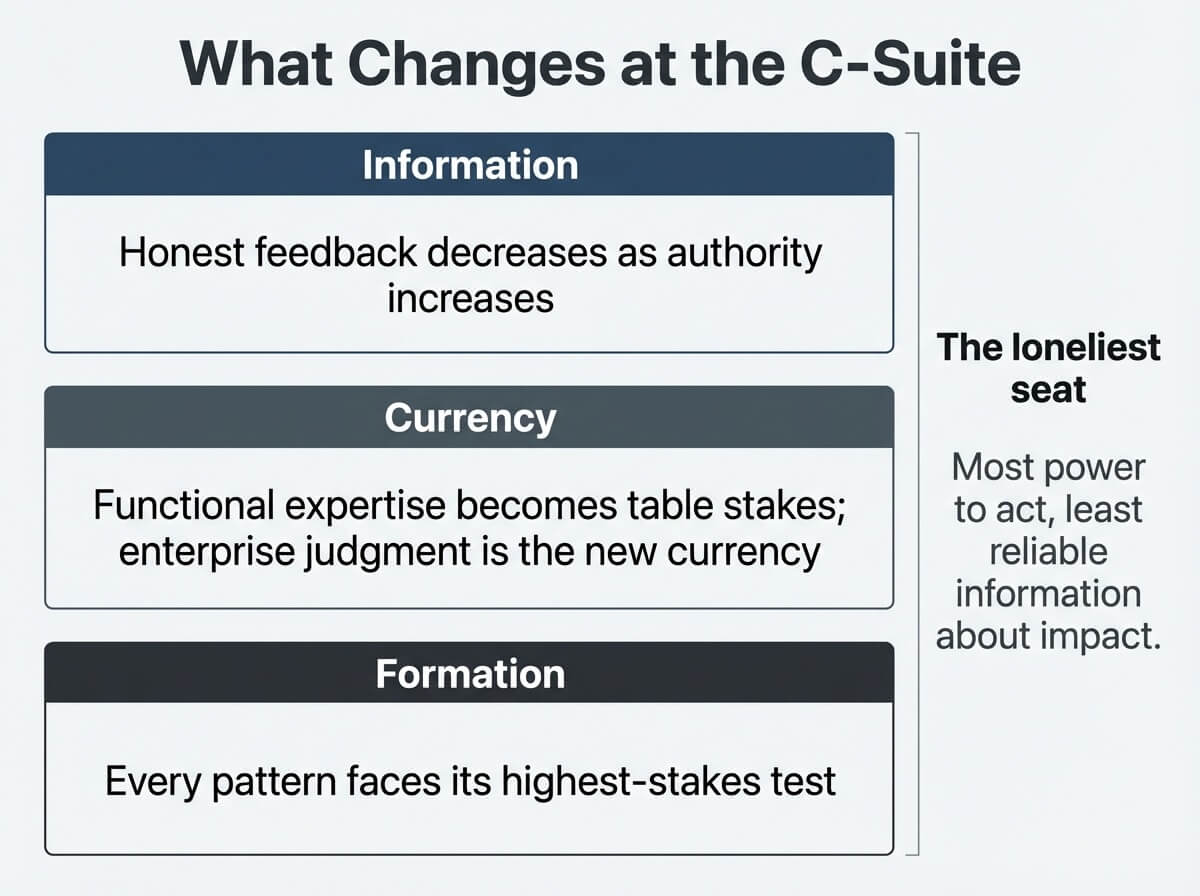
At the C-suite level, strategic thinking means holding the enterprise view simultaneously with functional execution. Seeing trade-offs across the system. Setting organizational context rather than solving organizational problems. The central challenge at this level is not capability – it is isolation. Fewer peers, fewer honest feedback mechanisms, more filtered information. The formation pulls that were manageable at VP level get amplified by structural dynamics that change everything at the top.
Across functions, the default formation of each role creates distinct strategic thinking challenges. The technology leader fights the builder’s instinct – the pull to solve the architecture problem rather than frame the organizational decision. The finance leader fights the precision trap – the pull to run another analysis rather than make the judgment call. The operations leader fights the optimization instinct – the pull to make the current process better rather than question whether to run it at all. Leaders who came from consulting or turnaround backgrounds face a different version: when the fixer becomes the leader, the restlessness of a stable organization can pull them back into problem-solving mode.
The unifying thread across all levels and functions: strategic thinking requires the same three moves – longer time horizon, system awareness, problem framing before solving. The content changes. The structure is constant.
Where to Go Deeper
This article covers the territory. The articles below go deeper on specific dimensions, organized by what you are trying to understand.
If the tactical pull is showing up as an inability to delegate – and you keep taking back work your team can handle – see Why Letting Go Feels Like Losing Control.
What is the difference between strategic thinking and strategic planning?
Strategic planning is a process – setting goals, allocating resources, defining timelines. Strategic thinking is a cognitive mode – reasoning about outcomes, implications, and system-level connections. You can execute an entire strategic planning cycle while thinking tactically throughout. The plan may be sound, but the thinking behind it never left the operational level. Strategic thinking is what makes the plan worth following. It is the judgment behind the process, not the process itself.
Why do experienced leaders struggle with strategic thinking?
The skills that built their careers – domain expertise, speed, precision, operational command – create formation-level pulls that work against strategic thinking. The expert identity resists ambiguity. The trained time horizon defaults to shorter cadences than the role requires. The attentional filter screens out weak strategic signals in favor of operational urgency. These are not character flaws or bad habits. They are the features of a professional formation built over a decade or more of being rewarded for tactical excellence.
Can strategic thinking be developed, or is it innate?
It can be developed – but not through the methods most people try first. Reading broadly, blocking “thinking time,” and attending strategy offsites address the information environment, not the formation-level pulls that cause tactical reversion. What works: role-level anchoring (explicitly tracking the strategic-to-tactical ratio of your work), horizon practice (running a second temporal layer alongside your operational one), and problem framing discipline. Coaching accelerates the development because formation is largely invisible from inside it – an external partner can surface the patterns the leader cannot see.
What does strategic thinking look like for a VP or director?
At the director and VP level, strategic thinking means seeing one to two levels above your current scope – understanding how your function’s decisions affect adjacent functions and beginning to manage decisions rather than make them all yourself. The central challenge is the identity shift from “I know the answer” (domain expert) to “I frame the question” (organizational leader). A VP thinking strategically measures a good week by which strategic questions they clarified, not by what they shipped.
You got the feedback. Maybe it came in a performance review, maybe offhand after a meeting, maybe dressed up in a 360 report with neutral language. “Needs to think more strategically.”
You know it’s true. You also know you’ve tried. You blocked time for strategy. You read more broadly. You started asking bigger questions in meetings. And for a few weeks it worked – or seemed to. Then Monday happened, and the inbox happened, and the deal happened, and by the time you looked up, you were back in the weeds.
The standard advice for strategic thinking treats the problem as behavioral. It assumes you need better habits. For a leader who has spent a decade or more building expertise in a specific domain, the problem is not behavioral. It is structural – built into how your career shaped the way you think.
Key Takeaways
Generic “think bigger” advice targets habits, not the formation-level causes that keep experienced leaders operating tactically
Three structural forces drive tactical reversion: expert identity, trained time horizon, and attentional filter – all installed by years of career success
Formation-aware interventions work with your wiring rather than asking you to override it
When self-directed change keeps reverting under pressure, the pattern is formation-level and benefits from structured support
Why “Think Bigger” Advice Doesn’t Work
“Think more strategically” is one of the most common pieces of leadership feedback – and one of the least useful. More strategic by how much? By 5%? By 100%? Is it a different subject entirely, or more of the same subject at a different altitude? The recommendation, on its own, makes no sense.
The more disturbing thing is that a leader who receives this recommendation does not ask a question. “When you say more strategically – what do you mean? How would you think about this? What would you consider?” That silence might signal something deeper about the organizational culture – where asking for clarification gets perceived as incompetence.
The advice that follows is usually some version of: block time for reflection, read outside your domain, ask bigger questions in meetings. None of it is wrong. But for experienced leaders, it treats the symptom and misses the cause.
Early in a career, behavior change works because professional identity is still forming. You can bolt on new habits without friction. But by the time you’ve spent 15 years being rewarded for deep expertise in a specific domain, the tactical pull has roots that run below the level of habits. Three forces are working against you:
Your expert identity – the part of you that earned every promotion by being the sharpest technical, analytical, or operational mind in the room – actively resists the ambiguity that strategic thinking requires. Your trained time horizon defaults to the cadence your function operates on, not the cadence your role now demands. And your attentional filter routes tactical signals to your conscious awareness first, because that’s what your career trained it to do.
These are not character flaws. They are the features that what your career installed in you. The question is whether those features serve you at the next level.
What Strategic Thinking Actually Requires at Your Level
Tactical thinking asks: what is the right answer to this problem? Strategic thinking asks: is this the right problem? The first is domain expertise. The second is organizational judgment. Both matter. But at the director level and above, the second becomes the job.
One way to see the difference: strategic leaders start with outcomes. Not “starting with why” in the motivational sense – starting with outcomes in the structural sense. When someone else is doing the execution, what impact do you need? What side effects will emerge? What does the organization need to become? How do you think about the risks?
These are questions that did not exist at lower levels. Making sense of the cacophony of new questions, structuring them, and arriving at coherent responses – that is one concrete manifestation of strategic thinking.
Three components distinguish it from tactical execution:
Outcome-orientation. You measure your contribution by the decisions you shape and the conditions you create, not by the tasks you complete. The VP who measures a good week by what they shipped is still operating tactically. The VP who measures a good week by which strategic questions they clarified is making the shift.
System view. You see connections between decisions that look unrelated from inside any single function. A pricing change affects the sales pipeline, which affects hiring plans, which affects the culture initiative. The leader solving the wrong problem is often solving the right problem in their domain while missing how it cascades across the organization.
Input architecture. You choose which signals to act on, which to monitor, and which to ignore. Tactical leaders act on whatever arrives. Strategic leaders design their information environment. There is a reason your calendar looks the way it does – and it may not be a reason that serves strategic thinking. For a fuller picture of how this varies by functional background, see what “strategic” means for your function.
The Identity Pull – Why Your Expert Brain Keeps Taking Over
Your expertise is load-bearing. You did not become a Managing Director, a VP, or a C-suite leader by thinking in generalities. You became valuable by being the person who solved the hardest problems in your domain – the deepest technical architect, the most rigorous analyst, the operator who could stabilize any situation.
That identity earned everything you have. It is also what pulls you back into tactical mode under pressure.
At senior levels, strategic thinking often requires sitting with ambiguity that your expert identity finds genuinely uncomfortable. When the answer is unclear, when the data is incomplete, when the path forward requires judgment rather than analysis – the formation’s default response is to return to the domain where you do know the answer. The CTO starts reviewing system architecture instead of framing the organizational decision. The CFO demands another round of data when the real issue is stakeholder alignment, not analytical certainty. The COO optimizes the process when the actual question is whether to run the process at all.
This is not weakness. It is the expert identity doing exactly what decades of career success trained it to do.
Under stress, leaders fall back on familiar turf. The sheer recognition of going back – designing better systems for the CTO, demanding more data for the CFO – they recognize “that’s me in that role.” The shift begins when they see that under pressure, they need to transcend their formation rather than retreat into it.
The formation insight is this: you are not avoiding strategy. You are protecting an identity that has been your most reliable source of professional self-worth for years. That identity does not need to be abandoned. It needs to be repositioned. The question is not “how do I stop being an expert?” but “how does my expertise inform strategic judgment rather than replace it?”
The practical signal is straightforward. If you are solving a problem when your actual job is to frame it – if you are doing work that your direct reports could do – if the question you are answering is not the question the organization needs answered – the expert identity has taken over. Recognizing the pattern is the first step. Designing a protocol to catch it and redirect – before you spiral back into the comfortable domain – is where the real work begins.
Every functional formation installs a default temporal lens – the cadence at which your career trained you to measure results, evaluate decisions, and identify success. A technology leader trained in sprint cycles naturally thinks in weeks to quarters. A finance leader trained in fiscal years and capital allocation naturally thinks in quarters to years. A marketing leader trained in campaign performance straddles days and months simultaneously.
None of these horizons are wrong. They become limiting when the role requires a different one.
The promotion problem works like this: the new role demands strategic thinking at a longer time horizon, but the formation’s default snaps back whenever external pressure is removed. This is why the strategy offsite produces clarity that evaporates Monday morning. The environment temporarily forced a different horizon. The formation pulled you back.
Three signals that your time horizon is shorter than your role requires:
Every decision you make feels urgent. You measure your value by what you produced this week rather than how you positioned the team this quarter. And everything on your to-do list is completable within 30 days – nothing on it requires monitoring over months.
The intervention is not to abandon the shorter horizon. Operational reality still demands it. The practice is maintaining two horizons simultaneously – a tactical execution layer and a strategic monitoring layer – with different review cadences. Two or three questions, reviewed weekly, that only become visible at a 12-18 month timescale. Not replacing the operational rhythm. Running a second track alongside it.
These are not generic habits. They are formation-aware interventions – designed to work with your expert identity and trained horizon rather than asking you to override them.
1. Audit what you are solving versus what you are framing.
At the end of each week, list the five things you spent the most time on. Categorize each as “solving” (answering a question, completing a task, fixing a problem) or “framing” (defining which problems matter, setting context for others, making judgment calls about direction).
Activity This Week
Solving or Framing?
Reviewed and revised the Q3 pipeline forecast
Solving
Defined success criteria for the new market entry
Framing
Debugged the integration issue the team escalated
Solving
Restructured the leadership meeting agenda around strategic questions
Framing
Prepared the board presentation deck
Solving
If fewer than two of the five are framing, the balance is off. This is not about doing less – it is about tracking where your cognition is actually going. The audit makes the pattern visible. Most leaders who try it are surprised by how solving-heavy their weeks are.
2. Name your default horizon and build a second one.
Identify the cadence your formation trained you on. Most leaders know this intuitively – it is the timescale where your judgment feels most reliable. Then deliberately create a parallel monitoring layer at a longer horizon. Not longer meetings. Not more planning documents. A short list of two or three questions, reviewed weekly, that only matter if you look 12 to 18 months out: Where is the industry moving? What capability are we not building? Which relationship will matter in a year that does not seem urgent today?
This creates the strategic track without requiring you to abandon the operational one. Leaders who have been through the transition from execution to strategy through when the fixer becomes the leader describe this parallel-horizon practice as the single most concrete shift.
3. Change the question before the meeting.
Before entering any consequential conversation, ask yourself: what is the question behind the question? Tactical meetings have surface questions – how do we hit the number, what is the status of the project, when will this be done. Strategic leaders are always listening for what the surface question is pointing at. “When will this be done” may really be “can we trust this team to deliver.” “How do we hit the number” may really be “is this the right number to be chasing.”
This is not abstract. It is a cognitive habit you can practice in any meeting, starting today.
What is deliberately not in this list: reading widely, attending strategy conferences, blocking “thinking time” in the calendar. These are real practices. They address context, not formation. The three interventions above target the structural causes directly. For the execution-level mechanics of freeing your calendar from tactical work, see the delegation framework that frees capacity.
When This Requires More Than Self-Coaching
The three practices above can shift behavior. They cannot, on their own, rebuild a formation. The tactical pull is years deep. Self-directed practices help. They do not replace the structural work.
Two signals that self-coaching has reached its ceiling:
The default keeps reverting – not occasionally, but reliably, and especially under pressure. You do the audit, you see the pattern, and the next time a high-stakes situation arrives, you are back in solving mode before you realize it. The reversion is not a failure of discipline. It is the formation doing what it was built to do.
The feedback is coming from multiple directions and in multiple contexts. When your manager, your peers, and your direct reports are all seeing the same pattern in different settings, the cause is formation-level rather than situational. Situational problems respond to situational fixes. Formation-level patterns require a different kind of work.
For leaders navigating this shift, two paths accelerate it. A self-paced course structures the formation-level work across the three dimensions above – identity, time horizon, and information processing – with exercises designed for your specific functional background. For leaders where the feedback is connected to a promotion conversation, a leadership transition, or performance pressure, executive coaching moves the formation-level work faster because a coach can work with you in real time – observing the pattern as it happens and intervening in the moment. Understanding what changes at the C-suite can help clarify whether the shift is one you want to make on your own timeline or need to accelerate.
Where to Go Deeper
This article covers the structural mechanism behind tactical reversion. For the broader landscape – what strategic thinking is, why it matters at senior levels, and how it develops – see Strategic Thinking for Leaders. The articles below each cover a specific dimension in depth.
If you transitioned from a consulting or execution-heavy background – and the restlessness of a stable organization pulls you back into problem-solving mode – see When the Fixer Becomes the Leader.
What does it mean to think strategically as a leader?
Strategic thinking at the leadership level means shifting from solving problems to framing them – defining which problems matter, how decisions cascade across the organization, and what outcomes to optimize for. It requires outcome-orientation (starting with impact rather than execution), system view (seeing connections across functions), and deliberately operating at a longer time horizon than your formation’s default. The specific shape of strategic thinking varies by functional background.
Why do experienced leaders default to tactical thinking?
Experienced leaders default to tactical mode because their career formation – the years of being rewarded for deep domain expertise – creates structural forces that pull them back. Three formation-level causes drive the reversion: expert identity (ambiguity triggers a retreat to the domain where you know the answers), trained time horizon (your default cadence is shorter than the role requires), and attentional filter (you notice tactical signals first because that is what your career trained). These are not habits you can override with willpower. They are structural features of how your career shaped your cognition.
How long does it take to develop strategic thinking skills?
The behavioral shifts – auditing your solving-versus-framing balance, building a second time horizon, changing the question before meetings – can produce visible changes within weeks. The formation-level shift underneath takes longer, typically 6 to 12 months of sustained practice. Leaders who work with a coach or structured program tend to make the shift faster because the formation-level patterns are difficult to see from inside them. Pressure tends to accelerate reversion, so the real test is whether the shift holds under stress, not just in calm conditions.
Can strategic thinking be coached?
Yes – and coaching is particularly effective for this specific capability because the barriers to strategic thinking are often invisible to the leader experiencing them. A coach provides the external perspective to name the formation pattern as it happens, the structured reflection to build new cognitive habits, and the real-time intervention during high-stakes moments when the tactical pull is strongest. The coaching approach matters: formation-aware coaching that addresses the structural causes works differently from generic leadership coaching that treats strategic thinking as a behavioral checklist.
Key Takeaways
When a career built for crisis meets a stable environment, the quiet doesn’t register as success – it registers as something you haven’t found yet
Reorganizing things that work isn’t a control problem – it’s an identity that has no mode for “this is working and my job is to not touch it”
One diagnostic question is worth more than any delegation framework: “Is this problem real, or am I importing urgency because the situation doesn’t have enough natural crisis?”
The crisis skills translate – triage becomes design, urgency becomes ambition – but the transfer requires naming the pattern first
The team meeting just ended. You made a decision: restructure the reporting lines in the product division. Your team lead looked at you and said, “The current structure has been working for two years.” She’s right. You could see that even as you were drawing the new org chart on the whiteboard. The current structure is fine. But “fine” landed in your body like a problem statement. Something about a working system felt like a system you hadn’t examined closely enough. So you examined it. And now it’s changing, and the reason it’s changing is that you needed it to change more than it needed to change.
You are six months into this role. Nothing has broken. You are starting to wonder if the problem is that nothing has broken.
The Quiet That Feels Suspicious
You’ve been in the role long enough to know the team is competent. The numbers are stable. The processes run. There’s no fire to put out. And your nervous system doesn’t believe it. The absence of crisis doesn’t register as success – it registers as something you haven’t found yet. It’s quiet. Sometimes even too quiet. And that is suspicious.
So you look. When you scan for problems in a room where there are no problems, you start finding things that could be problems. The reporting structure that could be more efficient. The process that could be tighter. The team member whose approach is different from yours. You reorganize. You replace. You optimize. And the team, which was running fine, starts to feel the instability of being led by someone who can’t stop fixing things that aren’t broken.
The standard coaching prescription for this: learn to let go. Trust your team. Delegate more. Stop micromanaging. That advice isn’t wrong – it’s aimed at the wrong target. You’re not holding on because you don’t trust people. You’re not reorganizing because you need control. You’re fixing because the patterns your career installed have no mode for “this is working and my job is to not touch it.” If you’ve spent a career in turnaround consulting or crisis-driven leadership, you know exactly what this feels like. The room is asking you to maintain, and you don’t have a word for that.
The Identity With No Steady State
The career installed a specific sentence: “I am the person who walks into chaos and creates order.” When the chaos is gone, the sentence has no object. “I am the person who…” what? Maintains order? Sustains a working system? Those aren’t sentences the formation can finish. Not because maintaining is beneath you – because the career never installed the identity for it. There is a genuine absence where the steady-state self should be.
Finance leaders have maintenance mode. Monthly close is the heartbeat. The reporting cadence continues whether the quarter was exceptional or routine. Operations leaders have maintenance mode. System health, process optimization, SLA management – the work continues when nothing is on fire. These formations installed a version of professional identity that includes “things are running and my contribution is to keep them running.” Yours didn’t.
The closest thing to maintenance in the turnaround career is business development between engagements – and that’s not maintaining. That’s hunting. Scanning for the next crisis, the next mandate, the next room where everything is broken and you’re the one who walks in. The between-engagements identity is not “sustainer.” It’s “finder of the next thing to fix.” And when you take a permanent seat, that hunting instinct doesn’t turn off. It turns inward. The thing it finds to fix is the organization you’re supposed to be running.
The formation that walks into chaos and creates order doesn’t have a setting for “order has been created and my job is to live in it.”
This is why “learn to let go” misses the mark. Letting go implies you’re holding something. What’s actually happening is that the strength that built your career has no target in this room, and it’s manufacturing one. The reorganization, the process replacement, the relentless optimization of things that were working – these are the formation operating in the only mode it has, pointed at the only available surface.
The Diagnostic Question
There is one question that is worth more than any delegation framework, any leadership assessment, any “strengths and weaknesses” inventory. It is this:
“Is this problem real, or am I importing urgency because the situation doesn’t have enough natural crisis?”
Asked honestly, without judgment – just as a genuine inquiry into what’s happening right now. The answer is often: both. The problem is real AND you’re amplifying it. The reporting structure genuinely could be better AND the reason you’re changing it has more to do with needing something to change than with the organizational benefits of changing it. The triage instinct is reading something genuine AND the formation needs a target. Both can be true simultaneously.
The question doesn’t prescribe what to do next. That’s what makes it useful. It creates a pause – the kind of pause that a career built for speed never installed. Not a pause that slows you down. A pause that lets you choose whether the speed is serving the situation or serving the identity.
What the Crisis Skills Become
The crisis skills are real. The ability to walk into a broken room and see immediately what needs to happen. The triage instinct that sorts severity in minutes. The decisiveness that doesn’t wait for perfect information. The capacity to create order where there was none. These don’t need to be unlearned. They need a different target.
The triage lens – the same rapid pattern recognition that finds what’s broken – can find what’s nascent. It can scan a room not for problems but for possibilities. Not “what needs fixing?” but “what’s emerging that needs structure?” The urgency that drove you through restructuring engagements can become ambition directed at building something that didn’t exist before. The ability to create order from chaos can become the ability to create structure from possibility.
But the transfer isn’t automatic. It requires naming the pattern precisely enough that you can see it operating in real time. “I’m reorganizing this team because the structure genuinely needs updating” is one thing. “I’m reorganizing this team because I need something to fix” is another. Both look identical from the outside. The difference is visible only from the inside – and only once you have language for what your formation is doing when it doesn’t have a crisis to work with.
That naming – precise enough to catch the pattern in motion, without judgment about the pattern itself – is where the old currency stops and the new one begins. The crisis formation is not something to overcome. It’s something to see clearly enough to direct. When you can tell the difference between a room that needs your triage instinct and a room that needs you to sit in the quiet, the formation becomes a choice rather than a reflex.
The patterns your career installed are genuine assets. Speed, clarity under pressure, the ability to make order where there was none – those capabilities don’t expire when the crisis ends. They need room to point at something new. If the quiet has been making you suspicious, and the diagnostic question landed as something you recognized rather than something you read – formation-aware coaching starts from exactly that recognition.
Key Takeaways
A career in turnaround consulting doesn’t just build crisis competence – it installs a specific identity that has no “off” setting and no maintenance mode
The formation that made you exceptional in a crisis is the same formation creating friction in a permanent seat – the strength and the limitation are the same pattern
The shift from mandate-backed authority to negotiated consensus isn’t about acquiring influence skills – it’s about recognizing that the currency that earned your standing has changed
A coach who understands what a career in turnaround consulting installs asks different questions than one working from a generic leadership framework
Six months into the permanent role. Nothing is broken. The team is competent, the numbers are stable, and you have reorganized the reporting structure twice. You replaced a process that was working with one you designed from scratch. The team lead who pushed back on the change wasn’t wrong – the old process was fine. You can see that now. But something about the quiet makes you suspicious. You keep waiting for the crisis that will make the room feel like yours again.
Or you are between mandates. The contract ended three weeks ago. The authority ended with it. You are writing proposals in a coffee shop, and the person you were last month – the one who ran a company – doesn’t exist in this room. The financial pressure is real, but the void underneath it is worse.
Or you are six months into something that should be going well, and someone just told you to “slow down and build relationships.” You heard them challenge your intelligence. Because in your world, speed is not a habit you chose. It is who you became.
If any of those three scenarios lands in your chest rather than your head, this article is for you. Not because something is wrong with you. Because the patterns your career installed are doing exactly what they were designed to do. And the room changed.
What a Career in Turnaround Consulting Installs
You didn’t just learn to act fast under pressure. Action became who you are. Somewhere between your first restructuring engagement and your fiftieth, the ability to walk into a room where everything was broken and start fixing it fused with your sense of self so completely that the two became indistinguishable. When someone asks you to write a report instead of solving the problem, you don’t experience a preference mismatch. You experience identity threat – the thing your career built being questioned. The formation has no maintenance mode. Tech leaders can maintain systems. Finance leaders can maintain rigor. Operations leaders can maintain processes. You don’t have “maintain” in your vocabulary. Only “fix” and “build from scratch.” When someone asks you to sustain something that’s already working, you hear: we don’t need you.
Your career also trained you to read one signal channel with extraordinary precision: whether the operation is in distress. Revenue trajectory, cash position, operational bottlenecks, stakeholder alignment – you can assess severity within hours of walking through the door. But there is another channel your career never trained you to read: how you are experienced as a colleague. Whether people seek your input or brace for it. Whether the room leans in when you speak or waits for you to finish so they can get back to the pace they were comfortable with. Between engagements, the signal drops to zero. The only metric is “did I win the next mandate?” That oscillation between brutal clarity and void creates chronic background anxiety even during the periods when everything is going well.
You learned to read every signal in the room. The signals that matter here are the ones you were never trained to see.
During an active mandate, you have more unilateral decision rights than most permanent C-suite. Boards and PE sponsors explicitly authorize you for the hard calls the existing team couldn’t or wouldn’t make. Between mandates: zero positional authority. No corporate role oscillates like this. The CFO always has a CFO’s authority. The COO always has a COO’s. Your authority appears with the engagement letter and disappears when the engagement ends. The anxiety this creates is categorically different from what corporate leaders experience. A General Counsel worries about being heard. An operations leader worries about being recognized. You worry about something more existential: will there be a next mandate?
Your career taught you to decide with sixty percent of the data. Uncertainty is resolved through action, not analysis. Clients hired you because you project certainty – “I know what to do” is the posture that earns the mandate. But there is an inversion underneath: you sell certainty while living in uncertainty. The gap between what you project and what you feel has been compounding for years. The coaching conversation may be the first place you’ve been able to admit “I’m not sure” without it costing you professionally.
And then there is how you process a room. Walk through any door and the first scan is: what’s broken? The logic isn’t decomposition or modeling or argumentation. It’s triage – assess severity, stabilize, treat. The speed is real. Fast pattern recognition, fast decision, fast action. That speed served you in every engagement. The blind spot it creates: human and cultural dimensions. You can design a restructuring plan that is operationally perfect and fails because the remaining workforce is demoralized. You didn’t miss it because you don’t care. You missed it because your career never required reading that channel.
Where the Mandate Ends
Dimension
What Consulting Rewarded
What the Permanent Seat Requires
Authority
Mandate-backed. Unilateral. Time-bounded.
Negotiated. Shared with peers. No end date.
Consequences
Deliver results, exit before politics compound.
Every unpopular decision lives with you. Next quarter, next year.
Value source
Externality. Fresh eyes, no political debts, hard calls.
Track record + origination. Three audiences simultaneously.
Peer credibility. One audience: the people in the room with you every day.
The table reads cleanly. Living it doesn’t. When the mandate ends and the permanent seat begins, everything that earned your standing inverts. The authority that came with the engagement letter now has to be built through sustained investment in peer relationships – relationships where the negotiation never ends and nobody hands you permission to decide. The externality that made you valuable – fresh perspective, political neutrality, willingness to make the hard calls – evaporated the day you accepted. You are the insider now. Your perspective is invested, not fresh. Your political neutrality is gone.
The shift feels like a demotion even when it’s a promotion. The authority is continuous but constrained, and your formation reads “constrained” as “diminished.” You have been told to shift the currency – from track record to peer influence, from origination to organizational trust. That instruction makes sense on paper. But the instruction doesn’t account for the fact that the currency you’re being asked to build is one your career never traded in.
The room didn’t get smaller. The rules changed. And nobody handed you the new ones because nobody in the room had to learn them – they absorbed them over fifteen years you spent somewhere else.
If the turnaround formation looks familiar from the operational formation, look closer. The COO’s authority is permanent and internal – they build organizations and sustain them. Your authority was temporary and client-granted. If it resembles the precision formation, notice where it diverges: the CFO manages risk down. You resolve uncertainty through action. Same financial acuity, opposite risk posture. The closest parallel is the product formation – both action-oriented, both comfortable with uncertainty. The divergence is time horizon. The CPO installed multi-dimensional timing. You installed a single window: the engagement. Everything beyond eighteen months is territory your career never crossed.
The generic advice – “build relationships,” “think longer term,” “the strength that got you here won’t get you there” – is not wrong. It is structurally incomplete. It treats what you do without reaching what you became. And what you became is the product of a career that selected for crisis competence at every turn.
What Changes When Your Coach Gets This
There is a difference between a coach who says “you need to build more collaborative relationships” and one who says “your career trained you to build client relationships, stakeholder relationships, sponsor relationships. Peer relationships where the authority is permanently shared and the negotiation never ends – that’s the one you’ve never built. What would it look like to start?”
The first question sends you to a stakeholder management workshop. The second one stops you. It stops you because it names something you’ve been feeling but couldn’t articulate: the relationships aren’t hard because you lack social skills. They’re hard because the kind of relationship the room requires is one your formation never installed. You know how to earn trust from clients. You know how to earn trust from sponsors. Earning trust from peers who have their own authority and their own agenda and who aren’t going anywhere – that’s a different structure entirely. And naming the difference is where the work starts.
A coach who understands what a career in turnaround consulting installs doesn’t start with generic frameworks. They start with a question that tells you they already see what your career built: who are you when nothing needs fixing? That question is not a lifestyle inquiry about work-life balance. It is an identity question – and it is the one your formation was never required to answer, because there was always something that needed fixing. When the question lands as an identity question rather than a philosophical one, it opens something that no stakeholder mapping exercise can reach.
The outcome is not about abandoning what the career built. The crisis competence is real. The ability to walk into chaos, assess rapidly, decide under uncertainty, and execute under time pressure – those are genuine assets that transfer. The work is expanding the formation’s range so that the skills built for crisis can operate in contexts where the crisis is over and the room is asking for something else entirely.
The patterns your career installed are not a problem to solve. They are the material you built your success from. Every mandate you completed, every organization you stabilized, every board that trusted you with the hardest decisions in the building – that happened because the formation worked. It still works. The question is whether you can see where it stops serving you, and what becomes possible when someone helps you notice the edges you’ve never been asked to examine. If this resonates – not as theory but as something you recognize from the inside – formation-aware executive coaching starts from exactly this understanding.
Two leaders sit in the same presentation. The CFO notices the revenue projection that does not reconcile with the expense assumptions on slide twelve. The CTO notices the architectural dependency that nobody has accounted for in the timeline. The CMO notices that the positioning narrative contradicts the brand promise made to the market last quarter. The COO notices that the implementation plan assumes a capacity the operations team does not have. Each leader heard the same presentation. Each leader heard a different presentation.
What you notice first — the number that does not fit, the system that will not scale, the narrative that will not land, the process that will break — was not chosen. It was installed by a career that trained your attention on specific signals and made everything else background noise. Your career did not just teach you what to think about. It taught you what to see.
Key Takeaways
Every function installs a specific information processing filter — what you notice first, what counts as evidence, how you structure problems, and what your trained blind spot is.
The filter is not a preference. It is perceptual. You literally see different information in the same situation depending on which career shaped you.
At senior levels, the information processing filter becomes both the leader’s greatest asset and their primary constraint — because the room needs processing capacity the filter cannot provide.
A coach who understands your information processing pattern helps you see the filter itself, not just what it shows you.
What Your Career Taught You to See
Information processing is the most invisible formation dimension. Identity is felt. Risk instincts are triggered. Time horizons are debated. But the way you process information — what your attention selects, what your mind does with it, and what it discards — operates below conscious awareness. It is not a thinking style. It is the architecture of the thinking itself.
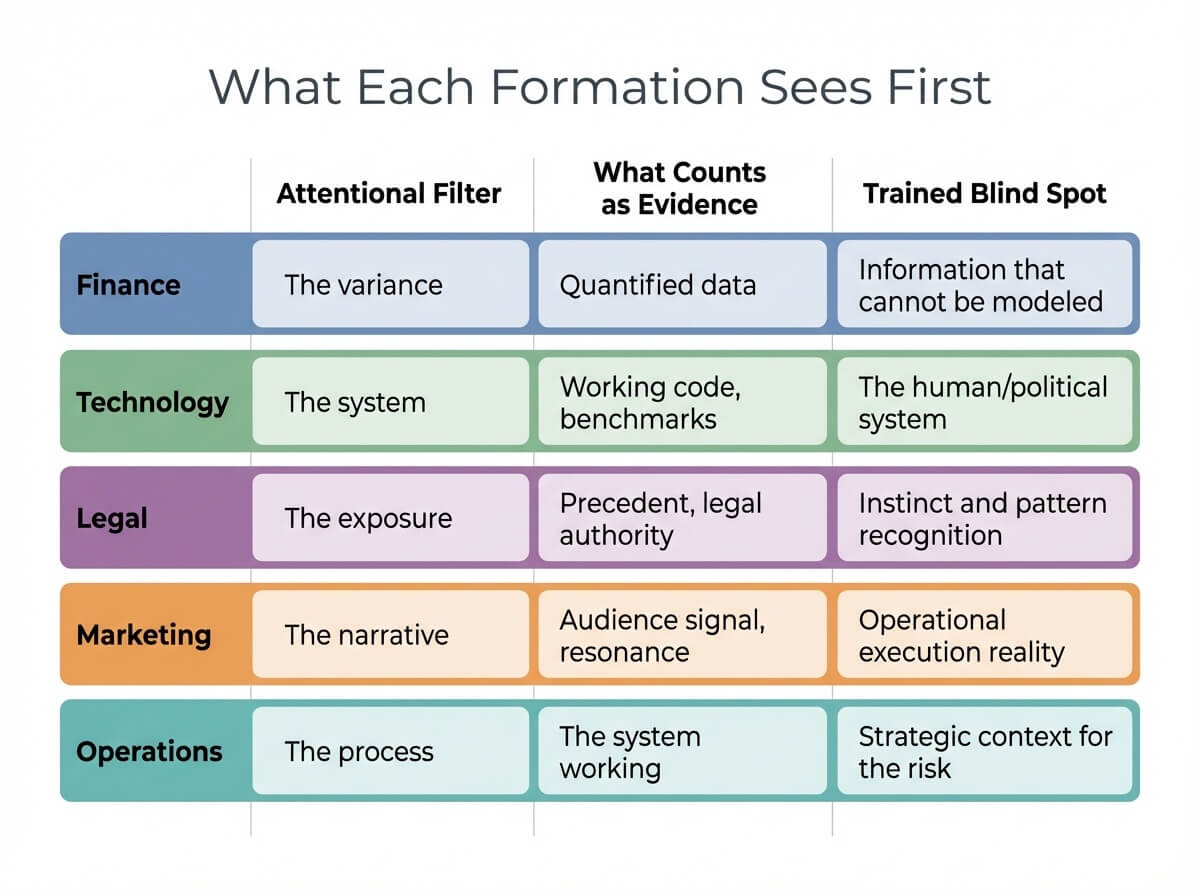
Finance: the number that does not fit. The attentional filter notices variances, inconsistencies, and unvalidated assumptions. Information is structured through models — quantified, scenario-tested, sensitivity-analyzed. What counts as evidence: documented data, verifiable assumptions, defensible methodology. The trained blind spot: information that cannot be quantified is processed as noise rather than signal. The executive intuition that comes from pattern recognition across decades of deals is dismissed because it does not come with footnotes.
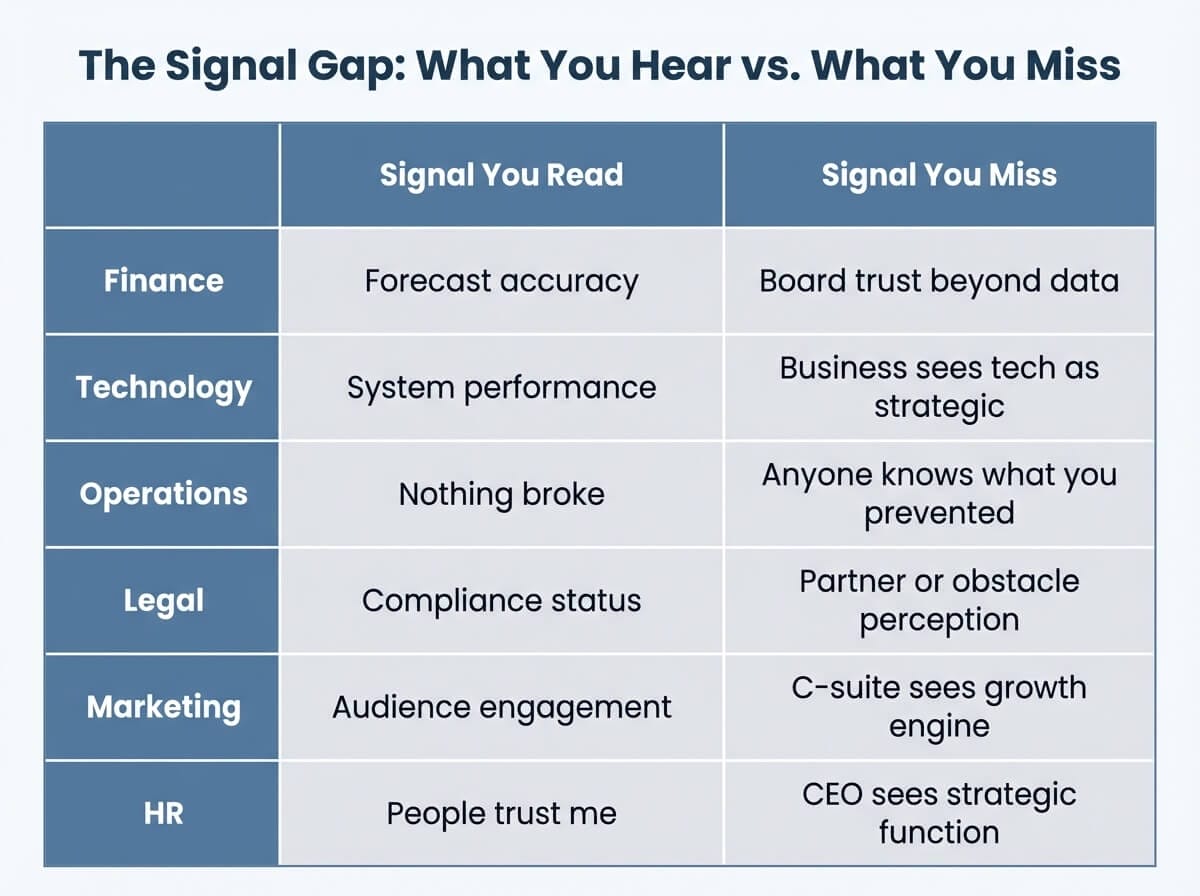
Table showing what five formations notice first, what they trust as evidence, and their trained blind spot
Technology: the system underneath. The attentional filter notices architecture, dependencies, and scalability constraints. Information is structured through systems thinking — how components interact, where the bottleneck lives, what scales and what breaks. What counts as evidence: working code, performance benchmarks, technical validation. The trained blind spot: the human system. The CTO who can see every technical dependency in an architecture diagram may not see the political dependency that will actually determine whether the project ships.
Legal: the exposure waiting to happen. The attentional filter notices liability, regulatory risk, and contractual gaps. Information is structured through precedent and argumentative logic. What counts as evidence: documented authority, legal analysis, established case law. The trained blind spot: “instinct” is not trusted. The pattern recognition that runs faster than a legal brief is dismissed as insufficient evidence — even when it is built on decades of case analysis.
Marketing: the narrative arc. The attentional filter notices audience resonance, competitive positioning, and story coherence. Information is structured through narrative — what will land, what the market is ready to hear, how this positions against the competition. What counts as evidence: audience signal, market movement, creative resonance. The trained blind spot: the operational reality underneath the narrative. The campaign that will land perfectly with the audience may be impossible to execute at scale.
Operations: the process that will break. The attentional filter notices throughput, capacity constraints, and execution dependencies. Information is structured through workflow — what happens first, what depends on what, where the bottleneck lives. What counts as evidence: the process working. The trained blind spot: the strategic context. The operations leader who can see every execution risk may not see the market opportunity that justifies accepting the risk.
You do not just think differently from your peers. You see differently. The same presentation, the same data, the same conversation — and five different leaders walk away having processed five different realities.
When Filters Collide
The strategy review. The CEO presents a growth initiative. The CFO’s filter activates: where is the financial model? What are the assumptions? What is the sensitivity to a delayed launch? The CTO’s filter activates: can the platform support this? What are the architectural dependencies? The CMO’s filter activates: does this narrative work for the market? Will customers care? The COO’s filter activates: can we actually execute this? Do we have the capacity?
Each leader asks a question from their filter. Each question is legitimate. And the meeting devolves into four parallel conversations that never converge — because each leader is processing different information from the same input and no one realizes they are not talking about the same thing.
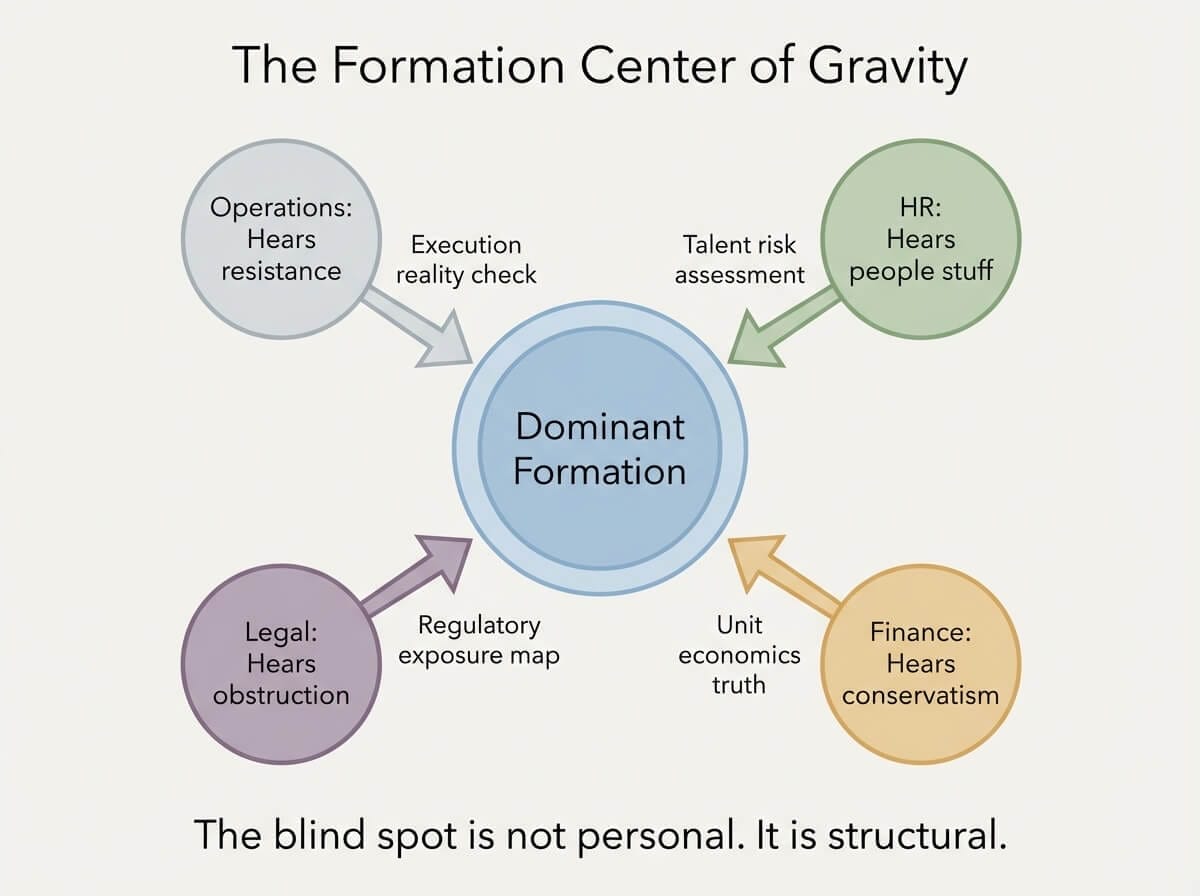
This is why leadership teams have blind spots. The room’s collective filter — shaped by its center of gravity — determines which information gets processed and which gets treated as noise. In a technology-dominated room, the operations leader’s capacity warning gets filtered out. In a finance-dominated room, the marketing leader’s narrative insight gets filtered out. The filter is collective, and the room does not know it is filtering.
ℹ
Note
The “smart leaders solving the wrong problem” pattern is almost always an information processing collision. The leader is solving the problem their filter shows them — which is a real problem. It is just not the problem the situation requires. The CTO solves the architecture problem while the adoption problem goes unaddressed. The CFO solves the financial model while the strategic narrative goes unwritten.
The Filter as Asset and Constraint
The information processing filter is the leader’s most valuable asset at the functional level. The CFO who notices the variance that nobody else caught. The CTO who sees the scalability constraint that would have killed the project. The GC who identifies the regulatory exposure that would have become a crisis. Each filter saves the organization from problems that other filters would miss.
At the senior level, the filter becomes a constraint — not because it stops working, but because the role demands processing capacity the filter cannot provide. The CTO who needs to evaluate a market opportunity cannot rely on the technical filter alone. The CFO who needs to assess a talent strategy cannot rely on the quantitative filter alone. The role asks for multi-dimensional processing, and the formation provides single-dimensional depth.
The response under pressure is predictable. The leader defaults to their filter — solves the problem they can see with the tools they have — and the problem they cannot see goes unaddressed. The strength that earned the promotion becomes the lens that constrains what the leader can perceive at the new level.
What Coaching Changes
You cannot turn off the filter. It is perceptual, not cognitive. But you can learn to see it — to notice when your filter is active, what it is selecting for, and what it is discarding. That metacognitive awareness is the difference between a leader who is captive to their processing pattern and one who uses it deliberately.
A coach who understands information processing helps the leader notice the filter in real time. “You have described three technical risks. What is the non-technical risk you have not mentioned?” That question does not criticize the technical filter. It activates a complementary channel. The leader does not stop seeing architecture. They start also seeing the human system, the narrative, the market timing — the dimensions their filter was trained to background.
The coaching is not about processing information differently. It is about processing more of it — expanding the bandwidth of what the leader perceives without abandoning the depth the formation provides. The CFO who notices the variance and notices the room’s emotional response to the variance. The CTO who sees the architecture and sees the political dynamics that will determine adoption. Same filter. Wider aperture.
Seeing the Filter
The problem that smart leaders keep solving is real. It is just not the only problem in the room. The filter your career installed shows you the problem it was trained to see — with remarkable precision and speed. That precision is your asset. The narrowness of the aperture is your constraint.
The expansion is not about thinking differently. It is about noticing what you are not thinking about. That awareness — the ability to see the filter rather than just seeing through it — is what separates leaders who are excellent within their formation from leaders who can operate across formations.
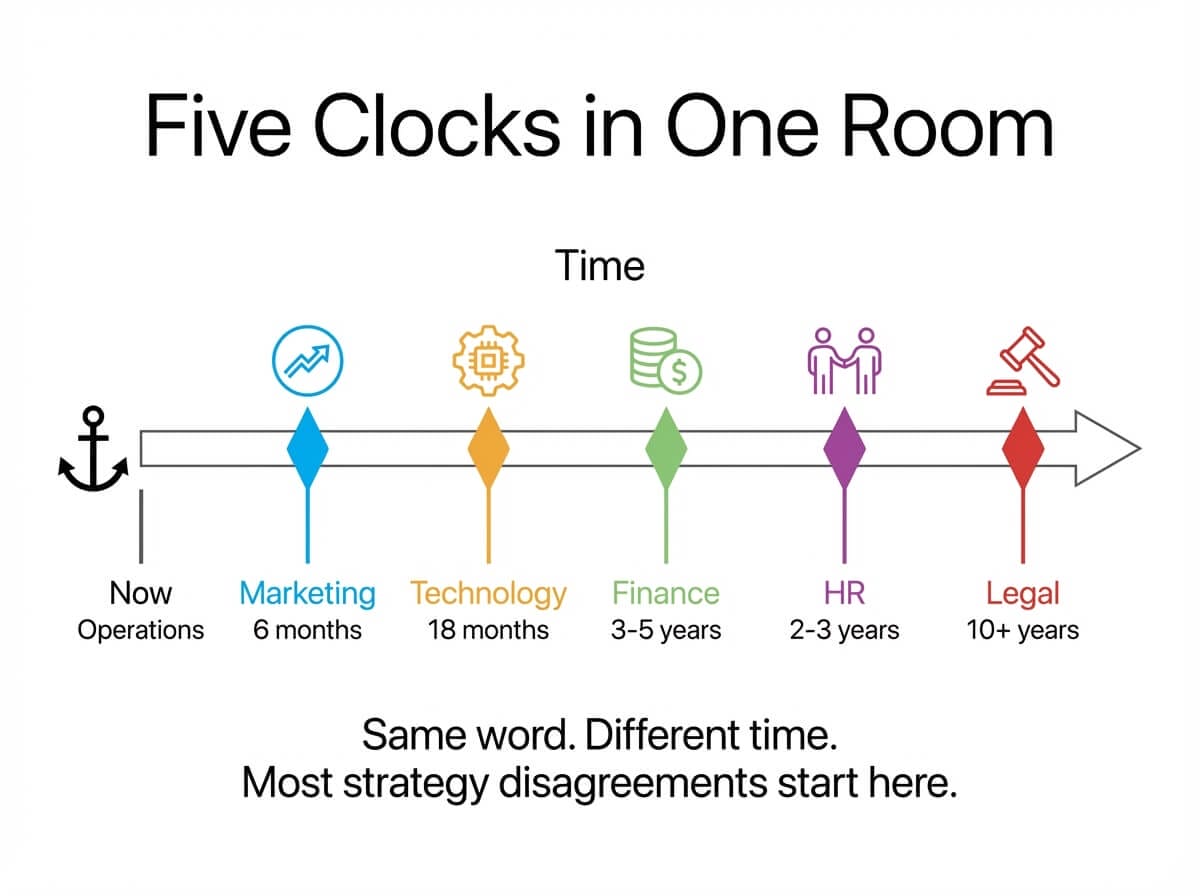
Ask five C-suite leaders to define “long-term” and you will get five different numbers. The CTO thinks in eighteen-month platform cycles. The CFO thinks in three-to-five-year capital allocation windows. The General Counsel thinks in decades of regulatory precedent. The CMO thinks in six-month campaign arcs. The COO thinks in whatever timeline keeps the operation from breaking. They sit in the same meeting, use the same word, and mean entirely different things. Most strategy disagreements are not disagreements about strategy. They are disagreements about time.
The time horizon you carry into every decision was not chosen. It was installed — by a career that rewarded one rhythm and labeled every other rhythm as either too slow or too reckless. What your career taught you about when to act, how long to wait, and what counts as “too late” is as deeply embedded as any other formation pattern. And it is invisible until you sit across from someone whose career installed a different clock.
Key Takeaways
Every function installs a specific natural time horizon — a default rhythm for how far ahead the leader thinks, plans, and evaluates decisions.
When leaders from different formations disagree about strategy, the disagreement is often about time: how far to look, how fast to move, what counts as “long-term.”
The senior leadership transition requires extending the time horizon beyond the function’s natural rhythm — and that extension creates a tension between instinct and strategic vision.
A coach who understands your formation’s time horizon helps you see when your instinct about timing is serving the situation and when it is serving the formation.
The Clock Your Career Installed
Technology: sprints, releases, platform cycles. Eighteen months is a long bet. The technology formation thinks in iterative cycles — build, ship, learn, iterate. The instinct is to move fast, validate quickly, and avoid committing to timelines the market might invalidate. A three-year strategic plan feels like a guess dressed up as certainty.
Finance: quarters, fiscal years, capital allocation windows. Three to five years is the natural planning horizon. The finance formation thinks in structured forecasts, scenario models, and investment cycles. A six-month campaign commitment feels rushed. A decade-long infrastructure bet feels speculative.
Timeline showing five different formation time horizons from 6 months to decades
Legal: precedent, regulation, liability timelines. Decades are the natural frame. The legal formation thinks in terms of what has held up over time, what regulatory cycles are in motion, and what exposure might materialize years from now. A quarterly planning cycle feels dangerously short. Legal sees risk that will not arrive for three years. The room is planning for the next three quarters.
Marketing: campaigns, brand cycles, market windows. Six months is a long play. The marketing formation thinks in moments of attention, competitive positioning, and cultural relevance. A window that is open today may be closed next quarter. The instinct is urgency — the market does not wait for models to validate.
Operations: the current timeline. Whatever keeps the system running without disruption. The operations formation is calibrated to the present — what is working now, what is about to break, what capacity exists for the next demand. Long-term thinking is real, but it is always anchored to “what does this mean for operational continuity today?”
HR: naturally long. Culture compounds over years. Talent development takes time. The HR formation often thinks in longer horizons than anyone else at the table — but expresses it in language that does not translate to quarterly metrics. The CHRO who says “this will take two years to show results” is often right and often ignored.
Five leaders sit in the same room and say “long-term.” One means eighteen months. One means five years. One means a decade. They are not speaking the same language. They just think they are.
When Clocks Collide
The strategy meeting. The CTO proposes a platform migration. Timeline: eighteen months. The CFO wants a five-year return model before approving the investment. The CMO needs to know how the migration will affect the next two product launches, both within six months. The COO wants to know what breaks during the transition. The GC flags regulatory implications that will not be clear for three years.
Every leader is being reasonable. Each is applying the time horizon their career installed. The disagreement is not about the migration. It is about which clock the decision should be evaluated on — and nobody in the room sees that the disagreement is about time rather than strategy.
The same collision happens at scale in every strategy discussion:
Tension
Formation A’s Clock
Formation B’s Clock
What It Looks Like
CTO vs. CFO
18-month platform cycles
3-5 year return windows
Engineering feels blocked; finance feels rushed
CMO vs. Legal
6-month campaign arcs
Multi-year regulatory cycles
Marketing feels constrained; legal feels ignored
COO vs. CEO
Current operational reality
Multi-year transformation vision
Ops feels destabilized; CEO feels resisted
CHRO vs. CFO
2-3 year culture/talent cycles
Quarterly reporting pressure
HR cannot prove ROI on the CFO’s timeline
ℹ
Note
Risk disagreements and time horizon disagreements often look identical. The CFO who resists a marketing investment and the CMO who resists financial analysis may both be responding to time, not risk. The CFO needs more time to validate. The CMO has less time before the window closes. Both are managing time pressure from different clocks.
The Extension Challenge
At senior levels, the role asks every leader to extend their natural time horizon. The CTO must think beyond the next platform release to the strategic arc of technology investment over three to five years. The CMO must think beyond the next campaign to the market positioning that will define the company over a decade. The COO must think beyond operational continuity to the organizational design the future strategy requires.
Extending the time horizon is not an intellectual problem. Most leaders can think longer when asked. The challenge is that the instinct — the formation-installed default — keeps pulling the leader back to their natural rhythm. The CTO who commits to a three-year strategy finds themselves re-evaluating every quarter when the technology landscape shifts. The CMO who commits to a long-term brand investment finds themselves anxious when short-term metrics dip. The instinct is not wrong. It is operating on the old clock while the role demands the new one.
The “think more strategically” feedback is often, at its core, a time horizon feedback: the room needs you to extend your planning window beyond the cycle your career installed. That extension creates the tension between instinct and vision. The instinct says “act now, validate fast.” The vision says “hold the direction, trust the longer arc.” Both are right. The question is which clock the situation requires.
What Coaching Changes
A coach who understands the time horizon formation helps the leader distinguish between formation-driven urgency and situation-driven urgency. “This feels too slow” can mean “the market is actually moving faster than our plan” or it can mean “my formation is uncomfortable with any timeline longer than eighteen months.” Both readings are valid. They lead to different responses.
The coaching question is not “How can you think longer-term?” The question is: “When you feel the pull to re-evaluate this decision, is that the situation telling you something or the clock your career installed?” That distinction — between the signal and the formation — is where the leader develops genuine strategic judgment about timing rather than either overriding their instinct or being captive to it.
The Room Needs Every Clock
The leadership team that makes the best strategic decisions is not the one where everyone thinks in the same time horizon. It is the one where every formation’s clock is recognized as a legitimate input rather than an obstruction. The CMO’s urgency catches windows the CFO’s analysis would miss. The CFO’s patience catches risks the CMO’s urgency would accept. The CHRO’s long-term perspective catches the talent and culture costs that the quarterly planning cycle ignores.
If your instinct about timing keeps colliding with the room — or if the room keeps moving at a pace that feels wrong to you — the question is not who is right about the timeline. It is whether you can see the clock your career installed and use it as one input among several, rather than as the only correct rhythm.
You were promoted because of a specific strength. The precision that caught what others missed. The technical depth that solved what others could not. The operational instinct that kept things running when everything else was falling apart. The creative vision that moved people. That strength was not one skill among many. It was the skill — the thing your career was built on, the thing the organization noticed, the thing that earned the title you now hold.
And it is the thing holding you back.
Not because it was wrong. Not because it is no longer valuable. Because the room that promoted you for it now needs something else from you, and the patterns your career installed keep pulling you back to the strength like a reflex. The paradox is structural: the stronger the skill that earned the promotion, the harder it is to release — and the more the new role needs you to.
Key Takeaways
The skill that earned the promotion is not the skill the new role rewards. The paradox is universal, but the specific way it manifests depends on which career shaped you.
The strongest professional skills are the hardest to release because they are fused with professional identity. Letting go does not feel like delegation. It feels like losing yourself.
Working harder at the old strength is the default response to the new role’s challenges — and it is the one response that will not work.
A coach who understands the paradox does not tell you to stop doing the thing you are best at. They help you see what the old strength is substituting for.
The Pattern
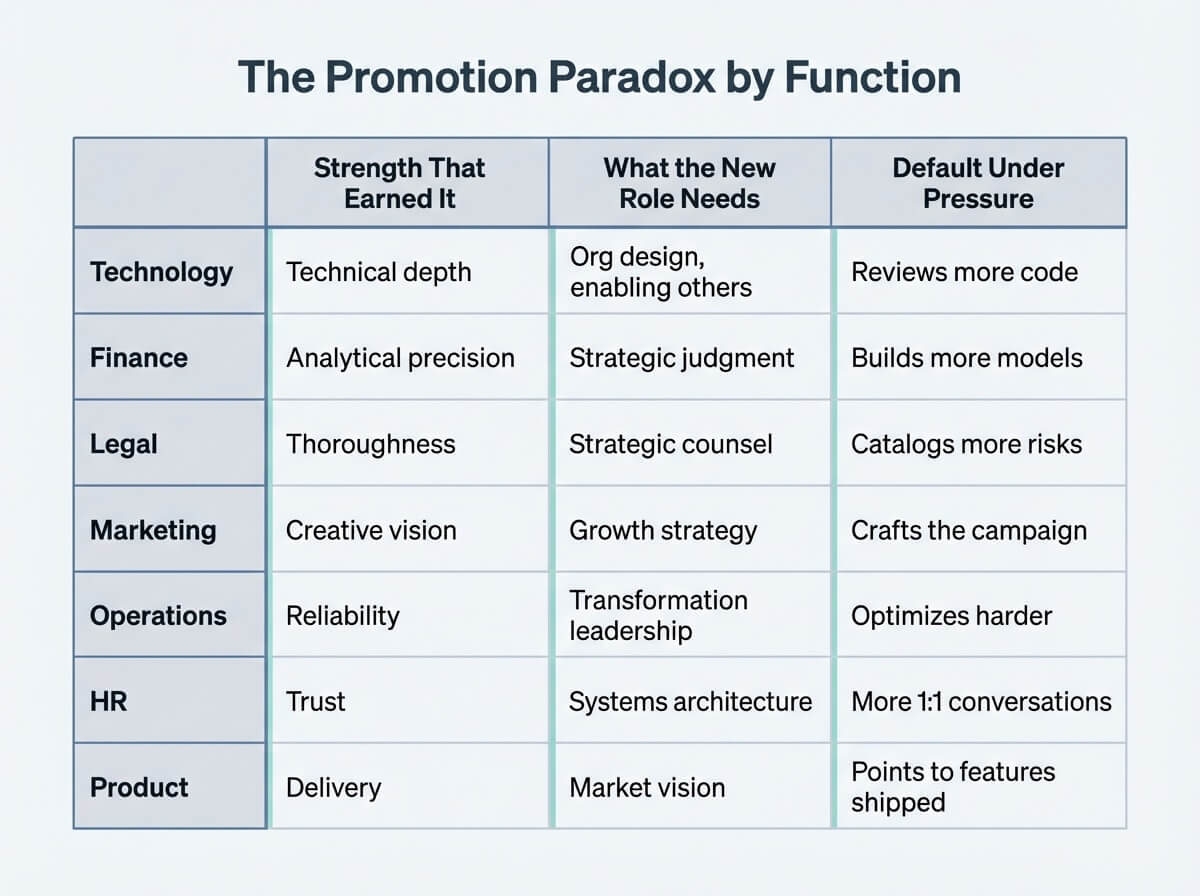
The promotion paradox follows the same structure across every function. Three elements. First: the strength that earned the promotion. Second: the new demand the role creates. Third: the default behavior under pressure, which is always a return to the strength — executed harder, faster, or more intensely — because it is the only proven strategy the leader has.
Formation
The Strength That Earned It
What the New Role Needs
The Default Under Pressure
Finance
Analytical precision — sees what others miss
Strategic judgment the data cannot fully justify
Builds a more rigorous model
Technology
Technical depth — solves what others cannot
Organizational design, enabling others to build
Reviews more code, solves harder bugs personally
Legal
Thoroughness — finds every risk
Strategic counsel, helping the org navigate through risk
Catalogues more risks without prioritizing
Marketing
Creative vision — makes things that resonate
Growth strategy, connecting creativity to business outcomes
Crafts the campaign personally rather than building the narrative
Operations
Reliability — keeps things running
Transformation leadership, designing what the org needs to become
Optimizes existing processes harder
HR
Trust — the person everyone comes to
Systems architecture, connecting people strategy to enterprise value
Takes on more individual coaching conversations
Product
Delivery — defines the right thing and gets it built
Market vision, spending credibility before evidence arrives
Points to features shipped as evidence of contribution
Read your row. The third column is where you go when the new role feels uncertain. And the new role almost always feels uncertain — because the currency shifted and the old strategy is the only one you have.
Why the Strongest Skills Are Hardest to Release
If the strength were ordinary, releasing it would be uncomfortable but manageable. The promotion paradox is sharpest when the strength is exceptional — when it is the thing the leader is genuinely better at than almost anyone around them. The CTO who really is the best engineer on the team. The CFO who really does build the most reliable models. The GC whose legal analysis really is the most thorough in the organization.
The excellence is not imagined. It is real. And that reality makes the release harder, not easier, because the leader is not just letting go of a habit. They are letting go of the thing that provides the clearest evidence, every day, that they are good at what they do. The code review is not about quality control. It is about the feeling of competence. The model is not about accuracy. It is about the feeling of being the person who sees what others cannot.
The paradox is not that the strength stops working. It is that the strength works so well at the old level that the leader cannot stop spending it — even when the new level is asking for a completely different investment.
Under pressure, the reflex intensifies. The CTO reviews more code. The CFO builds more scenarios. The COO optimizes harder. The GC documents more risk. Each behavior feels like contribution. Each behavior is a retreat to the formation’s home ground — the place where the leader knows they are excellent — and a withdrawal from the new territory where excellence has not yet been established.
The Inflection Point
There is a predictable moment, usually four to six months after the promotion, when the leader realizes the old strategy has hit diminishing returns. The effort is the same or greater. The impact is less. The feedback — “think more strategically,” “delegate more,” “step back from the details” — keeps arriving. And the leader’s first instinct is to try the old strategy one more time, with more intensity, because the alternative is stepping into a space where they do not yet feel competent.
This inflection is where most leaders either break through or settle in. Breaking through means accepting that the strength is no longer the primary contribution — that it has become table stakes rather than currency — and beginning to invest in the new capability the role demands. Settling in means continuing to do the old work at a higher level, producing excellent functional output while the leadership contribution the organization actually needs goes undelivered.
ℹ
Note
Most leaders who “plateau” after a promotion have not failed. They have settled in to the old strength at the new level. The organization gets a very competent senior individual contributor rather than the leader it promoted them to become. Both the leader and the organization sense something is missing. Neither can quite name it.
What Coaching Surfaces
Generic coaching hears the promotion paradox and offers delegation frameworks, time management strategies, and prioritization tools. A coach who understands the formation hears the same pattern and asks a different question: “What is the old work giving you that the new work does not yet provide?”
That question goes beneath the behavior to the identity. The answer is almost always a version of: certainty. Competence. The feeling of knowing I am good at this. The old work provides clear, fast feedback. The new work provides slow, ambiguous feedback. The leader retreats to the old work not because they lack the capability for the new — but because the new work does not yet tell them they are doing well.
The coaching that follows from that recognition is not about giving up the strength. It is about understanding what the strength is substituting for — and finding another way to meet the need it serves. The CTO who needs the feeling of competence can find it in building a high-performing engineering organization. The CFO who needs the feeling of being right can find it in making strategic calls that prove out over time. The path forward is not abandonment. It is redirection.
The strength that got you promoted is not the problem. It is the foundation. A CTO without technical credibility, a CFO without analytical rigor, a GC without legal precision — none of these is a better leader. The strength stays. It becomes table stakes — the thing the room assumes you have, not the thing it rewards you for.
Table showing the promotion paradox for seven functions — the strength, the new demand, and the default under pressure
The paradox resolves not by releasing the strength but by expanding what you build on top of it. The precision becomes the foundation for judgment. The technical depth becomes the foundation for organizational design. The operational excellence becomes the foundation for transformation. The same engine. A different target.
If you are in the four-to-six-month window after a major promotion and the old strategy is producing less than it used to, a conversation with a coach who understands the paradox is where the foundation starts becoming the launch pad rather than the ceiling.
Every leadership team has a voice it is not hearing. Not because someone is being silenced. Because the room’s dominant formation has made one perspective so normal that the alternative perspective — the one that would complete the picture — does not register as relevant. It is spoken. It is not heard. And the decisions that follow have a specific, predictable shape: they solve for the dimension the room can see and miss the dimension the room cannot.
The voice that is missing is usually not the quietest person in the room. It is the person whose formation processes the situation through a lens the majority does not share. The operations leader in a room full of growth strategists. The legal mind in a room full of builders. The HR perspective in a room that speaks only in revenue and market share. The voice is present. The formation the room was built around makes it invisible.
Key Takeaways
Every leadership team has a formation center of gravity — one or two dominant formations that shape how the room defines problems, evaluates solutions, and makes decisions.
The blind spot is structural, not personal. The voice that is missing is usually present but filtered out by the room’s dominant formation.
The most common team dysfunctions — groupthink on strategy, repeated arguments, decisions that fail in execution — are often formation blind spots rather than leadership failures.
A team coach who understands the formations in the room can name the missing voice without making anyone wrong.
The Room’s Center of Gravity
Every leadership team has a center of gravity — one or two formations that disproportionately shape how the room operates. In a technology company, the engineering formation often dominates: problems are framed as systems to be designed, solutions are evaluated by technical elegance, and the room speaks in architecture and scalability. In a financial services firm, the finance formation dominates: problems are framed as risk/return equations, solutions are evaluated by provable ROI, and the room speaks in models and scenarios.
The center of gravity is not determined by who talks the most. It is determined by what language the room treats as legitimate. When the CTO says “the architecture cannot support that,” the room hears a hard constraint. When the CHRO says “the culture cannot absorb that pace of change,” the room hears a soft opinion. Both statements may be equally accurate. The room gives one the weight of fact and the other the weight of perspective. That asymmetry is the center of gravity operating.
The leadership team’s blind spot is not a gap in intelligence. It is a gap in formation. The room can only see what its dominant formation has trained it to notice.
The Voices That Disappear
Operations in a growth-obsessed room. The COO sees that the growth strategy will break the operational infrastructure. The supply chain cannot absorb the volume. The deployment pipeline was not built for this pace. The hiring plan does not account for onboarding capacity. The COO raises these concerns. The room hears “resistance to change.” What was actually offered: a reality check that would have prevented the execution failure that arrives six months later. The operations formation’s visibility paradox plays out in real time — the voice that sees the most is heard the least.
HR in a revenue-driven room. The CHRO sees the talent risk underneath the restructuring plan. The senior managers who will leave. The culture debt that will compound. The succession gaps that will widen. The CHRO raises these concerns. The room hears “people stuff.” The CFO asks for the financial impact. The CHRO cannot produce a model because culture debt does not fit in a spreadsheet. The room moves on. Eighteen months later, the turnover spike arrives and the organization wonders what happened.
Diagram showing how a dominant formation filters four other voices on a leadership team
Legal in a move-fast room. The GC sees the regulatory exposure. The privacy gap. The compliance risk that has not been assessed. The GC raises these concerns. The room hears “legal is slowing us down again.” The risk instinct that the legal formation installed reads as obstruction to formations that metabolize risk through speed and iteration.
Finance in a narrative-driven room. The CFO sees the unit economics that do not support the market story. The runway that assumes revenue growth the model cannot justify. The capital allocation that prioritizes story over substance. The CFO raises these concerns. The room hears “finance is being conservative again.” The precision formation reads as excessive caution to formations that lead with conviction.
ℹ
Note
The pattern is consistent: the voice that would complete the room’s understanding of the decision is the voice the room’s center of gravity has implicitly trained everyone to discount. Not through malice. Through formation.
The Cost of the Blind Spot
Formation blind spots are expensive. Not in the obvious way — not as a single bad decision that can be traced to a single missed input. In the systemic way: a pattern of decisions that consistently solve for one dimension and miss another.
The technology-dominated room builds elegant systems that nobody adopts because the user experience perspective was treated as secondary. The finance-dominated room produces financially sound strategies that fail in execution because operational reality was treated as an implementation detail. The growth-dominated room scales faster than the organization can absorb because the people perspective was treated as a soft concern.
The blind spot does not produce catastrophic failures. It produces predictable patterns of incomplete decisions — and the leadership team that keeps having the same argument in different rooms is usually experiencing the same formation blind spot from different angles.
What Team Coaching Changes
Generic team coaching identifies communication patterns, personality differences, and trust deficits. A team coach who understands formation sees something more structural: which formations are in the room, which one dominates, and which voice the room has implicitly agreed to discount.
The coaching intervention is not “make sure everyone gets to speak.” The intervention is naming the center of gravity: “This room makes decisions in [finance/engineering/growth] language. What decision would you make differently if you gave equal weight to the perspective that just got filtered out?”
That question does not blame the dominant formation. It makes the structure visible. And once the team can see the pattern — “we consistently discount the operations perspective because our center of gravity is growth” — they can adjust without anyone having to change their personality or their formation. The adjustment is structural: build a decision process that formally accounts for the voice the room naturally mutes.
The most effective leadership teams are not the ones where every voice is equally loud. They are the ones where every formation’s contribution is recognized as structural rather than optional.
Your leadership team has a center of gravity. Every team does. The question is not whether the center of gravity exists. The question is whether your team can see it — and whether the voice it mutes is the one that would complete the picture the room needs to make better decisions.
If your team keeps having the same argument, keeps being surprised by execution failures, or keeps making decisions that look right in the room but break in the field, the issue may not be strategy or alignment or communication. It may be a formation blind spot that no one in the room can see because the room was built around it.
The first thing that changes when you reach the C-suite is the silence. Not the silence of a quiet office. The silence of realizing that the people who used to tell you what they really thought are now managing what they say around you. The feedback that used to come freely — from peers, from your manager, from the team — is filtered, strategic, or absent. You have more authority than you have ever had. You have less honest information than you have ever had. And nobody warned you that those two things would arrive together.
The C-suite transition is not a bigger version of the Director-to-VP transition. It is a qualitatively different challenge. The rules change. The isolation is structural. And the formation patterns that carried you through every previous level face their most demanding test — because at this altitude, what your career installed meets the full weight of enterprise leadership.
Key Takeaways
The C-suite transition is qualitatively different from every previous promotion. It is not a bigger version of the VP role. It is a different kind of leadership entirely.
Isolation is structural, not personal. Honest feedback decreases as authority increases. The leader with the most power to act has the least reliable information about how they are experienced.
Every formation pattern faces its highest-stakes test at the C-suite. The old currency is table stakes. The new currency — enterprise judgment, board presence, institutional stewardship — cannot be earned through the methods that always worked.
A coach at this level is often the only person in the leader’s life who has no agenda other than the leader’s own development.
What Changes at the Top
At Director and VP level, you learned to operate across functions, build alliances, and translate between strategy and execution. Those skills transfer. What does not transfer is the assumption that you can build trust the same way you always have.
At the C-suite, trust is not earned through output. It is earned through judgment — the willingness to make calls the data cannot fully justify, to hold positions under board scrutiny, to set direction for an enterprise where the consequences are existential and the timeline extends beyond your own tenure. The currency shift at this level is the most painful of the career because the new currency is the one you have the least practice spending.
The CTO who arrives at the C-suite with technical credibility discovers that the board does not evaluate technical credibility. They evaluate strategic narrative. The CFO who arrives with analytical rigor discovers that the board does not need better analysis. They need someone who says “here is what I believe we should do and why” with the kind of conviction that a career in finance never required. The CHRO who arrives with deep organizational trust discovers that trust at the individual level does not automatically translate into influence at the board level.
The loneliest seat in the organization is not lonely because nobody is around. It is lonely because everyone who is around has an agenda — and the leader is the only person in the room who is supposed to hold the whole.
The Isolation Problem
The isolation is not a failure of communication. It is a structural feature of the role. When you become the person who approves budgets, sets direction, and makes the calls that affect everyone’s career, the information environment changes. People manage what they tell you. Peers become competitors for board attention. Direct reports calibrate their candor to your mood. The higher you go, the more curated the information you receive.
This isolation hits every formation, but it hits differently:
Vertical diagram showing three things that change at the C-suite: information, currency, and formation
The CTO loses access to the technical community that used to provide honest feedback about their thinking. The engineering team now defers rather than debates. The builder identity that thrived on collaborative problem-solving has no collaborative space left.
The CFO loses the analytical sparring partners who used to challenge the model. The finance team presents conclusions, not arguments. The precision that was sharpened through debate now operates in an echo chamber.
The COO loses the operational feedback loop. The systems still run. The team still executes. But the strategic-level feedback — whether the operating model is right for where the organization is headed — only comes from the CEO and the board. Both have limited bandwidth and limited operational depth.
The GC loses the advisory dialogue. Legal is consulted after decisions are made, not before. The strategic counsel the role demands is offered in a context where the direction has already been set.
ℹ
Note
The isolation paradox: the leader with the most authority to change the organization has the least reliable information about how the organization experiences their leadership. This is not fixed by open-door policies or town halls. It is structural — and it is one of the primary reasons C-suite leaders seek coaching.
Formation Patterns at Maximum Altitude
Every formation pattern that operated at lower altitudes intensifies at the C-suite. The stress behaviors sharpen. The blind spots widen. The identity structures face their most demanding expansion.
The risk instinct faces enterprise-level uncertainty. The CFO who learned to quantify risk must now set the organization’s risk appetite — a qualitatively different task than modeling individual exposures. The CTO who learned to test and iterate must now make platform bets that cannot be tested at small scale. The GC who learned to prevent exposure must now advise on risks the organization should accept.
The signal environment becomes its most distorted. Board feedback is sporadic, politically loaded, and filtered through governance dynamics. Peer feedback is strategic. Direct report feedback is managed. The leader who relied on clear, functional signals to know whether they were doing well now operates in an environment where the most important signals are the hardest to read.
The time horizon extends to its maximum stretch. Decisions made now may not validate for three to five years. The CPO’s market bets may not confirm for longer. The CHRO’s culture investments compound slowly and invisibly. The leader must hold confidence in a direction the environment cannot yet confirm or deny.
Why Coaching at This Level
At the C-suite, a coach may be the only person in the leader’s professional life who has no agenda other than the leader’s own development. Not the board’s agenda. Not the team’s agenda. Not the organization’s performance agenda. The leader’s own understanding of who they are becoming in this role and what the role is asking them to leave behind.
A coach who understands the formation brings additional specificity. They know that the CTO’s sense of losing touch with the team is not about management style. It is about a builder identity mourning the loss of collaborative building. They know that the CFO’s hesitation to make a board recommendation without a complete model is not about confidence. It is about a formation that defined irresponsible as any call the data cannot justify. They know that the COO’s silence in strategy meetings is not about disengagement. It is about an operations formation that taught them the background is where they belong.
The coaching question at this level is not about skills or strategy. It is: who are you becoming in this role — and where is the formation that got you here creating the ceiling for what the role now asks?
The C-suite seat comes with authority, isolation, and a set of demands that no previous role prepared you for. The person who fills it carries a formation — a career’s worth of installed patterns about what good looks like, what risk feels like, what success sounds like, and who they are when they lead. The gap between what the seat demands and what the formation provides is the territory where the real leadership development happens.
Not through programs. Not through books. Through the sustained, honest, structurally-aware conversation that only happens when someone understands both the seat and the person sitting in it.
Every career trains you to listen for specific signals that tell you whether you are doing a good job. The engineer listens for system uptime and code quality. The finance leader listens for forecast accuracy. The marketer listens for engagement metrics and campaign performance. Over years, those signals become the only channel. You get very good at reading them. And you become deaf to everything else.
The feedback you are not hearing — the signal your formation never taught you to read — is usually the one that determines whether you advance, stall, or plateau. Not because it is more important than the signals you already track. Because it is the one the room is using to evaluate you while you are busy measuring something else.
Key Takeaways
Every function installs a specific signal environment — what counts as success, what feedback you are attuned to, and what channels you do not read.
The signal gap is not about missing feedback. It is about formation-level deafness to entire categories of information your career never trained you to hear.
At senior levels, the signal environment shifts from functional metrics to relational and strategic signals. Leaders who keep listening for the old signals miss the new ones entirely.
A coach who understands your signal environment helps you build new channels without abandoning the ones your career installed.
What Your Career Trained You to Hear
The signal environment is specific to each function. Not vaguely different. Precisely different — in what registers as success, what registers as failure, and what does not register at all.
Finance: accuracy and precision. You know whether the forecast was right. You know whether the model held. You know whether the numbers were clean. What you may not hear: whether the board trusts your judgment beyond the numbers. Whether your peers experience you as a strategic partner or a scorekeeper. The signal environment is quantitative. The signal that determines your trajectory at the top is relational.
Technology: system performance and shipping velocity. You know whether the product works. You know whether the team is delivering. You know whether the architecture scales. What you may not hear: whether the business understands the value of what you built. Whether the CEO sees technology as a strategic lever or a cost center. The signal environment is technical. The signal that matters now is narrative.
Operations: uptime and continuity. Silence equals success. If nothing broke, you did your job. What you may not hear: whether anyone knows what you prevented. Whether your strategic insight — you see more of the organization than almost anyone — is valued or invisible. The operations leader’s signal environment is the starkest version of this: success is defined by the absence of failure, and the absence of failure produces the absence of recognition.
Table showing the signal gap for six functions — what each formation reads versus what it misses
Legal: negative-only. You track compliance status, case outcomes, regulatory actions. Silence means nothing went wrong, which means you succeeded. What you may not hear: whether you are experienced as a partner or an obstacle. Whether people bring you problems early because they trust you, or late because they want to limit the conversation.
Marketing: engagement and resonance. You know whether the campaign landed, whether the audience responded, whether the brand is gaining share of voice. What you may not hear: whether the C-suite views marketing as a growth engine or a cost line. The signal environment is audience-facing. The signal that determines your seat at the table is board-facing.
HR: people trust and program completion. You know whether employees come to you, whether training programs fill, whether engagement scores move. What you may not hear: whether the CEO sees HR as a strategic function or a support function. Whether talent strategy is connected to enterprise value in the board’s mind. The trust signal is strong. The strategic signal is muted.
The feedback you are not hearing is rarely hidden. It is broadcasting on a channel your career never installed the antenna for.
The Signal Shift at Senior Levels
At IC and manager level, functional metrics are sufficient. The signal environment matches the job: do the work well, and the signals that tell you whether you are doing well are the same signals your career trained you to read. The finance analyst who tracks forecast accuracy is reading the right channel. The engineer who tracks system reliability is reading the right channel.
At Director and VP level, the signal environment splits. Functional metrics still matter — they are table stakes. But a new set of signals emerges: relational signals (how you are experienced by peers and leadership), influence signals (whether your input shapes decisions beyond your function), and narrative signals (whether the story the organization tells about your function is the story you want told). The currency shifts, and so does the feedback channel.
The problem is that the old signal environment is loud and clear. You know how to read it. You are good at it. And the new signals are quiet, ambiguous, and unfamiliar. The natural response is to double down on the signals you can read — build a better model, ship faster, optimize harder — while the signals that will determine your trajectory go unheard.
Formation
Signal You Read
Signal You Miss
The Gap
Finance
Was the forecast accurate?
Does the board trust my judgment beyond data?
Quantitative success, relational silence
Technology
Does the system work? Did we ship?
Does the business see technology as strategic?
Technical success, narrative invisibility
Operations
Did anything break?
Does anyone know what I prevented?
Invisible success, zero recognition signal
Legal
Were there compliance issues?
Am I experienced as a partner or an obstacle?
Negative-only signal, no positive channel
Marketing
Did the audience respond?
Does the C-suite see marketing as a growth engine?
Audience signal strong, board signal muted
HR
Do people trust me?
Does the CEO see HR as strategic?
Trust signal strong, enterprise signal weak
Why Better Listening Is Not the Answer
The conventional advice is: seek more feedback. Ask your peers how they experience you. Request 360 reviews. Solicit input from stakeholders. This is not wrong. It is incomplete — because the issue is not that the feedback is unavailable. The issue is that your formation processes the feedback through filters that were installed years ago.
The finance leader who receives feedback that “the board wants more strategic input” hears: build a more strategic model. The formation translates relational feedback into functional terms because functional terms are the only language the signal environment recognizes. The technology leader who receives feedback that “we need better communication about engineering value” hears: write a better technical brief. The formation converts a narrative signal into a technical output.
The translation is not conscious. It is automatic. And it means that even when the new signal is received, the formation processes it into the old channel and produces the old response. More data. Better systems. Tighter processes. The exact output the formation was designed to produce — applied to a signal that is asking for something different entirely.
ℹ
Note
This is why the identity dimension interacts with the signal environment. The leader does not just miss the new signal. They receive it and unconsciously convert it into the old signal — because the old signal is the one their identity knows how to respond to.
What a Coach Who Gets This Does
A coach who understands the signal environment does not tell you what signals to listen for. They help you notice what you are not hearing — and more importantly, why you are not hearing it.
The coaching question for the operations leader is not “How can you make your contributions more visible?” It is: “How do you distinguish between ‘everything is running fine’ and ‘I am doing exceptional work that nobody can see’?” That question does not ask them to self-promote. It helps them develop a new signal channel for their own impact.
The coaching question for the finance leader is not “How can you be more influential?” It is: “When you say the board does not trust your judgment, what signal are you reading to reach that conclusion?” That question surfaces the formation’s signal-processing habit — the tendency to interpret relational dynamics through a quantitative lens.
In each case, the coaching does not replace the old signal environment. It builds a new channel alongside it. The finance leader still reads the numbers. They also start reading the room. The operations leader still tracks uptime. They also start registering their own strategic contribution. The formation’s signal stays. A new signal gets added.
The feedback you are not hearing is not hidden. It is broadcasting. Your career simply never installed the antenna for it. The CFO’s board presence signal. The CTO’s narrative signal. The COO’s visibility signal. The GC’s partnership signal. Each is available. Each requires a new kind of listening that the old formation did not teach.
Building that new channel does not mean abandoning the old one. The signals your career trained you to read are real and valuable. They are also insufficient for the level you now occupy. The expansion is from single-channel to multi-channel — hearing what the function measures and what the room evaluates.