
The Feedback You’re Not Hearing (And Why It Matters More)
Every career trains you to listen for specific signals that tell you whether you are doing a good job. The engineer listens for system uptime and code quality. The finance leader listens for forecast accuracy. The marketer listens for engagement metrics and campaign performance. Over years, those signals become the only channel. You get very good at reading them. And you become deaf to everything else.
The feedback you are not hearing — the signal your formation never taught you to read — is usually the one that determines whether you advance, stall, or plateau. Not because it is more important than the signals you already track. Because it is the one the room is using to evaluate you while you are busy measuring something else.
Key Takeaways
- Every function installs a specific signal environment — what counts as success, what feedback you are attuned to, and what channels you do not read.
- The signal gap is not about missing feedback. It is about formation-level deafness to entire categories of information your career never trained you to hear.
- At senior levels, the signal environment shifts from functional metrics to relational and strategic signals. Leaders who keep listening for the old signals miss the new ones entirely.
- A coach who understands your signal environment helps you build new channels without abandoning the ones your career installed.
What Your Career Trained You to Hear
The signal environment is specific to each function. Not vaguely different. Precisely different — in what registers as success, what registers as failure, and what does not register at all.
Finance: accuracy and precision. You know whether the forecast was right. You know whether the model held. You know whether the numbers were clean. What you may not hear: whether the board trusts your judgment beyond the numbers. Whether your peers experience you as a strategic partner or a scorekeeper. The signal environment is quantitative. The signal that determines your trajectory at the top is relational.
Technology: system performance and shipping velocity. You know whether the product works. You know whether the team is delivering. You know whether the architecture scales. What you may not hear: whether the business understands the value of what you built. Whether the CEO sees technology as a strategic lever or a cost center. The signal environment is technical. The signal that matters now is narrative.
Operations: uptime and continuity. Silence equals success. If nothing broke, you did your job. What you may not hear: whether anyone knows what you prevented. Whether your strategic insight — you see more of the organization than almost anyone — is valued or invisible. The operations leader’s signal environment is the starkest version of this: success is defined by the absence of failure, and the absence of failure produces the absence of recognition.
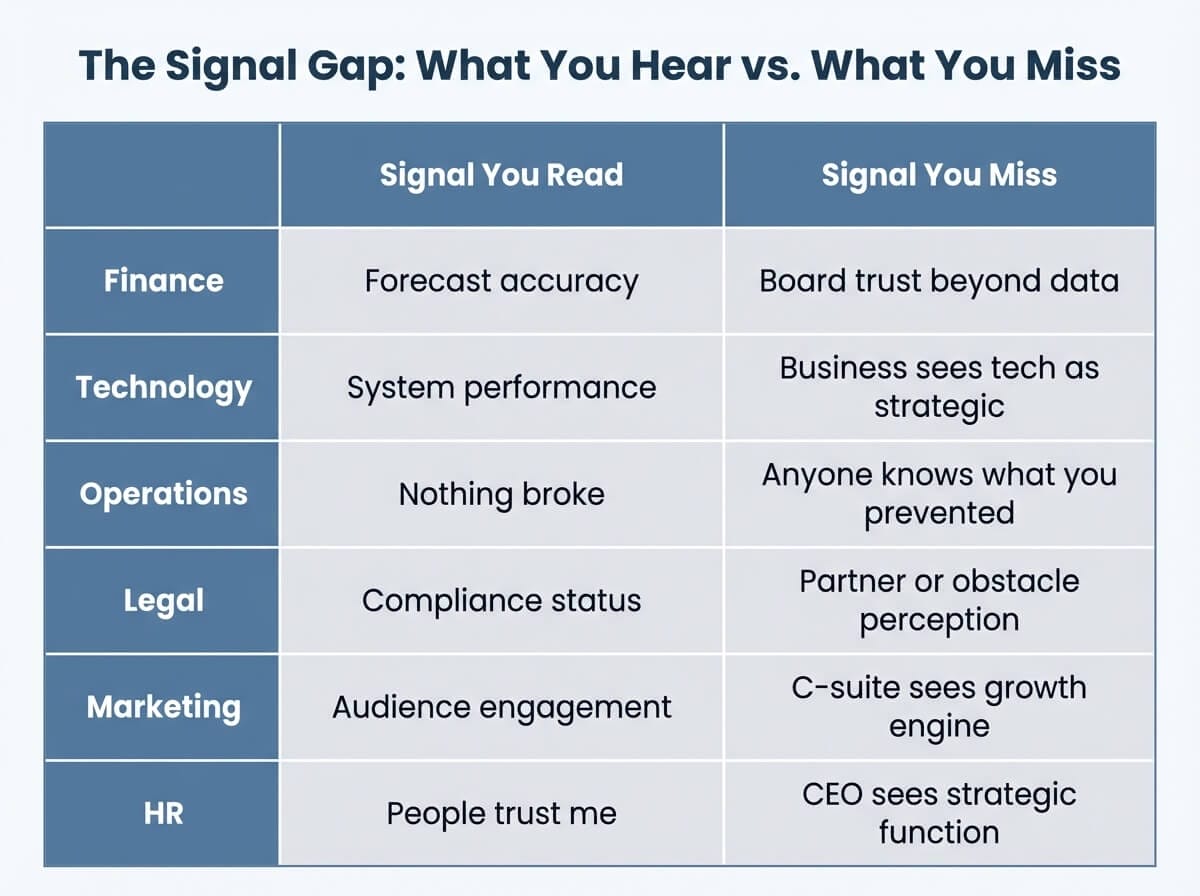
Legal: negative-only. You track compliance status, case outcomes, regulatory actions. Silence means nothing went wrong, which means you succeeded. What you may not hear: whether you are experienced as a partner or an obstacle. Whether people bring you problems early because they trust you, or late because they want to limit the conversation.
Marketing: engagement and resonance. You know whether the campaign landed, whether the audience responded, whether the brand is gaining share of voice. What you may not hear: whether the C-suite views marketing as a growth engine or a cost line. The signal environment is audience-facing. The signal that determines your seat at the table is board-facing.
HR: people trust and program completion. You know whether employees come to you, whether training programs fill, whether engagement scores move. What you may not hear: whether the CEO sees HR as a strategic function or a support function. Whether talent strategy is connected to enterprise value in the board’s mind. The trust signal is strong. The strategic signal is muted.
The feedback you are not hearing is rarely hidden. It is broadcasting on a channel your career never installed the antenna for.
The Signal Shift at Senior Levels
At IC and manager level, functional metrics are sufficient. The signal environment matches the job: do the work well, and the signals that tell you whether you are doing well are the same signals your career trained you to read. The finance analyst who tracks forecast accuracy is reading the right channel. The engineer who tracks system reliability is reading the right channel.
Sensing a Gap?
If you have been working harder at the signals you know how to read while something else determines your trajectory, that gap is where coaching starts.
At Director and VP level, the signal environment splits. Functional metrics still matter — they are table stakes. But a new set of signals emerges: relational signals (how you are experienced by peers and leadership), influence signals (whether your input shapes decisions beyond your function), and narrative signals (whether the story the organization tells about your function is the story you want told). The currency shifts, and so does the feedback channel.
The problem is that the old signal environment is loud and clear. You know how to read it. You are good at it. And the new signals are quiet, ambiguous, and unfamiliar. The natural response is to double down on the signals you can read — build a better model, ship faster, optimize harder — while the signals that will determine your trajectory go unheard.
| Formation | Signal You Read | Signal You Miss | The Gap |
|---|---|---|---|
| Finance | Was the forecast accurate? | Does the board trust my judgment beyond data? | Quantitative success, relational silence |
| Technology | Does the system work? Did we ship? | Does the business see technology as strategic? | Technical success, narrative invisibility |
| Operations | Did anything break? | Does anyone know what I prevented? | Invisible success, zero recognition signal |
| Legal | Were there compliance issues? | Am I experienced as a partner or an obstacle? | Negative-only signal, no positive channel |
| Marketing | Did the audience respond? | Does the C-suite see marketing as a growth engine? | Audience signal strong, board signal muted |
| HR | Do people trust me? | Does the CEO see HR as strategic? | Trust signal strong, enterprise signal weak |
Why Better Listening Is Not the Answer
The conventional advice is: seek more feedback. Ask your peers how they experience you. Request 360 reviews. Solicit input from stakeholders. This is not wrong. It is incomplete — because the issue is not that the feedback is unavailable. The issue is that your formation processes the feedback through filters that were installed years ago.
The finance leader who receives feedback that “the board wants more strategic input” hears: build a more strategic model. The formation translates relational feedback into functional terms because functional terms are the only language the signal environment recognizes. The technology leader who receives feedback that “we need better communication about engineering value” hears: write a better technical brief. The formation converts a narrative signal into a technical output.
The translation is not conscious. It is automatic. And it means that even when the new signal is received, the formation processes it into the old channel and produces the old response. More data. Better systems. Tighter processes. The exact output the formation was designed to produce — applied to a signal that is asking for something different entirely.
This is why the identity dimension interacts with the signal environment. The leader does not just miss the new signal. They receive it and unconsciously convert it into the old signal — because the old signal is the one their identity knows how to respond to.
What a Coach Who Gets This Does
A coach who understands the signal environment does not tell you what signals to listen for. They help you notice what you are not hearing — and more importantly, why you are not hearing it.
The coaching question for the operations leader is not “How can you make your contributions more visible?” It is: “How do you distinguish between ‘everything is running fine’ and ‘I am doing exceptional work that nobody can see’?” That question does not ask them to self-promote. It helps them develop a new signal channel for their own impact.
The coaching question for the finance leader is not “How can you be more influential?” It is: “When you say the board does not trust your judgment, what signal are you reading to reach that conclusion?” That question surfaces the formation’s signal-processing habit — the tendency to interpret relational dynamics through a quantitative lens.
In each case, the coaching does not replace the old signal environment. It builds a new channel alongside it. The finance leader still reads the numbers. They also start reading the room. The operations leader still tracks uptime. They also start registering their own strategic contribution. The formation’s signal stays. A new signal gets added.
This pattern connects to a broader dynamic: what your career installed.
Building the New Channel
The feedback you are not hearing is not hidden. It is broadcasting. Your career simply never installed the antenna for it. The CFO’s board presence signal. The CTO’s narrative signal. The COO’s visibility signal. The GC’s partnership signal. Each is available. Each requires a new kind of listening that the old formation did not teach.
Building that new channel does not mean abandoning the old one. The signals your career trained you to read are real and valuable. They are also insufficient for the level you now occupy. The expansion is from single-channel to multi-channel — hearing what the function measures and what the room evaluates.
If something in this article described a signal gap you have been sensing but not naming, a conversation with a coach who understands your signal environment is where the new channel starts to come online.
A Conversation About What You Are Not Hearing
A 30-minute call where your coach understands the signal environment your career installed and where the gap lives at your current level.
Book a Free Consultation →