
Leadership in Chaos: Executive Coaching for Crisis | Tandem
Sleep researchers studying elite sport coaches find decision-making impairment after sustained sleep loss. Communication scholars publish frameworks for leading through uncertainty. A monk tells an audience of CEOs that stillness matters more than speed. Harvard researchers document what happens when every leadership decision becomes a public test of values. These signals arrived within weeks of each other, and they converge on one uncomfortable conclusion: the internal capacity leaders bring to a crisis matters more than the external playbook they follow.
Chaos is no longer the exception. For many senior leaders, it has become the operating environment. Market volatility, restructuring, political uncertainty, and organizational change overlap and compound. The question is no longer whether leaders will face sustained pressure. The question is whether they have built the internal architecture to lead through it without burning out, making impulsive decisions, or losing the trust of the people watching them.
Key Takeaways
- Sustained sleep loss and pressure produce measurable cognitive impairment that most leaders fail to recognize in themselves
- Crisis communication depends on four practical dimensions - Competence, Connection, Clarity, and Collaboration - that coaching helps leaders develop
- The discipline of pausing before responding separates reactive leadership from effective leadership under pressure
- Executive coaching builds the internal architecture leaders need for sustained uncertainty, not just tactical crisis management
The Hidden Cost of Leading Under Pressure
Most leaders in sustained crisis operate under conditions that would concern any researcher studying cognitive performance. A study published in Psychiatric Times documented an elite sport coach averaging fewer than four hours of sleep across an 11-day tournament - a pattern that mirrors what many senior executives experience during restructuring, mergers, or prolonged organizational uncertainty.
The cognitive cost is not abstract. Research on sustained wakefulness shows that 17 to 19 hours without sleep produces performance decrements on psychomotor and cognitive tasks comparable to a blood alcohol concentration of approximately 0.05. For leaders making consequential decisions about people, strategy, and organizational direction, this level of impairment carries real risk - and most of them have no idea it is happening.
The problem compounds because pressure does not just impair thinking. It changes the kind of thinking leaders default to. As Gaur Gopal Das observed at a recent leadership forum, leaders under pressure tend to chase "instant closures" - rushing decisions to relieve mental discomfort rather than to solve the actual problem. The impulse feels like decisiveness. It often produces the opposite.
What makes this particularly dangerous is that the leaders most committed to their organizations are often the ones running hardest. They confuse exhaustion with dedication. Their teams see someone working around the clock and assume everything is under control. The gap between perceived performance and actual cognitive capacity widens without anyone noticing until the consequences surface in a bad call, a ruptured relationship, or a pattern of reactive decisions that erodes the executive burnout they were trying to prevent.
Why “Push Through” No Longer Works
The prevailing leadership playbook for decades was built on grit. Push harder. Stay later. Project confidence. The environment would eventually stabilize, and the leader who endured would come out stronger. That playbook assumed disruption was temporary - a storm to weather before returning to normal operations.
That assumption no longer holds. As one coaching industry editorial put it directly: "Chaos has become the context in which leadership now happens." The environment has shifted, and the approaches that worked in shorter cycles of disruption are breaking down under sustained, compounding pressure.
Recent data on workplace engagement reinforces this. Large-scale analysis found that only 21% of people are fully engaged at work, raising a hard question for leaders: how many members of their own teams are genuinely bought in versus simply executing roles? Coaching impact goes beyond tactics here. Leadership style shapes how people respond under pressure. Mental and emotional load influences decision-making and composure at every level of the organization, not just the top.
The old model treated pressure as a test of character. The emerging evidence suggests it is a test of capacity - and capacity can be built. The shift for leaders is fundamental: from forcing control over everything to getting grounded enough to lead from that grounded place. From demanding a perfect big decision to choosing the next small step. From projecting certainty to communicating honestly about what is known and what is not.
This is not a softer approach. It requires more discipline than the old push-through model, not less. It requires leaders to recognize when their own exhaustion is distorting their judgment and to build practices that maintain their effectiveness across months of sustained uncertainty rather than just the first few weeks of a crisis.
Four Dimensions of Crisis Communication
When uncertainty is high, leaders' communication behavior gets watched and scrutinized more intensely than during stable periods. Every message, every tone shift, every delayed response carries outsized meaning. Laurie Schloff, writing in choice Magazine, offers a practical framework for coaching leaders through this heightened communication environment: the Four C's.
Apply the Four C’s to Your Next Message
Bring a real announcement or tough conversation. We’ll pressure-test Competence, Connection, Clarity, and Collaboration before you hit send.
The framework identifies four core dimensions that executive coaches can help leaders develop and sustain during crisis: Competence, Connection, Clarity, and Collaboration. Each dimension addresses a specific failure mode that tends to emerge when pressure is sustained.
| Dimension | What It Means | What It Looks Like in Practice |
|---|---|---|
| Competence | Demonstrating the knowledge and capability to handle the situation | Leaders ground decisions in data and context rather than defaulting to reassurance. They name what they know, what they are working on, and where they need input. |
| Connection | Maintaining genuine human relationships under stress | Leaders check in with individuals, not just teams. They acknowledge the difficulty without pretending it away. Empathy is not a detour from the work - it is part of the work. |
| Clarity | Communicating priorities and direction even when full answers are unavailable | Leaders distinguish between what is decided and what is still in process. They resist the urge to over-promise or to stay silent when partial information is available. |
| Collaboration | Engaging others in navigating uncertainty rather than directing from above | Leaders create space for input, distribute decision-making where appropriate, and make it clear that navigating uncertainty is a shared effort. |
The framework is practical precisely because it does not require leaders to have answers. It requires them to show up with intention across four dimensions that their people are already evaluating, whether the leader is aware of it or not.
Executive coaches working with leaders during uncertainty often find that communication is where the stress shows first. A leader who defaults to silence, or who oscillates between false confidence and visible anxiety, creates cascading problems across the organization. Coaching provides a structured space to develop communication strategy before the next high-stakes conversation - and to debrief honestly after it, which is where the real learning happens. Building these capacities is central to developing executive presence under conditions that strip away every comfortable default.
The Discipline of Not Reacting
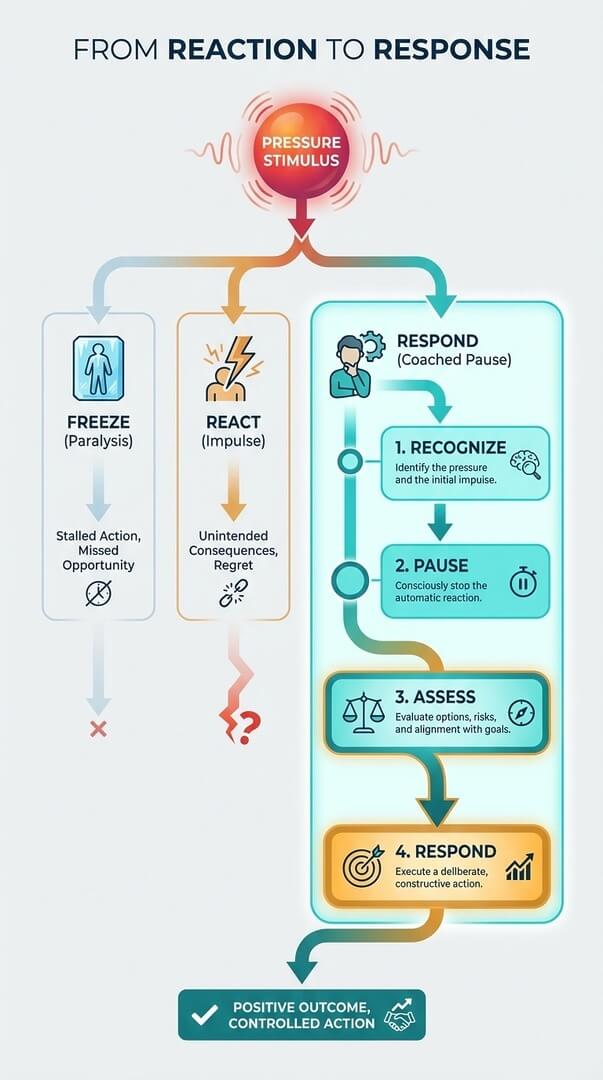
There is a counterintuitive pattern in leaders who perform well during sustained pressure. They are not the fastest decision-makers. They are the ones who have learned to create a pause between stimulus and response - and they have practiced that pause until it becomes reliable under stress.
Gaur Gopal Das, speaking to an audience of business leaders, made this point with precision: "The most certain thing to do is not be impulsive." He described stillness not as passivity but as a leadership tool. "In stillness, you can reflect better, prioritize better, respond better."
Reacting quickly is not the same as responding effectively. The pause between stimulus and response is where leadership actually happens under pressure.
This maps directly to what executive coaches observe in practice. Leaders under pressure tend to fail in one of two directions. Some freeze - overwhelmed by the complexity, they delay decisions until the window for effective action has closed. Others become impulsive - making rapid decisions that feel productive but are driven by the discomfort of not knowing rather than by clear thinking. Both failure modes come from the same source: the absence of a practiced internal process for handling pressure.
Coaching addresses both by building that process. The coached pause is not about slowing down for its own sake. It is a structured internal sequence: recognize the pressure, pause before acting on it, assess what is actually needed, then respond with intention. Over time, this sequence becomes the leader's default under stress instead of the reactive patterns that pressure naturally triggers.
The idea of micro-decisions reinforces this. Rather than trying to solve everything at once or forcing control over a chaotic situation, effective leaders under pressure choose the next small step. One clear communication. One honest conversation. One decision that moves things forward without pretending to resolve the whole situation. This is not a retreat from leadership - it is leadership calibrated to conditions where big sweeping moves often do more harm than good.
When Every Decision Is a Public Test
The pressure on senior leaders today is not just internal. It is increasingly visible. Research published by Harvard Business Review surveyed 300 nonprofit and community leaders and convened over 100 global leaders from social impact organizations. The findings apply well beyond the nonprofit sector: leaders face overlapping economic, political, technological, and social pressures that turn routine decisions into public tests of values and integrity.
A single decision can carry strategic, human, and reputational consequences simultaneously. The line between professional judgment and personal responsibility has blurred. Leaders are making calls that affect people's livelihoods while stakeholders, board members, employees, and sometimes the public are watching and evaluating not just the outcome but the process and the posture behind it.
The HBR research surfaced four patterns shaping how leaders handle this kind of instability. What stands out is that the leaders who perform best under this scrutiny are not the ones who project the most confidence. They are the ones who have done the internal work to align their values with their actions - and who can maintain that alignment when the pressure to compromise is highest.
This is where executive coaching provides something that tactical crisis management cannot. A change management risk assessment addresses the operational dimension of organizational disruption. Coaching addresses the personal dimension - the leader's relationship with their own values, their capacity for transparency, and their ability to make difficult decisions without losing the trust that makes future leadership possible.
How Executive Coaching Supports Leaders Through Crisis
The research and practitioner perspectives synthesized here point to a consistent conclusion: leaders under sustained pressure need structured support that goes beyond tactical advice. They need a relationship where they can examine their own thinking, test their communication before it reaches their teams, and build practices that maintain their cognitive and emotional capacity across extended periods of uncertainty.
Executive coaching provides this in several concrete ways. During periods of heightened uncertainty, coaching relationships often increase in frequency. Sessions shift from developmental goals to real-time support for executive coaching for leadership growth and communication under pressure. Coaches serve as a grounding presence - someone outside the organization's emotional system who can reflect back what they observe without the political filters that internal relationships inevitably carry.
Communication strategy becomes a central coaching focus. Leaders prepare for high-stakes conversations in session, practice delivering difficult messages, and debrief afterward. The Four C's framework translates directly into coaching work: helping leaders assess their competence narrative, maintain genuine connection with their people, communicate with appropriate clarity, and create authentic collaboration even when the instinct is to consolidate control.
Role alignment and purpose clarity also become critical coaching territory during crisis. The best teams under pressure are not just talented - they are clearly aligned in roles, expectations, and purpose. Coaching helps leaders create and communicate that alignment rather than assuming it exists. When leaders build this kind of internal architecture through coaching, they stop needing a new crisis playbook for every disruption. They develop the capacity to lead through whatever comes next - which is the real value of unlocking leadership potential through coaching rather than relying on situational tactics.
Tandem Coaching's approach to executive coaching is built on this principle: coaching is not crisis management. It is the sustained development of a leader's capacity to think clearly, communicate honestly, and act with intention regardless of what the environment throws at them.
Frequently Asked Questions
What is the difference between crisis management and leadership coaching during a crisis?
Crisis management focuses on tactical response - communication plans, stakeholder management, operational continuity. Leadership coaching during a crisis focuses on the leader's internal capacity: how they process pressure, make decisions under uncertainty, and maintain the cognitive and emotional clarity needed to lead effectively over sustained periods.
How often should executives meet with a coach during times of uncertainty?
Many coaching relationships increase frequency during high-pressure periods, shifting from biweekly to weekly sessions. Some leaders benefit from shorter, more frequent check-ins focused on real-time communication challenges and decision support rather than longer developmental sessions.
Can coaching help with decision fatigue during extended periods of pressure?
Yes. Coaching helps leaders recognize when exhaustion and pressure are affecting their judgment, develop structured decision-making practices that reduce cognitive load, and build the discipline of micro-decisions - choosing the next clear step rather than trying to resolve everything at once.
When does a leader need coaching support versus a different kind of intervention?
Coaching is appropriate when a leader has the fundamental skills but needs support maintaining effectiveness under pressure. If a leader is experiencing clinical burnout, anxiety, or mental health concerns, a therapist or medical professional is the right first step. Coaching and clinical support can work alongside each other, but they serve different purposes.
Stress-Testing Your Leadership Under Chaos
Let’s talk through your current pressure points—sleep debt, crisis communication, or public scrutiny—and map the right coaching support.
Book a Free Consultation →