
Executive Burnout Coaching: What Happens Inside the Room
What happens during executive burnout coaching?
Burnout coaching follows a specific arc. Sessions one and two map energy expenditure, not calendar time, through an audit that reveals where meaning has disappeared. Sessions three and four examine whether the executive is carrying work that belongs to their team. Sessions five and six produce concrete delegation lists and boundary protocols matched to their operating environment.
She sat across from me and said, “I’ve lost my edge.” Not burned out. Not overwhelmed. Just… slower. Decisions that used to come in seconds now took days. Sunday evenings brought a dread she couldn’t explain. She’d stopped reading the industry publications she used to devour and started over-scheduling her calendar so there was no room to feel what was happening underneath.
She wasn’t describing a performance problem. She was describing executive burnout — something a coach trained in deep, non-judgmental listening is positioned to hear before the words are even said. And like most leaders who sit in that chair, she didn’t have a name for it yet.
Key Takeaways
- Executive burnout shows up as decision avoidance and emotional withdrawal long before anyone uses the word “burnout”
- Burnout is a system problem, not a personal failing. The WHO classifies it as an occupational phenomenon.
- Coaching addresses burnout at the behavioral and systemic level, not through stress tips or time management hacks
- A 2024 randomized clinical trial found that three months of biweekly coaching significantly reduced burnout
- Knowing when coaching fits and when therapy or organizational change is needed is part of the process
What Executive Burnout Actually Looks Like
Executive burnout rarely announces itself. The leaders who experience it almost never use the word. What they say instead: “Everything takes longer than it should.” “I don’t care about things I used to care about.” “I need to get sharper.” They frame it as a performance issue because that is the language they know. The gap between what they say and what a coach hears is where the work begins.
The patterns are specific to the executive level. Decision fatigue shows up as perfectionism or procrastination on choices that used to be instinctive. Emotional exhaustion registers as a flat affect: leaders who used to feel passion for their work now feel nothing at all. Withdrawal looks like checking out during board conversations or delegating not strategically but to avoid engagement. Over-scheduling becomes a defense mechanism: if every hour is filled, there is no silence where feelings might surface.
Executive coaching for burnout starts with recognizing these signals — and ADHD leadership coaching strategies add a further layer of precision when executive function differences are driving the exhaustion pattern. High performers are often the most vulnerable because the same drive that produced their leadership success prevents them from reading exhaustion as a signal. They interpret it as an obstacle to push through. That interpretation is the trap.
And sometimes, what looks like burnout is the body’s signal that the executive is in the wrong role entirely. When the work no longer connects to what a leader values, rest alone will not fix it. That is when burnout signals a career transition, not a problem to solve in place.
It’s Not a Personal Failure
In 2019, the WHO classified burnout as an occupational phenomenon in the ICD-11. Not a medical diagnosis. Not a character flaw. An occupational phenomenon. That distinction matters because it locates the problem where it belongs: in the relationship between a person and their work conditions.
Christina Maslach’s research identified six organizational mismatches that predict burnout: workload, control, reward, community, fairness, and values. When three or more are present in a leadership environment, burnout is not a surprise. It is the predictable outcome of a system that demands more than it returns.
As Jennifer Moss wrote in Harvard Business Review: “Burnout is about your workplace, not your people.” When every VP in the same organization presents with the same symptoms, the problem is not the individuals.
This reframe changes the intervention. Coaching that treats burnout as a personal resilience deficit misses the point. The leader who burns out is often responding rationally to an irrational system. Effective leadership coaching examines both the system and the executive’s relationship to it.
The leader who burns out is often responding rationally to an irrational system.

What Coaching for Burnout Actually Does
Burnout coaching is not advice-giving. It is not stress management tips layered onto an already overloaded schedule. A coaching engagement for burnout follows a specific arc, and understanding what an executive coach does in these sessions is what separates this intervention from everything else on offer.
Is This the Arc You Need Right Now?
The shift from “how do I push through?” to “what is this telling me?” happens in coaching. A free consultation is where that conversation starts.
Sessions 1-2: Naming the Pattern
The executive arrives talking about performance. The coach listens for what is underneath. By the end of the second session, they have mapped the executive’s week. Not the calendar, but the energy expenditure. Where energy goes in, where it drains. Most executives are shocked by how little recovery time exists in their weeks. This is the energy audit: tracking not just time but the quality of engagement across every responsibility.
This matters because burnout coaching that starts with time management misses the real issue. The problem is rarely how much the executive works. It is what the work costs them emotionally and where meaning has disappeared.
Sessions 3-4: Mapping the System
Burnout is rarely just personal. The coach explores the organizational system: Is this executive carrying work that belongs to their team? Are they compensating for structural gaps? A 360-degree feedback process or stakeholder assessment often surfaces patterns the executive cannot see from inside. This is where the systemic lens matters. The executive may be the symptom, not the cause.
The delegation question is telling. When we map what only the executive can do versus what they hold out of habit, the ratio is often revealing. Delegation resistance in burned-out leaders is rarely about control. It is about identity. They built their career on being the person who handles everything.
Sessions 5-6: Redesigning Behaviors
Concrete changes land here. Delegation mapping produces a clear list of what to hand off. Boundary protocols get specific: when does email stop, which meetings can be declined, what recovery looks like for this particular leader’s life. These are not generic wellness recommendations. They are redesigned behaviors matched to the executive’s specific operating environment.
The coach holds accountability for these commitments across sessions. That accountability matters because the organizational pressure that produced burnout does not pause while the executive recovers. Without someone holding the line, old patterns reassert themselves within weeks.
The Inflection Point
The shift happens when the executive stops asking “How do I push through this?” and starts asking “What is this exhaustion telling me about how I am working?” That reframe from endurance to self-awareness is where coaching lands. Sustainable burnout recovery is not about working less. It is about working with awareness of capacity and making conscious trade-offs about where leadership energy goes — and developing the clarity for strategic thinking for leaders is what makes those trade-offs stick.
Coaching does not fix burnout by adding more tools to an overloaded toolkit. It works by helping a leader see which tools they are gripping too tightly.
When Coaching Fits and When It Doesn’t
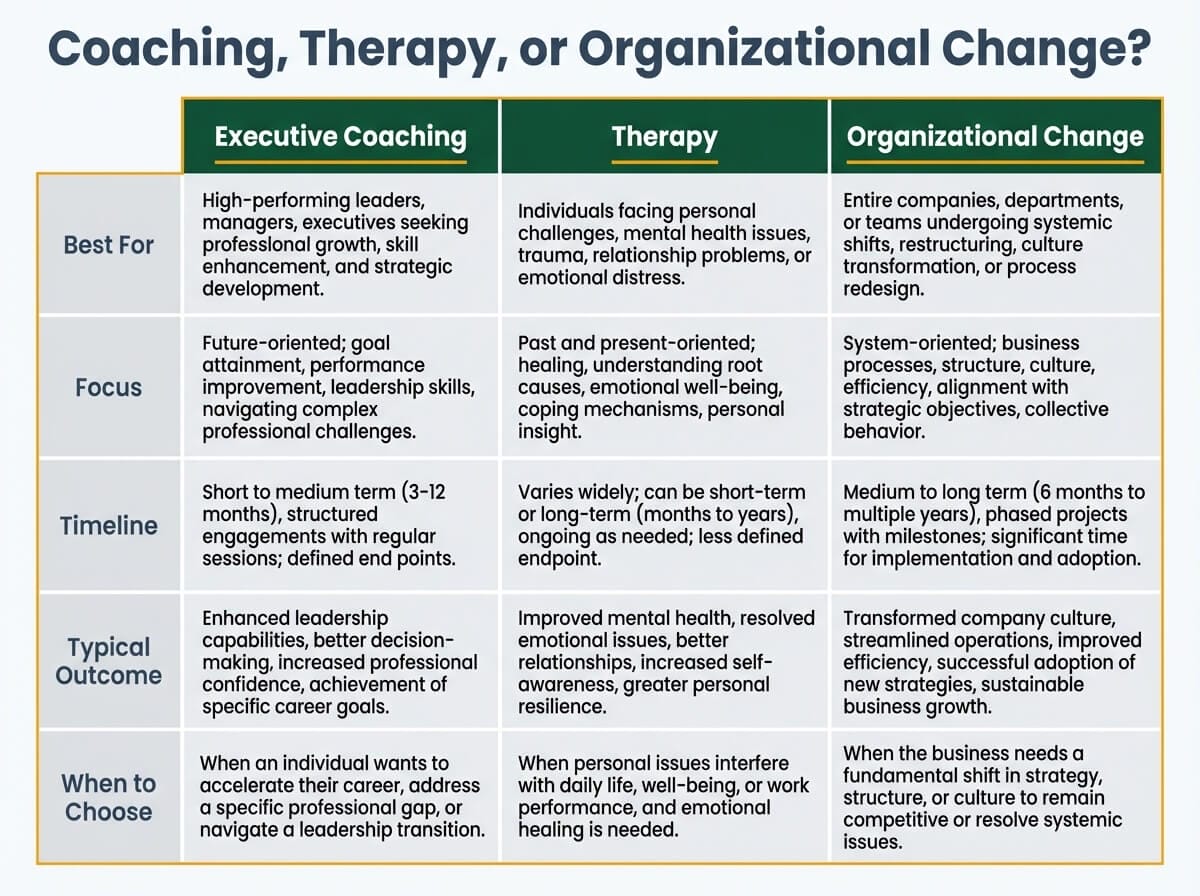
Coaching is the right intervention when burnout stems from behavioral patterns, role design, or boundary failures the executive can influence. But it is not always the right tool, and a qualified coach knows when coaching is not the right intervention. The distinction matters.
| Executive Coaching | Therapy | Organizational Change | |
|---|---|---|---|
| Best for | Behavioral patterns, boundary redesign, values realignment | Clinical depression, anxiety disorders, trauma responses | Systemic workload, culture, structural dysfunction |
| Focus | Forward-looking: what to change and how | Root-cause: what happened and why it persists | System-level: policies, staffing, incentives |
| Timeline | 3-6 months, biweekly sessions | Varies: weeks to years | 6-18 months for meaningful culture shifts |
| Outcome | Restored decision quality, sustainable work patterns, renewed engagement | Resolved clinical symptoms, deeper self-understanding | Reduced systemic burnout drivers across the organization |
| Escalate when | Client shows clinical indicators (persistent sleep disruption, substance use, anxiety unresponsive to behavioral change) | Burnout has organizational, not personal, roots | Individual coaching cannot overcome structural dysfunction |
These are not mutually exclusive. A leader may need coaching and therapy simultaneously. An organization may need structural change while individual executives get support. The integrity signal that matters most in burnout work: knowing when to refer out. That builds trust more than any promise of results.
What Actually Changes
A randomized clinical trial published in JAMA Network Open in 2024 found that three months of biweekly coaching significantly reduced burnout and improved well-being in physicians, one of the highest-burnout professions. This was not a survey. It was a controlled trial with measurable outcomes.
Fortune 500 companies that have invested in coaching programs report a 788% return on investment, driven primarily by retention and performance gains. For organizations weighing whether coaching is worth the investment for burnout recovery, the data points toward a clear answer.
What coaches observe in practice aligns with the research. Executives who complete a burnout-focused engagement report restored decision quality within the first two months. Team engagement often improves as the leader’s emotional availability returns. The personal life changes too: weekends feel like weekends again, not extensions of the workweek. The balance between leadership demands and personal well-being stops feeling impossible.
The evidence does not promise coaching eliminates burnout. What it shows is that coaching changes the relationship between the executive and the pressures they face. That behavioral shift, the move from reactive endurance to conscious choice, is what produces lasting recovery. Building resilience through coaching means building the capacity to recognize and respond to stress before it becomes chronic. Part of that recovery involves rebuilding structural systems that prevent the overload from returning: time management and productivity coaching addresses the calendar and energy disciplines that keep the conditions for burnout from reassembling.
That behavioral shift — the move from reactive endurance to conscious choice — is what produces lasting recovery.
What Executive Burnout Recovery Looks Like Over Time
Recovery from executive burnout is not a single event. It is a sequence, and knowing the sequence keeps leaders from mistaking an early plateau for failure. In practice, executive burnout recovery moves through three rough phases, each with a different marker of progress.
Weeks 1–4: Stabilization
The first month is about stopping the slide, not fixing everything. The executive learns to name what is happening and protects two or three non-negotiable recovery anchors — a guarded evening, a hard stop on weekend email, a standing block nothing overwrites. The calendar barely changes yet. What changes is that the leader stops treating exhaustion as a character flaw to override. Restoring well-being for executives starts with that permission, not with a new productivity system.
Weeks 5–12: Redesign
This is where the delegation and boundary work from the coaching sessions gets tested against real organizational pressure. Decision quality returns first — choices that felt impossibly heavy start moving again. This is the phase most burnout recovery coaching is built around, and it maps to the JAMA trial’s three-month window, where measurable burnout reduction showed up.
Months 4–6: Consolidation
New patterns stop feeling effortful and start feeling normal. The executive reset is complete not when the person works less, but when they can read their own capacity in real time and adjust before hitting the wall again. Sustainable recovery is a skill the leader keeps, not a state a coach installs.
Frequently Asked Questions
How long does coaching for burnout take?
Most executives see meaningful shifts in 3-6 sessions over 6-12 weeks. The JAMA clinical trial showed significant burnout reduction at three months of biweekly coaching. Full behavioral change, where new patterns feel automatic rather than effortful, typically takes six months. The timeline depends on how deeply burnout has taken root and whether organizational conditions support the changes the executive is making.
Is burnout a coaching issue or a medical issue?
Burnout is an occupational phenomenon, not a medical diagnosis (per the WHO’s ICD-11 classification). Coaching is appropriate when burnout stems from behavioral patterns, role design, or values misalignment. When burnout has crossed into clinical depression, persistent anxiety, or substance use, a licensed therapist is the right first step. Coaching and therapy address different layers and often work well together.
Can coaching prevent burnout before it starts?
Yes. Preventive coaching helps high performers recognize early warning signs: declining engagement, creeping cynicism, the slow loss of strategic perspective — the kind of capacity that becomes critical when leaders are thinking more strategically across the organization. The energy audit and boundaries work that characterize burnout coaching are equally valuable as prevention tools. Leaders who build awareness of their capacity limits and establish recovery practices are far less likely to reach the point of full burnout.
What does executive burnout recovery actually involve?
Recovery moves through three phases: stabilization (weeks 1–4, protecting recovery anchors and stopping the downward slide), redesign (weeks 5–12, where delegation and boundaries get tested against real pressure and decision quality returns), and consolidation (months 4–6, where the new patterns become automatic). The goal of burnout recovery coaching is not working less — it is building the capacity to read your own limits and adjust before hitting the wall again.
How is executive burnout coaching different from corporate wellness or stress-management programs?
Corporate wellness and stress-management programs treat symptoms at scale — meditation apps, resilience workshops, generic time-management training. Executive burnout coaching works one leader at a time on the specific decisions, delegation patterns, and boundaries driving the exhaustion. For leaders in high-stress environments, that individual precision is the difference between a temporary reset and a durable change. Business and corporate burnout coaching that stops at stress tips rarely holds, because it never touches the role design underneath.
If you recognized yourself in the patterns described here, that recognition is not weakness. It is the first move toward recovery. Coaching does not require you to be broken. It requires you to be honest about what is not working. When you are ready to have that conversation, Tandem’s executive coaching services start with exactly that kind of honesty.
Stop the Burnout Spiral Before It Spreads
If cynicism, reduced effectiveness, or “always on” expectations are creeping in, let’s map the quickest leverage points for relief and performance.
Book a Free Consultation →