“Think More Strategically” — What That Actually Means for Your Function
“Think more strategically.”
You have heard it in a review, a one-on-one, a passing comment from someone two levels above you. And your first response was probably to do the thing your career trained you to do — but harder. The finance leader builds a longer-horizon model. The engineer drafts a technology roadmap. The operations leader creates a three-year capacity plan. The marketing leader develops a competitive positioning framework. Each of these is strategic thinking. None of them is what the feedback is actually asking for.
The problem is not that you lack strategy. The problem is that “strategic” means something different at the level you occupy now than it did at the level where you learned it. And nobody defines the shift. They just keep saying the word and expecting you to hear something your formation never taught you to hear. The guide on how to think more strategically maps exactly what that shift demands at the Director and VP level.
Key Takeaways
- “Think more strategically” is the most common piece of feedback at the Director/VP level — and the least defined. What it means depends entirely on which career shaped the person hearing it.
- Every function installs a specific version of strategic thinking. Extending the time horizon within your domain is not the shift. The shift is extending your lens beyond your domain entirely.
- The real strategic gap is not about vision. It is about operating in uncertainty — forming positions before the data is complete, influencing decisions you do not control, contributing to conversations where your functional expertise is not the point.
- A coach who understands what “strategic” means to your specific formation can surface the gap between what you are doing and what the room needs without reducing the problem to “you need a broader perspective.”
What “Strategic” Means in Your Formation
Every career installs its own definition of strategic thinking. That definition works — at the level where it was installed.
In finance, strategic means scenario modeling: project forward, weight probabilities, stress-test assumptions. The finance leader who is told to think more strategically builds a better model. More variables, longer horizon, tighter sensitivity analysis. In technology, strategic means systems architecture: how does this decision affect the platform in eighteen months? The engineer who is told to think more strategically drafts a deeper roadmap. In operations, strategic means anticipating bottlenecks at scale: what will break when we grow? In marketing, strategic means market positioning: where do we play and how do we win the narrative?
Each version of strategic thinking is legitimate. Each version is also bounded by the function that installed it. The finance leader’s strategy is about the numbers. The technology leader’s strategy is about the systems. The operations leader’s strategy is about the process. The feedback — “think more strategically” — is not asking for a better version of functional strategy. It is asking for something the function never taught.
The feedback says “strategic.” What it means is: form a position on something outside your domain and defend it in a room where nobody shares your expertise.
The Actual Shift
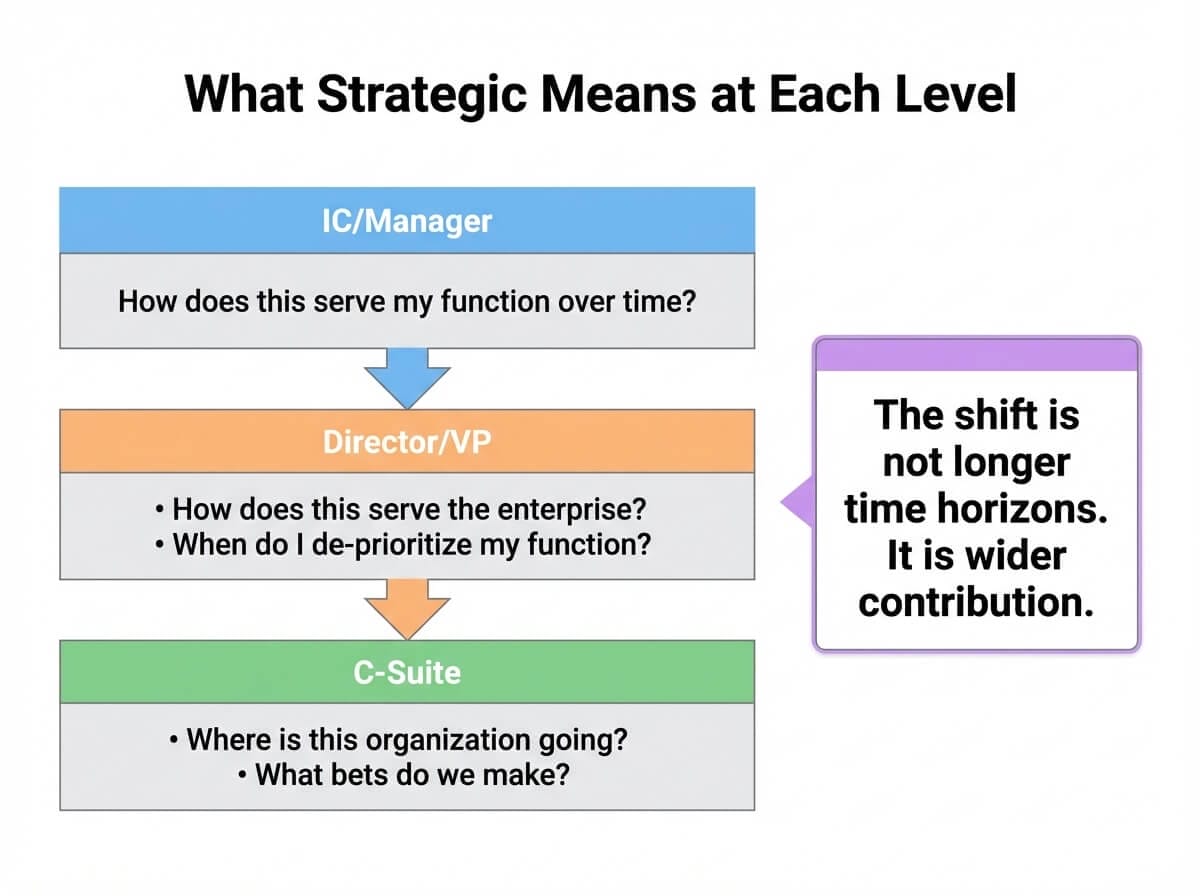
At IC and manager level, the time horizon lives inside the function. The sprint, the quarter, the campaign cycle, the audit calendar. Strategic means: how does this decision serve the function over time? At Director and VP level, the time horizon must extend beyond the function. Strategic means: how does this decision serve the enterprise? And more uncomfortably: how does my function’s interest sometimes conflict with the enterprise’s interest, and what do I do when it does?
This is where the shift gets hard. The patterns your career installed trained you to optimize your domain. The new level asks you to sometimes de-prioritize your domain for the whole. The finance leader who recommends funding a marketing initiative that has no provable ROI — because the competitive positioning matters more than the model — is thinking strategically. It also feels, to their formation, like professional malpractice.
The real gap is not about extending the time horizon. It is about operating in uncertainty. Forming positions before the data is complete. Influencing decisions you do not control. Contributing to conversations where your functional expertise is not the point — where what matters is your judgment as a leader, not your credibility as a specialist. That is a fundamentally different kind of contribution than your career prepared you for.
| Level | What “Strategic” Means | What Success Looks Like |
|---|---|---|
| IC / Manager | How does this serve my function over time? | The project delivers. The team performs. The work is excellent. |
| Director / VP | How does this serve the enterprise? When do I de-prioritize my function? | Cross-functional influence. Decisions shaped beyond your domain. |
| C-Suite | Where is this organization going and why? What bets do we make? | Enterprise direction set. Judgment expressed before data is complete. |
Why Working Harder Does Not Fix It
The first response to “think more strategically” is almost always: work harder at the version of strategic thinking your career already installed. The finance leader builds a more rigorous model. The engineer creates a more comprehensive roadmap. The operations leader develops a more detailed capacity plan. Each effort is excellent. None of them answers the feedback.
Heard This Feedback Before?
If “think more strategically” keeps following you from review to review, the issue is not capability. It is the gap between what your career installed and what the room needs.
This is the currency shift in action. The old currency — functional strategic excellence — has diminishing returns. The new currency — enterprise-level judgment expressed across functions — requires spending credibility in rooms where you are not the expert. That is deeply uncomfortable for a leader whose career taught them that credibility comes from expertise.
There is a predictable inflection point. Around month four or five after a major promotion, the leader realizes that working harder at the old approach is not producing the results it used to. The effort is the same or greater. The impact is less. This is when most leaders start questioning themselves. Not because they are failing, but because the one strategy they know — excellence through functional expertise — has hit diminishing returns, and they do not have a second strategy.
The identity problem is underneath the strategic problem. “Think more strategically” asks you to contribute in a space where your functional identity does not protect you. The discomfort is not about capability. It is about showing up in a conversation where you cannot rely on the thing that makes you feel credible.
What a Coach Who Gets This Asks
Generic coaching hears “I keep getting feedback to be more strategic” and offers frameworks: how to think in longer time horizons, how to present strategically, how to build a strategic narrative. These are useful. They are also surface-level — they address the output without addressing why the leader keeps defaulting to functional strategy despite knowing better.
A coach who understands the formation hears the same sentence and recognizes that “strategic” is a word the leader’s career defined one way and the organization is now defining another way. The coaching question is: “When they say ‘strategic,’ what do you think they are actually asking for?”
That question invites the leader to surface the gap themselves — to discover that the feedback is not about thinking bigger within their function but about contributing beyond it. And the follow-up — “What keeps you from offering a point of view in conversations outside your domain?” — opens the identity question: what happens when the room does not need your expertise and you have to lead with judgment instead?
The patterns in this article connect to several related dynamics across careers and levels: what strategic thinking actually requires in terms of time horizon, why functional training shapes the problems you prioritize, and how different functions define strategic risk.
The Contribution the Room Needs
The room does not need you to be less of a specialist. It needs you to be a specialist who can also step outside the specialty and add value as a leader. That is not a different person. It is a wider version of the person your career built. The analytical mind that serves the enterprise, not just the function. The operational instinct that shapes strategy, not just executes it. The technical depth that informs organizational bets, not just system architecture.
If “think more strategically” has been following you from review to review, the issue is not your capability. It is the gap between the influence your role asks for and the version of strategic contribution your career installed. That gap does not close with more functional excellence. It closes when someone helps you see what the room is actually asking for — and what it costs you, at the level of identity, to give it.
If that resonated, a conversation with a coach who understands your formation is a place to start. Not with a strategic framework. With the question underneath the feedback.
A Conversation About What the Room Is Really Asking
A 30-minute call where your coach already understands the strategic gap between what your function installed and what the role demands. No frameworks. Just the question underneath the feedback.
Book a Free Consultation →