Learning Loops in Coaching: Turn Every Session Into Skill Development
Key Takeaways
- Single-loop learning adjusts your technique. Double-loop learning questions the assumption that produced the technique - a fundamentally different kind of development.
- A "knot" is a loop that keeps closing on the same safe variable, circling the surface explanation while the belief underneath it goes unexamined.
- Hours of practice accumulate familiarity. Structured reflection paired with practice is what converts those hours into actual development.
What Learning Loops Are
A coach finishes a session, notices the client resisted every question about their team dynamic, and thinks: I should have tried a different approach to that topic. That thought is a learning loop. It takes the outcome of a session and feeds it back into the next one.
But not all loops produce the same kind of learning. Some loops refine your technique. Others reshape how you think about coaching itself. The difference between these two types determines whether ten years of practice gives you ten years of development or one year repeated ten times.
Chris Argyris, the organizational theorist who spent decades studying how professionals learn (and fail to learn), mapped this distinction as single-loop versus double-loop learning. His framework was built for organizations, but it applies with uncomfortable precision to how learning loops accelerate skill development in coaching practice. The feedback you collect after every session is raw material. What you do with that material - whether you adjust surface behavior or interrogate the assumptions underneath it - shapes the entire arc of your development.
Understanding this distinction is the entry point to reflective practice that actually produces growth rather than comfortable pattern reinforcement.
Single-Loop vs. Double-Loop Learning
Single-loop learning adjusts your actions based on results. You asked a question that fell flat, so next time you ask a different question. You noticed a client shut down when you challenged them directly, so you soften your approach. The governing assumptions - your beliefs about what coaching is, what your role should be, how change happens - stay untouched. You are optimizing within a fixed frame.
Double-loop learning changes the frame. Instead of asking "What should I do differently?" it asks "Why did I think that was the right thing to do in the first place?" The loop closes not on the action but on the assumption that produced it.
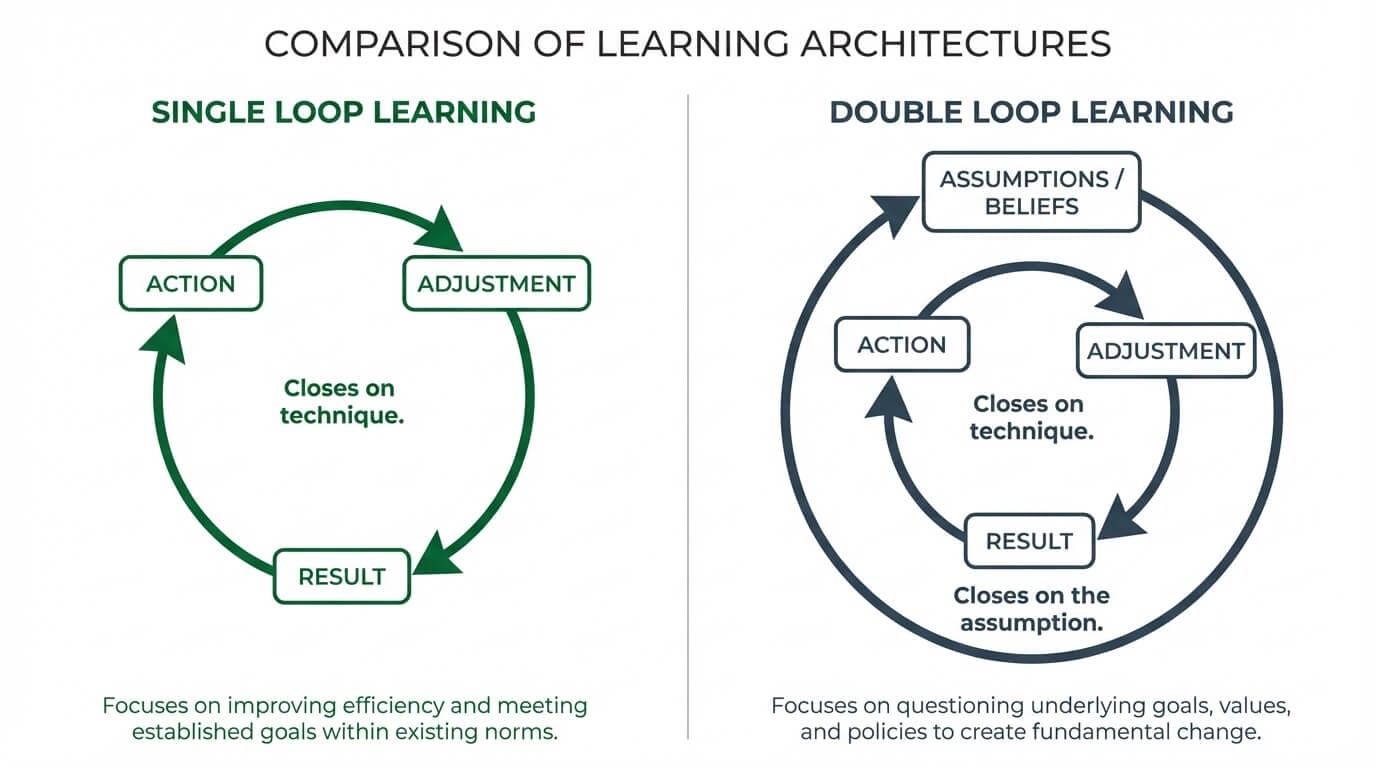
Argyris found this distinction everywhere he looked - in executives, teachers, engineers, consultants. The pattern was consistent: highly skilled professionals were the most likely to get stuck in single loops. Their competence gave them enough success to avoid examining the beliefs driving their choices.
Coaching is no exception. A coach running a single loop after a session where the client didn't commit to action might think: "I need better commitment questions." A coach running a double loop looks at the same session and asks: "What is my assumption about why clients need to leave sessions with commitments? Where did that belief come from? Is it serving this client?"
The single-loop coach improves their toolkit. The double-loop coach discovers that their toolkit was built on an assumption they never chose consciously.
You can hear the shift in language. A single-loop coach says: "I should have asked a different question there." A double-loop coach says: "I notice I keep reaching for questions when the client goes quiet, and I think it is because I am uncomfortable with silence. What is driving that discomfort?"
That shift - from "I should have" to "I notice I keep" - is the signal that the second loop is running.
Learning Loops in Coaching Practice
Learning loops look different at different stages of development. The loop architecture matures as coaches accumulate experience - not automatically, but when they build the right feedback structures into their practice. Three composite portraits from coaching sessions show the progression.
The ACC-Level Single Loop
A coach preparing for their ACC credential finishes a session and reviews their recording. The client asked about a conflict with their direct report, and the coach spent twelve minutes exploring the relationship history before realizing they never asked what the client wanted from the conversation. The coach writes in their journal: "Get to the desired outcome earlier. Don't let the story run."
This is useful. The next session will probably be tighter. But the loop only touches technique - session management, question timing, structure adherence. The coach is learning to operate the model they were taught. They are not yet examining why they let the story run in the first place. Was it people-pleasing? A belief that understanding context is always necessary before moving forward? The single loop doesn't ask.
The Post-ACC Double Loop
A year later, the same coach reviews a session where a client dismissed three consecutive reflections. Instead of writing "Try different reflection styles," the coach pauses and asks: "Why do I keep offering reflections when the client is clearly in problem-solving mode? Do I believe reflections are always the right move? Where did I learn that?" They realize their training emphasized reflective listening so heavily that they default to it even when the coaching session calls for something else entirely. The assumption - "reflection before action" - had become invisible through repetition.
The double loop surfaces it. The coach doesn't just change their technique; they update the belief that was selecting their techniques for them.
The PCC-Level Meta-Loop
An experienced PCC-level coach notices something during a session, not after it. The client is describing a leadership challenge, and the coach catches themselves formulating a powerful question. In that moment, the coach asks internally: "Am I reaching for this question because it serves the client, or because I want to demonstrate coaching skill?" They let the question go. The silence that follows produces more than the question would have.
This is not single or double loop. It is the loop infrastructure running in real time - a meta-awareness of one's own learning patterns happening inside the coaching session itself, not just in post-session review. The coach is simultaneously coaching and observing how they coach.
When the Loop Closes Wrong
A knot forms when a learning loop closes on the wrong variable. The coach is reflecting, learning, adjusting - but the loop keeps circling back to the same safe explanation, skipping the assumption that actually needs examination.
The most dangerous loops are the ones that feel productive. You are reflecting, adjusting, working the problem - and the knot just pulls tighter, because real inquiry would mean looking at the one thing you have decided not to question.
The most common knot in coaching supervision looks like this: a coach notices that clients repeatedly fail to follow through on commitments. Session after session, the coach adjusts. They try different commitment questions. They add accountability structures. They follow up between sessions. Nothing changes. The coach concludes: "This client is not motivated enough."
The loop is closing on client motivation every time. The variable it never reaches is the coach's own assumption about accountability - that commitments made in session should translate to action outside of it, and that when they don't, the gap is in the client. When a mentor coach or supervisor opens that loop with a different question - "What is YOUR assumption about how accountability works in coaching?" - the knot begins to loosen. The coach discovers they believe accountability means the client should do what they said they would do. They have never examined whether the commitment was genuinely the client's or whether it was offered to close out the session on a productive note.
Knots are invisible to the person running the loop precisely because they feel like learning. The coach is reflecting. They are adjusting. They are working hard at it. But the loop keeps resolving to the same variable because examining the real one would require questioning something the coach takes as given about their role, their method, or their identity as a professional.
This is where coaching presence intersects with learning loops. A coach caught in a knot often has strong presence in the room - they are attentive, skilled, engaged. The knot is not about what happens during the session. It is about what happens in the coach's relationship with their own practice.
Building a Learning Loop Practice
Awareness of loop architecture is useful. Tools that make it concrete are better. Two practices, drawn from supervision work, build double-loop learning into the rhythm of a coaching practice without requiring a supervision session every week.
The Loop Journal
After each coaching session, write two entries. First: What I adjusted (technique, timing, approach). Second: Why I thought my original choice was right. The first entry runs the single loop. The second opens the double loop by forcing you to articulate the assumption behind the action. Over weeks, patterns in the "why" column become visible that no amount of technique adjustment would reveal.
The loop journal works because it externalizes the assumption. Most coaches can identify what they would do differently. Fewer can name the belief that made the original choice seem obvious. Writing it down converts an invisible default into something you can actually examine.
The second tool is a quarterly pattern inventory. Review your loop journal entries from the past three months and look for recurring themes in the "why" column. Which assumptions show up most often? Which ones have you updated? Which ones keep appearing without resolution?
The assumptions that keep appearing without resolution are candidate knots. They are the variables your loop keeps circling without closing on. Bringing these to a reflective practice session, a peer supervision group, or a mentor coach gives you external perspective on what the loop is skipping.
Neither tool requires a partner, though both become sharper with one. The loop journal is a solo practice. The pattern inventory can be done alone, but sharing it with a peer group or mentor coach surfaces blind spots that self-review cannot reach. Supervision exists, in part, to find the knots that the coach's own loop infrastructure is designed to miss.
Start small. One journal entry per session. One pattern review per quarter. The infrastructure builds on itself - once you start noticing the "why" column, you cannot stop noticing it during sessions. That is the meta-loop beginning to form.
Loop Architecture Across Credentials
The ICF credential progression maps loosely but usefully to loop architecture. At the ACC level, coaches are learning to close loops at all - to take session outcomes and feed them back into their practice in a structured way. Much of ACC-level development is building the habit of post-session reflection and identifying what to adjust.
ACC Certification — $3,999
60+ training hours, mentor coaching, and supervision included. Everything ICF requires for your Associate Certified Coach credential.
I have watched coaches hit 3,000 hours and stay stuck. And I have watched coaches at 500 hours grow faster than people twice their experience. The difference was never the hours. It was always what they did with the space after the session ended.
At PCC, the developmental challenge shifts. The coach has reliable single loops. The work now is closing on assumptions - examining not just what happened in a session but why the coach's default choices seemed right. PCC-level mentor coaching frequently surfaces beliefs about the coaching role that the coach absorbed during training and never revisited.
At MCC, the loop infrastructure is largely automatic. The coach is running real-time awareness of their own patterns during sessions, not just in retrospective review. The distinction between "coaching" and "observing how I coach" collapses into a single integrated practice.
None of this happens through session volume alone. A coach with 2,500 hours of practice and no loop infrastructure may be less developed than a coach with 500 hours and a disciplined journal practice. The hours are necessary. The loops determine whether the hours produce development or just familiarity. If you are working toward your ACC credential or considering the next step, Tandem's ICF ACC program builds reflective loop practices into the training structure from the start.
Frequently Asked Questions
What is the difference between reflective practice and learning loops?
Reflective practice is the broader discipline of examining your coaching work after the fact. Learning loops describe the specific mechanism within reflective practice - what your reflection closes on. You can have a strong reflective practice that runs only single loops (adjusting technique without examining assumptions). Learning loops are the internal architecture of how reflection produces change.
How do I know if I am running a double loop or just overthinking?
Double-loop learning changes something. If your examination of an assumption leads you to coach differently - not just think differently about coaching - the loop is productive. If you find yourself analyzing the same pattern repeatedly without any shift in your actual practice, the loop may have become a knot closing on self-criticism rather than genuine inquiry. A useful test: can you name the specific assumption you updated and point to a session where you acted on the update?
Can I use learning loops with clients, not just for my own development?
The loop framework applies to any learning context, but be cautious about importing coaching development vocabulary into client sessions. Clients benefit from the experience of double-loop learning - examining assumptions beneath their behaviors - without needing the Argyris terminology. Your job is to facilitate the loop, not teach the model. When a client says "I keep trying different approaches and nothing works," that is an invitation to open the second loop on their assumptions, not to explain loop theory.
ACC Certification — $3,999
60+ training hours, mentor coaching, and supervision included. Everything ICF requires for your Associate Certified Coach credential.
See the ACC Program →