What Got You Here Won’t Get You There — The Currency Version
There is a moment in every senior leader’s career when the skill that earned the promotion stops working. Not because it was wrong. Because the room changed. The CFO’s precision, the CTO’s technical depth, the COO’s operational excellence — each was the reason they were promoted. Each becomes the reason they plateau. The strength and the ceiling are the same thing. And nobody sends a memo when the exchange rate shifts.
If you have spent years building credibility in a function and that description lands somewhere deeper than theory, this article is about the pattern underneath. Not a personality flaw. Not a skill gap. A structural dynamic where the patterns your career installed keep paying in a currency the room has stopped accepting.
Key Takeaways
- Every career level trades in a different currency — the specific competence that earns standing and credibility. What works at one level has diminishing returns at the next.
- The shift is not announced. Nobody tells you the exchange rate changed. You just notice that working harder at the old thing produces less and less.
- The old currency does not become worthless. It becomes table stakes — necessary but no longer sufficient.
- Leaders spend old currency because it is tied to professional identity. Releasing it feels like losing the thing that makes them credible.
- A coach who understands the currency shift does not ask you to abandon the old strength. They help you see where the new level is asking you to invest.
The Currency You Earned
Every function installs a specific form of excellence that defines what it means to be good. Not good at your job — good, full stop. In finance, it is precision: you are credible because you are accurate. In technology, it is building: you are credible because your systems work. In legal, it is thoroughness: you are credible because you find the risk before it finds the organization. In marketing, it is resonance: you are credible because your work moves people. In operations, it is reliability: you are credible because nothing breaks. In HR, it is trust: you are credible because people come to you. In product, it is delivery: you are credible because the thing shipped and users adopted it.
That currency is real. It took years to earn and it works — at the level where you earned it. The problem is that each major career transition resets the exchange rate, and the currency that bought credibility at one level buys less at the next.
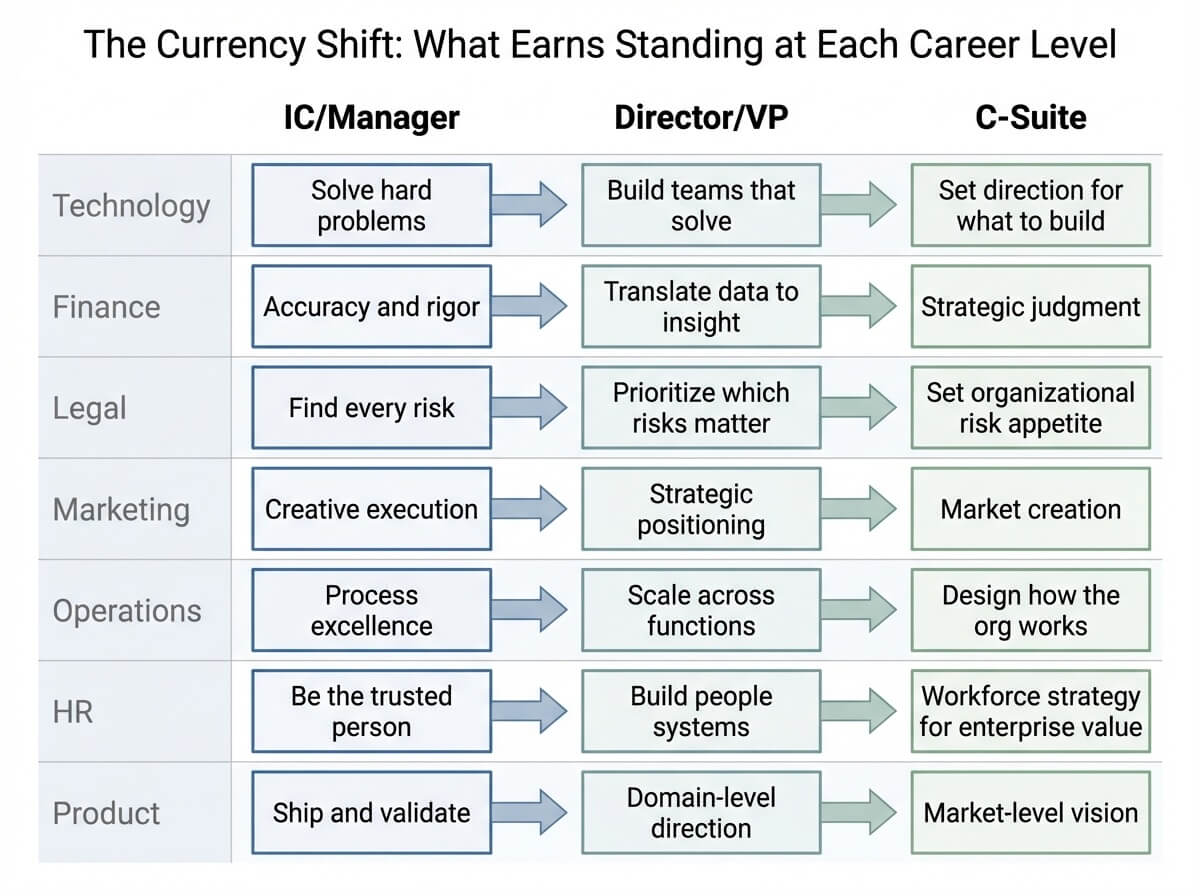
| Function | IC / Manager Currency | Director / VP Currency | C-Suite Currency |
|---|---|---|---|
| Technology | Code quality, solving the hardest problems. “I solve hard problems.” | Team output, architectural decisions, translating technical to business. “My team solves hard problems.” | Strategic bets, innovation portfolio, organizational design. “I set the direction for what we build and why.” |
| Finance | Accuracy, catching errors, reliable models. “I see what others miss.” | Translating data into insight for non-finance audiences. “I help others see what the numbers mean.” | Strategic judgment, capital allocation, board narrative. “I shape where we invest and why.” |
| Legal | Airtight reasoning, risk identification. “I find the problem before it finds us.” | Risk prioritization, enabling smart risk-taking. “I help the business take smart risks.” | Strategic counsel, organizational risk appetite, board governance. “I help the organization navigate complexity.” |
| Marketing | Creative execution, campaign performance. “I make things that resonate.” | Strategic positioning, cross-functional influence. “I shape how the market sees us.” | Growth strategy, market creation, competitive narrative. “I define where we play and how we win.” |
| Operations | Process excellence, reliability. “I make things run.” | Cross-functional orchestration, scaling systems. “I make things run at scale.” | Organizational design, transformation leadership. “I design how the organization works.” |
| HR | Employee trust, being the safe person. “People come to me.” | Talent strategy, data-informed people decisions. “I shape the systems that shape how people work.” | Culture architecture, workforce strategy, board-level people narrative. “I build the human capability the strategy requires.” |
| Product | Delivery by proxy — features ship, users adopt. “I define the right things and they get built.” | Strategic judgment within a domain. “I set the direction for this domain and it proved right.” | Market vision, spending credibility before the evidence arrives. “I define where this market is heading.” |
Read your row. If the posture at your current level does not describe how you actually operate — if you are still living in the column to the left — you are spending old currency.
The Shift Nobody Announces
The first major shift hits at Director or VP. The world moves from personal output and team execution to influence without direct authority. You must now operate across functions where nobody reports to you, translate between strategy and execution for audiences with different priorities, and build alliances you never needed before.
Recognize Your Row?
If you found yourself in the wrong column of that table, that recognition is where coaching starts. We begin by naming what your career built — not by asking you to abandon it.
What travels forward is credibility. Deep knowledge of the work earns respect. What derails is staying in execution mode: solving problems the team should solve, reviewing work that should be delegated, defining personal value through individual contribution rather than through influence.
The old currency does not become worthless. It becomes table stakes — necessary but no longer sufficient. And the difference between table stakes and currency is the difference between being respected and being influential.
The second shift hits at C-suite. Cross-functional influence gives way to enterprise-level judgment. The board does not want your functional analysis. They want strategic counsel — where should we invest, what should we stop, how does this organization navigate what is coming? The carry-forward that derails is thinking departmentally: over-indexing on the function that raised you, confusing being informed with being in control.
Each shift activates the same dynamic. When your career becomes your identity, the currency shift threatens something deeper than competence. The finance leader asked to stop building models is not being asked to change a behavior. They are being asked to trust something other than data. The technology leader asked to stop reviewing code is not being asked to manage their time better. They are being asked to find a new source of professional self-worth. The strength that got you promoted is the one holding you back — not because it was wrong, but because it answered a question the room stopped asking.
What Spending Old Currency Looks Like
The same dynamic shows up across functions, wearing different clothes.
The CFO who was promoted for financial rigor keeps building the model personally. Forty-slide decks. Every assumption documented, every sensitivity tested. The board wants three slides and a recommendation. The CFO gives them more data because more data is where credibility lives in their formation. Being right about the numbers used to be enough. Now the room is asking for judgment that the numbers alone cannot justify.
The CTO who was promoted for technical judgment still reviews every pull request. Still solves the hardest bug rather than building a team that solves hard bugs without them. The hands-on-keyboard identity resists releasing because it is where they feel most competent. The new currency — organizational design, strategic bets, board-level communication — does not produce the fast, clear feedback that code does.
The COO whose operational excellence was invisible keeps optimizing individual processes rather than designing cross-functional systems. Keeps being the person who fixes what breaks rather than the person who builds resilience so things break less. The work is excellent. The room needs something the work does not provide: a voice that speaks to where the organization is going, not just how well it runs.
The General Counsel keeps cataloging every risk without prioritizing. The CMO keeps crafting the campaign rather than building the strategic narrative. The CHRO keeps being the trusted confidant rather than the systems architect. The CPO keeps pointing at features shipped rather than asking whether the right things were built.
Each of these leaders is doing excellent work. That is the trap. The work itself is not the problem. The problem is the work substitutes for the harder, less certain work the role actually requires. And the old work feels like contribution because it always was — until the exchange rate changed.
What Changes With a Coach Who Gets This
Generic coaching hears “I keep presenting better analyses to the board but they still don’t trust my judgment” and offers influence coaching: presentation skills, executive presence, stakeholder management. These are not wrong. They are incomplete. They treat the symptom without naming the structure underneath.
See How Tandem Coaches Differently
Our approach starts with understanding the currency your career installed. Not personality assessments. Not generic influence coaching. Your formation — and where the exchange rate changed.
A coach who understands the currency shift hears the same sentence and recognizes that this leader is spending Director-level currency in a C-Suite environment. The analysis was the old currency. The board is not asking for better analysis. They are asking for a point of view — expressed with the kind of conviction that a career in finance actively trained out of them, because conviction without evidence is, in their formation, irresponsible.
The coaching question is not “How can you be more influential?” The question is: “You have described ‘better analysis’ three times as your solution. What would change if the quality of the analysis was not the variable you adjusted?”
That question respects the formation. It does not tell the CFO to stop being analytical. It surfaces the assumption that analysis is always the right investment. And it opens a space where the leader can discover — on their own terms — that the new level is asking them to spend a currency they have never fully trusted: judgment.
The coach who understands what your career installed does not ask you to abandon it. They ask what happens when the room stops rewarding it.
This is the same dynamic for every formation. The technology leader who needs to stop building and start directing. The legal leader who needs to stop preventing and start navigating. The operations leader who needs to stop running and start designing. The coaching does not change the engine. It redirects what the engine is pointed at.
The New Investment
The patterns your career installed are not the problem. They are the foundation. A CFO without analytical rigor is not a better CFO. A CTO without technical credibility is not a better CTO. The foundation stays. It is necessary. It is no longer the thing that earns the room’s confidence at this level.
The question is not whether to release the old currency. The question is whether you can see the shift clearly enough to invest in the new one before the old one fully devalues. That investment — from precision to judgment, from building to directing, from preventing to navigating, from running to designing — is not a skill gap to close. It is a professional identity to expand.
If you recognized your row in that table and found yourself in the wrong column, that recognition is where coaching starts. Not with a development plan. With a conversation where someone who understands what your career built — and where it might be reaching its limit — asks the questions you have not been asking yourself.
A Conversation About What the Room Is Actually Asking For
A 30-minute call where your coach already understands the currency your career built and where it might be reaching its limit. No assessment. No intake form. Just a conversation that starts where your formation meets the new level.
Book a Free Consultation →