Executive Team Coaching: What It Is, How It Works, and When Your Team Needs It
What is executive team coaching and how does it work?
Executive team coaching treats the leadership team as a single client — not the individuals on it. A coach stands outside the team system, surfaces patterns the team cannot see from inside, and holds members accountable to their own agreements. Engagements run 6–12 months and end when the team sustains results without the coach present.
The executive leadership team meets weekly. They present updates. They approve budgets. They make decisions that nobody follows through on. Between meetings, each member runs their function independently. Strategy gets reinterpreted in hallways. Disagreements surface as passive noncompliance rather than direct conversation.
This pattern has a name, and there is a coaching discipline designed for it. Executive team coaching works with the leadership team as a decision-making system, not with the individuals on it. The distinction matters because the dysfunction lives in the relationships between leaders, not inside any single leader.
Key Takeaways
- Executive team coaching treats the leadership team as a single entity, not as individuals who happen to share a conference room. The 7 cornerstones of effective team coaching provides the ICF-grounded framework that structures that work. For context on how individual executive coaching differs, the executive coaching guide covers the full individual engagement arc from assessment to sustainability.
- Three trigger patterns signal when a leadership team needs coaching: strategic misalignment, trust erosion, and team transition
- A typical engagement runs 6–12 months, with the exit criterion being team self-sufficiency, not coach dependency
- Coaching fails when the team does not want it or when the organizational environment contradicts what coaching aims to build
What Executive Team Coaching Is
Executive team coaching is a sustained coaching engagement where the client is the leadership team itself—a practice certified by the ICF ACTC credential. Not the CEO, not the CHRO who signed the contract, not the individual executives who sit around the table. The coach works with the team as a single entity: a multi-person client whose patterns, agreements, and relational dynamics are the subject of the work.
Buyers reach this same work under several names. Leadership team coaching and senior leadership team coaching describe the engagement when an executive or senior leadership team is the client. Management team coaching applies it a layer below the C-suite, and corporate or business team coaching frames it in organizational terms. The vocabulary tracks the team’s level and the language of whoever is buying. The discipline does not change: the coach works with the team as one decision-making system rather than developing its members one at a time.
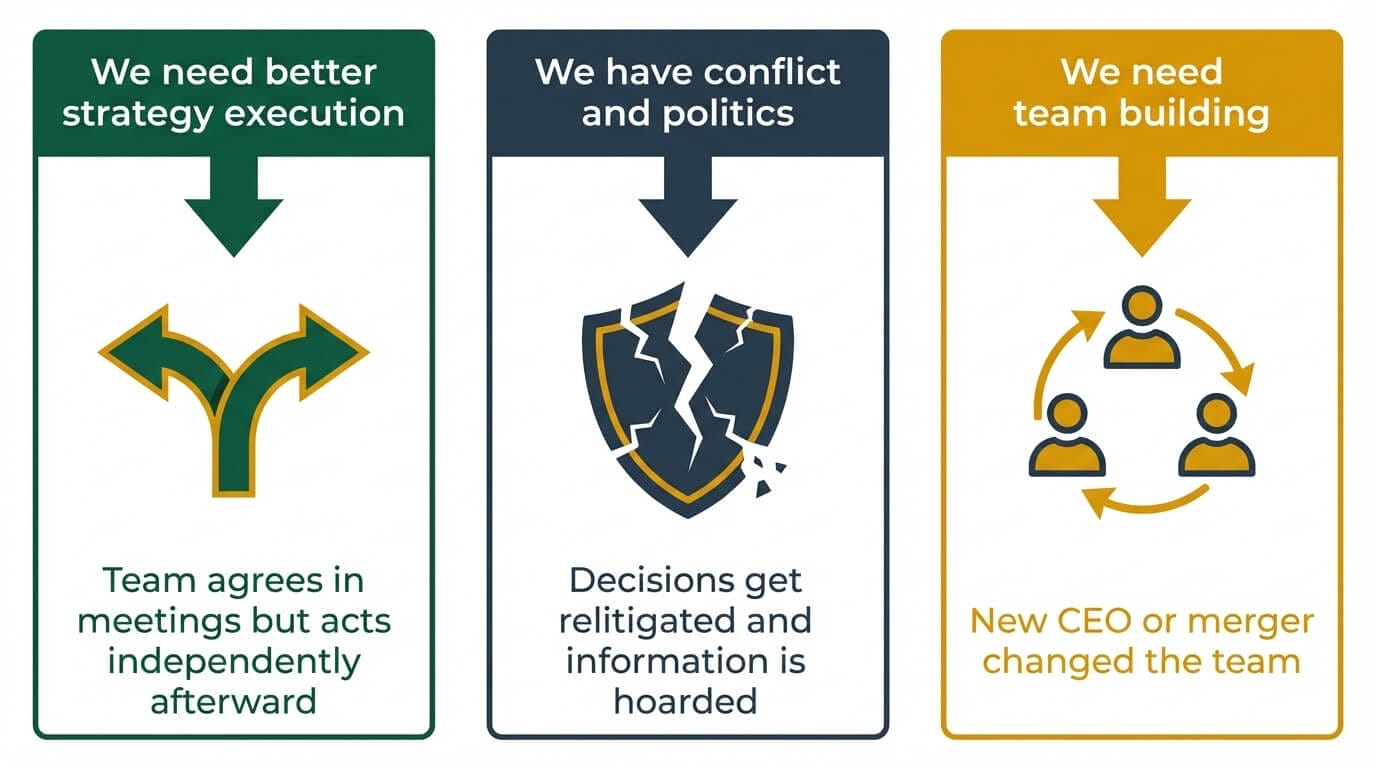
This is fundamentally different from two interventions that buyers frequently confuse it with.
Individual executive coaching develops each leader separately. A coach meets with the VP of Engineering on Tuesdays and the CFO on Thursdays. Both improve their personal leadership. Neither session addresses what happens when those two leaders interact: the competing priorities, the turf boundaries, the information that does not flow between their organizations.
Facilitated strategy offsites produce decisions and action items over one or two days. The facilitator leads from the center of the room, structuring the conversation toward outcomes. When the offsite ends, so does the intervention. The patterns that produced the misalignment before the offsite typically reassert themselves within weeks.
Executive team coaching occupies different territory. The coach stands outside the team system, not at its center. The engagement runs months, not days. The team does its own work. The coach surfaces patterns the team cannot see from inside, holds the team accountable to its own agreements, and creates space for the conversations the team has been avoiding. The process builds the team’s capacity for self-management rather than creating dependency on an outside expert.
When Leadership Teams Need Coaching
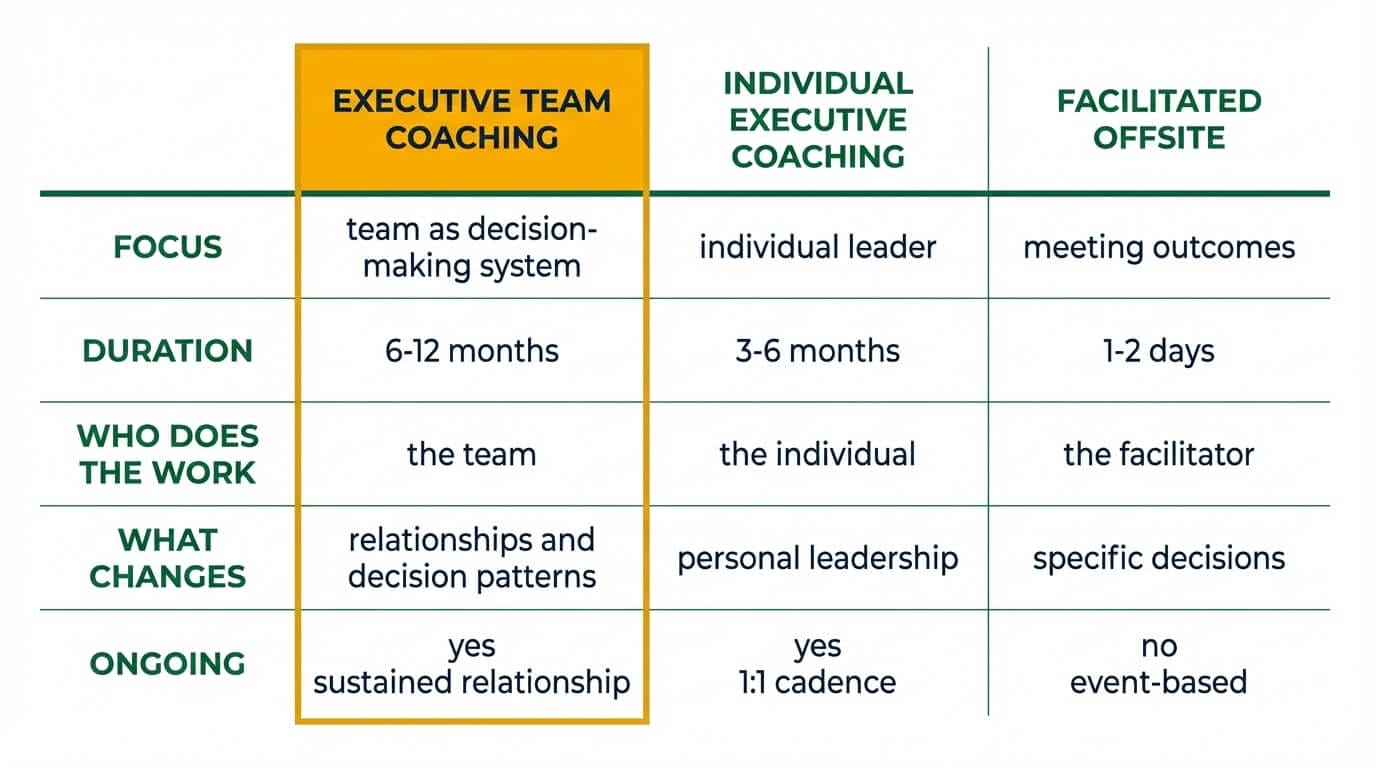
Three patterns consistently signal that an executive team has outgrown what individual development and periodic offsites can address. Each pattern has a presenting problem that organizations name first, and a deeper problem underneath it that coaching actually works on. Recognizing which pattern applies determines whether coaching is the right intervention.
Strategic misalignment. The presenting complaint: “We need better strategy execution.” The team agrees on direction during meetings. They nod, take notes, and then act independently once they return to their functions. The strategy gets reinterpreted in each silo. Decisions made collectively get relitigated in one-on-ones. Senior leaders leave the room aligned and arrive at their next staff meeting telling different stories about what was decided.
The real problem is not the strategy. It is that the team has no shared decision-making protocol, no mechanism for productive disagreement, and no accountability structure that holds across organizational boundaries. Strategic thinking happens inside each function but not between them. The leadership team lacks the practice of making decisions together and holding those decisions as binding.
Trust erosion. The presenting complaint: “We have too much conflict and politics.” Information gets hoarded. Decisions get reverse-engineered for political advantage. Leaders manage up rather than managing across. New initiatives die not from opposition but from quiet noncompliance. One-on-one relationships between leaders may function adequately, but the group dynamic produces results that no individual relationship explains.
The real problem: the team’s interpersonal trust has degraded to the point where self-protection is more rational than collaboration. Individual coaching cannot repair this because the trust deficit exists between people, not within them. Building trust requires the team to learn new patterns of communication and conflict resolution together, in the room, under pressure, with real stakes.
Transition. The presenting complaint: “We need team building.” A new CEO arrives, a merger reshuffles the leadership ranks, or a restructuring changes who reports to whom. The old team dynamics no longer apply, but nobody has built new ones. Senior leaders who were peers last month now report to someone who was their peer’s peer. Relationships that worked under the old structure may not transfer.
The real problem: the team does not yet exist as a functioning unit. Its members share a reporting line but not a shared purpose, shared norms, or shared experience of working through conflict together. Leadership team coaching development in these moments accelerates what would otherwise take 12–18 months of trial and error. These transitions often overlap with succession planning and leadership development work already underway.
Individual coaching cannot repair a trust deficit that exists between people, not within them.
How Executive Team Coaching Works
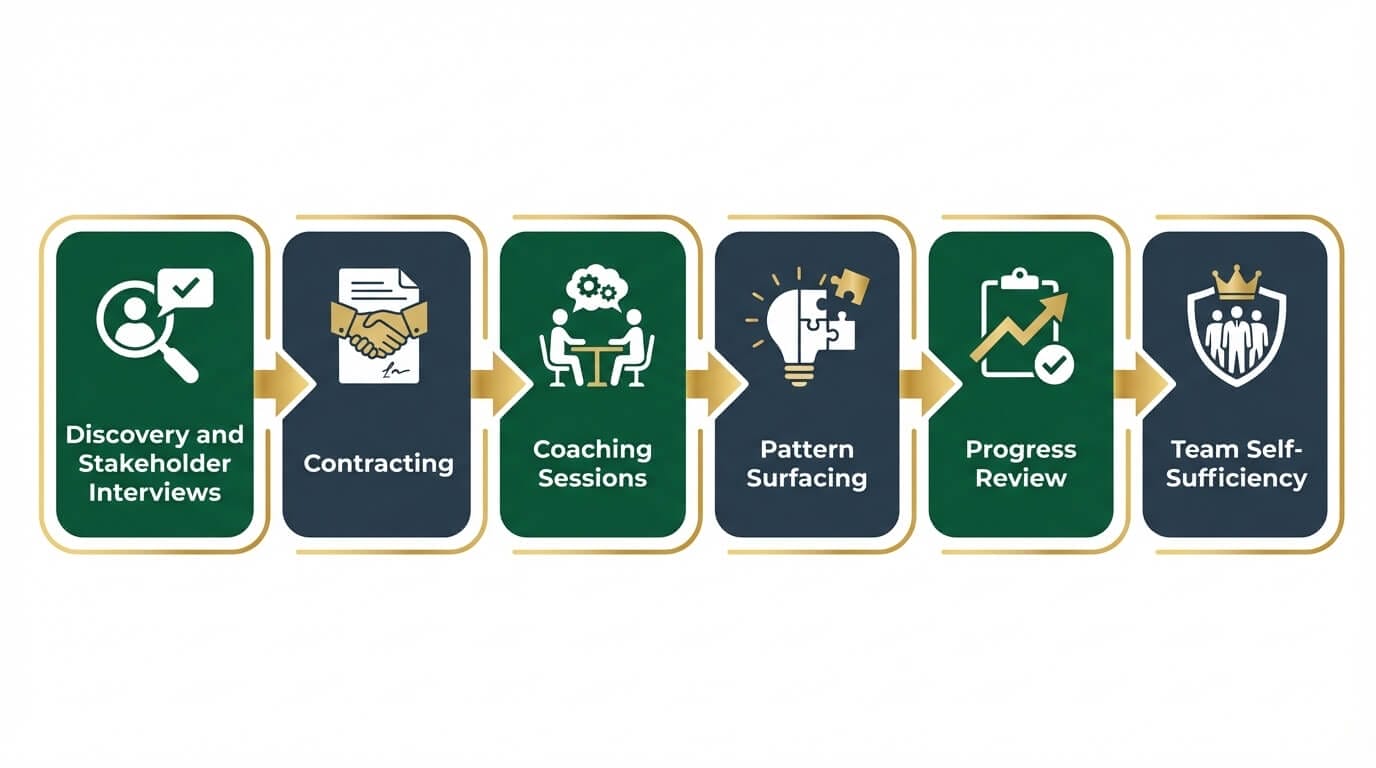
An executive team coaching engagement typically runs six to twelve months. The structure follows a progression from discovery and stakeholder interviews through contracting, regular coaching sessions, pattern surfacing, and accountability, ending when the team can hold itself to its own standards without external support.
Discovery and stakeholder interviews. The coach interviews each team member individually, along with key stakeholders above and around the team. The purpose is not to diagnose the team’s problems. The team will do that work itself. Discovery maps the terrain: what each member sees as the team’s challenges, what conversations are not happening, where the gaps between stated values and actual behavior sit. These individual sessions also begin building the coaching relationship and establishing the psychological safety that group work requires.
Contracting. The coaching contract is negotiated with the team, not dictated by the sponsor. This distinction matters. When a CHRO hires a team coach, the CHRO often has a specific outcome in mind: “Fix the conflict between the VP of Sales and the VP of Product.” The team coach resists that framing. The team decides what it wants to work on, even if the answer differs from what the sponsor expected. If the sponsor’s goals and the team’s goals conflict, that tension becomes part of the coaching work.
Coaching sessions. The team meets with the coach on a regular cadence, typically biweekly or monthly. Sessions focus on the team’s real work: actual decisions, actual conflicts, actual patterns playing out in the room. The coach is not the center of the conversation. The team talks to each other, not to the coach. The coach steps in when patterns become visible: when the team reverts to familiar avoidance, when one voice consistently dominates, when the agreed-upon norms get silently violated.
When the challenge is individual rather than collective, C-suite coaching addresses the same structural conditions at the single-leader level. This is where executive team coaching diverges most sharply from professional development training or facilitated workshops. The coach does not deliver content, run exercises, or lead the group through a predetermined agenda. The team does its own work. The coach’s role is to help the team see what it cannot see from inside its own dynamics, and to support the team in developing its own capacity to manage those dynamics going forward.
Pattern surfacing and accountability. Over months, the team begins to see its own patterns without the coach pointing them out. A member notices when the team is relitigating a settled decision. Another flags when the conversation is circling rather than progressing. The coach’s role shifts from surfacing patterns to reinforcing the team’s growing capacity to self-correct.
Self-sufficiency. The engagement ends when the team can hold itself accountable without external support. The strongest outcome of executive team coaching: a team that functions without the coach in the room. The goal is not a permanent coaching relationship but a leadership team that has internalized the skills and practices it needs to sustain high performance independently.
One coaching engagement produced a team that, after months of improved results, decided to revert to their old working patterns. The coach did not fight the decision. Within two weeks, the team recognized the old patterns were not working. They returned to the new approach voluntarily. Not because the coach told them to, but because they had internalized the change through their own experience. That is what sustainable development looks like at the team level.
The strongest outcome of executive team coaching: a team that functions without the coach in the room.
What Executive Team Coaching Produces
Framed in the language the leadership team’s organization actually uses: faster decisions that hold. Fewer meetings where the same issue resurfaces. Strategic priorities that translate into coordinated action across functions. Team members who challenge each other productively instead of avoiding conflict or engaging in political maneuvering.
Stay in the Loop
Coaching insights and strategies delivered periodically to your inbox.
The changes are behavioral and structural, not motivational. Teams that complete a coaching engagement develop concrete practices: decision protocols, escalation norms, feedback cadences, and ways of naming when the team is slipping back into old patterns. These persist after the coaching ends because the team built them together. They are not the coach’s frameworks imposed from outside. The learning is experiential: the team practices new behaviors in the context of real business challenges, not in a training simulation.
Honesty about what coaching cannot guarantee: specific revenue improvements, particular delivery velocity gains, or measurable ROI percentages. The business outcomes are real but they manifest as improved leadership effectiveness rather than as numbers a CFO can put on a slide. Organizations that need hard ROI metrics before investing may find that consulting, which delivers specific recommendations and measurable implementation plans, is a better fit for their decision-making culture.
How to Evaluate a Team Coach
Four questions separate coaches who work effectively with executive teams from those whose experience is primarily individual coaching repackaged for groups. The answers reveal whether the coach understands the team as a system, holds relevant credentials, has executive-level experience, and will name honestly when coaching is not the right fit.
Has the coach been on an executive team? Coaching executive teams from the outside is not the same as understanding the room from the inside. A coach who has sat in the chair—who has navigated the politics, managed the competing mandates, experienced the loneliness of disagreeing with a CEO’s direction, brings pattern recognition that no certification alone provides. That experience shapes how the coach reads group dynamics, when they choose to intervene, and what they recognize as organizational rather than interpersonal. Both of Tandem’s founders spent 15–20+ years in technology leadership before becoming coaches. They have been on the teams they now coach.
Does the coach work with the team as a system? Ask specifically: “Will you meet with team members individually or coach us as a group?” If the answer emphasizes individual sessions with periodic group check-ins, that is individual coaching with a group wrapper. Team coaching means the primary work happens with the team in the room, working on the patterns between members.
What credentials does the coach hold? The ICF team coaching competencies (ACTC credential) specifically address the skills of coaching a team as an entity. A PCC or MCC credential demonstrates general coaching competence but does not guarantee team coaching capability. The combination of executive-level coaching credentials plus team-specific training is the strongest indicator. Ask about professional development: a coach who continues to invest in their own learning signals the same growth orientation they will ask your team to adopt.
Will the coach name when coaching is not the right intervention? Ask: “Under what circumstances would you tell us not to hire you?” A coach who answers this honestly, who names the conditions under which coaching fails, is more trustworthy than one who positions coaching as a universal solution. The answer reveals whether the coach will have the hard conversation with your team or your sponsor when the environment contradicts the coaching goals. That willingness matters more than methodology. For team coaching investment context, this candor also signals the coach is optimizing for your outcomes, not for engagement duration.
Tandem provides business team coaching services built on both executive experience and ICF-level credentials, the combination that makes the evaluation criteria above possible. Our approach treats the leadership team as the client, works with real business challenges rather than simulated exercises, and measures success by the team’s ability to sustain results after the engagement ends. When choosing a coaching firm for team engagements, the evaluation criteria above apply regardless of the provider.
A coach who names the conditions under which coaching fails is more trustworthy than one who positions coaching as a universal solution.
When Coaching Is Not the Answer
Three conditions make executive team coaching structurally unable to produce results, regardless of the coach’s skill: the team does not want it, the organizational environment contradicts the goal, or the problem is structural rather than relational. Recognizing these early saves time, money, and the credibility of coaching as an intervention.
The team does not want it. When a board mandates coaching for a leadership team that does not see a problem, the team arrives in sessions defending against an intervention they did not choose. “Just because a manager says ‘go coach that team’ doesn’t mean that team is ready for coaching. If they feel like they’re being punished by getting a coach, you’re not going to be able to do anything.” The team must have its own reason to change. Without willingness, the coaching relationship has no foundation.
The organizational environment contradicts the goal. The leadership team is asked to collaborate, but the management system around them rewards competition. Individual performance reviews pit leaders against each other for a fixed bonus pool. Promotion structures require leaders to advocate for their function rather than the enterprise. “What is important for their survival is pleasing their boss, and therefore they can’t be dedicated to the team’s success because they’ve got to worry about their individual success.” Coaching cannot override incentive structures. When the organizational environment actively undermines what coaching aims to build, the ceiling is structural and no amount of skilled facilitation will raise it.
The problem is structural, not relational. Sometimes the leadership team’s dysfunction is not about trust, communication, or decision-making patterns. It is about org design: overlapping mandates, unclear reporting lines, roles that require leaders to compete rather than collaborate. These are consulting or organizational design problems. The same principle applies at the individual level — when individual coaching is not enough, naming that honestly matters. When team coaching is not the right fit, naming the alternative honestly (consulting, restructuring, mediation) is more valuable than forcing a coaching engagement onto a structural problem.
FAQ
How long does executive team coaching take?
Most executive team coaching engagements run 6–12 months. Shorter engagements rarely allow enough time for the team to move through discovery, develop new patterns, and internalize changes. The exit criterion is team self-sufficiency, meaning the team’s ability to hold itself accountable to its own agreements, not a predetermined end date. Some teams reach this point in six months; others need the full year, particularly when deep trust repair is part of the work.
Can executive team coaching happen remotely?
Yes. Remote and hybrid executive team coaching is effective, though the coach may recommend occasional in-person sessions for initial discovery and critical turning points. The sustained cadence of biweekly or monthly sessions works well in virtual format.
How do you get buy-in from a leadership team that is skeptical about coaching?
Start with the presenting problem, not with “coaching.” Executive teams respond to business language: “We need to make faster decisions that hold” or “We need to stop relitigating strategy every quarter.” Frame the engagement as working on specific organizational challenges, not as a coaching program. The team’s willingness to work on its own dynamics matters more than enthusiasm for coaching as a concept. Once the team experiences early results, a meeting where disagreement produces a better decision rather than a stalemate, skepticism typically resolves on its own.
What is the difference between executive team coaching and leadership team coaching?
They describe the same discipline. The label usually tracks the team’s level and the buyer’s vocabulary: leadership team coaching and senior leadership team coaching when an executive or senior leadership team is the client, management team coaching one layer below the C-suite, and corporate or business team coaching when the framing is organizational. In every version the work is identical. The coach treats the team as a single decision-making system rather than coaching its members individually. What changes is the seniority of the team and the stakes of its decisions, not the method.
Is Your Leadership Team Ready for Coaching?
The three trigger patterns above may sound familiar. A 30-minute conversation can help you determine whether executive team coaching fits your situation, or whether a different intervention would serve you better.
Book a Conversation →