Executive Presence for Women: Beyond the Double Bind
How can women develop executive presence?
Start with a 360 assessment split by rater group, not averaged. That data reveals whether the gap is in expression, authority, or organizational template mismatch. Each gap type requires a different intervention. Treating a context gap as an expression gap through generic presence tips reinforces the double bind rather than resolving it.
Women share four frustrations in coaching intake conversations more than any others:
- “I’m not being heard.”
- “My ideas get ignored or taken by others.”
- “Being direct gets me labeled as aggressive.”
- “Being gentle makes people see me as weak.”
Read those four statements together. The last two contradict each other. Direct gets punished. Gentle gets punished. The feedback points in two directions at once — a double bind that intensifies when the executive is also navigating the strategic framework for transforming executive roles in the AI era through time reallocation.
That contradiction is not a personal failing. It is a signal that requires a coach specifically equipped to work with it — which is why choosing from the top female executive coaches who understand these dynamics from the inside is often the most effective starting point. It is a signal — one that coaches trained in the core listening competencies for coaching agile leaders and executives are specifically equipped to hear and work with. Specifically, it signals that the organization is defining “executive presence” through a template that penalizes certain leadership styles regardless of how they are delivered. The question is not how do I fix my presence? but which part of this feedback is about me, and which part is about the system I operate in?
That question has a specific, data-driven answer. 360-degree assessment data, disaggregated by stakeholder group, reveals whether the feedback reflects the leader’s behavior or the organization’s implicit definition of who gets to be “executive.” Understanding what executive presence means diagnostically, rather than as a checklist of traits to perform, changes everything about how women leaders approach this work. The same diagnostic shift informs executive mentorship and support networks for ADHD leaders, where presence gaps often trace back to systemic barriers rather than personal deficits.
Key Takeaways
- Contradictory presence feedback for women often signals a context gap (an organizational template mismatch), not a personal failing
- 360-degree data split by rater group reveals whether feedback reflects the leader’s behavior or the evaluators’ expectations
- Four development strategies match interventions to gap types: expression, authority, context, and organizational allies
- Coaching adapts the leader but cannot fix an organizational culture with narrow presence definitions
The Double Bind as a Context Gap
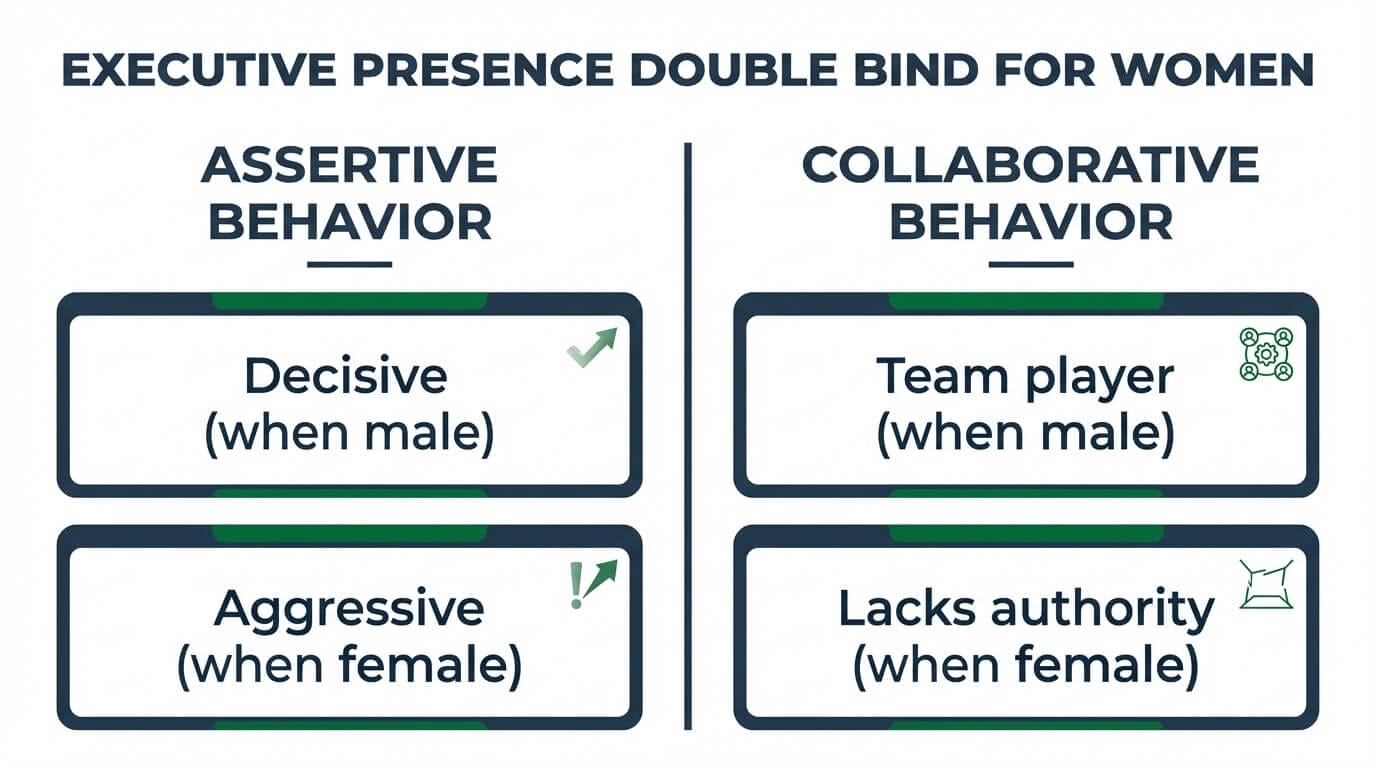
Executive presence for women operates under a structural constraint that no behavioral adjustment alone can resolve. Catalyst’s double-bind research documents the mechanism: women who display assertive communication styles receive lower likeability ratings. Women who display collaborative, relational styles receive lower competence ratings. The penalty applies regardless of which direction the leader adjusts.
Tinsley and Ely’s analysis in Harvard Business Review sharpened the finding: organizations interpret identical behaviors differently depending on the gender of the leader. Decisive action reads as leadership in one context and bulldozing in another. The variable is not the behavior. It is the audience’s cultural template for what “executive” looks like.
Newer work puts a sharper edge on this, and it lands directly on the techniques presence training actually teaches. In a series of experiments involving more than 3,000 people across the United States, University of Limerick researcher Mary Hausfeld found that charismatic communication benefited women and men alike — women using these techniques were read as charismatic and effective, and in some cases drew more support from followers. The condition is in the fine print. Women received the full benefit only when they already held a formal position of authority. For women still making the case for a seat at the table, the same techniques returned less. For men, no such condition applied: charisma paid regardless of title. Context moved the result too, and again only for women — an identical performance lands differently in finance, law or engineering than it does in healthcare, education or the non-profit sector.
Read carefully, that is a finding about evaluation rather than about capability. The techniques work. What varies is the authority the audience already grants the person using them, which means a woman without positional authority is being asked to earn authority using a tool whose payout depends on having it. That is not a training problem, and no amount of rehearsal closes it.
Standard executive presence advice treats this as a challenge to overcome through better individual calibration: find the sweet spot between assertive and warm, project confidence without threatening, speak up without dominating. That framing assumes the sweet spot exists. The double-bind data says it does not, at least not consistently across stakeholder groups.
The frustration is concrete. A woman leader runs a direct meeting. She receives feedback that she was “too aggressive.” She softens her approach in the next meeting. She receives feedback that she “lacked conviction.” She adjusts again. The target keeps moving because the target was never about her behavior in the first place. It was about an implicit set of expectations that shift depending on who is evaluating and what their definition of “executive” includes.
A more precise framing treats the double bind as a context gap: the organization’s definition of executive presence was built on a default template that rewards certain communication styles and penalizes others, independent of effectiveness. The context gap is not about the leader. It is about the environment the leader operates in.
This distinction matters because it changes the coaching intervention. Closing a genuine expression gap (where the leader processes deeply but displays little) responds to behavioral practice. Closing a context gap (where the organization’s template systematically misreads the leader’s style) requires a different approach entirely. McKinsey’s Women in the Workplace data confirms that women’s representation drops at every transition point from entry level to C-suite. The pipeline attrition is not random. It correlates with the points where presence evaluations carry the most weight in promotion decisions — which is why executive coaching for career transitions often begins precisely at those inflection points.
The double bind is not a problem to solve through better calibration. It is a diagnostic signal. When feedback points in two directions at once, the variable is the organization’s template, not the leader’s behavior.
What 360 Data Reveals About Gendered Feedback
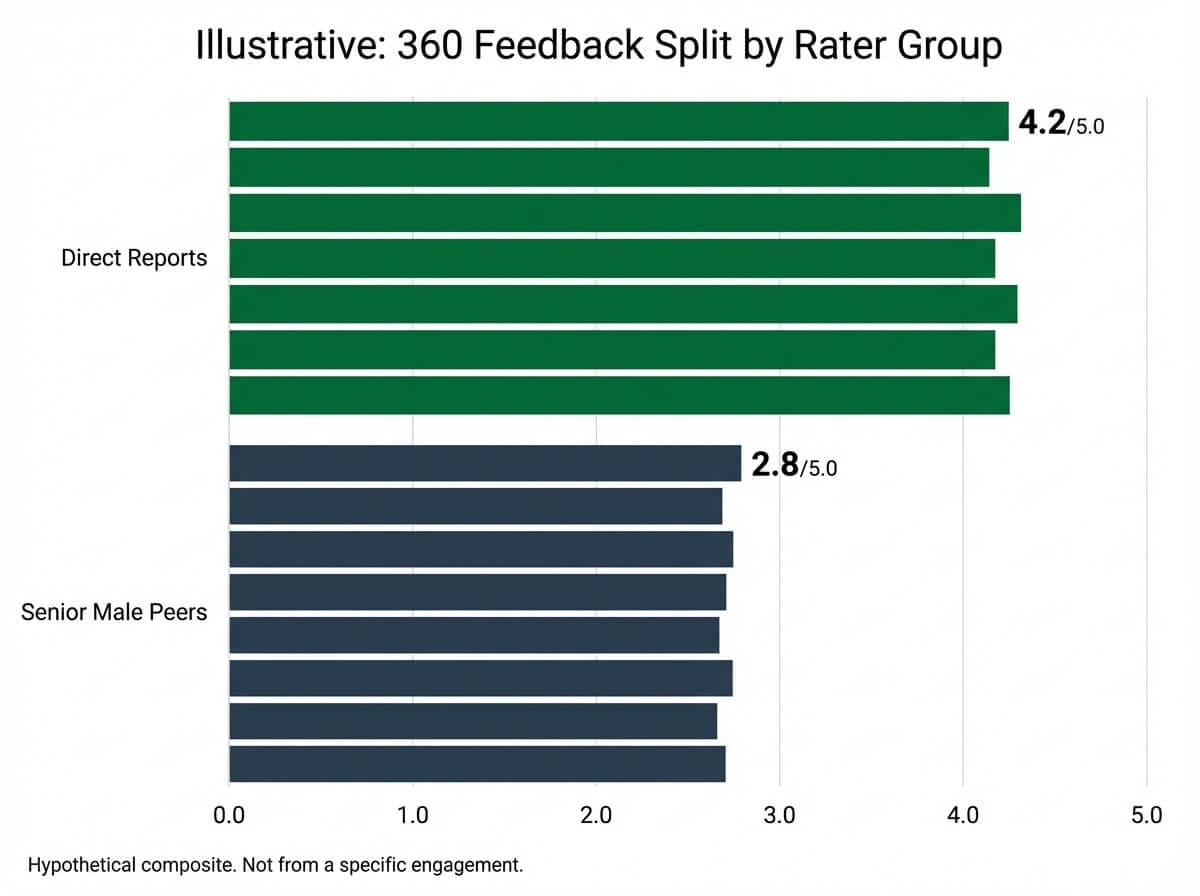
The double bind becomes visible in 360-degree feedback data when ratings are split by stakeholder group rather than averaged into a single score. Three executive presence patterns surface consistently in assessment data from women leaders who report contradictory presence feedback.
Pattern 1: The rater-group split. Consider a senior VP whose 360-degree feedback shows a pronounced divide: direct reports rate her communication 4.2 out of 5.0. Peer-level male colleagues rate the same dimension 2.8 out of 5.0. Senior leadership ratings fall somewhere between, often splitting along the evaluator’s own communication style. A composite score of 3.5 would suggest moderate competence. The disaggregated data tells a completely different story: one audience sees a strong communicator while another sees a weak one. The gap is not about her behavior. It is about which audience is evaluating, and through what definition of “executive.”
Pattern 2: The “too much / not enough” paradox. Open-ended 360 comments include contradictory descriptors from different rater groups. “Needs to be more assertive” from one group and “can be too direct” from another. When the feedback is averaged, the contradiction disappears into a mediocre composite score. When the ratings are disaggregated by rater group, the contradiction becomes the finding. The average hides the diagnosis. The split reveals it.
Pattern 3: The emotional intelligence overlay. Women with the strongest emotional intelligence assessment scores often face the widest perception gaps. High emotional attunement makes them more aware of the double bind, which leads to real-time self-editing in meetings. She reads the room, senses that directness will be penalized, recalibrates mid-sentence, and the recalibration itself reads as uncertainty. That self-monitoring consumes cognitive bandwidth that should go toward the work itself. Over time, it creates a visible hesitancy that gets read as lacking confidence. The original feedback creates the very behavior it warned against. Standard advice to “develop your emotional intelligence” misdiagnoses this problem. The intelligence is already there. The expression is what needs targeted work.
An organizational audit conducted before coaching begins distinguishes whether the feedback reflects a genuine gap or a systemic template mismatch. The audit examines who gave what feedback, through what lens, and whether the “presence problem” maps to the leader’s actual behavior or to a narrow cultural definition she did not write. Without this step, coaching risks treating the leader as the sole variable in a system where she is one of several. With this step, the coaching plan targets the right gap: expression, authority, or context.
That diagnostic step determines everything that follows in coaching. It is the difference between adapting the leader to the system and equipping the leader to work within the system with clarity about which part of the adaptation is worth the cost. Explore how 360 assessments reveal gendered perception gaps in detail.
Development Strategies That Account for Context
Generic presence advice fails women leaders because it prescribes the same tips regardless of which gap type produces the feedback. “Be more assertive” and “build your personal brand” and “project confidence” assume one universal deficit. The assessment data almost never confirms that assumption. Assessment-driven coaching matches the intervention to the diagnosis. Four strategies apply depending on what the data reveals.
Strategy 1: Close genuine expression gaps. If 360-degree feedback shows consistent low visibility across all rater groups (not just some), the issue is expression, not perception bias. The leader processes deeply but displays little. Genos EQ emotional expression scores often confirm this: high internal awareness paired with minimal external display. Coaching targets specific communication adjustments: narrating decision rationale in real time instead of announcing conclusions, asking “what are you seeing?” before offering your own read, making internal processing visible to the people who need to see it. These are not personality changes. They are communication shifts within the leader’s authentic range.
Strategy 2: Build authority in audience-aware ways. Some women leaders carry genuine expertise but still operate in the register that earned their previous promotion: over-preparing, proving value through volume, adding to every conversation. This over-preparation pattern is common across genders, but for women it is reinforced by organizational signals that her authority needs more evidence to be accepted. The 40-slide deck for a meeting that warranted five is a compensatory behavior, not a strategy. The shift from proving to projecting requires restraint, not effort. Speaking less so that when you do speak, it carries more weight. Selective contribution over comprehensive coverage. Developing executive presence through this lens means adjusting organizational positioning, not personal confidence.
Strategy 3: Address the context gap strategically. When the organizational audit reveals that the primary barrier is a narrow presence template, the development path splits. Some leaders choose strategic adaptation: they learn to read the organizational culture, identify where selective adjustment is worth the cost to their career advancement, and adapt in targeted ways while preserving their core leadership identity. Others reach the conclusion that the fit is poor. Both are legitimate paths. The coach’s role is to ensure the leader makes that choice with full organizational awareness, not by defaulting to self-blame.
The advice to “stop apologizing and speak more directly” assumes the problem is always an expression gap. When the actual barrier is a context gap, increasing directness without organizational support triggers the likeability penalty without gaining the competence credit. Each behavioral adjustment aimed at the wrong gap type reinforces the double bind rather than resolving it. Diagnosis before prescription is the difference between development and self-editing.
Strategy 4: Build organizational allies. Individual behavior change has limits when the system is the primary variable. Peer sponsorship and senior advocacy function as system-level complements to individual coaching. A senior sponsor who can articulate the leader’s value in language the organization’s culture recognizes as “executive” creates a bridge between the leader’s actual influence and the organization’s ability to see it. Trust-building with key stakeholders who can reframe how the leader’s style is interpreted within the organizational culture addresses the context gap in ways that self-improvement alone cannot. Relationships at the right organizational altitude change which template gets applied. For executive presence examples showing how each strategy plays out in practice, see how gap-matched coaching produces different outcomes than generic advice.
The organizational picture explains why so much of the development burden keeps falling on individual women to solve for themselves. Brandon Hall Group's 2026 Women in Leadership research found that only 28% of organizations describe themselves as highly effective at developing women for senior leadership roles, and fewer than 14% have actually achieved more than 50% women in senior positions. The gap between stated commitment and functional infrastructure is enormous. For a woman developing her executive presence, this matters in a specific way: the development strategies you adopt have to assume the organizational scaffolding around you is thinner than the diversity statement suggests. Waiting for the system to produce context-appropriate development is a low-probability bet. Building it deliberately - through sponsorship, coaching, peer groups, and the specific feedback mechanisms that account for the double bind - is what actually moves people through the pipeline that exists, not the one the org chart implies.
When Coaching Alone Is Not Enough
Coaching adapts the leader. It does not change the organizational culture. That honest limitation is where this conversation earns or loses trust.
Executive Coaching for Senior Leaders
1:1 partnership with MCC-credentialed coaches—built for senior leaders navigating high-stakes decisions, transitions, and growth into the C-suite.
When the organizational audit reveals that the context gap is the primary barrier, the coaching engagement shifts from “develop the leader” to “help the leader see the full picture and choose.” The assessment data maps the terrain. The coaching conversation explores what the leader wants to do with that information.
Some leaders choose adaptation. They sharpen their ability to read the culture, identify where strategic adjustment is worth the cost, and adjust selectively. They accept the trade-off and build influence within the existing template, while working to gradually broaden the organization’s definition of leadership through their track record.
Some leaders choose exit. They recognize that the organization’s presence template is narrow enough that sustained adaptation would cost more than it returns. The coaching engagement helps them articulate what they are looking for in a better-fit environment and how to position their leadership style as an asset rather than a liability. Career development planning shifts from “how do I succeed here?” to “where does my leadership style create natural authority?” That reframe alone, understanding that the misfit is mutual rather than unilateral, reduces the anxiety that accompanies career transitions for women who have been told the problem is their presence.
Coaching firms that promise to “unlock your executive presence” without naming the organizational variable are selling a partial solution. The most honest coaching outcome for some women is not behavioral change but organizational clarity.
Both paths are legitimate. The coach’s role is to ensure the leader makes that decision from organizational clarity, not from the assumption that the problem is always personal.
For the organization, the recommendation sometimes shifts to the CHRO or talent development leadership. The conversation becomes about which leadership styles the culture is systematically excluding and what that exclusion costs in retention, pipeline diversity, and decision quality. Organizations that define executive presence through a single template lose leaders whose influence operates through different channels: relational authority, collaborative decision-making, or stakeholder engagement that builds trust over time rather than commanding attention in the moment. That is an organizational coaching conversation, not an individual one.
Tandem names this in the discovery conversation. We tell prospective clients that not every presence challenge is about the leader. Sometimes the most honest recommendation is not more coaching but a structural conversation with the organization about its implicit definition of who gets to be “executive.” Tandem is a woman-owned, HUB-certified firm. Cherie Silas, one of fewer than 1,000 Master Certified Coaches worldwide, has coached women leaders through exactly this question. Executive presence coaching that starts with the organizational audit produces different work than coaching that assumes the leader is the sole variable. For leaders who want an executive coaching experience built for women leaders, the difference starts in the first conversation.
How Women Can Start Developing Executive Presence
Every strategy above depends on one prerequisite: knowing which gap you are actually closing. Women who ask how to develop executive presence are usually handed a training list first - an assertiveness workshop, a personal-branding program, a communication course - before anyone has established whether the barrier is expression, authority, or an organizational template no course can touch. The order of operations matters more than the tactics.
A defensible development path for leadership presence runs in this sequence:
- Diagnose before you develop. Run a 360 assessment split by rater group. Disaggregated data tells you whether the feedback is consistent (an expression gap you can close through practice) or contradictory (a context gap that training alone will not resolve).
- Match the intervention to the gap. Expression gaps respond to targeted communication work. Authority gaps respond to positioning shifts, not more preparation. Context gaps require organizational allies and, sometimes, a clear-eyed decision about fit. Generic executive presence training for women assumes everyone carries the same deficit; the assessment data almost never agrees.
- Build the scaffolding the org chart implies but rarely provides. A senior sponsor, a peer group of women leaders, and feedback mechanisms that account for the double bind do more for durable presence than any single workshop.
This is where a checklist and structured executive coaching diverge. Coaching built for women leaders starts with the diagnostic, then matches the work to what the assessment actually reveals - which is why recommendations that skip the diagnosis so reliably miss.
FAQ: Executive Presence for Women
Why is executive presence harder for women to develop?
The double bind creates contradictory feedback: assertive women face likeability penalties while collaborative women face competence penalties. This means the “right” behavior shifts depending on the audience, making consistent presence development structurally more difficult. The challenge is not lower capability. It is a moving target that men in similar roles typically do not face.
Can executive coaching fix the double bind?
Coaching can close genuine expression and authority gaps effectively. It cannot change an organizational culture that defines “executive” through a narrow template. When the context gap is the primary barrier, coaching helps the leader diagnose the system, choose a strategy (adapt or find a better fit), and execute that strategy with organizational awareness.
What makes presence coaching different for women?
Gender-aware presence coaching starts with an organizational audit that assesses whether feedback reflects the leader’s behavior or the organization’s definition of leadership. That diagnostic step determines the coaching plan. Standard presence coaching skips this step and treats the leader as the sole variable, which can reinforce the double bind rather than resolve it.
The presence question for women leaders is not “how do I fix myself?” It is “which part of this feedback is about me, and which part is about the system I operate in?”
That question has a specific, data-driven answer. Assessment instruments reveal the gap type. 360-degree data split by rater group shows whether the feedback is consistent or contradictory. An organizational audit identifies whether the culture’s presence template includes or excludes the leader’s natural style.
A coaching engagement that starts with that question produces different work than one that assumes the problem is always the leader. For leaders ready to act on what that engagement surfaces, the 30-day productivity transformation provides a structured sequence for converting new awareness into operating habits.
Not Sure Where to Start?
Book a free consultation to discuss your goals and find the right path forward.
Book a Free Consultation →