Plan targeted outreach to referral partners so your professional network starts sending clients, using a proven, step-by-step coaching framework.
Free PDF - professionally formatted, ready to print or fill digitally
Download Free PDF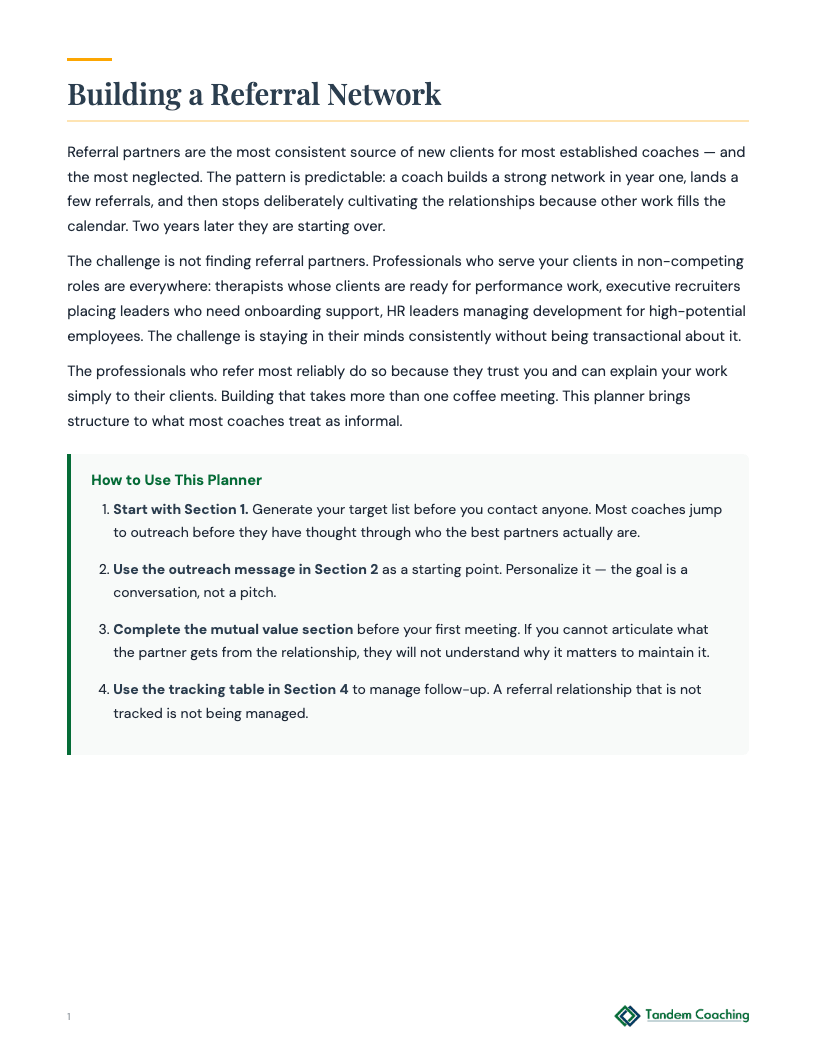
Your best source of new clients is probably someone you already know. This planner helps you identify those relationships and approach them with the right conversation.
A coach who had solid referral relationships in her first two years has let them lapse. She's been at full capacity and stopped nurturing the network. Now a major client engagement is ending and she has no pipeline. She has relationships that could generate referrals but hasn't contacted most of them in 12 to 18 months. The planner gives her a structured way to re-activate rather than starting over.
Give as between-session work with a specific instruction: start with Section 4 (tracking table) before Section 1 (target list). Have her populate the tracking table with names she already knows and enter the last contact date. The exercise of filling in the 'last contact' column is itself diagnostic - most coaches underestimate how long it's actually been. Once the timeline is visible, the re-activation plan follows more naturally than if she starts from scratch.
In Section 3 (mutual value proposition), watch whether she can articulate what the referral partner gets from the relationship in specific terms. Vague answers - 'a trusted resource for their clients' - indicate she hasn't thought through the value from the partner's perspective. The partners who refer most reliably do so because they can explain the coach's work simply and accurately. If she can't articulate it, neither can they.
Start with the tracking table: 'Who on this list has sent you a client in the past 18 months?' Then: 'Who on this list do you believe thinks of you as the person they'd call for executive coaching?' The gap between those two lists is the network health problem. Then move to re-activation: 'What would a genuine, non-transactional check-in look like for the two or three relationships with the most potential?' Don't plan the pitch - plan the conversation.
If the tracking table reveals that the coach has never received a referral from any professional relationship and has been relying entirely on inbound leads or personal network, the referral strategy is starting from zero rather than re-activating. Severity: low. That's a different problem than a dormant network - it requires building the category of relationship from the beginning, not re-engaging existing partners.
A newly credentialed coach (ACC) who comes from a human resources background wants to build her practice without paid advertising. She has strong professional relationships from her HR career but hasn't thought through which of those relationships could become referral partnerships. She's been making coffee meetings without a strategic frame for which meetings matter most.
Have her complete Section 1 (identify referral partners) before any outreach conversation. The checklist of partner categories is a starting point - but the more important step is having her map which professionals in each category she already has a relationship with. Give the instruction: 'Go through the category list and write one to two names per category of people you actually know. Don't add names you'd need to cold-contact - just people who would recognize your name.' That constraint immediately reveals where her warm network sits.
Watch whether she loads up on same-profession contacts - other coaches, HR colleagues - rather than adjacent professionals who serve her target clients in a different capacity. Coaches who refer most effectively to other coaches usually have clear niche differentiation. If she and her HR colleagues do similar work, the referral relationship doesn't have a natural basis. The most durable partners are typically non-competing professionals who serve the same client.
After the Section 1 work, ask: 'Who on this list has the most direct contact with the specific people you want to coach?' Then: 'What does their client or colleague look like the day before they'd reach out to you?' That question - what does the client look like right before they need a coach - sharpens the referral conversation more than any value proposition statement does. Partners need to recognize the moment, not just know the coach exists.
If she has no relationships with adjacent professionals outside of HR - her entire network is HR practitioners - the referral strategy requires building new professional categories, not activating existing relationships. Severity: low. That's a longer-term network development challenge. Consider whether she needs a different short-term client acquisition strategy while building the referral base over 12 to 18 months.
An executive coach who has built most of his practice from referrals from a single therapist colleague - who has since retired. Over three years, that one relationship generated a dozen clients. He has no other referral infrastructure. The planner gives him a way to rebuild deliberately rather than scrambling for individual leads.
Start with the post-tool prompt at the end of the planner: 'How many partners on your list last received contact from you in the past 90 days?' In his case, the answer is probably zero - because there was only one partner. That single data point clarifies the scope of the rebuild before the Section 1 work begins. Then work forward: 'Given what made that relationship work well, what kind of professional generates that same kind of referral fit?'
Watch whether he tries to replicate the specific relationship type (therapist) rather than the characteristics of the relationship (trusted, shared client base, non-competing). The prior partner happened to be a therapist, but the category of relationship that worked was one where the client had done personal work and was ready for performance focus. That characteristic could describe several professional categories beyond therapists.
Work through Section 3 (mutual value proposition) carefully. 'What did your referral partner get from this relationship?' If he can describe it specifically - 'She knew I'd take her clients seriously and not turn them into a coaching revolving door' - he has a value proposition he can articulate to the next five partners. If he describes it vaguely - 'she trusted me' - the next relationship will be harder to build intentionally because he doesn't know what made the first one work.
If the coach is highly resistant to outreach - avoids the contact plan, finds reasons why every potential partner wouldn't work - the resistance may be about the professional risk of positioning himself clearly enough for others to describe. Some coaches avoid referral relationships because being referable requires being specific about who they serve and what they do. Severity: low. Name the positioning question directly rather than working on outreach tactics.
A coach whose client experience is inconsistent from one engagement to the next
Coach BusinessA coach who improvises discovery calls and loses prospects to inconsistency
Coach BusinessA client wants to move from reactive client communication to a proactive engagement strategy with clear touchpoints