Emotional Triggers Map

Pathway Builder 🔒
Domain
Life Coaching
Type
Worksheet
Phase
Discovery Action
Details
30 min Between sessions As-needed
Topics
Emotions Resilience Mindset

Coaching tools for personal clarity and intentional living.

When to Use This Tool
Client reacts in ways they later regret but cannot identify what triggered the response
Client is aware their reactions are disproportionate but the pattern keeps repeating
Client wants to respond intentionally but has not mapped the trigger-to-behavior chain
How to Introduce This Tool

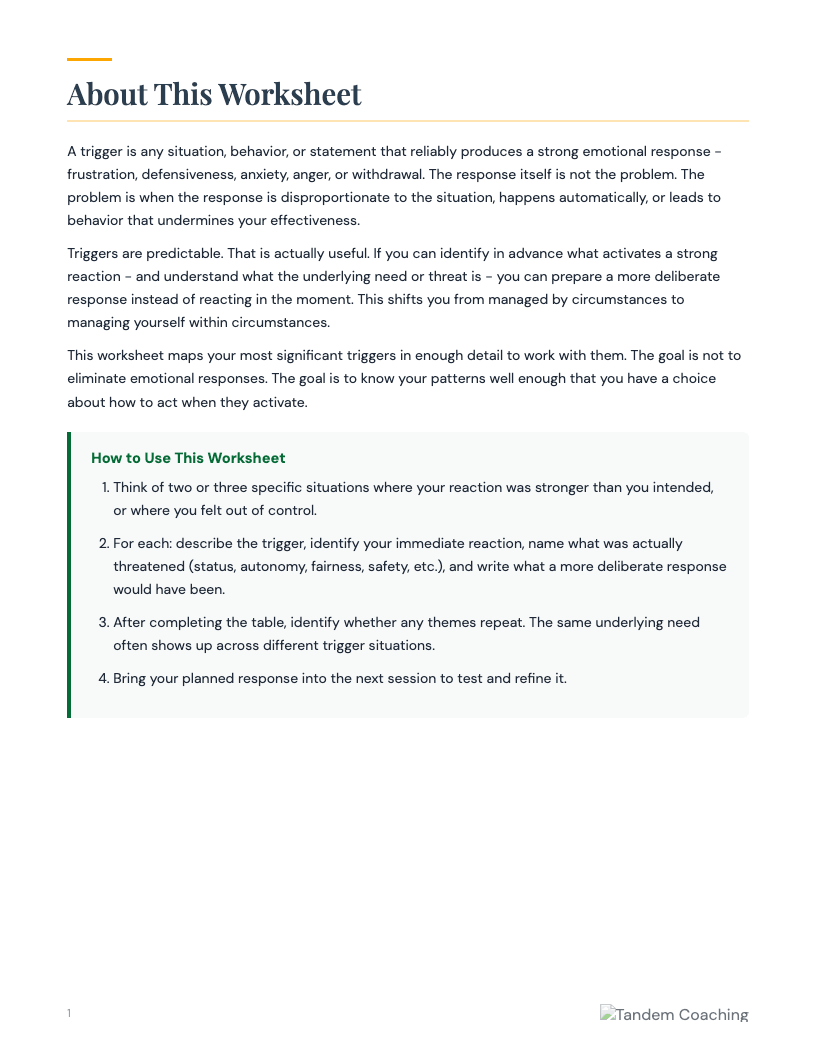
This worksheet traces a trigger through your immediate response, the thought pattern underneath, the behavior it produces, and what an intentional response would look like instead - would mapping a recent example give us something concrete to work with?

Download This Tool

Free PDF - print-ready, professionally formatted

Download Free PDF
Preview Worksheet · 30 min

For the Coaching Practitioner

Coaching Scenarios Plus
1 Executive who becomes dismissive in meetings without understanding why
Context

A director of engineering consistently shuts down in team meetings when his technical decisions are questioned by non-technical stakeholders. He doesn't raise his voice or make accusations — he goes flat, stops engaging, and gives short answers until the meeting ends. Afterward he is functional again. He has received feedback that 'you check out when challenged' and is frustrated by this because he cannot name what causes it. He knows it happens. He does not know why, and previous attempts to 'stay more open' have produced no lasting change.

How to Introduce

The resistance to watch for here is the client's assumption that self-awareness means knowing the emotion — not the chain underneath it. 'You know what you feel in those moments. What we haven't mapped yet is the specific trigger, the story your mind generates from it, and the behavior that follows. Those are different things. This worksheet traces one recent example all the way through — from the specific thing that activated you to the thought pattern it produced to what you actually did and what you would want to do instead.' The distinction between descriptive awareness and structural mapping is what makes this worth doing.

What to Watch For

The Trigger section is where most clients get vague. Watch whether he describes the trigger as a general dynamic ('being questioned') or as a specific instance ('when a product manager suggested the architecture decision was arbitrary in front of the full team'). The specific version is workable; the general version won't produce a usable chain. Also watch the Thought Pattern section — if it reads as a description of the emotion rather than the story ('I felt dismissed' instead of 'the room was deciding I don't know what I'm doing'), the thought-to-behavior link hasn't been separated yet.

Debrief

Start with the chain from trigger to behavior, not with the intentional response. 'Looking at what you wrote: the trigger activated the thought, and the thought produced the behavior. Which of those three steps is the earliest point where you had any awareness in the moment?' That question locates the intervention window. Then: 'At that earliest awareness point, what would it have taken to pause for long enough to choose the response you wrote in the last section?' Don't solve it — let him name the condition.

Flags

If the thought pattern he describes consistently involves beliefs about professional authority or legitimacy — 'I'm not being treated as the expert in the room' — and this appears across multiple trigger situations with similar intensity, the trigger may be connected to a recurring belief about his standing that has deeper roots than the worksheet can address. Severity: low. Continue with the mapping work, but note the belief pattern in the thought column for later exploration.

2 Senior manager whose reactive pattern has made her team conflict-avoidant
Context

A VP of operations received 360 feedback indicating that her direct reports avoid bringing her difficult information, particularly about operational failures. She was surprised by this — she considers herself direct and solutions-focused. In coaching she describes a pattern she is aware of: when she hears about a problem, she immediately moves into rapid-fire diagnosis and accountability questions. She does not register her tone in those moments as reactive because she is focused on the problem. Her team registers it as threatening.

How to Introduce

Use the worksheet to give her access to a side of the interaction she cannot currently observe. 'The feedback is telling you that your team is reading your reaction before you have said anything specific. That suggests there is something happening in your Immediate Response section — emotional and physical — that is visible to them before you get to the solutions. This worksheet maps that gap: what activates you, what you feel before you speak, and what behavior follows. You may not experience what you do as reactive. They do. This gives us a way to see what they're reading.' Name the gap between self-perception and team perception directly.

What to Watch For

The Immediate Response section (emotional and physical) is the diagnostic. Watch whether she can identify any somatic component — jaw tightening, a shift in posture, a change in breathing — or whether her Immediate Response column reads as pure cognitive assessment ('I immediately start analyzing the problem'). A blank or purely cognitive Immediate Response column suggests she has limited access to her pre-verbal state, which is exactly what her team is reading. Don't push for content she doesn't have — but note the gap.

Debrief

After reviewing the completed worksheet, focus on the distance between the Trigger and the Behavior. 'There is a physical response happening between when you hear the news and when you start asking accountability questions. Your team is responding to that physical moment — before you ask anything. Looking at the Intentional Response you wrote: what would have to change in the Immediate Response section for that intentional behavior to be accessible?' This keeps the work in the trigger-to-behavior chain rather than turning it into a performance discussion.

Flags

If she cannot identify any emotional or somatic content in the Immediate Response section after working through two or three recent examples — if the chain reads as purely cognitive throughout — the self-access gap may be significant enough to limit what the worksheet can produce. Severity: low. Continue the tool, but the underlying self-awareness work may benefit from practices that develop somatic awareness over time, not just situational reflection.

3 Mid-level manager whose trigger pattern is blocking a key professional relationship
Context

A manager on a technology team has a working relationship with his counterpart in the finance organization that has become strained over the past six months. He describes the finance manager as 'condescending' and reports that nearly every interaction with her leaves him activated for hours afterward. He has tried to 'not let it get to him' without success. His coach suspects the situation involves a repeating trigger rather than a generically difficult person, but the client has not yet mapped the specific element of their interactions that activates him most reliably.

How to Introduce

Frame the worksheet as an investigation, not a judgment. 'What we don't know yet is exactly what is happening in the moments that activate you — what specifically, not the general experience of condescension. This worksheet traces one specific interaction: what you observed, what you felt, the story your mind generated, what you did, and what you would want to do. Working through one recent conversation with enough specificity often reveals something that surprise questions by themselves don't.' The client's resistance is usually the assumption that the trigger is obvious — the other person's behavior. The worksheet moves the focus to the chain he is participating in.

What to Watch For

Watch whether the Trigger section describes observable behavior ('she spoke to me in front of the group as if I hadn't read the report') or interpretation ('she was condescending again'). Observable specifics are workable; interpretations loop. Also watch the Thought Pattern section for the meaning the trigger carries — 'she doesn't think finance and tech should have equal standing in these conversations' is a different workable target than 'she's dismissive,' and it may reveal whether the trigger is about this person or about a dynamic that appears in other contexts.

Debrief

Start with the question at the bottom of the worksheet: 'Where in the chain do you have the most access to choice?' If he identifies the Behavior section (what he actually did), that is late in the chain — the intervention is happening after most of the damage. If he identifies the Thought Pattern section, ask: 'What would it take to notice that thought at a 3 instead of a 7 on the intensity scale?' Then move to the Intentional Response: 'What you wrote here — is that available from the current state you're describing, or does the state itself need to change first for that response to be accessible?'

Flags

If the trigger pattern he maps is not specific to the finance manager but recognizable from other professional relationships involving a similar dynamic (perceived hierarchy, being spoken to as junior, external challenge to his expertise), the trigger has roots that extend beyond this relationship. Severity: low. The worksheet work is appropriate for the immediate relationship, but name the pattern if it appears: 'I notice this description matches what you told me about the engagement with the external consultants last quarter. Is that the same trigger?'

Tool Flow
Requires
  • named emotional trigger or reactive pattern
Produces
  • trigger-to-behavior chain mapped for specific situation
  • intentional alternative response named
  • highest-leverage intervention point in chain identified

Pairs Well With

Wellness

Trigger Awareness Log

I know I overreact sometimes but I can't predict what sets me off

15 min Tracker
ADHD

Sitting with Feelings

A client moves straight to action whenever they feel discomfort, bypassing the emotion

15 min Framework
ADHD

ADHD Thought Reflection Worksheet

ADHD adult who reacts to situations based on assumptions rather than facts

15 min Worksheet

This tool is part of a coaching pathway

Step 2 of 6 in Client can name what stressed them last week but cannot name the pattern underneath it

Next: Business Continuity Planner → Explore all pathways →


Related Articles

Maximizing Your Coaching Effectiveness: Practical Ways to Apply ICF Competencies

Maximizing Your Coaching Effectiveness: Practical Ways to Apply ICF Competencies

Read article →
Benefits of Leadership Development Programs - Unveiled for Corporates

Benefits of Leadership Development Programs - Unveiled for Corporates

Read article →
We are hired to give our clients solutions that work. Aren’t we?

We are hired to give our clients solutions that work. Aren’t we?

Read article →
Klarna AI Layoffs: Why 55% of Companies Regret AI-Driven Cuts

Klarna AI Layoffs: Why 55% of Companies Regret AI-Driven Cuts

Read article →
ICF Team Coaching Competencies: What They Look Like in Practice

ICF Team Coaching Competencies: What They Look Like in Practice

Read article →
CTO Career AI Disruption: Navigate Tech Leadership Transformation

CTO Career AI Disruption: Navigate Tech Leadership Transformation

Read article →