DBT Wise Mind Worksheet

Pathway Builder 🔒
Domain
Wellness
Type
Worksheet
Phase
Discovery Action
Details
30 min Mid session As-needed
Topics
Emotions Mindset

Supporting sustainable performance and personal resilience.

When to Use This Tool
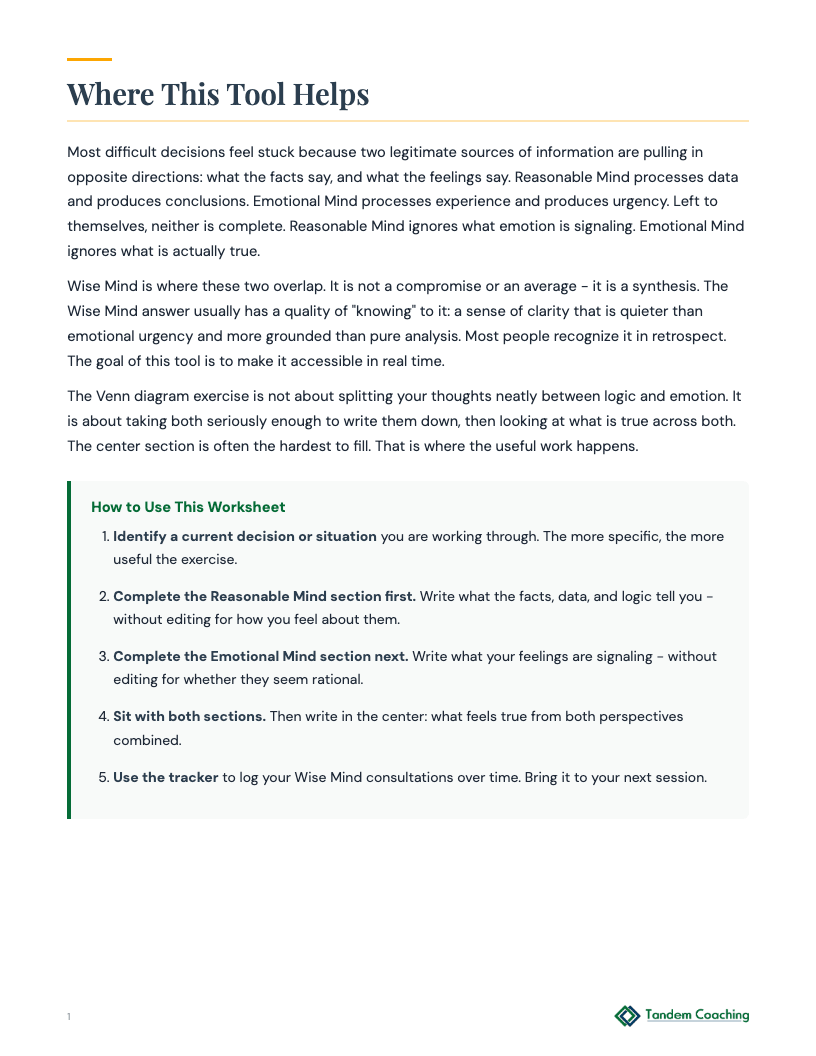
A client makes decisions from pure emotion or pure logic and misses what the other side knows
Someone learning to locate the overlap between reasonable mind and emotional mind
Building a daily practice of pausing to access wise mind before responding
How to Introduce This Tool

On this decision — or in this situation — which part of you is driving most: the analytical side, the emotional side, or somewhere in between?

Coaching Tool Disclaimer
This tool is designed for coaching contexts, not clinical use. If you or your client is in crisis, contact the 988 Suicide and Crisis Lifeline (call or text 988) or Crisis Text Line (text HOME to 741741).

Download This Tool

Free PDF - print-ready, professionally formatted

Download Free PDF
Preview Worksheet · 30 min

For the Coaching Practitioner

Coaching Scenarios Plus
1 Analytical executive who dismisses emotional data in consequential decisions
Context

A CFO makes major decisions through pure analysis and consistently reaches conclusions that are technically correct but produce unexpected human consequences — people resign, teams destabilize, relationships break. He describes emotion as noise and is genuinely puzzled when the numbers-right outcome fails.

How to Introduce

Lead with the Reasonable Mind column and let him complete it fully before asking about Emotional Mind. 'Fill the left column completely first — everything the data and logic say. Then we'll do the right column. Most of your decisions are made at high quality in the left column. What we're checking for is whether there's information the right column holds that the analysis is missing.' Some clients in this profile have never been asked to take their emotional data seriously in a professional context. Keep the framing information-theoretic rather than relational.

What to Watch For

Watch the Emotional Mind column for entries that are one-liners while the Reasonable Mind column is five paragraphs. The asymmetry usually reflects a genuine underdevelopment of the right column, not a lack of emotional experience. Ask him to spend at least as much time on the Emotional Mind section as the Reasonable Mind section, even if what he writes there surprises him. If the center 'Wise Mind knows' section is empty, the synthesis has not happened yet.

Debrief

Start with the center section: 'What did you write for Wise Mind knows? What is the quality of that — does it feel like a guess or like something you actually know?' The phenomenology of Wise Mind — the quality of knowing versus the quality of deciding — is often the most useful exploration for clients who live primarily in Reasonable Mind. Then ask: 'When was the last time you made a decision that had this quality? What did it feel like compared to a purely analytical one?'

Flags

If the Emotional Mind column contains only intellectual descriptions of emotion — 'I am concerned about retention risk' — rather than actual felt states, the client is analyzing his emotions rather than accessing them. Severity: low. This is a useful coaching observation: he can conceptualize emotion as data without yet being able to read it directly. The distinction matters for what comes next.

2 Client paralyzed by emotion in a decision that requires action
Context

A director has been sitting with a career decision for four months — an internal move that offers advancement but would mean leaving a team she has built. The emotional weight of leaving feels equivalent to the career cost of staying, and she cannot move. She describes feeling like she goes in circles.

How to Introduce

Position the Reasonable Mind column as relief, not dismissal of her experience. 'The Emotional Mind has been running this analysis solo for four months and it isn't resolving. What we're doing with the worksheet is bringing the Reasonable Mind into the conversation — not to override the emotion, but to give the synthesis something to work with. The center section is where both inputs can be considered at the same time instead of taking turns.' Some clients in this profile believe that attending to the rational case means abandoning the people they care about. Name that belief directly if it surfaces.

What to Watch For

Watch whether the Wise Mind center section simply repeats the Emotional Mind content with slightly more composed language. If 'My Wise Mind knows I can't leave my team' looks nearly identical to 'My Emotional Mind says it would be devastating to leave,' the synthesis hasn't happened. The center section should contain something that neither outer section contains alone — a constraint, a condition, a both/and that neither pure analysis nor pure emotion can reach.

Debrief

Start with the Wise Mind directive: 'What is my Wise Mind telling me to do?' Read it back to her and ask: 'When you read that — does it feel like something you know, or something you wish were true?' That distinction usually surfaces whether she is in actual Wise Mind or constructing a position she wants to believe. Then ask about the practice tracker: 'What did you notice the second time you used this, compared to the first?'

Flags

If the center section is consistently empty across multiple uses of the worksheet — she can populate both outer columns but cannot synthesize — the block may be something the worksheet cannot address: an underlying grief, an unresolved loyalty, a fear that making a decision means losing something permanently. Severity: low to moderate. Note it; the stuck synthesis is itself a useful coaching data point.

3 Leader who acts on emotion quickly and accurately but cannot explain why to others
Context

A VP makes fast decisions that regularly turn out to be right, but she cannot articulate the reasoning behind them. This limits her credibility with a board that requires a logical case, and it limits her ability to develop her team's decision-making capability. She describes herself as intuitive and trusts it completely.

How to Introduce

Reframe the exercise as a translation tool rather than a correction. 'Your Wise Mind access may already be working. What we're building with the worksheet is the ability to reconstruct the reasoning path — to articulate what the Reasonable Mind contribution was in decisions where you led with knowing. That reconstruction is what your board needs, and it's what your direct reports can learn from.' Some clients in this profile resist the exercise because they fear analysis will disrupt the intuition. Hold the opposite hypothesis: articulating the synthesis may strengthen it.

What to Watch For

Watch the Reasonable Mind column for post-hoc rationalization — constructing a logical case that supports the intuitive conclusion rather than genuinely examining the facts. Ask her: 'Is there anything in the Reasonable Mind column that points away from the direction your Wise Mind is suggesting? Write that in too.' The discipline of including contrary evidence is what separates synthesis from justification.

Debrief

After several practice tracker entries, ask her to read back two or three of them and identify whether the Wise Mind answer changed between the tracker entry and what she actually did. If she regularly had a Wise Mind answer and acted differently, explore what override that in practice. If the Wise Mind answer was consistently right and she followed it, the tracker is now providing evidence she can use to make the case to others.

Flags

If every Wise Mind answer on the tracker points in the same direction regardless of the situation — always toward action, always toward the team, always toward a particular value — the synthesis may have a strong attractor that is functioning as a default rather than a genuine integration. Severity: low. Not necessarily a problem, but worth naming: 'I notice your Wise Mind consistently points toward X. What does that tell you about where your center of gravity is?'

4 Client in a values conflict between career advancement and personal life demands
Context

A senior manager is offered a promotion that requires significant travel and longer hours during a period when his young children need more of him. Both claims feel absolute. He cannot find a position that honors both, and any cognitive analysis produces the same tied result.

How to Introduce

Frame the Venn diagram explicitly as a tool for a tied decision. 'When analysis reaches a tie, that means both inputs are weighty. The worksheet doesn't resolve the tie through more analysis — it asks what you actually know, underneath both sets of data. The center section is for the thing that is true from both directions simultaneously, not a compromise between them.' Some clients in this situation are looking for the worksheet to tell them what to do. Be clear: 'This won't make the choice for you — it will help you locate what you already know about it.'

What to Watch For

Watch whether the center section is a list of conditions rather than a statement of knowing — 'I would accept if X and Y and Z were true' versus 'I know what I need to do.' Conditional acceptance is a Reasonable Mind response. A Wise Mind synthesis is usually unconditional. If the center is a negotiated position, ask: 'What would you write there if none of those conditions could be met?'

Debrief

Start with the directive: 'What is my Wise Mind telling me to do?' Read it back. Then ask: 'If you set this worksheet aside and sat with that sentence for 24 hours — does it hold, or does it dissolve?' Some clients need to test the durability of a Wise Mind answer before they can act on it. The practice tracker is designed exactly for that: consulting Wise Mind across time, not just once.

Flags

If the client returns to the worksheet multiple times and the Wise Mind center remains empty or shifts each time, the decision may be one where external constraints need to change before genuine synthesis is possible — a conversation with his manager, a conversation with his partner. Severity: low. The worksheet is for decisions the client has enough information to make. If structural facts are missing, those need to be gathered first.

Tool Flow
Requires
  • named specific decision or stuck situation to work through
Produces
  • Venn diagram with fact-based and emotion-based inputs
  • synthesized Wise Mind statement and decision direction
  • practice tracker of Wise Mind consultations over time

Pairs Well With

Wellness

Trigger Awareness Log

I know I overreact sometimes but I can't predict what sets me off

15 min Tracker
Wellness

ABC Model

A client reacting strongly to situations and wants to understand why

15 min Framework
Life

Wheel of Emotions

Client describes feeling 'bad' or 'off' but cannot name the emotion with any specificity

15 min Assessment

This tool is part of a coaching pathway

Step 4 of 6 in Client can name what stressed them last week but cannot name the pattern underneath it

Next: GROW Model Coaching Worksheet → Explore all pathways →


Related Articles

ICF Core Competencies: Coaching Mindset Self-Development

ICF Core Competencies: Coaching Mindset Self-Development

Read article →
Maximizing Your Coaching Effectiveness: Practical Ways to Apply ICF Competencies

Maximizing Your Coaching Effectiveness: Practical Ways to Apply ICF Competencies

Read article →
Executive Career Reinvention: When Starting Over Makes Sense

Executive Career Reinvention: When Starting Over Makes Sense

Read article →
Loops and Knots - Amplifying Your Coaching Impact

Loops and Knots - Amplifying Your Coaching Impact

Read article →
Jensen Huang AI Jobs Framework: What He Got Right & What He Misses

Jensen Huang AI Jobs Framework: What He Got Right & What He Misses

Read article →
Master Your Coaching Toolkit: 5 Must-Have Techniques for Driving Client Success

Master Your Coaching Toolkit: 5 Must-Have Techniques for Driving Client Success

Read article →