Two leaders sit in the same presentation. The CFO notices the revenue projection that does not reconcile with the expense assumptions on slide twelve. The CTO notices the architectural dependency that nobody has accounted for in the timeline. The CMO notices that the positioning narrative contradicts the brand promise made to the market last quarter. The COO notices that the implementation plan assumes a capacity the operations team does not have. Each leader heard the same presentation. Each leader heard a different presentation.
What you notice first — the number that does not fit, the system that will not scale, the narrative that will not land, the process that will break — was not chosen. It was installed by a career that trained your attention on specific signals and made everything else background noise. Your career did not just teach you what to think about. It taught you what to see.
Key Takeaways
Every function installs a specific information processing filter — what you notice first, what counts as evidence, how you structure problems, and what your trained blind spot is.
The filter is not a preference. It is perceptual. You literally see different information in the same situation depending on which career shaped you.
At senior levels, the information processing filter becomes both the leader’s greatest asset and their primary constraint — because the room needs processing capacity the filter cannot provide.
A coach who understands your information processing pattern helps you see the filter itself, not just what it shows you.
What Your Career Taught You to See
Information processing is the most invisible formation dimension. Identity is felt. Risk instincts are triggered. Time horizons are debated. But the way you process information — what your attention selects, what your mind does with it, and what it discards — operates below conscious awareness. It is not a thinking style. It is the architecture of the thinking itself.
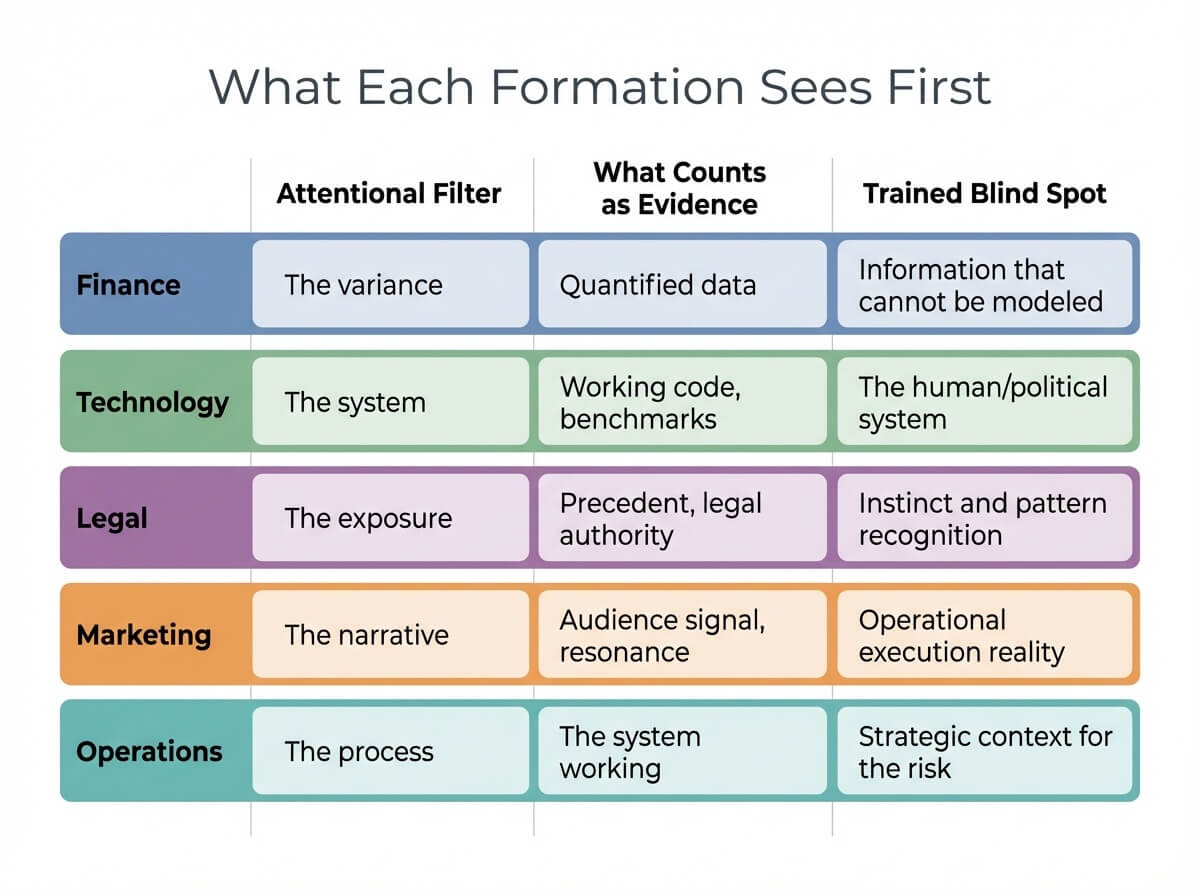
Finance: the number that does not fit. The attentional filter notices variances, inconsistencies, and unvalidated assumptions. Information is structured through models — quantified, scenario-tested, sensitivity-analyzed. What counts as evidence: documented data, verifiable assumptions, defensible methodology. The trained blind spot: information that cannot be quantified is processed as noise rather than signal. The executive intuition that comes from pattern recognition across decades of deals is dismissed because it does not come with footnotes.
Table showing what five formations notice first, what they trust as evidence, and their trained blind spot
Technology: the system underneath. The attentional filter notices architecture, dependencies, and scalability constraints. Information is structured through systems thinking — how components interact, where the bottleneck lives, what scales and what breaks. What counts as evidence: working code, performance benchmarks, technical validation. The trained blind spot: the human system. The CTO who can see every technical dependency in an architecture diagram may not see the political dependency that will actually determine whether the project ships.
Legal: the exposure waiting to happen. The attentional filter notices liability, regulatory risk, and contractual gaps. Information is structured through precedent and argumentative logic. What counts as evidence: documented authority, legal analysis, established case law. The trained blind spot: “instinct” is not trusted. The pattern recognition that runs faster than a legal brief is dismissed as insufficient evidence — even when it is built on decades of case analysis.
Marketing: the narrative arc. The attentional filter notices audience resonance, competitive positioning, and story coherence. Information is structured through narrative — what will land, what the market is ready to hear, how this positions against the competition. What counts as evidence: audience signal, market movement, creative resonance. The trained blind spot: the operational reality underneath the narrative. The campaign that will land perfectly with the audience may be impossible to execute at scale.
Operations: the process that will break. The attentional filter notices throughput, capacity constraints, and execution dependencies. Information is structured through workflow — what happens first, what depends on what, where the bottleneck lives. What counts as evidence: the process working. The trained blind spot: the strategic context. The operations leader who can see every execution risk may not see the market opportunity that justifies accepting the risk.
You do not just think differently from your peers. You see differently. The same presentation, the same data, the same conversation — and five different leaders walk away having processed five different realities.
When Filters Collide
The strategy review. The CEO presents a growth initiative. The CFO’s filter activates: where is the financial model? What are the assumptions? What is the sensitivity to a delayed launch? The CTO’s filter activates: can the platform support this? What are the architectural dependencies? The CMO’s filter activates: does this narrative work for the market? Will customers care? The COO’s filter activates: can we actually execute this? Do we have the capacity?
Each leader asks a question from their filter. Each question is legitimate. And the meeting devolves into four parallel conversations that never converge — because each leader is processing different information from the same input and no one realizes they are not talking about the same thing.
This is why leadership teams have blind spots. The room’s collective filter — shaped by its center of gravity — determines which information gets processed and which gets treated as noise. In a technology-dominated room, the operations leader’s capacity warning gets filtered out. In a finance-dominated room, the marketing leader’s narrative insight gets filtered out. The filter is collective, and the room does not know it is filtering.
ℹ
Note
The “smart leaders solving the wrong problem” pattern is almost always an information processing collision. The leader is solving the problem their filter shows them — which is a real problem. It is just not the problem the situation requires. The CTO solves the architecture problem while the adoption problem goes unaddressed. The CFO solves the financial model while the strategic narrative goes unwritten.
The Filter as Asset and Constraint
The information processing filter is the leader’s most valuable asset at the functional level. The CFO who notices the variance that nobody else caught. The CTO who sees the scalability constraint that would have killed the project. The GC who identifies the regulatory exposure that would have become a crisis. Each filter saves the organization from problems that other filters would miss.
At the senior level, the filter becomes a constraint — not because it stops working, but because the role demands processing capacity the filter cannot provide. The CTO who needs to evaluate a market opportunity cannot rely on the technical filter alone. The CFO who needs to assess a talent strategy cannot rely on the quantitative filter alone. The role asks for multi-dimensional processing, and the formation provides single-dimensional depth.
The response under pressure is predictable. The leader defaults to their filter — solves the problem they can see with the tools they have — and the problem they cannot see goes unaddressed. The strength that earned the promotion becomes the lens that constrains what the leader can perceive at the new level.
What Coaching Changes
You cannot turn off the filter. It is perceptual, not cognitive. But you can learn to see it — to notice when your filter is active, what it is selecting for, and what it is discarding. That metacognitive awareness is the difference between a leader who is captive to their processing pattern and one who uses it deliberately.
A coach who understands information processing helps the leader notice the filter in real time. “You have described three technical risks. What is the non-technical risk you have not mentioned?” That question does not criticize the technical filter. It activates a complementary channel. The leader does not stop seeing architecture. They start also seeing the human system, the narrative, the market timing — the dimensions their filter was trained to background.
The coaching is not about processing information differently. It is about processing more of it — expanding the bandwidth of what the leader perceives without abandoning the depth the formation provides. The CFO who notices the variance and notices the room’s emotional response to the variance. The CTO who sees the architecture and sees the political dynamics that will determine adoption. Same filter. Wider aperture.
Seeing the Filter
The problem that smart leaders keep solving is real. It is just not the only problem in the room. The filter your career installed shows you the problem it was trained to see — with remarkable precision and speed. That precision is your asset. The narrowness of the aperture is your constraint.
The expansion is not about thinking differently. It is about noticing what you are not thinking about. That awareness — the ability to see the filter rather than just seeing through it — is what separates leaders who are excellent within their formation from leaders who can operate across formations.
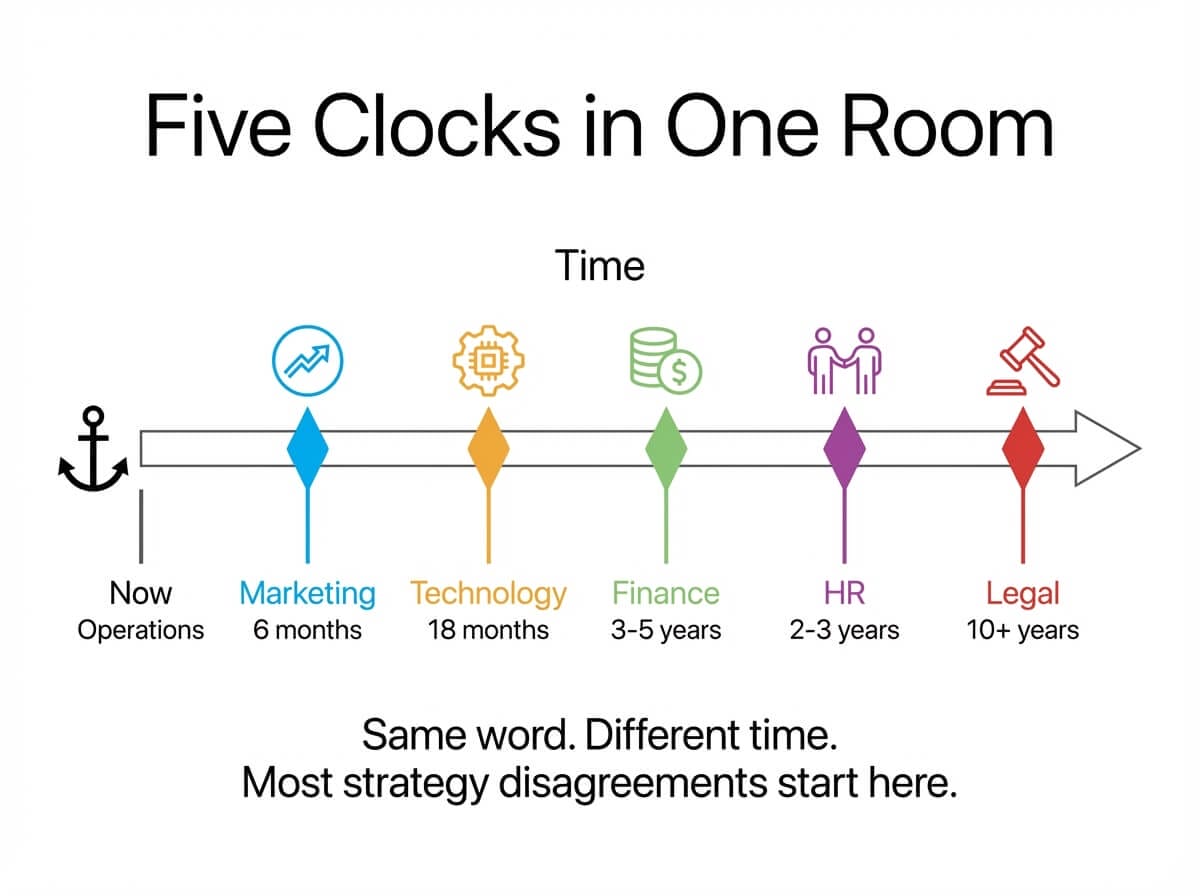
Ask five C-suite leaders to define “long-term” and you will get five different numbers. The CTO thinks in eighteen-month platform cycles. The CFO thinks in three-to-five-year capital allocation windows. The General Counsel thinks in decades of regulatory precedent. The CMO thinks in six-month campaign arcs. The COO thinks in whatever timeline keeps the operation from breaking. They sit in the same meeting, use the same word, and mean entirely different things. Most strategy disagreements are not disagreements about strategy. They are disagreements about time.
The time horizon you carry into every decision was not chosen. It was installed — by a career that rewarded one rhythm and labeled every other rhythm as either too slow or too reckless. What your career taught you about when to act, how long to wait, and what counts as “too late” is as deeply embedded as any other formation pattern. And it is invisible until you sit across from someone whose career installed a different clock.
Key Takeaways
Every function installs a specific natural time horizon — a default rhythm for how far ahead the leader thinks, plans, and evaluates decisions.
When leaders from different formations disagree about strategy, the disagreement is often about time: how far to look, how fast to move, what counts as “long-term.”
The senior leadership transition requires extending the time horizon beyond the function’s natural rhythm — and that extension creates a tension between instinct and strategic vision.
A coach who understands your formation’s time horizon helps you see when your instinct about timing is serving the situation and when it is serving the formation.
The Clock Your Career Installed
Technology: sprints, releases, platform cycles. Eighteen months is a long bet. The technology formation thinks in iterative cycles — build, ship, learn, iterate. The instinct is to move fast, validate quickly, and avoid committing to timelines the market might invalidate. A three-year strategic plan feels like a guess dressed up as certainty.
Finance: quarters, fiscal years, capital allocation windows. Three to five years is the natural planning horizon. The finance formation thinks in structured forecasts, scenario models, and investment cycles. A six-month campaign commitment feels rushed. A decade-long infrastructure bet feels speculative.
Timeline showing five different formation time horizons from 6 months to decades
Legal: precedent, regulation, liability timelines. Decades are the natural frame. The legal formation thinks in terms of what has held up over time, what regulatory cycles are in motion, and what exposure might materialize years from now. A quarterly planning cycle feels dangerously short. Legal sees risk that will not arrive for three years. The room is planning for the next three quarters.
Marketing: campaigns, brand cycles, market windows. Six months is a long play. The marketing formation thinks in moments of attention, competitive positioning, and cultural relevance. A window that is open today may be closed next quarter. The instinct is urgency — the market does not wait for models to validate.
Operations: the current timeline. Whatever keeps the system running without disruption. The operations formation is calibrated to the present — what is working now, what is about to break, what capacity exists for the next demand. Long-term thinking is real, but it is always anchored to “what does this mean for operational continuity today?”
HR: naturally long. Culture compounds over years. Talent development takes time. The HR formation often thinks in longer horizons than anyone else at the table — but expresses it in language that does not translate to quarterly metrics. The CHRO who says “this will take two years to show results” is often right and often ignored.
Five leaders sit in the same room and say “long-term.” One means eighteen months. One means five years. One means a decade. They are not speaking the same language. They just think they are.
When Clocks Collide
The strategy meeting. The CTO proposes a platform migration. Timeline: eighteen months. The CFO wants a five-year return model before approving the investment. The CMO needs to know how the migration will affect the next two product launches, both within six months. The COO wants to know what breaks during the transition. The GC flags regulatory implications that will not be clear for three years.
Every leader is being reasonable. Each is applying the time horizon their career installed. The disagreement is not about the migration. It is about which clock the decision should be evaluated on — and nobody in the room sees that the disagreement is about time rather than strategy.
The same collision happens at scale in every strategy discussion:
Tension
Formation A’s Clock
Formation B’s Clock
What It Looks Like
CTO vs. CFO
18-month platform cycles
3-5 year return windows
Engineering feels blocked; finance feels rushed
CMO vs. Legal
6-month campaign arcs
Multi-year regulatory cycles
Marketing feels constrained; legal feels ignored
COO vs. CEO
Current operational reality
Multi-year transformation vision
Ops feels destabilized; CEO feels resisted
CHRO vs. CFO
2-3 year culture/talent cycles
Quarterly reporting pressure
HR cannot prove ROI on the CFO’s timeline
ℹ
Note
Risk disagreements and time horizon disagreements often look identical. The CFO who resists a marketing investment and the CMO who resists financial analysis may both be responding to time, not risk. The CFO needs more time to validate. The CMO has less time before the window closes. Both are managing time pressure from different clocks.
The Extension Challenge
At senior levels, the role asks every leader to extend their natural time horizon. The CTO must think beyond the next platform release to the strategic arc of technology investment over three to five years. The CMO must think beyond the next campaign to the market positioning that will define the company over a decade. The COO must think beyond operational continuity to the organizational design the future strategy requires.
Extending the time horizon is not an intellectual problem. Most leaders can think longer when asked. The challenge is that the instinct — the formation-installed default — keeps pulling the leader back to their natural rhythm. The CTO who commits to a three-year strategy finds themselves re-evaluating every quarter when the technology landscape shifts. The CMO who commits to a long-term brand investment finds themselves anxious when short-term metrics dip. The instinct is not wrong. It is operating on the old clock while the role demands the new one.
The “think more strategically” feedback is often, at its core, a time horizon feedback: the room needs you to extend your planning window beyond the cycle your career installed. That extension creates the tension between instinct and vision. The instinct says “act now, validate fast.” The vision says “hold the direction, trust the longer arc.” Both are right. The question is which clock the situation requires.
What Coaching Changes
A coach who understands the time horizon formation helps the leader distinguish between formation-driven urgency and situation-driven urgency. “This feels too slow” can mean “the market is actually moving faster than our plan” or it can mean “my formation is uncomfortable with any timeline longer than eighteen months.” Both readings are valid. They lead to different responses.
The coaching question is not “How can you think longer-term?” The question is: “When you feel the pull to re-evaluate this decision, is that the situation telling you something or the clock your career installed?” That distinction — between the signal and the formation — is where the leader develops genuine strategic judgment about timing rather than either overriding their instinct or being captive to it.
The Room Needs Every Clock
The leadership team that makes the best strategic decisions is not the one where everyone thinks in the same time horizon. It is the one where every formation’s clock is recognized as a legitimate input rather than an obstruction. The CMO’s urgency catches windows the CFO’s analysis would miss. The CFO’s patience catches risks the CMO’s urgency would accept. The CHRO’s long-term perspective catches the talent and culture costs that the quarterly planning cycle ignores.
If your instinct about timing keeps colliding with the room — or if the room keeps moving at a pace that feels wrong to you — the question is not who is right about the timeline. It is whether you can see the clock your career installed and use it as one input among several, rather than as the only correct rhythm.
You were promoted because of a specific strength. The precision that caught what others missed. The technical depth that solved what others could not. The operational instinct that kept things running when everything else was falling apart. The creative vision that moved people. That strength was not one skill among many. It was the skill — the thing your career was built on, the thing the organization noticed, the thing that earned the title you now hold.
And it is the thing holding you back.
Not because it was wrong. Not because it is no longer valuable. Because the room that promoted you for it now needs something else from you, and the patterns your career installed keep pulling you back to the strength like a reflex. The paradox is structural: the stronger the skill that earned the promotion, the harder it is to release — and the more the new role needs you to.
Key Takeaways
The skill that earned the promotion is not the skill the new role rewards. The paradox is universal, but the specific way it manifests depends on which career shaped you.
The strongest professional skills are the hardest to release because they are fused with professional identity. Letting go does not feel like delegation. It feels like losing yourself.
Working harder at the old strength is the default response to the new role’s challenges — and it is the one response that will not work.
A coach who understands the paradox does not tell you to stop doing the thing you are best at. They help you see what the old strength is substituting for.
The Pattern
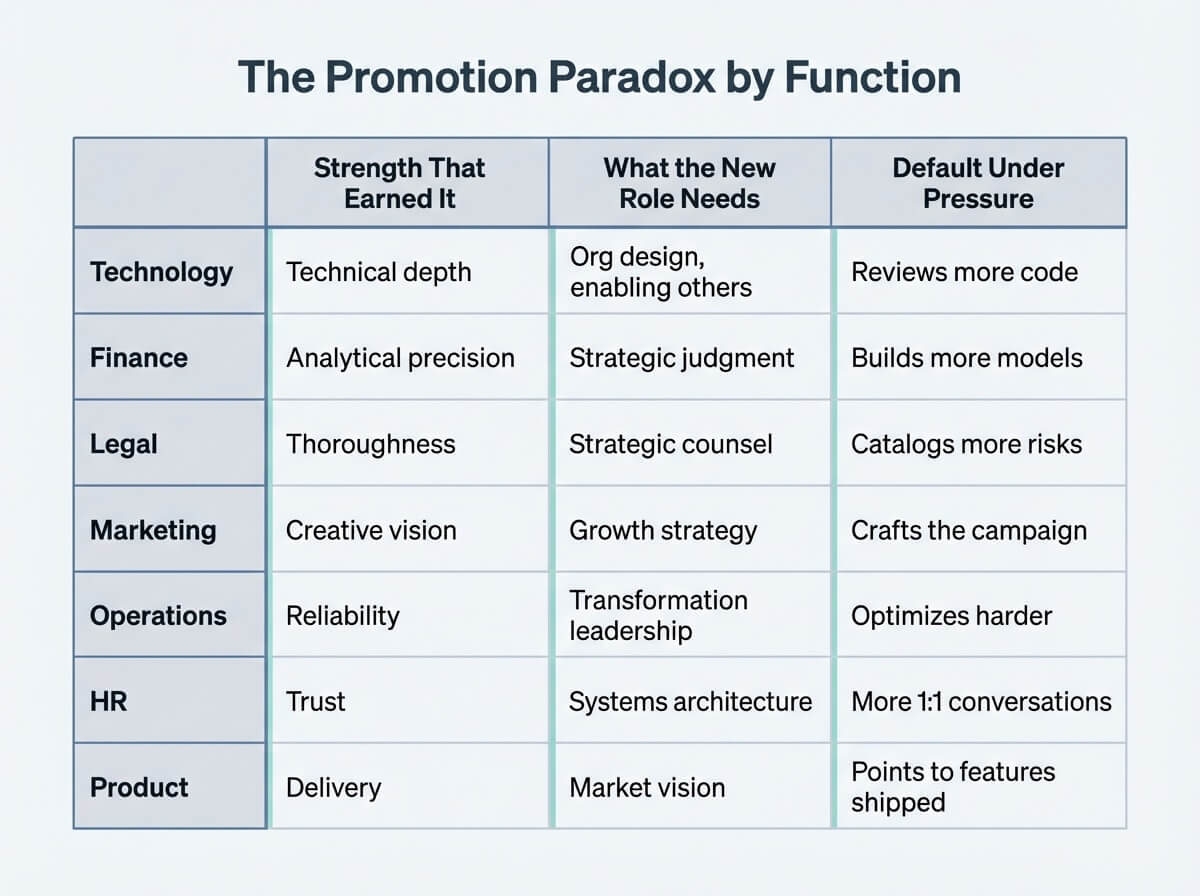
The promotion paradox follows the same structure across every function. Three elements. First: the strength that earned the promotion. Second: the new demand the role creates. Third: the default behavior under pressure, which is always a return to the strength — executed harder, faster, or more intensely — because it is the only proven strategy the leader has.
Formation
The Strength That Earned It
What the New Role Needs
The Default Under Pressure
Finance
Analytical precision — sees what others miss
Strategic judgment the data cannot fully justify
Builds a more rigorous model
Technology
Technical depth — solves what others cannot
Organizational design, enabling others to build
Reviews more code, solves harder bugs personally
Legal
Thoroughness — finds every risk
Strategic counsel, helping the org navigate through risk
Catalogues more risks without prioritizing
Marketing
Creative vision — makes things that resonate
Growth strategy, connecting creativity to business outcomes
Crafts the campaign personally rather than building the narrative
Operations
Reliability — keeps things running
Transformation leadership, designing what the org needs to become
Optimizes existing processes harder
HR
Trust — the person everyone comes to
Systems architecture, connecting people strategy to enterprise value
Takes on more individual coaching conversations
Product
Delivery — defines the right thing and gets it built
Market vision, spending credibility before evidence arrives
Points to features shipped as evidence of contribution
Read your row. The third column is where you go when the new role feels uncertain. And the new role almost always feels uncertain — because the currency shifted and the old strategy is the only one you have.
Why the Strongest Skills Are Hardest to Release
If the strength were ordinary, releasing it would be uncomfortable but manageable. The promotion paradox is sharpest when the strength is exceptional — when it is the thing the leader is genuinely better at than almost anyone around them. The CTO who really is the best engineer on the team. The CFO who really does build the most reliable models. The GC whose legal analysis really is the most thorough in the organization.
The excellence is not imagined. It is real. And that reality makes the release harder, not easier, because the leader is not just letting go of a habit. They are letting go of the thing that provides the clearest evidence, every day, that they are good at what they do. The code review is not about quality control. It is about the feeling of competence. The model is not about accuracy. It is about the feeling of being the person who sees what others cannot.
The paradox is not that the strength stops working. It is that the strength works so well at the old level that the leader cannot stop spending it — even when the new level is asking for a completely different investment.
Under pressure, the reflex intensifies. The CTO reviews more code. The CFO builds more scenarios. The COO optimizes harder. The GC documents more risk. Each behavior feels like contribution. Each behavior is a retreat to the formation’s home ground — the place where the leader knows they are excellent — and a withdrawal from the new territory where excellence has not yet been established.
The Inflection Point
There is a predictable moment, usually four to six months after the promotion, when the leader realizes the old strategy has hit diminishing returns. The effort is the same or greater. The impact is less. The feedback — “think more strategically,” “delegate more,” “step back from the details” — keeps arriving. And the leader’s first instinct is to try the old strategy one more time, with more intensity, because the alternative is stepping into a space where they do not yet feel competent.
This inflection is where most leaders either break through or settle in. Breaking through means accepting that the strength is no longer the primary contribution — that it has become table stakes rather than currency — and beginning to invest in the new capability the role demands. Settling in means continuing to do the old work at a higher level, producing excellent functional output while the leadership contribution the organization actually needs goes undelivered.
ℹ
Note
Most leaders who “plateau” after a promotion have not failed. They have settled in to the old strength at the new level. The organization gets a very competent senior individual contributor rather than the leader it promoted them to become. Both the leader and the organization sense something is missing. Neither can quite name it.
What Coaching Surfaces
Generic coaching hears the promotion paradox and offers delegation frameworks, time management strategies, and prioritization tools. A coach who understands the formation hears the same pattern and asks a different question: “What is the old work giving you that the new work does not yet provide?”
That question goes beneath the behavior to the identity. The answer is almost always a version of: certainty. Competence. The feeling of knowing I am good at this. The old work provides clear, fast feedback. The new work provides slow, ambiguous feedback. The leader retreats to the old work not because they lack the capability for the new — but because the new work does not yet tell them they are doing well.
The coaching that follows from that recognition is not about giving up the strength. It is about understanding what the strength is substituting for — and finding another way to meet the need it serves. The CTO who needs the feeling of competence can find it in building a high-performing engineering organization. The CFO who needs the feeling of being right can find it in making strategic calls that prove out over time. The path forward is not abandonment. It is redirection.
The strength that got you promoted is not the problem. It is the foundation. A CTO without technical credibility, a CFO without analytical rigor, a GC without legal precision — none of these is a better leader. The strength stays. It becomes table stakes — the thing the room assumes you have, not the thing it rewards you for.
Table showing the promotion paradox for seven functions — the strength, the new demand, and the default under pressure
The paradox resolves not by releasing the strength but by expanding what you build on top of it. The precision becomes the foundation for judgment. The technical depth becomes the foundation for organizational design. The operational excellence becomes the foundation for transformation. The same engine. A different target.
If you are in the four-to-six-month window after a major promotion and the old strategy is producing less than it used to, a conversation with a coach who understands the paradox is where the foundation starts becoming the launch pad rather than the ceiling.
Every leadership team has a voice it is not hearing. Not because someone is being silenced. Because the room’s dominant formation has made one perspective so normal that the alternative perspective — the one that would complete the picture — does not register as relevant. It is spoken. It is not heard. And the decisions that follow have a specific, predictable shape: they solve for the dimension the room can see and miss the dimension the room cannot.
The voice that is missing is usually not the quietest person in the room. It is the person whose formation processes the situation through a lens the majority does not share. The operations leader in a room full of growth strategists. The legal mind in a room full of builders. The HR perspective in a room that speaks only in revenue and market share. The voice is present. The formation the room was built around makes it invisible.
Key Takeaways
Every leadership team has a formation center of gravity — one or two dominant formations that shape how the room defines problems, evaluates solutions, and makes decisions.
The blind spot is structural, not personal. The voice that is missing is usually present but filtered out by the room’s dominant formation.
The most common team dysfunctions — groupthink on strategy, repeated arguments, decisions that fail in execution — are often formation blind spots rather than leadership failures.
A team coach who understands the formations in the room can name the missing voice without making anyone wrong.
The Room’s Center of Gravity
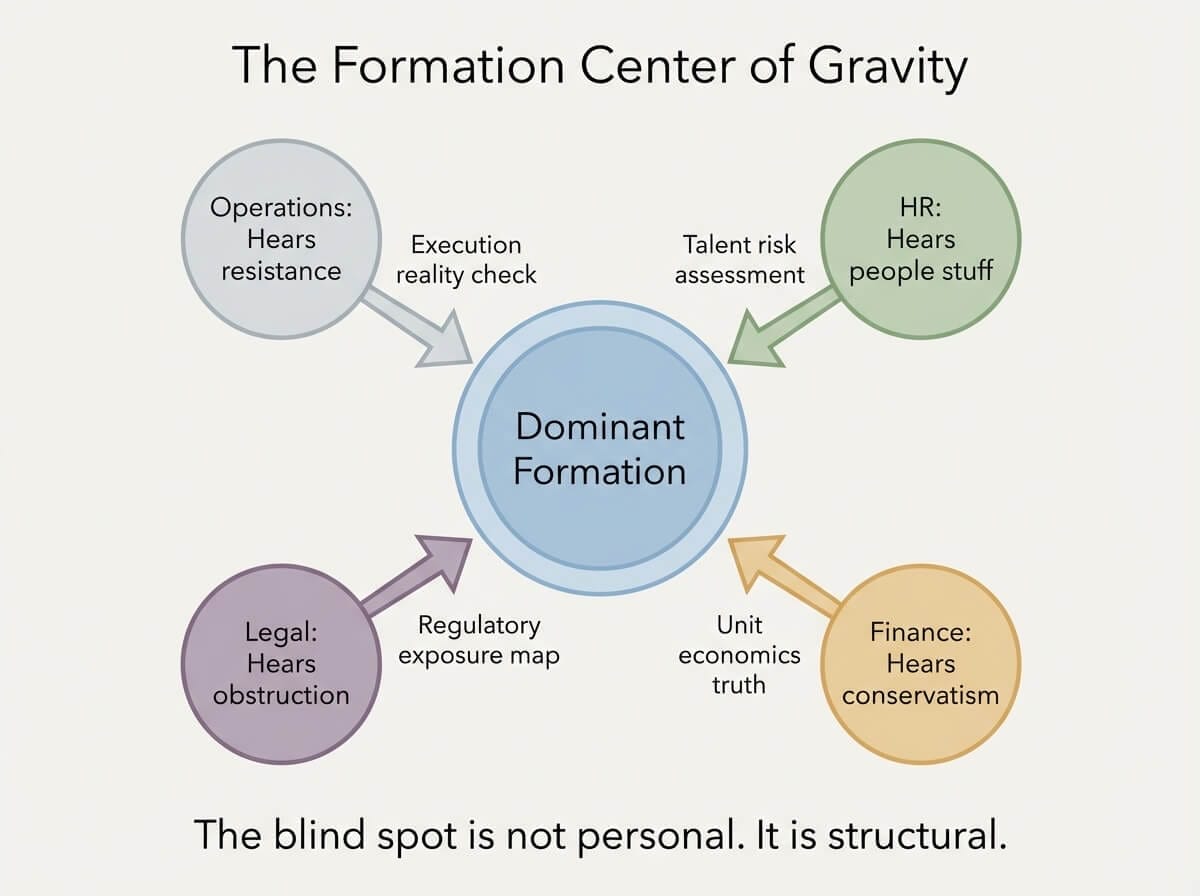
Every leadership team has a center of gravity — one or two formations that disproportionately shape how the room operates. In a technology company, the engineering formation often dominates: problems are framed as systems to be designed, solutions are evaluated by technical elegance, and the room speaks in architecture and scalability. In a financial services firm, the finance formation dominates: problems are framed as risk/return equations, solutions are evaluated by provable ROI, and the room speaks in models and scenarios.
The center of gravity is not determined by who talks the most. It is determined by what language the room treats as legitimate. When the CTO says “the architecture cannot support that,” the room hears a hard constraint. When the CHRO says “the culture cannot absorb that pace of change,” the room hears a soft opinion. Both statements may be equally accurate. The room gives one the weight of fact and the other the weight of perspective. That asymmetry is the center of gravity operating.
The leadership team’s blind spot is not a gap in intelligence. It is a gap in formation. The room can only see what its dominant formation has trained it to notice.
The Voices That Disappear
Operations in a growth-obsessed room. The COO sees that the growth strategy will break the operational infrastructure. The supply chain cannot absorb the volume. The deployment pipeline was not built for this pace. The hiring plan does not account for onboarding capacity. The COO raises these concerns. The room hears “resistance to change.” What was actually offered: a reality check that would have prevented the execution failure that arrives six months later. The operations formation’s visibility paradox plays out in real time — the voice that sees the most is heard the least.
HR in a revenue-driven room. The CHRO sees the talent risk underneath the restructuring plan. The senior managers who will leave. The culture debt that will compound. The succession gaps that will widen. The CHRO raises these concerns. The room hears “people stuff.” The CFO asks for the financial impact. The CHRO cannot produce a model because culture debt does not fit in a spreadsheet. The room moves on. Eighteen months later, the turnover spike arrives and the organization wonders what happened.
Diagram showing how a dominant formation filters four other voices on a leadership team
Legal in a move-fast room. The GC sees the regulatory exposure. The privacy gap. The compliance risk that has not been assessed. The GC raises these concerns. The room hears “legal is slowing us down again.” The risk instinct that the legal formation installed reads as obstruction to formations that metabolize risk through speed and iteration.
Finance in a narrative-driven room. The CFO sees the unit economics that do not support the market story. The runway that assumes revenue growth the model cannot justify. The capital allocation that prioritizes story over substance. The CFO raises these concerns. The room hears “finance is being conservative again.” The precision formation reads as excessive caution to formations that lead with conviction.
ℹ
Note
The pattern is consistent: the voice that would complete the room’s understanding of the decision is the voice the room’s center of gravity has implicitly trained everyone to discount. Not through malice. Through formation.
The Cost of the Blind Spot
Formation blind spots are expensive. Not in the obvious way — not as a single bad decision that can be traced to a single missed input. In the systemic way: a pattern of decisions that consistently solve for one dimension and miss another.
The technology-dominated room builds elegant systems that nobody adopts because the user experience perspective was treated as secondary. The finance-dominated room produces financially sound strategies that fail in execution because operational reality was treated as an implementation detail. The growth-dominated room scales faster than the organization can absorb because the people perspective was treated as a soft concern.
The blind spot does not produce catastrophic failures. It produces predictable patterns of incomplete decisions — and the leadership team that keeps having the same argument in different rooms is usually experiencing the same formation blind spot from different angles.
What Team Coaching Changes
Generic team coaching identifies communication patterns, personality differences, and trust deficits. A team coach who understands formation sees something more structural: which formations are in the room, which one dominates, and which voice the room has implicitly agreed to discount.
The coaching intervention is not “make sure everyone gets to speak.” The intervention is naming the center of gravity: “This room makes decisions in [finance/engineering/growth] language. What decision would you make differently if you gave equal weight to the perspective that just got filtered out?”
That question does not blame the dominant formation. It makes the structure visible. And once the team can see the pattern — “we consistently discount the operations perspective because our center of gravity is growth” — they can adjust without anyone having to change their personality or their formation. The adjustment is structural: build a decision process that formally accounts for the voice the room naturally mutes.
The most effective leadership teams are not the ones where every voice is equally loud. They are the ones where every formation’s contribution is recognized as structural rather than optional.
Your leadership team has a center of gravity. Every team does. The question is not whether the center of gravity exists. The question is whether your team can see it — and whether the voice it mutes is the one that would complete the picture the room needs to make better decisions.
If your team keeps having the same argument, keeps being surprised by execution failures, or keeps making decisions that look right in the room but break in the field, the issue may not be strategy or alignment or communication. It may be a formation blind spot that no one in the room can see because the room was built around it.
The first thing that changes when you reach the C-suite is the silence. Not the silence of a quiet office. The silence of realizing that the people who used to tell you what they really thought are now managing what they say around you. The feedback that used to come freely — from peers, from your manager, from the team — is filtered, strategic, or absent. You have more authority than you have ever had. You have less honest information than you have ever had. And nobody warned you that those two things would arrive together.
The C-suite transition is not a bigger version of the Director-to-VP transition. It is a qualitatively different challenge. The rules change. The isolation is structural. And the formation patterns that carried you through every previous level face their most demanding test — because at this altitude, what your career installed meets the full weight of enterprise leadership.
Key Takeaways
The C-suite transition is qualitatively different from every previous promotion. It is not a bigger version of the VP role. It is a different kind of leadership entirely.
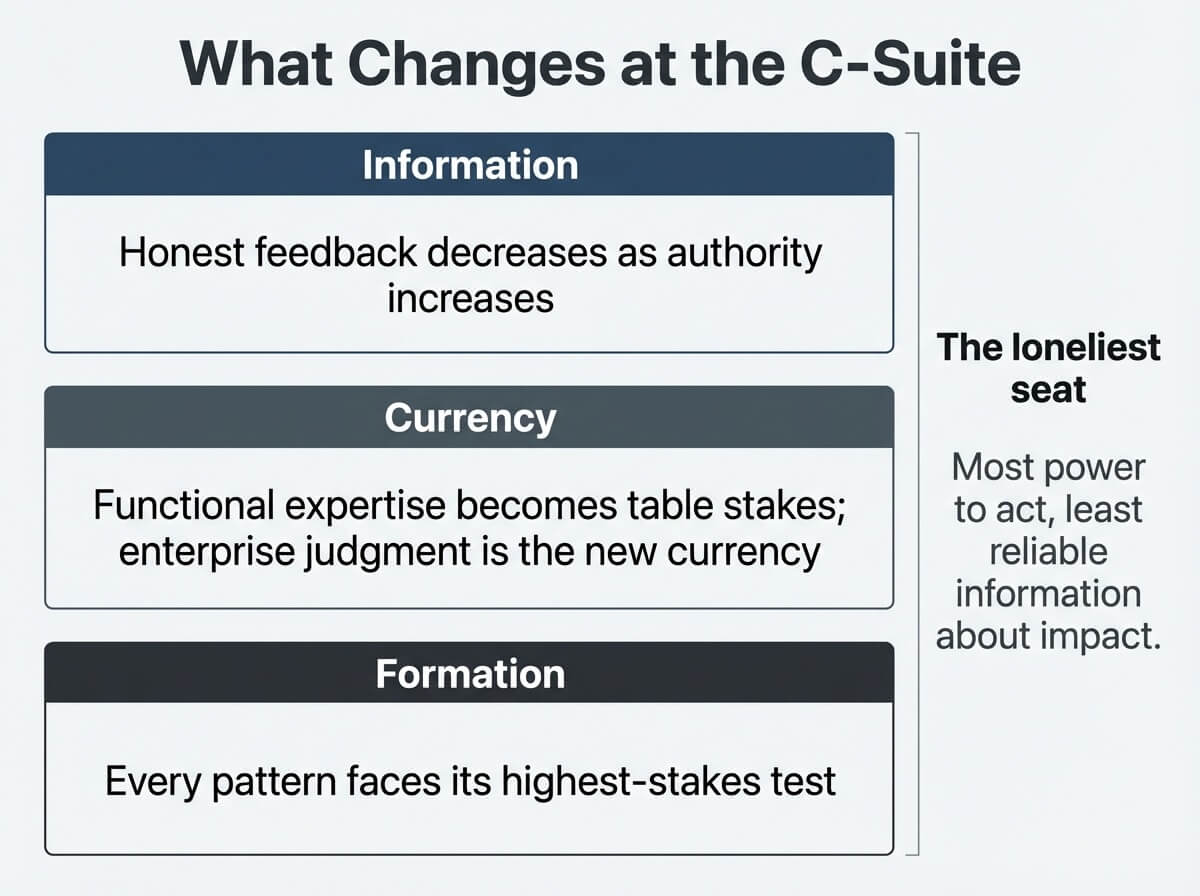
Isolation is structural, not personal. Honest feedback decreases as authority increases. The leader with the most power to act has the least reliable information about how they are experienced.
Every formation pattern faces its highest-stakes test at the C-suite. The old currency is table stakes. The new currency — enterprise judgment, board presence, institutional stewardship — cannot be earned through the methods that always worked.
A coach at this level is often the only person in the leader’s life who has no agenda other than the leader’s own development.
What Changes at the Top
At Director and VP level, you learned to operate across functions, build alliances, and translate between strategy and execution. Those skills transfer. What does not transfer is the assumption that you can build trust the same way you always have.
At the C-suite, trust is not earned through output. It is earned through judgment — the willingness to make calls the data cannot fully justify, to hold positions under board scrutiny, to set direction for an enterprise where the consequences are existential and the timeline extends beyond your own tenure. The currency shift at this level is the most painful of the career because the new currency is the one you have the least practice spending.
The CTO who arrives at the C-suite with technical credibility discovers that the board does not evaluate technical credibility. They evaluate strategic narrative. The CFO who arrives with analytical rigor discovers that the board does not need better analysis. They need someone who says “here is what I believe we should do and why” with the kind of conviction that a career in finance never required. The CHRO who arrives with deep organizational trust discovers that trust at the individual level does not automatically translate into influence at the board level.
The loneliest seat in the organization is not lonely because nobody is around. It is lonely because everyone who is around has an agenda — and the leader is the only person in the room who is supposed to hold the whole.
The Isolation Problem
The isolation is not a failure of communication. It is a structural feature of the role. When you become the person who approves budgets, sets direction, and makes the calls that affect everyone’s career, the information environment changes. People manage what they tell you. Peers become competitors for board attention. Direct reports calibrate their candor to your mood. The higher you go, the more curated the information you receive.
This isolation hits every formation, but it hits differently:
Vertical diagram showing three things that change at the C-suite: information, currency, and formation
The CTO loses access to the technical community that used to provide honest feedback about their thinking. The engineering team now defers rather than debates. The builder identity that thrived on collaborative problem-solving has no collaborative space left.
The CFO loses the analytical sparring partners who used to challenge the model. The finance team presents conclusions, not arguments. The precision that was sharpened through debate now operates in an echo chamber.
The COO loses the operational feedback loop. The systems still run. The team still executes. But the strategic-level feedback — whether the operating model is right for where the organization is headed — only comes from the CEO and the board. Both have limited bandwidth and limited operational depth.
The GC loses the advisory dialogue. Legal is consulted after decisions are made, not before. The strategic counsel the role demands is offered in a context where the direction has already been set.
ℹ
Note
The isolation paradox: the leader with the most authority to change the organization has the least reliable information about how the organization experiences their leadership. This is not fixed by open-door policies or town halls. It is structural — and it is one of the primary reasons C-suite leaders seek coaching.
Formation Patterns at Maximum Altitude
Every formation pattern that operated at lower altitudes intensifies at the C-suite. The stress behaviors sharpen. The blind spots widen. The identity structures face their most demanding expansion.
The risk instinct faces enterprise-level uncertainty. The CFO who learned to quantify risk must now set the organization’s risk appetite — a qualitatively different task than modeling individual exposures. The CTO who learned to test and iterate must now make platform bets that cannot be tested at small scale. The GC who learned to prevent exposure must now advise on risks the organization should accept.
The signal environment becomes its most distorted. Board feedback is sporadic, politically loaded, and filtered through governance dynamics. Peer feedback is strategic. Direct report feedback is managed. The leader who relied on clear, functional signals to know whether they were doing well now operates in an environment where the most important signals are the hardest to read.
The time horizon extends to its maximum stretch. Decisions made now may not validate for three to five years. The CPO’s market bets may not confirm for longer. The CHRO’s culture investments compound slowly and invisibly. The leader must hold confidence in a direction the environment cannot yet confirm or deny.
Why Coaching at This Level
At the C-suite, a coach may be the only person in the leader’s professional life who has no agenda other than the leader’s own development. Not the board’s agenda. Not the team’s agenda. Not the organization’s performance agenda. The leader’s own understanding of who they are becoming in this role and what the role is asking them to leave behind.
A coach who understands the formation brings additional specificity. They know that the CTO’s sense of losing touch with the team is not about management style. It is about a builder identity mourning the loss of collaborative building. They know that the CFO’s hesitation to make a board recommendation without a complete model is not about confidence. It is about a formation that defined irresponsible as any call the data cannot justify. They know that the COO’s silence in strategy meetings is not about disengagement. It is about an operations formation that taught them the background is where they belong.
The coaching question at this level is not about skills or strategy. It is: who are you becoming in this role — and where is the formation that got you here creating the ceiling for what the role now asks?
The C-suite seat comes with authority, isolation, and a set of demands that no previous role prepared you for. The person who fills it carries a formation — a career’s worth of installed patterns about what good looks like, what risk feels like, what success sounds like, and who they are when they lead. The gap between what the seat demands and what the formation provides is the territory where the real leadership development happens.
Not through programs. Not through books. Through the sustained, honest, structurally-aware conversation that only happens when someone understands both the seat and the person sitting in it.
Every career trains you to listen for specific signals that tell you whether you are doing a good job. The engineer listens for system uptime and code quality. The finance leader listens for forecast accuracy. The marketer listens for engagement metrics and campaign performance. Over years, those signals become the only channel. You get very good at reading them. And you become deaf to everything else.
The feedback you are not hearing — the signal your formation never taught you to read — is usually the one that determines whether you advance, stall, or plateau. Not because it is more important than the signals you already track. Because it is the one the room is using to evaluate you while you are busy measuring something else.
Key Takeaways
Every function installs a specific signal environment — what counts as success, what feedback you are attuned to, and what channels you do not read.
The signal gap is not about missing feedback. It is about formation-level deafness to entire categories of information your career never trained you to hear.
At senior levels, the signal environment shifts from functional metrics to relational and strategic signals. Leaders who keep listening for the old signals miss the new ones entirely.
A coach who understands your signal environment helps you build new channels without abandoning the ones your career installed.
What Your Career Trained You to Hear
The signal environment is specific to each function. Not vaguely different. Precisely different — in what registers as success, what registers as failure, and what does not register at all.
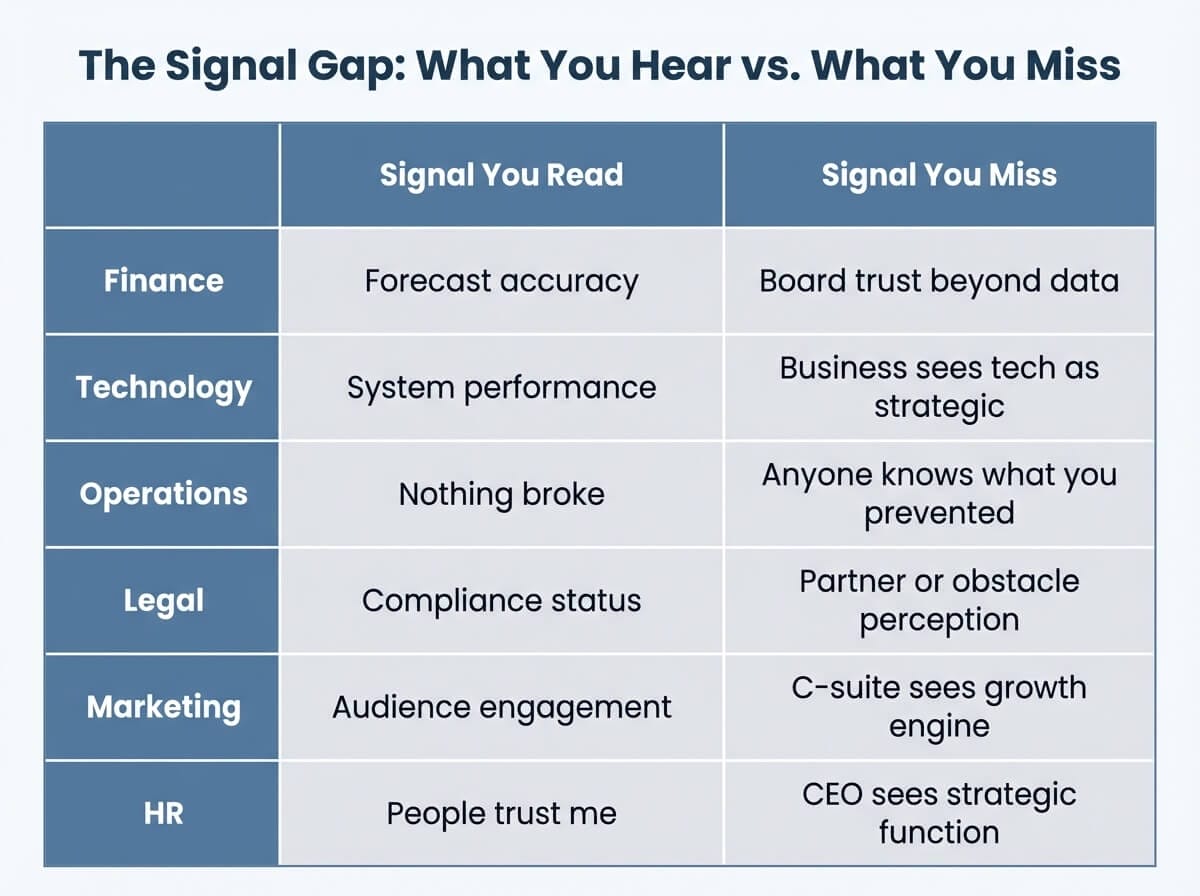
Finance: accuracy and precision. You know whether the forecast was right. You know whether the model held. You know whether the numbers were clean. What you may not hear: whether the board trusts your judgment beyond the numbers. Whether your peers experience you as a strategic partner or a scorekeeper. The signal environment is quantitative. The signal that determines your trajectory at the top is relational.
Technology: system performance and shipping velocity. You know whether the product works. You know whether the team is delivering. You know whether the architecture scales. What you may not hear: whether the business understands the value of what you built. Whether the CEO sees technology as a strategic lever or a cost center. The signal environment is technical. The signal that matters now is narrative.
Operations: uptime and continuity. Silence equals success. If nothing broke, you did your job. What you may not hear: whether anyone knows what you prevented. Whether your strategic insight — you see more of the organization than almost anyone — is valued or invisible. The operations leader’s signal environment is the starkest version of this: success is defined by the absence of failure, and the absence of failure produces the absence of recognition.
Table showing the signal gap for six functions — what each formation reads versus what it misses
Legal: negative-only. You track compliance status, case outcomes, regulatory actions. Silence means nothing went wrong, which means you succeeded. What you may not hear: whether you are experienced as a partner or an obstacle. Whether people bring you problems early because they trust you, or late because they want to limit the conversation.
Marketing: engagement and resonance. You know whether the campaign landed, whether the audience responded, whether the brand is gaining share of voice. What you may not hear: whether the C-suite views marketing as a growth engine or a cost line. The signal environment is audience-facing. The signal that determines your seat at the table is board-facing.
HR: people trust and program completion. You know whether employees come to you, whether training programs fill, whether engagement scores move. What you may not hear: whether the CEO sees HR as a strategic function or a support function. Whether talent strategy is connected to enterprise value in the board’s mind. The trust signal is strong. The strategic signal is muted.
The feedback you are not hearing is rarely hidden. It is broadcasting on a channel your career never installed the antenna for.
The Signal Shift at Senior Levels
At IC and manager level, functional metrics are sufficient. The signal environment matches the job: do the work well, and the signals that tell you whether you are doing well are the same signals your career trained you to read. The finance analyst who tracks forecast accuracy is reading the right channel. The engineer who tracks system reliability is reading the right channel.
At Director and VP level, the signal environment splits. Functional metrics still matter — they are table stakes. But a new set of signals emerges: relational signals (how you are experienced by peers and leadership), influence signals (whether your input shapes decisions beyond your function), and narrative signals (whether the story the organization tells about your function is the story you want told). The currency shifts, and so does the feedback channel.
The problem is that the old signal environment is loud and clear. You know how to read it. You are good at it. And the new signals are quiet, ambiguous, and unfamiliar. The natural response is to double down on the signals you can read — build a better model, ship faster, optimize harder — while the signals that will determine your trajectory go unheard.
Formation
Signal You Read
Signal You Miss
The Gap
Finance
Was the forecast accurate?
Does the board trust my judgment beyond data?
Quantitative success, relational silence
Technology
Does the system work? Did we ship?
Does the business see technology as strategic?
Technical success, narrative invisibility
Operations
Did anything break?
Does anyone know what I prevented?
Invisible success, zero recognition signal
Legal
Were there compliance issues?
Am I experienced as a partner or an obstacle?
Negative-only signal, no positive channel
Marketing
Did the audience respond?
Does the C-suite see marketing as a growth engine?
Audience signal strong, board signal muted
HR
Do people trust me?
Does the CEO see HR as strategic?
Trust signal strong, enterprise signal weak
Why Better Listening Is Not the Answer
The conventional advice is: seek more feedback. Ask your peers how they experience you. Request 360 reviews. Solicit input from stakeholders. This is not wrong. It is incomplete — because the issue is not that the feedback is unavailable. The issue is that your formation processes the feedback through filters that were installed years ago.
The finance leader who receives feedback that “the board wants more strategic input” hears: build a more strategic model. The formation translates relational feedback into functional terms because functional terms are the only language the signal environment recognizes. The technology leader who receives feedback that “we need better communication about engineering value” hears: write a better technical brief. The formation converts a narrative signal into a technical output.
The translation is not conscious. It is automatic. And it means that even when the new signal is received, the formation processes it into the old channel and produces the old response. More data. Better systems. Tighter processes. The exact output the formation was designed to produce — applied to a signal that is asking for something different entirely.
ℹ
Note
This is why the identity dimension interacts with the signal environment. The leader does not just miss the new signal. They receive it and unconsciously convert it into the old signal — because the old signal is the one their identity knows how to respond to.
What a Coach Who Gets This Does
A coach who understands the signal environment does not tell you what signals to listen for. They help you notice what you are not hearing — and more importantly, why you are not hearing it.
The coaching question for the operations leader is not “How can you make your contributions more visible?” It is: “How do you distinguish between ‘everything is running fine’ and ‘I am doing exceptional work that nobody can see’?” That question does not ask them to self-promote. It helps them develop a new signal channel for their own impact.
The coaching question for the finance leader is not “How can you be more influential?” It is: “When you say the board does not trust your judgment, what signal are you reading to reach that conclusion?” That question surfaces the formation’s signal-processing habit — the tendency to interpret relational dynamics through a quantitative lens.
In each case, the coaching does not replace the old signal environment. It builds a new channel alongside it. The finance leader still reads the numbers. They also start reading the room. The operations leader still tracks uptime. They also start registering their own strategic contribution. The formation’s signal stays. A new signal gets added.
The feedback you are not hearing is not hidden. It is broadcasting. Your career simply never installed the antenna for it. The CFO’s board presence signal. The CTO’s narrative signal. The COO’s visibility signal. The GC’s partnership signal. Each is available. Each requires a new kind of listening that the old formation did not teach.
Building that new channel does not mean abandoning the old one. The signals your career trained you to read are real and valuable. They are also insufficient for the level you now occupy. The expansion is from single-channel to multi-channel — hearing what the function measures and what the room evaluates.
Ask the CTO about risk and she describes a controlled experiment: ship a small version, see what breaks, iterate. Ask the General Counsel about risk and he describes a landscape of exposures to be mapped, assessed, and mitigated before any action occurs. Put them in the same room on the same project, and the CTO experiences the GC as someone who kills momentum. The GC experiences the CTO as someone who ignores consequences. Both are managing risk. They are managing it from formations that define the word differently.
This is not a communication problem. It is not fixed by better meetings or clearer decision-making frameworks. What risk means to you — what triggers the alarm, what counts as sufficient mitigation, what “responsible” sounds like — was installed by a career that rewarded one version of risk management and labeled every other version as either reckless or paralyzed. That installation is invisible until you sit across from someone whose career installed a different one.
Key Takeaways
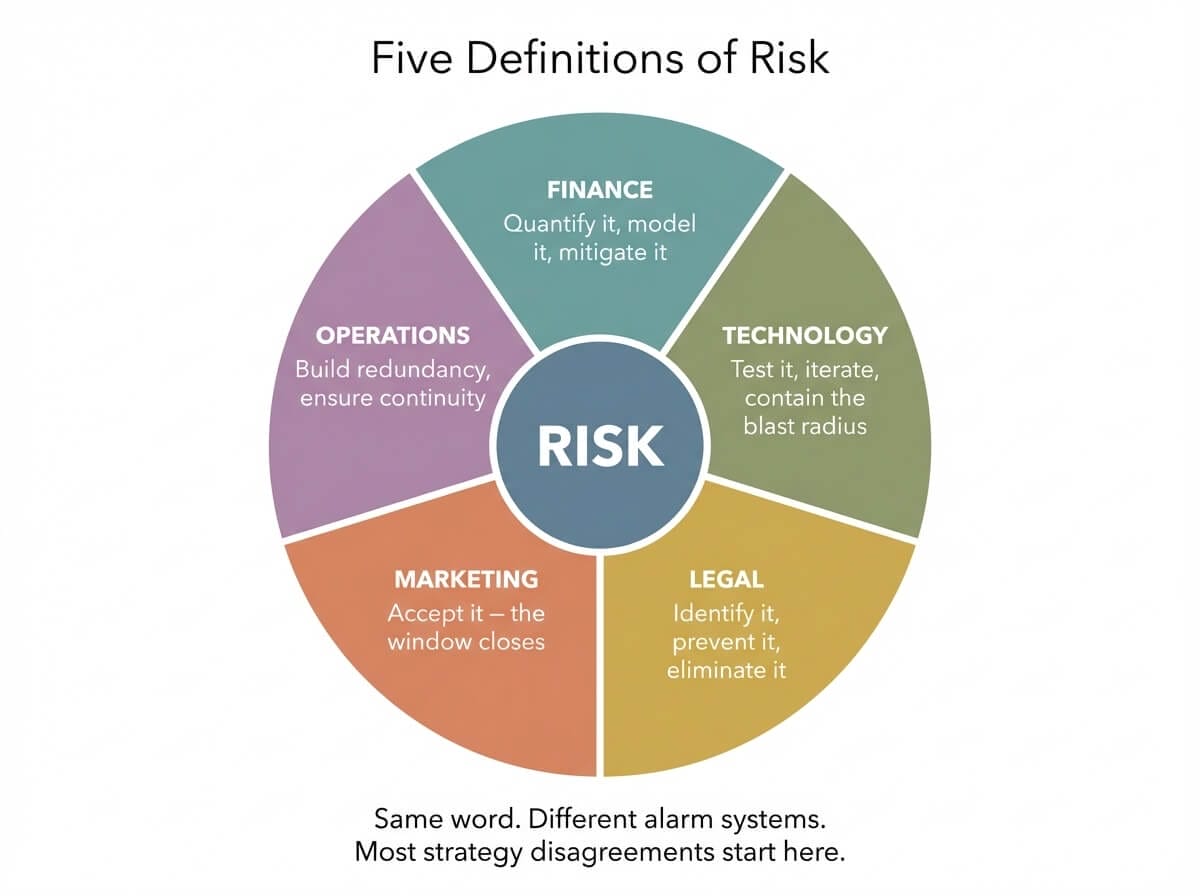
Every function defines risk differently. Finance quantifies it. Technology tests it. Legal prevents it. Marketing accepts it. Operations contains it. Each is a legitimate response to uncertainty.
Most “disagreements about risk” on leadership teams are actually collisions between formations that define the word differently. Neither side is wrong. Both are incomplete.
Your formation’s risk instinct is not your personality. It is trained. And it can be expanded without being abandoned.
A coach who understands what risk means to your specific formation helps you distinguish between formation-level caution and situation-level judgment.
Five Definitions, One Word
Risk is not an objective category. It is a formation-shaped perception. What the word activates — the alarm bells, the default response, the standard for “enough due diligence” — varies by function in predictable, specific ways.
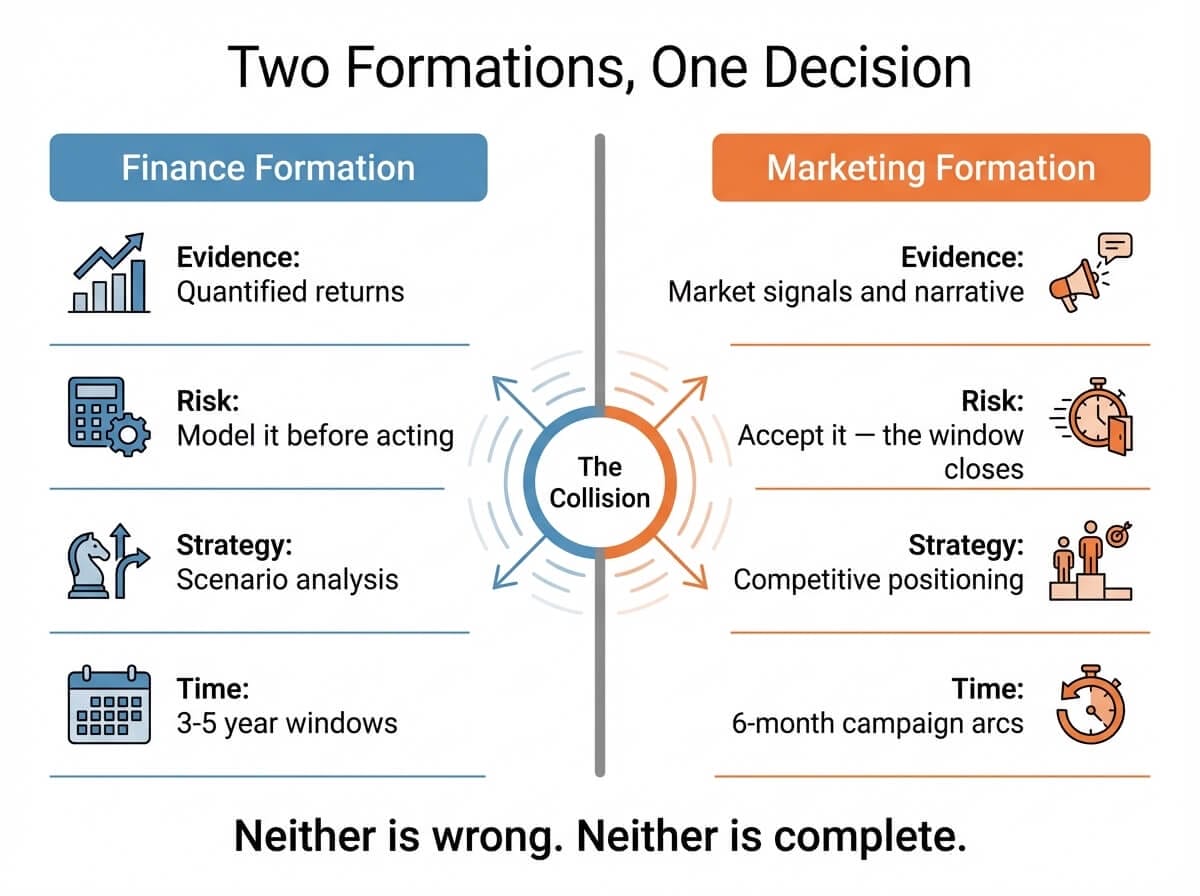
Finance: risk as quantity. Risk is a number. It can be measured, modeled, probability-weighted, and hedged. The responsible response is to quantify exposure and build scenarios before committing. A decision without a model is a guess, and finance formations do not guess.
Radial diagram showing five functional definitions of risk — finance quantifies, technology tests, legal prevents, marketing accepts, operations contains
Technology: risk as experiment. Risk is an input to the learning process. Ship small, observe what breaks, iterate. The responsible response is to move fast but reversibly — contain the blast radius, learn from failure, never bet the entire system on an untested approach. An irreversible commitment without a prototype violates the engineering instinct.
Legal: risk as exposure. Risk is a landscape of liabilities to be identified and eliminated before they materialize. The responsible response is prevention — no action until the exposure is mapped and mitigated. A decision that accepts known risk is, in the legal formation, not bold. It is negligent.
Marketing: risk as timing. Risk is the cost of inaction. Markets move, windows close, competitors establish positions. The responsible response is to act on conviction before the data is complete, because waiting for certainty means the opportunity has passed. Analysis paralysis is the risk the marketing formation fears most.
Operations: risk as disruption. Risk is anything that threatens continuity, reliability, or throughput. The responsible response is redundancy, fallback systems, and process resilience. Disrupting a working system for an unproven benefit is, in the operations formation, the definition of reckless.
Five leaders sit in the same room, hear the word “risk,” and five different alarm systems activate. Most strategy disagreements are not disagreements about strategy. They are disagreements about risk — which means they are disagreements about formation.
What Happens When Formations Collide on Risk
The product launch meeting. The CTO wants to ship. The product is ready, the team is energized, the market window is open. The General Counsel wants to review. The privacy assessment is incomplete, the terms of service need updating, the regulatory filing has not been confirmed. The CTO experiences the GC as a bottleneck. The GC experiences the CTO as a liability.
What neither sees is the formation logic driving the other’s behavior. Technology metabolizes risk through iteration: ship, learn, fix. Legal metabolizes risk through prevention: identify, mitigate, then proceed. Both are legitimate strategies for managing uncertainty. They cannot coexist in the same timeline without someone naming the structural tension.
The same collision plays out between the CFO and the CMO over investment decisions, between the COO and the CEO over transformation initiatives, between the CHRO and the CFO over talent investment. Each collision looks like a disagreement about the decision. Each collision is actually a disagreement about what “responsible” means. And because the word “responsible” feels like a moral category rather than a formation response, each leader experiences the other’s position not as a different perspective but as irresponsibility.
Collision
What Side A Sees
What Side B Sees
What Is Actually Happening
CTO vs. GC
Legal is killing momentum
Engineering is ignoring consequences
Iteration vs. prevention processing the same uncertainty
Quantification vs. conviction processing the same decision
COO vs. CEO
The CEO is disrupting what works
Operations resists all change
Continuity vs. transformation processing the same future
The Paradox
The paradox is that every formation’s risk instinct is both correct and incomplete. The CFO is right that unmeasured risk is dangerous. The CMO is right that unmoved-on risk is costly. The GC is right that unmitigated exposure can destroy an organization. The CTO is right that untested ideas never improve. The COO is right that disrupted systems fail before new ones work.
Each formation provides something the others do not. The organization needs all five risk responses operating simultaneously. The voice your leadership team is not hearing is usually the risk perspective that the room’s dominant formation has marginalized — not because it is wrong, but because it processes uncertainty in a way the majority finds uncomfortable.
ℹ
Note
The productive question is not “whose risk assessment is correct?” It is “what does this decision need that no single formation is providing on its own?” That reframe turns risk disagreements from personality conflicts into structural inputs — which is what they always were.
What Coaching Changes
For the individual leader, a coach who understands the risk formation helps distinguish between formation-level caution and situation-level judgment. “I am uncomfortable with this decision” can mean “this decision is genuinely dangerous” or it can mean “my formation is reacting to uncertainty the way it was trained to.” Both are real. They require different responses. The formation-aware coach helps the leader tell the difference.
The coaching question is not “Are you being too cautious?” The question is: “Is your discomfort about this specific situation, or about how your career taught you to process uncertainty in general?” That distinction — between the signal and the formation — is where the leader develops genuine risk judgment rather than either overriding their instinct or being captive to it.
For the team, a coach who understands all the formations in the room does not resolve the risk disagreement. They name it: “What I am hearing is two legitimate definitions of responsible that cannot both be satisfied simultaneously. What does this specific decision need?” That question moves the team from arguing about who is right to collaborating on what the situation requires.
What risk means to you is not what it means to your peers. That is not a limitation. It is a fact about what different careers install. The finance leader’s quantification instinct catches exposures the CMO’s timing instinct would miss. The engineering leader’s iteration instinct produces learning the legal leader’s prevention instinct would block. Each formation has a blind spot that another formation covers.
The question is not whether your risk instinct is correct. It usually is — for the domain that trained it. The question is whether you can see it as a trained response rather than an objective truth. That recognition — “my discomfort is formation, not fact” — does not make you less cautious or less rigorous. It makes you more accurate about when caution is serving you and when it is running you.
Your boss wants you to take a risk. Not a reckless one. A strategic bet — committing resources before the data is complete, backing a direction that could be wrong, putting your credibility behind something the numbers cannot fully justify. You know this. You have heard the feedback: be bolder, move faster, take a stand. And something in you resists. Not because you disagree. Because everything your career taught you about being good at your job says that moving without sufficient evidence is how people get hurt.
That resistance is not timidity. It is formation. Your function installed a specific relationship with risk and uncertainty — a trained instinct about when to act, what counts as sufficient evidence, and what “responsible” looks like. That instinct served you for years. It earned every promotion. And at this level, it is the thing standing between you and the contribution the room now expects.
Key Takeaways
Every function installs a specific relationship with risk. What counts as “responsible” in finance is different from engineering, legal, marketing, or operations. Each is legitimate. Each creates a different ceiling.
The senior leadership transition requires a fundamentally different relationship with uncertainty — not eliminating it, not modeling it, but acting within it.
The resistance to taking strategic risks is not a courage problem. It is a formation problem. Your career defined “responsible” in a way that the new level is asking you to transcend.
A coach who understands your formation’s relationship with risk does not push you to be bolder. They help you see what “responsible” means at the level you now occupy.
What Your Career Taught You About Risk
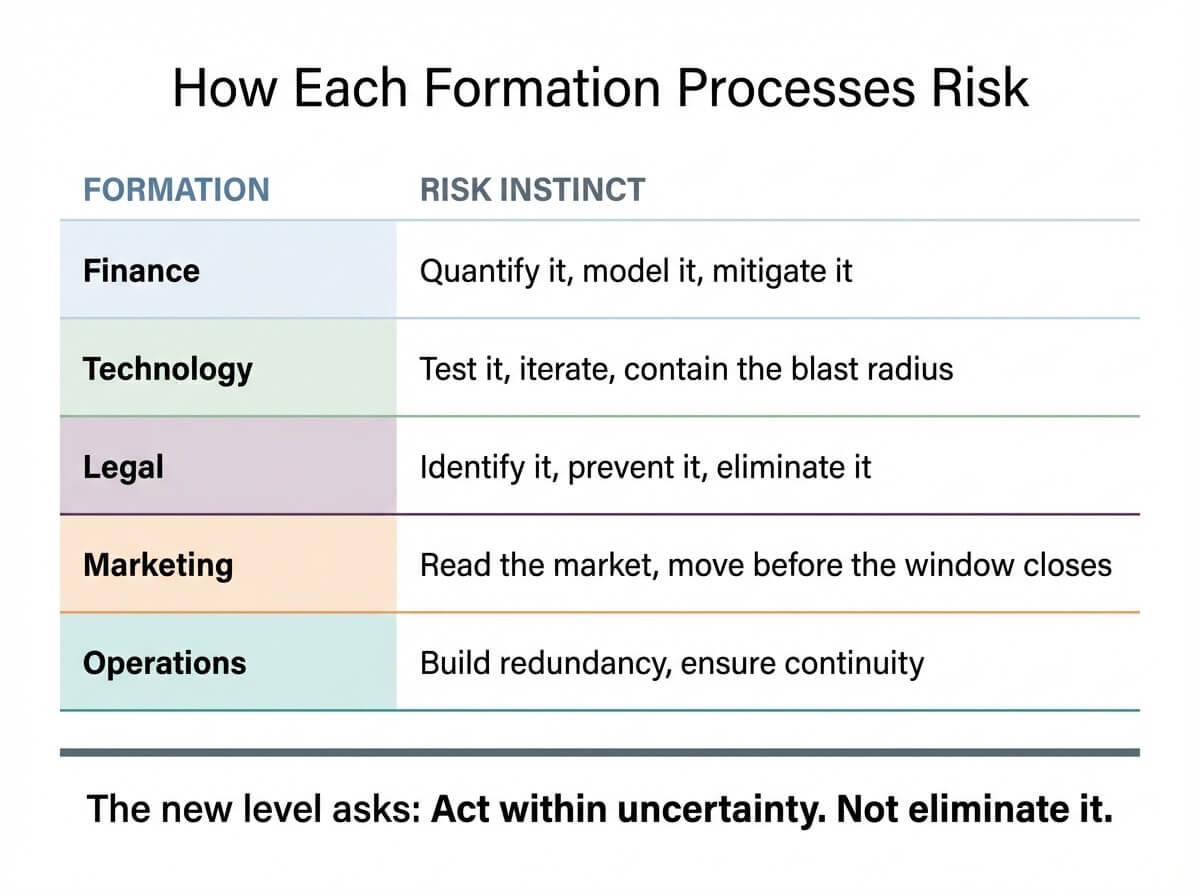
In finance, risk is quantified. You model it, assign probabilities, build scenarios. The responsible thing is to have the data before making the call. A decision without a model is, in the finance formation, a guess — and guesses are how organizations lose money.
In technology, risk is tested. You ship a small version, see what breaks, iterate. The responsible thing is to move fast but reversibly — build the experiment, contain the blast radius, learn from failure. A decision that cannot be rolled back is, in the engineering formation, architecturally unsound.
Diagram comparing how five functional formations process risk differently
In legal, risk is prevented. You identify exposure, map liability, eliminate uncertainty before it materializes. The responsible thing is to ensure nothing goes wrong. A decision that accepts known risk is, in the legal formation, negligence.
In marketing, risk is embraced. You move on narrative conviction, competitive timing, audience instinct. The responsible thing is to act before the window closes. A decision delayed by excessive analysis is, in the marketing formation, a missed opportunity.
In operations, risk is contained. You build redundancy, create fallback systems, design processes that absorb disruption. The responsible thing is to ensure continuity. A decision that threatens operational stability is, in the operations formation, irresponsible.
Ask five leaders to define “responsible risk-taking” and you will get five different answers — each trained into them by a career that rewarded one version and punished the others.
None of these is wrong. Each is a legitimate formation response to uncertainty. The problem arrives when the organization asks you to operate with a version of risk your career never installed.
What the New Level Asks
At IC and manager level, risk lives within the function. The boundaries are clear: your domain, your team, your deliverables. The consequences of a wrong call are contained. The evidence you need to act is usually available or attainable.
At Director and VP level, the risk equation changes. You must now influence decisions that span functions, commit to directions with incomplete data, and put your credibility behind recommendations that could be wrong. The evidence you are accustomed to having is not available at the speed the organization needs decisions. The “strategic thinking” feedback is often code for: we need you to act with less certainty than your formation says is responsible.
The specific form of the challenge depends on the formation:
Formation
What “Risk” Means at IC/Manager
What the New Level Demands
Where the Friction Lives
Finance
Model it, quantify it, mitigate it
Make the call before the model is complete
Conviction without complete data feels irresponsible
Technology
Test it, iterate, contain the blast radius
Commit to irreversible organizational bets
Irreversible decisions violate the engineering instinct
Legal
Identify it, mitigate it, prevent it
Accept some risks and help the org move through them
Accepting known risk feels like professional negligence
Marketing
Read the market, move before the window closes
Commit resources at enterprise scale, not campaign scale
Enterprise-scale bets require the rigor the formation resists
Operations
Build redundancy, ensure continuity
Disrupt existing systems to create new capability
Deliberate disruption violates the stability instinct
Why Courage Is the Wrong Frame
The conventional advice for leaders who resist strategic risk-taking is: be braver. Step out of your comfort zone. Lean into the discomfort. That framing treats the resistance as a character trait — as if the leader simply needs more courage.
The resistance is not a character trait. It is a formation response. The professional identity that defines “good” and “responsible” was built by a career that rewarded caution, thoroughness, precision, or containment. Asking the leader to “be braver” without addressing the formation underneath is like asking someone to speak a language they were never taught. They might be able to mimic the words. They will not feel fluent. And under pressure, they will default to their mother tongue.
This is why the inflection point is so predictable. The leader gets the feedback. They try to act on it — to move faster, take bigger swings, operate with less certainty. It feels wrong. The results are mixed because the attempt is performative rather than grounded. And the leader concludes that they are simply not the kind of person who takes strategic risks. The formation has won. Not because the leader lacks capacity, but because the formation’s definition of “responsible” was never surfaced and examined.
ℹ
Note
The leader who says “I am just not a risk-taker” is usually not describing a personality trait. They are describing a formation that defined responsible leadership as the opposite of the thing the organization is now asking for. That is a recognition worth having — and it changes what the coaching conversation can do.
What a Coach Who Gets This Asks
Generic coaching hears “I know I need to take more risks but I keep holding back” and offers courage frameworks: exposure therapy for risk, incremental experiments, reframing failure as learning. A coach who understands the formation hears the same sentence and recognizes that the leader’s definition of “responsible” is in conflict with what the level demands.
The coaching question is not “What would it take to be braver?” The question is: “What does ‘responsible’ mean to you right now — and what would ‘responsible’ look like if you defined it from the level you are at rather than the level that trained you?”
That question does not push the leader to override their instinct. It invites them to update the instinct. To discover that responsibility at Director or VP level is not the absence of risk — it is the wisdom to know which risks the organization needs taken. The old definition of responsible was right. It was right for the old level. The new level has a different version, and the formation has not caught up.
The risk your boss wants you to take is not recklessness. It is the version of responsibility that operates at the level you now occupy — where decisions are made with incomplete information, where the cost of inaction is often higher than the cost of a wrong call, and where the organization needs leaders who can hold uncertainty without freezing.
Your formation installed a definition of responsible that served you well. It still has value. It is no longer the whole picture. The expansion is not about becoming someone who ignores risk. It is about becoming someone who can hold what risk means to you alongside what risk means to the room — and act from both.
If the tension between your formation’s instinct and the role’s demand feels live for you, a coach who understands what your career installed can help you see the gap without asking you to be someone you are not. The goal is not to override the formation. The goal is to expand what “responsible” means.
“Think more strategically.”
You have heard it in a review, a one-on-one, a passing comment from someone two levels above you. And your first response was probably to do the thing your career trained you to do — but harder. The finance leader builds a longer-horizon model. The engineer drafts a technology roadmap. The operations leader creates a three-year capacity plan. The marketing leader develops a competitive positioning framework. Each of these is strategic thinking. None of them is what the feedback is actually asking for.
The problem is not that you lack strategy. The problem is that “strategic” means something different at the level you occupy now than it did at the level where you learned it. And nobody defines the shift. They just keep saying the word and expecting you to hear something your formation never taught you to hear.
Key Takeaways
“Think more strategically” is the most common piece of feedback at the Director/VP level — and the least defined. What it means depends entirely on which career shaped the person hearing it.
Every function installs a specific version of strategic thinking. Extending the time horizon within your domain is not the shift. The shift is extending your lens beyond your domain entirely.
The real strategic gap is not about vision. It is about operating in uncertainty — forming positions before the data is complete, influencing decisions you do not control, contributing to conversations where your functional expertise is not the point.
A coach who understands what “strategic” means to your specific formation can surface the gap between what you are doing and what the room needs without reducing the problem to “you need a broader perspective.”
What “Strategic” Means in Your Formation
Every career installs its own definition of strategic thinking. That definition works — at the level where it was installed.
In finance, strategic means scenario modeling: project forward, weight probabilities, stress-test assumptions. The finance leader who is told to think more strategically builds a better model. More variables, longer horizon, tighter sensitivity analysis. In technology, strategic means systems architecture: how does this decision affect the platform in eighteen months? The engineer who is told to think more strategically drafts a deeper roadmap. In operations, strategic means anticipating bottlenecks at scale: what will break when we grow? In marketing, strategic means market positioning: where do we play and how do we win the narrative?
Each version of strategic thinking is legitimate. Each version is also bounded by the function that installed it. The finance leader’s strategy is about the numbers. The technology leader’s strategy is about the systems. The operations leader’s strategy is about the process. The feedback — “think more strategically” — is not asking for a better version of functional strategy. It is asking for something the function never taught.
The feedback says “strategic.” What it means is: form a position on something outside your domain and defend it in a room where nobody shares your expertise.
The Actual Shift
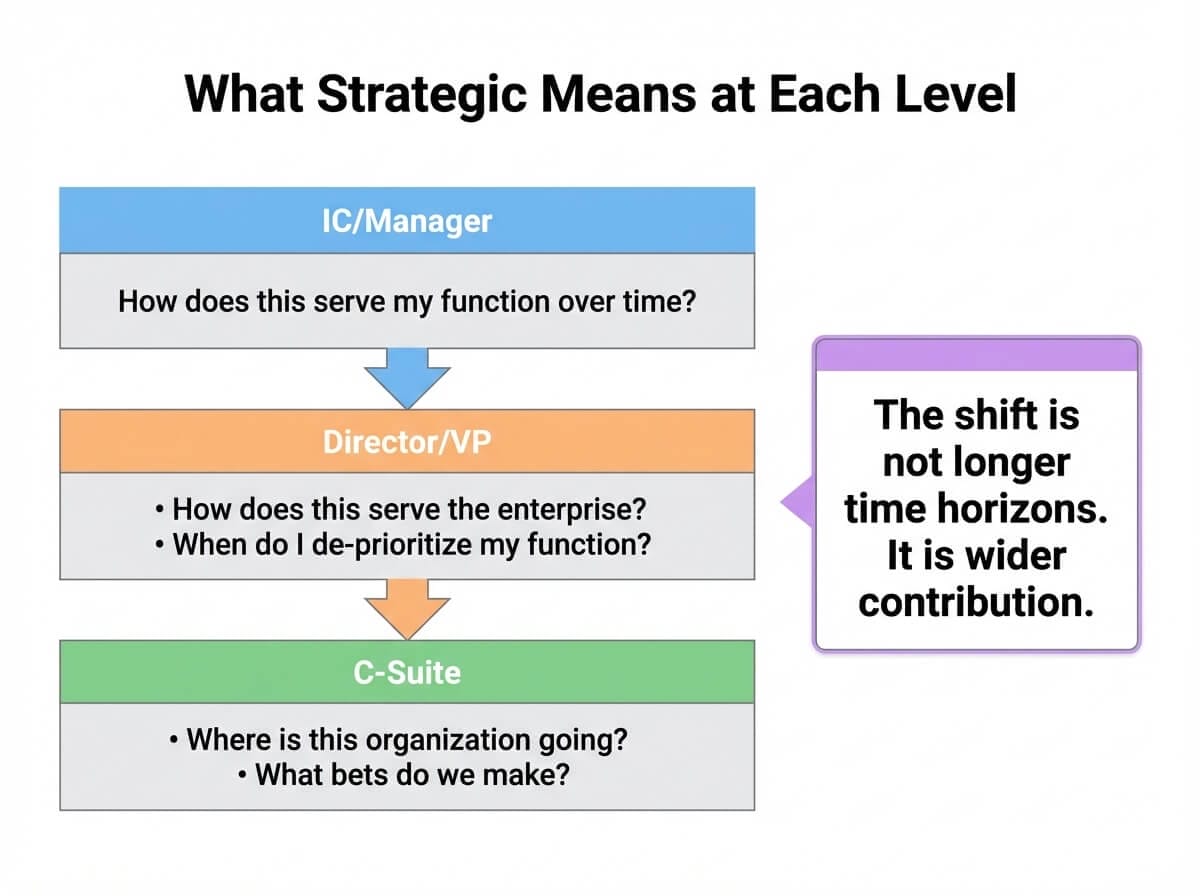
At IC and manager level, the time horizon lives inside the function. The sprint, the quarter, the campaign cycle, the audit calendar. Strategic means: how does this decision serve the function over time? At Director and VP level, the time horizon must extend beyond the function. Strategic means: how does this decision serve the enterprise? And more uncomfortably: how does my function’s interest sometimes conflict with the enterprise’s interest, and what do I do when it does?
This is where the shift gets hard. The patterns your career installed trained you to optimize your domain. The new level asks you to sometimes de-prioritize your domain for the whole. The finance leader who recommends funding a marketing initiative that has no provable ROI — because the competitive positioning matters more than the model — is thinking strategically. It also feels, to their formation, like professional malpractice.
The real gap is not about extending the time horizon. It is about operating in uncertainty. Forming positions before the data is complete. Influencing decisions you do not control. Contributing to conversations where your functional expertise is not the point — where what matters is your judgment as a leader, not your credibility as a specialist. That is a fundamentally different kind of contribution than your career prepared you for.
Level
What “Strategic” Means
What Success Looks Like
IC / Manager
How does this serve my function over time?
The project delivers. The team performs. The work is excellent.
Director / VP
How does this serve the enterprise? When do I de-prioritize my function?
Cross-functional influence. Decisions shaped beyond your domain.
C-Suite
Where is this organization going and why? What bets do we make?
Enterprise direction set. Judgment expressed before data is complete.
Why Working Harder Does Not Fix It
The first response to “think more strategically” is almost always: work harder at the version of strategic thinking your career already installed. The finance leader builds a more rigorous model. The engineer creates a more comprehensive roadmap. The operations leader develops a more detailed capacity plan. Each effort is excellent. None of them answers the feedback.
This is the currency shift in action. The old currency — functional strategic excellence — has diminishing returns. The new currency — enterprise-level judgment expressed across functions — requires spending credibility in rooms where you are not the expert. That is deeply uncomfortable for a leader whose career taught them that credibility comes from expertise.
There is a predictable inflection point. Around month four or five after a major promotion, the leader realizes that working harder at the old approach is not producing the results it used to. The effort is the same or greater. The impact is less. This is when most leaders start questioning themselves. Not because they are failing, but because the one strategy they know — excellence through functional expertise — has hit diminishing returns, and they do not have a second strategy.
ℹ
Note
The identity problem is underneath the strategic problem. “Think more strategically” asks you to contribute in a space where your functional identity does not protect you. The discomfort is not about capability. It is about showing up in a conversation where you cannot rely on the thing that makes you feel credible.
What a Coach Who Gets This Asks
Generic coaching hears “I keep getting feedback to be more strategic” and offers frameworks: how to think in longer time horizons, how to present strategically, how to build a strategic narrative. These are useful. They are also surface-level — they address the output without addressing why the leader keeps defaulting to functional strategy despite knowing better.
A coach who understands the formation hears the same sentence and recognizes that “strategic” is a word the leader’s career defined one way and the organization is now defining another way. The coaching question is: “When they say ‘strategic,’ what do you think they are actually asking for?”
That question invites the leader to surface the gap themselves — to discover that the feedback is not about thinking bigger within their function but about contributing beyond it. And the follow-up — “What keeps you from offering a point of view in conversations outside your domain?” — opens the identity question: what happens when the room does not need your expertise and you have to lead with judgment instead?
The room does not need you to be less of a specialist. It needs you to be a specialist who can also step outside the specialty and add value as a leader. That is not a different person. It is a wider version of the person your career built. The analytical mind that serves the enterprise, not just the function. The operational instinct that shapes strategy, not just executes it. The technical depth that informs organizational bets, not just system architecture.
Diagram showing how the definition of strategic thinking changes from IC/Manager through Director/VP to C-Suite
If “think more strategically” has been following you from review to review, the issue is not your capability. It is the gap between the influence your role asks for and the version of strategic contribution your career installed. That gap does not close with more functional excellence. It closes when someone helps you see what the room is actually asking for — and what it costs you, at the level of identity, to give it.
The quarterly business review is running long. The CMO presents the brand investment case. Market positioning, share of voice, competitive narrative. The CFO’s first question: “What’s the expected return and over what period?” The CMO hears: you do not trust my judgment. The CFO hears their own question as entirely reasonable — how do you invest without a return model? The CMO cannot produce a return model because brand impact does not work that way. The CFO cannot approve investment without one because fiduciary responsibility does not work any other way.
Neither leader is being unreasonable. Both are doing exactly what their careers trained them to do. The collision is not between two people. It is between two professional formations trying to process the same decision with different operating systems. And if this scene sounds like a meeting you have attended more than once, the problem is not the people in the room. It is what their careers installed long before they sat down at the same table.
Key Takeaways
The CFO-CMO tension is the most visible formation collision on most leadership teams — and the most frequently misdiagnosed as a personality conflict.
Finance processes decisions through evidence, quantified returns, and risk mitigation. Marketing processes decisions through narrative, market timing, and creative conviction. Both are legitimate. Neither is complete.
The friction is productive. Finance without marketing produces correct decisions nobody follows. Marketing without finance produces compelling strategies nobody can fund.
Resolving the tension is the wrong goal. Naming it — and understanding the formation logic on each side — is what turns a recurring argument into a strategic advantage.
A team coach who understands both formations does not pick a side. They help each leader see what the other’s formation provides that theirs does not.
Two Operating Systems, One Decision
A career in finance installs a specific relationship with evidence. Data before commitment. Returns quantified before resources allocated. Risk assessed before action taken. After fifteen or twenty years, this is not a policy. It is an instinct. When someone proposes investment without a model, the finance-trained mind does not hear confidence. It hears an unaudited claim. The CFO who asks “What’s the ROI?” is not being difficult. They are doing what their career built them to do.
A career in marketing installs a different relationship with evidence. Market windows that close. Brand value that compounds over years but cannot be isolated in a quarterly model. Competitive positioning that depends on timing and narrative, not on provable returns. The CMO who says “We can model this to death or we can move while the window is open” is not being reckless. They are doing what their career built them to do.
Both formations have legitimate relationships with risk. Finance metabolizes risk through quantification: measure it, model it, mitigate it. Marketing metabolizes risk through conviction: read the market, trust the narrative, move before the data is complete. Put them in the same room on the same decision, and the CFO experiences the CMO as someone who wants to spend money without evidence. The CMO experiences the CFO as someone who wants to analyze until the opportunity is gone.
Assessed intuitively, accepted as inherent to timing
What “strategic” means
A five-year scenario model with probability-weighted outcomes
A market narrative about where the category is headed
Time horizon
Three-to-five-year capital allocation windows
Six-month campaign arcs, quarterly brand cycles
What “responsible” looks like
No investment without a defensible return model
No delay when the market window is closing
Tell a CFO to “think more strategically” and they build a scenario model. Tell a CMO to “think more strategically” and they paint a market narrative. Both are strategic thinking. Neither would recognize the other’s version as strategy.
What Each Side Hears
The misread is symmetrical. The CFO interprets the CMO’s narrative confidence as a lack of analytical rigor. “If they had real evidence, they would present it as data. The fact that they are telling a story means they do not have the numbers.” The CMO interprets the CFO’s analytical questions as a lack of strategic vision. “If they understood the market, they would not need me to reduce it to a spreadsheet. The fact that they keep asking for ROI means they do not understand what brand does.”
Both readings are accurate projections of one formation onto the other. The CFO is right that the CMO is not providing quantified evidence. The CMO is right that the CFO is not grasping the market dynamic. The collision is not a misunderstanding that better communication can fix. It is a structural tension between two legitimate professional operating systems that define evidence, risk, and strategy differently.
The meeting ends without resolution. Both leaders leave frustrated. Both believe the other does not understand. And in three months, the same meeting happens again. Same argument. Same positions. Same frustration. Not because neither leader has grown. Because the formation underneath the argument has not been named.
ℹ
Note
This collision is not unique to the CFO and CMO. It is the most visible version of a dynamic that occurs whenever two formations with different evidence standards, risk orientations, and time horizons sit around the same decision. The CTO and GC have their own version. So do the COO and the CHRO. The specifics differ. The structure is the same.
Why the Tension Is Productive
The instinct is to resolve the tension. Get the CFO and CMO aligned. Find common ground. Build a shared framework for evaluating marketing investment. These are not bad ideas. They are incomplete ideas — because they assume the tension is a problem to be solved rather than a dynamic to be understood.
Comparison diagram showing finance and marketing formations processing the same decision through different operating systems
Finance without marketing produces correct decisions nobody follows. The analysis is sound. The strategy is defensible. The market moved while the organization was still modeling. Marketing without finance produces compelling strategies nobody can fund. The narrative is powerful. The positioning is sharp. The balance sheet cannot support it.
The collision between these two formations is not dysfunction. It is the organization’s decision-making immune system. The CFO’s rigor prevents reckless investment. The CMO’s conviction prevents analysis paralysis. Neither formation alone produces a good decision. The tension between them does — when both leaders can see the tension for what it is rather than experiencing it as the other person being wrong.
The productive question is not “who is right?” It is “what does this room need that neither formation is providing on its own?”
What Changes With a Coach Who Gets This
Generic team coaching hears this tension and offers communication frameworks. How to present to a finance audience. How to ask questions that feel collaborative rather than adversarial. Active listening exercises. Personality assessments that label one leader as “analytical” and the other as “creative.”
A team coach who understands both formations does not resolve the tension. They name the structure underneath it. In the room with both leaders, the question to the CFO is not “How can you be more supportive of marketing?” The question is: “What would it take for you to approve investment in something you cannot model?” That question surfaces the formation logic — the deep assumption that unmodeled investment is irresponsible — without attacking the person who holds it.
The question to the CMO is not “How can you present your case more analytically?” The question is: “What would it take for you to present a business case that a finance mind could evaluate without feeling like you reduced your work to a spreadsheet?” That question surfaces the CMO’s formation logic — the belief that reducing narrative to numbers strips it of the thing that makes it powerful — without dismissing it.
Neither question asks either leader to become the other. Both questions invite each leader to see the formation logic driving their position. And that recognition — “I keep asking for the model because my career taught me that decisions without models are irresponsible” — is where the recurring argument starts becoming a productive structural tension instead of a personal frustration.
The next time your leadership team hits the same argument for the third consecutive meeting, consider the possibility that nobody in the room is wrong. The CFO who insists on more data before committing and the CMO who insists on moving before the window closes are not having a disagreement about strategy. They are having a collision between two professional formations, each doing exactly what it was trained to do.
The resolution is not common ground. It is mutual recognition — each formation seeing what the other provides that it cannot. The rigor that prevents recklessness. The conviction that prevents paralysis. Both are the room working.
If your leadership team has a version of this collision — and most do — the question is not how to stop the argument. It is whether a coach who understands the formations in the room can help the team see the structure underneath the friction, so the tension becomes an asset instead of a recurring frustration.