

The Coaching Stance: What Changes When You Stop Facilitating and Start Coaching
Key Takeaways
- Coaching stance is not a role you switch into - it is a quality of presence that shows up in how you listen, what you notice, and what you do with the urge to contribute.
- Three listening shifts distinguish coaching from facilitating: where your attention goes, what you do with silence, and what you notice first.
- Four patterns pull coaches out of stance: expertise activation, anxiety about silence, over-identification, and outcome attachment.
- Recovery starts with naming what happened internally - then returning to curiosity about what the client is making of their situation.
The agile coaching world has a definition of coaching stance: it is one of nine stances you rotate through depending on what the situation needs. Coach, mentor, teacher, facilitator, consultant - pick the right one, apply it, move on.
The ICF world has a different definition. Coaching stance is not a role. It is a way of being - an internal posture of curiosity and non-judgment that underlies everything a coach does.
Both definitions are incomplete on their own. The agile version tells you what to do but nothing about how to be while doing it. The ICF version is philosophically correct and operationally vague.
What actually changes when you adopt a coaching stance is observable. It shows up in your listening - in where your attention goes, what you do with the urge to contribute, and what you notice first. That is the behavioral bridge between the two definitions, and it is what separates coaching from facilitating in practice.
Two Definitions of Coaching Stance - and What Both Get Wrong
The agile coaching community popularized a model of stances - typically nine roles a coach can adopt depending on context. The framework is useful. When a team needs skill transfer, you teach. When they need process design, you facilitate. When they need to think through a decision, you coach.
The problem is that the model treats stance as a selection mechanism. You assess the situation, pick the right tool, and apply it. But coaching stance is not a tool in the kit. It is the internal condition under which the other tools work differently.
The ICF tradition gets closer. Coaching skills framework development starts with presence - the capacity to be fully conscious and responsive in the moment. The ICF Updated Core Competencies describe coaching as a partnership that honors the client as the expert in their own life. That is a stance, not a technique.
But "way of being" is hard to operationalize. A new coach hears "be present" and nods, then walks into a session and immediately starts problem-solving because they do not know what being present looks like in behavioral terms.
What practitioners need is neither the menu nor the philosophy. They need the observable evidence: what is different about my behavior when I am holding a coaching stance versus when I have lost it?
The answer is in the listening.
What Changes in Your Listening When You Hold a Coaching Stance
Three shifts become visible in your listening when you move from a facilitating stance to a coaching stance. These are not techniques to practice. They are consequences of holding the stance - evidence that you are in it.
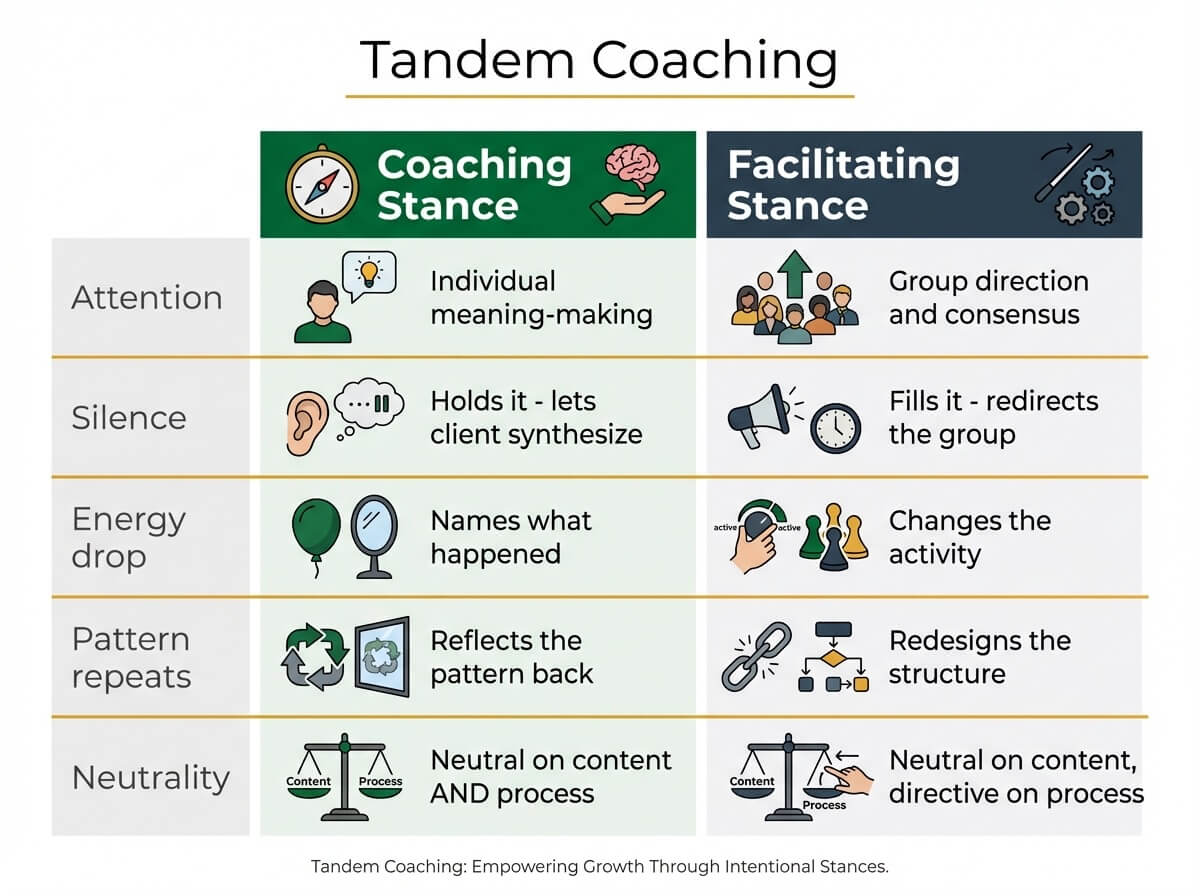
Where your attention goes. A facilitator listens for the group's direction - where is energy converging, what themes are emerging, how is the process working. A coach listens for what this specific person is making of their experience right now. The shift is from tracking the room to tracking the individual's meaning-making process. You stop listening for the answer and start listening for how they are constructing the question.
This is active listening in coaching at a deeper level - not just hearing words but attending to the architecture of the other person's thinking.
What you do with the urge to contribute. Every experienced facilitator and coach has moments where they see the pattern, know the answer, or have the perfect framework. In a facilitating stance, you synthesize and reflect it back to the group. In a coaching stance, you hold it. You let the silence do the work. You trust that the client's own synthesis will be more useful than yours, even when yours arrives first.
The coaching stance is not the absence of contribution. It is the discipline of waiting until your contribution serves the client's thinking rather than replacing it.
What you notice first. A facilitator notices when the process breaks down - energy dropping, side conversations starting, the agenda stalling. A coach notices when something shifts inside the person - a hesitation, a change in vocal tone, a sudden deflection. The facilitator sees the system. The coach sees the person inside the system.
None of these shifts require you to stop facilitating or stop coaching. They require you to be honest about which stance you are actually holding in this moment. Most coaches, when they record a session and review it honestly, discover they hold a coaching stance less often than they think they do. The awareness itself is the first developmental step.
Coaching Stance vs. Facilitating Stance: The Behavioral Differences
The distinction becomes concrete in session. Consider three moments that happen in virtually every coaching or facilitation engagement:
The client says "I don't know what to do." In a facilitating stance, you generate options - brainstorming, decision matrices, pros-and-cons lists. The facilitator's instinct is to move the person toward resolution. In a coaching stance, you stay with the not-knowing. You might ask "What about this feels unclear?" or simply wait. The coaching stance trusts that "I don't know" is rarely literal. It usually means "I know but I am not ready to say it" or "I know but I do not like the answer."
Energy drops in the middle of a conversation. A facilitator notices and acts - changes the activity, introduces a break, shifts the topic. A coach notices and names it. "Something just shifted. What happened?" The facilitator manages the energy. The coach investigates it. Both are valid responses. The question is which one you default to and whether you chose it consciously.
A pattern repeats across multiple sessions. The facilitator redesigns the structure - maybe the meeting format needs changing, the stakeholder mix is wrong, the cadence is off. The coach reflects the pattern back: "This is the third time we have arrived here. What do you make of that?" The facilitator fixes the container. The coach surfaces what the container is revealing.
The underlying principle is engaged neutrality - caring genuinely about the person while holding no investment in what they decide. A facilitating stance is neutral on content but directive on process. A coaching stance is neutral on both, though fully present to both.
You can facilitate with coaching skills. You cannot coach from a facilitating stance. The direction of the relationship between these two modes matters.
For a deeper look at how the coaching stance vs. facilitation in team contexts plays out, team coaching adds another layer - but the stance distinction holds.
What Pulls Coaches Out of Stance - and How to Get Back
Every coach loses their coaching stance. The ones who are good at it lose it and notice. The ones who are masterful lose it, notice, and return - sometimes within the same sentence.
Explore ICF-Accredited Training
ACC, Professional Coach (ACC+PCC+ACTC), Systems Coach Bridge, and ACTC programs with training, mentoring, and supervision included. See what fits your goals.
Four patterns account for most stance breaks:
Expertise activation. You have been in their situation. You know what works. The urge to share is not intellectual - it is physical, a forward lean, an intake of breath before you catch yourself. The more relevant your experience, the stronger the pull. This is especially acute for agile coaches who spent years solving exactly the problems their clients face.
Anxiety about silence. The client pauses. Three seconds feels like thirty. You fill it because the silence feels like failure - like you should be doing something. But the silence is often where the client does their most important work. Your discomfort is not their signal that they need help.
Over-identification. The client describes a dynamic you recognize intimately. Your own experience floods the space. Suddenly you are not listening to their situation. You are reliving yours. Your questions start steering toward what worked for you, not what matters to them.
Outcome attachment. You want this client to succeed. You have invested in their progress. And so you start subtly - or not so subtly - directing. Your questions narrow. Your reflections emphasize the data that supports the direction you think they should go. This is the hardest pattern to spot because the motivation feels virtuous. You are not being lazy or distracted. You are caring too much about a specific outcome.
The recovery pattern is the same for all four: name it internally. "I notice I want to solve this." Then return to curiosity: "What is the client making of this?" Let the next question come from what you heard, not from what you know.
This is not a one-time skill. It is a practice. The developmental arc from ACC to PCC to MCC is partly a story of how quickly and cleanly a coach recovers their stance after losing it.
Frequently Asked Questions
Is coaching stance the same as being passive?
No. Coaching stance is intensely active - it requires sustained attention, deliberate restraint of expertise, and real-time awareness of both the client and yourself. What it is not is directive. You are fully engaged but you have placed the client's agenda ahead of your own contributions.
Can you use a coaching stance in facilitation?
Yes, and experienced facilitators do this regularly. You can facilitate a process while holding a coaching stance toward individual participants - noticing their internal shifts, asking questions that serve their thinking rather than the group's momentum. The challenge is that facilitation often requires you to manage pace and process, which pulls toward a more directive mode.
How do you develop a coaching stance?
Through supervised practice with feedback. Mentor coaching and peer supervision are the primary vehicles. Reading about stance does not build it - you develop it by coaching, getting observed, and having someone name the moments when you lost it and when you held it. Formal credentialing programs like ICF ACC, PCC, and ACTC team coaching certification build stance through structured observation and competency assessment.
What is the difference between coaching stance and coaching presence?
Coaching presence is the broader concept - your overall quality of being in the session, including confidence, openness, and flexibility. Coaching stance is the specific internal posture from which that presence operates: the commitment to the client's agenda, the restraint of your own expertise, and the trust in the client's capacity. You can have presence without a coaching stance (a charismatic consultant has presence). You cannot have a coaching stance without presence.
ACTC Team Coaching — $2,499
ICF-accredited team coaching certification. Learn to facilitate team dynamics, group coaching, and organizational development.
Learn About ACTC Certification →