Coaching Skills for Change Management Professionals
The change practitioner who ran the stakeholder analysis was thorough. Fifty-two interviews. Color-coded impact matrix. Risk register updated weekly. And none of it told her what the regional VP was actually afraid of. The thing that would stall adoption for his entire division sat underneath every answer he gave, visible in the pauses and the careful phrasing, but invisible to the interview protocol. The question that would have surfaced it was not in the assessment template. It was a coaching question, and she had never been trained to ask it.
That gap between knowing the change management process and having the conversational capability to execute the hardest parts of it is not a knowledge gap. It is a skill gap. And it is the gap that separates change practitioners who produce plans from those who produce adoption.
The skills that close this gap come from coaching. Not coaching as a separate career, but coaching as a set of specific, developable capabilities that transform how change management practitioners do the work they already know how to do.
The Methodology Ceiling
Change management methodology training teaches a specific set of things well: how to assess readiness, how to build a communication plan, how to sequence adoption milestones, how to identify stakeholders and map their influence. It gives practitioners a structured process for moving an organization from state A to state B. And for the first few years, that process feels sufficient.
What it does not develop is conversational capability. The ability to sit in a room where the mood does not match the words. The ability to ask the follow-up question that nobody asked because the answer might be uncomfortable. The ability to tell a sponsor, directly and respectfully, that their behavior is undermining the initiative they approved.
Prosci teaches you that Desire is the second element of ADKAR. What it does not develop is your ability to sit across from a director who says "I am fully on board" while every behavioral signal says otherwise, and ask the question that surfaces the real barrier. That is a coaching competency. It is the difference between a change practitioner who documents adoption and one who actually moves it.
Most CM practitioners hit a ceiling three to five years in. They know more frameworks. They have run more change management programs. They can write a better change plan than they could five years ago. But their effectiveness plateaus. The plans get better. The results do not.
The ceiling is not knowledge. It is the ability to have the conversation the situation requires rather than the conversation the methodology scripted. Every experienced practitioner has felt this: the readiness assessment where every answer was technically complete and practically useless, the stakeholder meeting where the real issue sat visible to everyone and speakable by no one.
The plans get better. The results do not. That is the methodology ceiling, and no amount of framework knowledge will break through it.
The ADKAR model is elegant for diagnosis. It tells you where change is stalling. What it does not tell you is how to unstick it when the barrier is a sponsor who cannot articulate why the change matters, or a middle manager whose team compliance masks deep disengagement. Those situations require a different kind of capability. They require coaching skills.
Five Coaching Skills That Transform CM Practice
Five specific coaching capabilities transform change management conversations. All five are learnable. All five map directly to situations every experienced CM practitioner recognizes.
1. Deep Listening: Beyond Content to Pattern
Standard stakeholder interviews capture what people say. Coaching-level listening captures what they mean. When a project sponsor says "the team just needs more communication," a coached CM practitioner hears the unspoken second half: "because I do not know how to explain why this matters, and I am hoping a newsletter will do it for me."
The skill is not hearing words. It is hearing the pattern beneath them. In readiness assessments, this single capability transforms the quality of data you collect. You stop getting answers that look good on the impact matrix and start getting information you can actually use to design adoption support that addresses what people are really experiencing.
2. Powerful Questions: Beyond Information to Insight
The CM interview protocol asks, "What concerns do you have about this change?" Useful. The coaching question asks, "What would need to be true for you to lead this change with genuine conviction?" Different question. Different information. Different outcome.
Powerful questions do not extract data. They generate insight in the person answering them. The sponsor who answers the second question has to think about conviction, not compliance. They have to examine their own relationship to the change. For resistance conversations and sponsor engagement, this distinction changes everything. You move from collecting objections to facilitating self-discovery.
3. Sitting with Discomfort: Beyond Problem-Solving to Presence
When a respected engineer says, "This transformation makes everything I built irrelevant," the CM instinct is to reassure: "Your expertise is still valued." The coaching response is silence, followed by: "Tell me more about that."
The first response closes the conversation. The second opens the path to genuine engagement. In town halls and resistance meetings, the ability to hold space for difficult emotions without rushing to solve them is what creates real movement.
4. Direct Communication: Beyond Diplomacy to Honest Observation
The sponsor has not attended the last three steering meetings. The CM practitioner sends another politely-worded reminder. A CM practitioner with coaching in change management says, in private: "Your absence is being read as disengagement, and it is affecting adoption in the teams that report to you. What is going on?"
Directness, delivered with care, is a coaching skill most CM training never develops. It is also the skill that most frequently determines whether sponsors stay engaged or quietly disengage.
5. Evoking Awareness: Beyond Telling to Developing
The default CM approach to managers struggling with change: give them the talking points. The coaching approach: help them discover what their team actually needs to hear. One creates messengers. The other creates leaders.
The difference compounds across every level of the organization. When middle managers can articulate the change in their own words, grounded in their own understanding, their teams respond to conviction rather than compliance. And conviction, unlike compliance, survives the first difficulty. It holds when the project team disbands and the change has to sustain itself through daily decisions that no communication plan covers.
These five capabilities are not personality traits. They are change leadership capabilities that develop through structured practice. Each one maps to specific ICF coaching competencies, and each one directly addresses situations that methodology training alone does not prepare practitioners to handle.
What Changes When You Can Coach
Consider a CM practitioner who conducted thorough assessments, followed the methodology, and produced plans that earned praise from the steering committee. She watched adoption plateau at 60% in three consecutive initiatives, always at the same point: when the work shifted from planning to the difficult human conversations that determine whether change actually takes hold. Each time, she escalated to leadership. Each time, the escalation produced mandates rather than commitment. Each time, the mandates produced surface compliance that quietly eroded over the following quarter.
The methodology was not the problem. Her knowledge was not the problem. The problem was that every critical moment in the change required a conversation she did not have the skills to lead.
Twelve months and coaching certification later, the methodology was identical. What changed was the quality of every conversation along the way. Stakeholder assessments surfaced real barriers instead of polite concerns. Sponsor engagement sessions became development conversations where sponsors examined their own assumptions about why people should change. Resistance meetings became diagnostic opportunities that generated actionable insight instead of escalation requests.
The same practitioner. The same frameworks. Adoption that held above 80% because the human work happened alongside the process work. The escalation calls to leadership dropped. Not because resistance disappeared, but because resistance became useful information rather than a trigger for mandates.
Coaching skills do not replace methodology. They activate it. Most CM practitioners already know what to do. What coaching develops is the capability to do the difficult parts, the parts where process knowledge meets human complexity and the textbook runs out of answers. The methodology tells you to assess readiness. Coaching capability gives you the skill to ask the question that actually reveals it.
Same practitioner. Same frameworks. The only difference was the ability to have the conversation the situation actually required.
Developing Coaching Capability
Reading about coaching skills develops awareness, not capability. You can understand powerful questions intellectually. Asking them when a hostile VP is staring you down requires development through practice, feedback, and supervised application. This is the same principle coaching applies to the organizations you serve: knowing what to do and being able to do it under pressure are different things. The gap between them closes through deliberate practice, not more reading.
Three development approaches work, each at a different depth:
Peer practice. Practicing coaching conversations with other CM practitioners. You take turns coaching each other through real stakeholder scenarios. Low cost, accessible, and useful for building initial comfort with the skills. Limited by the depth of feedback available, but it breaks the pattern of only reading about coaching and starts building muscle memory for the conversational shifts.
Coaching supervision. Working with a mentor coach on specific client situations from your change work. You bring the stakeholder conversation that did not go the way you wanted, and a skilled coach helps you see what you missed and what you could try differently. Targeted, practical, and directly connected to the situations where you need these skills most.
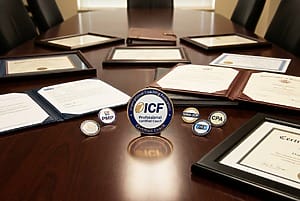
Coaching certification. Structured competency development through an ICF-accredited program. The most comprehensive path because it integrates practice, feedback, observed coaching sessions, and progressive challenge into a credentialed development arc. For CM practitioners complementing your change management certification with coaching credentials, this path builds the full capability set.
The common thread: you learn by doing, not by studying. Coaching capability develops the same way it develops capability in others, through practice with feedback in progressively challenging situations. Investing in your own development as a change leader follows the same principle you already apply to the organizations you serve.
The Certification Pathway
Most CM practitioners think of coaching certification as a career pivot. Something you do instead of change management. The reframe: it is a career multiplier.
An ICF Associate Certified Coach credential requires 60+ hours of coach-specific education and supervised practice through an ACC certification program. For a CM practitioner, that investment develops the exact competencies that determine whether your next change initiative reaches adoption or just compliance.
ACC or PCC credentials do not replace your Prosci or CCMP. They develop the human capability that makes your methodology knowledge actually effective. CM practitioners with coaching credentials occupy a different competitive position. They offer something methodology-only practitioners cannot: the ability to develop the people who execute the change, not just the plans that describe it.
The career math works in your favor. Change management practitioners with coaching skills are rare. Organizations that have invested in CM methodology are increasingly recognizing that methodology without conversational capability produces compliance without commitment. You already have the domain expertise. Coaching credentials add the development capability that turns expertise into results.
You already know what to do. Coaching credentials develop your ability to do it when a hostile room is staring you down.
The Real Test
The test is not whether you can name the five capabilities described here. It is what happens in your next stakeholder conversation.
When the prepared answer comes, the one that tells you nothing useful, do you accept it and check the box? Or do you ask the question that surfaces what is actually happening?
That choice, repeated across dozens of conversations in every change initiative, is the difference between adoption metrics and actual transformation.
The methodology tells you what to do. Coaching capability develops your ability to do it when it matters. One requires certification. The other requires development. And the CM practitioners who invest in both are the ones whose change initiatives survive contact with reality.
Key Takeaways
- Coaching skills develop conversational capability that methodology training alone cannot: deep listening, powerful questions, presence with discomfort, direct communication, and evoking awareness.
- The methodology ceiling hits three to five years in. Plans keep improving, but adoption results plateau because the work shifts from process to the difficult human conversations that determine whether change holds.
- Coaching does not replace change management frameworks. It activates them. The same practitioner with the same methodology produces fundamentally different results when they can lead the conversations that matter.
- Capability develops through practice under pressure, not through reading. Peer practice, coaching supervision, and ICF certification are three paths at different depths, and all require doing the work, not studying the theory.
- CM practitioners with coaching credentials occupy a rare and increasingly valuable competitive position: the ability to develop the people who execute the change, not just the plans that describe it.
Develop the Full Coaching Capability Set
ACC certification develops the five coaching competencies through supervised practice, not classroom instruction. Built for professionals who already know their domain.
Explore ACC Certification →