
Why Legal Leaders Lead Differently — And What That Costs Them
The acquisition conversation happened last Tuesday. You find out Thursday, in your one-on-one with the CEO, when she mentions it in passing: “The team felt good about the direction. We’ll need your diligence before we go to the board.” You nod. You open your notebook. You do not say what you are thinking, which is: I could have told you three things about that target’s regulatory exposure that would have changed the conversation entirely. But you were not in the room. You are never in the room until after the direction is set. Your job begins when the decision has already been made and someone needs to make sure it doesn’t blow up.
If you have spent fifteen or twenty years in law and that scene lands somewhere deeper than your intellect, this article is for you. Not because something is wrong with your leadership. Because the patterns your career installed are doing exactly what they were designed to do. And the room you built your career to protect has learned to work around you.
Key Takeaways
- Legal training doesn’t just teach analytical skills. It reshapes cognition itself. Adversarial reasoning stops being a technique and starts being how you define intelligence.
- Your greatest contributions are things that didn’t happen. The crisis averted, the exposure caught, the liability that never materialized. That invisibility is structural, not a communication problem.
- The shift from risk prevention to strategic counsel is not about being “less legal.” It is about pointing the adversarial lens at pathways, not just at risks.
- Advisory-track power means your counsel can be heard and then ignored. That structural dynamic creates a specific kind of leadership anxiety that generic coaching rarely names.
- A coach who understands what a legal career does to how a person thinks will redirect the adversarial mind rather than trying to soften it.
What Legal Training Installs
You didn’t just learn to stress-test propositions. Adversarial reasoning became how you define smart. Somewhere between your first moot court argument and your thousandth contract review, the habit of finding the flaw in every position fused with your sense of intelligence so completely that the two became inseparable. When a colleague says “try being less adversarial in leadership meetings,” they think they are offering feedback. You hear something closer to: think worse. Because in your formation, the ability to dismantle a proposition is not a style. It is the standard for rigorous thought.
This is the highest identity rigidity of any professional background. Higher than finance’s attachment to precision. Higher than technology’s attachment to building. A financial leader told to “worry less about the numbers” can intellectually separate the skill from the self, even if the separation is painful. A legal leader told to “stop playing devil’s advocate” cannot locate the line between the technique and their own cognition. The technique is the cognition. Legal training didn’t give you a tool. It rebuilt how you think.
When someone asks you to be less adversarial, they think they’re asking you to change a behavior. You hear them asking you to be less intelligent.
Your signal environment compounds the problem. Silence equals success. You know when something went wrong. You track case outcomes, compliance status, regulatory actions. But the channel that tells you how you are experienced as a colleague and leader goes unread. Whether people bring you problems early because they trust you, or late because they want to limit the conversation. Whether the room treats your input as counsel or as obstacle. Your default interpretation when you are excluded from a strategic discussion: “They didn’t understand the risk.” The alternative reading—that they experienced your presence as the thing that turns every exploration into an audit—doesn’t surface, because your signal attunement was trained on liability detection, not on how you land in a room.
Notice how you process a conversation. Exposure and liability register before anyone else has finished their opening sentence. You construct arguments from precedent. What counts as evidence: documented authority, verifiable legal analysis, established case law. What does not count: instinct, gut feeling, the CEO’s read on the market. Your formation dismisses that as insufficient evidence. What you may not see is that your own pattern recognition—the thing you dismiss as “just a hunch”—is built on decades of case analysis running faster than a brief. It is evidence. It just doesn’t come with footnotes.
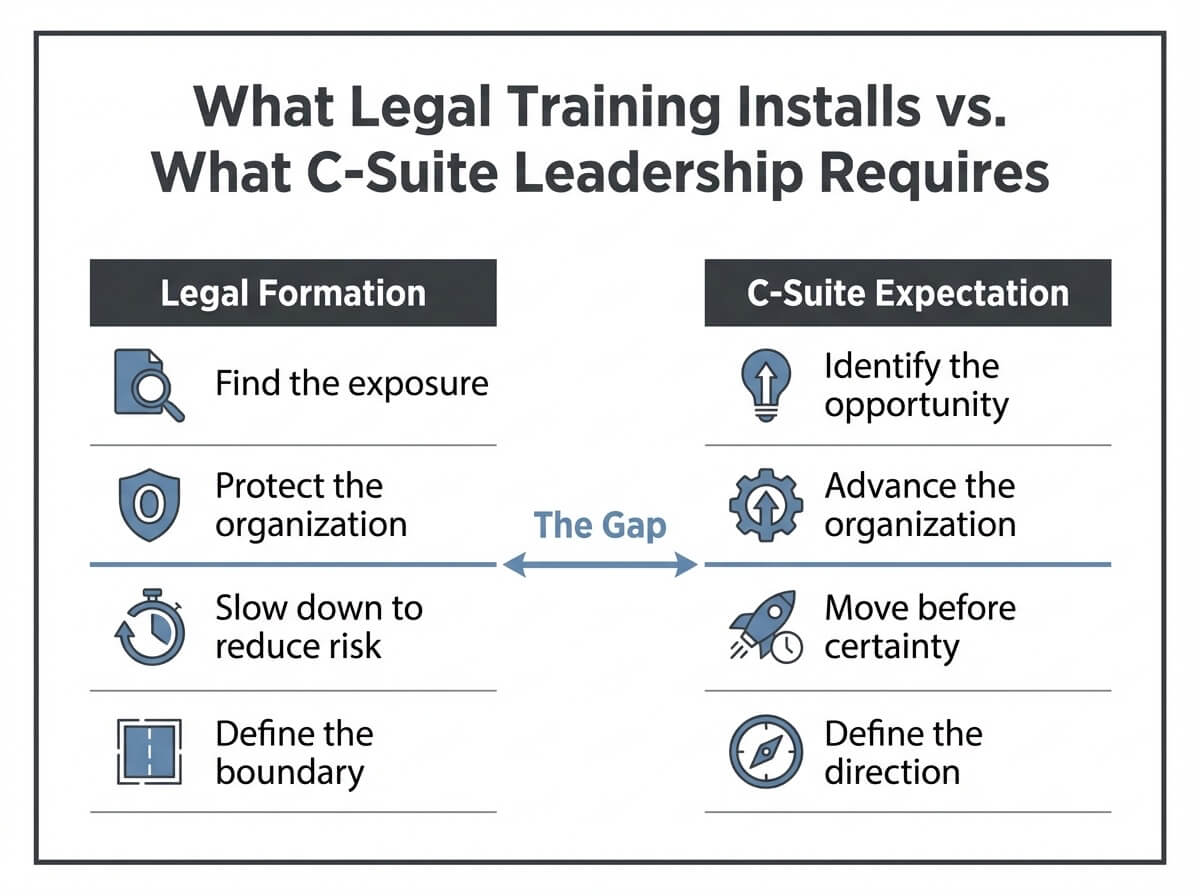
And then there is your relationship with risk. Risk, to you, is exposure to be identified and eliminated. Not quantified, as it is for your CFO. Not tested and iterated against, as it is for your CTO. Eliminated. Prevented from materializing. Your formation was built on preventing harm. Every “no” is an act of protection rooted in real liability analysis. The organization sees a gatekeeper. You see a guardian. Both readings are accurate. Neither is complete.
Where Protection Becomes a Ceiling
Every career level trades in a different currency. What earned your standing as an associate and senior counsel is not what earns it now, and the shift happened without anyone telling you the exchange rate had changed.
Recognize the Pattern?
If that description landed with uncomfortable precision, that’s what a first conversation feels like too. We start by naming what law installed—not asking you to abandon it.
| Career Level | Currency | What Earns Standing | The Posture |
|---|---|---|---|
| IC / Senior Counsel | Airtight reasoning | Risk identification, thoroughness, catching exposure before it materializes | “I find the problem before it finds us.” |
| Director / VP | Risk prioritization | Business partnership, deciding which risks matter, navigating rather than blocking | “I help the business take smart risks.” |
| C-Suite (GC / CLO) | Strategic counsel | Organizational risk appetite, board governance, institutional navigation | “I help the organization navigate complexity with confidence.” |
As an associate and senior counsel, every risk you flagged was proof of value. Every exposure caught early was a contribution. “I find the problem before it finds us” was both your reputation and your self-concept. It worked.
At director and VP, the game changed. The currency became risk prioritization: not finding every risk, but deciding which ones matter. Helping the business take smart risks rather than preventing all risk. But you kept cataloging every possible exposure without ranking them. You kept writing memos that documented liability rather than recommending a path forward. You defined success as “I identified the problem” when the new level defined success as “I helped navigate through the problem.” The shift is similar to what analytical leaders in other functions encounter, but the legal version has a specific edge: you were trained to believe that missing a risk is malpractice. Prioritizing means accepting that some risks will go unaddressed. That feels, to your formation, like professional negligence.
At C-suite level, the game changes again. The board does not want your risk assessment. They want strategic counsel. Organizational risk appetite. Board governance. How the institution navigates regulatory and competitive complexity as a whole. That shift—from best lawyer in the room to best strategic counselor in the room—requires you to spend a currency you have never fully trusted: judgment that goes beyond what the case law can justify. The CLO who still builds the legal analysis personally rather than trusting the team’s analysis and adding strategic perspective on top has brought the wrong currency to the boardroom.
The gatekeeper-to-enabler-to-strategist progression is not about becoming less rigorous. It is about expanding what rigor gets applied to. At IC level, rigor means finding every risk. At C-suite, rigor means determining which risks the organization should accept, which it should mitigate, and which it should ignore entirely. The analytical engine is the same. The target changes.
Under pressure, the adversarial thinking intensifies rather than flexes. “Let me play devil’s advocate” becomes exhausting for colleagues who have heard it in every meeting for three years. Risk language escalates: what was “moderate risk” becomes “significant exposure.” Memos get longer and more conservative. You block more initiatives, expand compliance documentation. “I can’t approve this” replaces “Here’s how we could structure this.” The cognitive style that defines your identity runs at higher speed and volume until it becomes the thing isolating you from the very decisions you should be shaping.
The Room You’re Not In
You keep providing counsel nobody asked for. The CEO shares an early-stage idea in a hallway conversation. You immediately identify three regulatory exposures and a potential contractual conflict. The CEO stops sharing early-stage ideas with you. Not because they don’t respect your legal judgment. Because every exploratory conversation becomes a risk assessment. You were right about the exposures. And now you learn about strategic initiatives from the board deck, not from the conversation where you could have shaped them.
You were right about the risk. And now you learn about the strategy from the board deck.
Your cross-functional peers have developed a specific cadence around you. They bring you in late, after the direction is set, with a narrow request: “Tell us if this is going to be a problem.” They do not ask “How should we think about this?” because experience has taught them that the question will produce a comprehensive risk memo rather than a navigable recommendation. The door that is closed to you is not locked by politics or disrespect. It is locked by pattern: every time you enter a conversation, the conversation becomes about what could go wrong.
The feedback you keep receiving is some version of “be a strategic partner.” What nobody tells you is that “strategic” for a legal leader does not mean thinking bigger about risk. It means offering a pathway, not just a warning. It means sitting in a room where the decision has already been made and finding the way to make it work within legal constraints, rather than explaining why it should not have been made. The hardest shift: your formation trained you to protect the organization by saying no. The new level needs you to protect the organization by saying “yes, and here is how.”
This is not the same as the COO’s invisibility, where operational excellence becomes the background hum that nobody notices. Your invisibility has a sharper edge. Your greatest contributions are things that did not happen. The crisis that was averted. The exposure that was caught before it materialized. The contract clause that saved the company eight figures in a dispute three years later. And then the organization asks you to demonstrate strategic value in a language that only recognizes what did happen. You are being measured in a currency your function was designed not to produce.
The question is not whether you have strategic value. It is whether the room can access it. If every conversation you enter becomes about what could go wrong, the organization will route around you to have conversations about what could go right. Not because they are reckless. Because they need space to explore before they need space to evaluate.
What Changes When Your Coach Gets This
Consider a General Counsel who tells their coach: “They keep making decisions without consulting me, and then I have to clean up the legal mess.”
See How Tandem Coaches Differently
Our approach starts with understanding what your career installed. Not personality assessments. Not generic executive presence frameworks. Your legal formation—and where it runs out of road.
A coach working from a generic leadership framework hears a stakeholder management problem. They offer relationship-building techniques: how to position yourself as approachable, how to frame legal input as supportive rather than obstructive, how to get invited to the table earlier. Potentially useful. But it misses the formation underneath.
A coach who understands what a legal career does to how a person thinks hears something different. They recognize a specific structural dynamic: an advisory-track leader whose cognitive mode—adversarial reasoning—is so deeply installed that it shapes every interaction, including the ones where the GC is trying to be collaborative. The coaching question is not “How could you be more approachable?” It is: “Your ability to stress-test propositions is rare. What would it look like to apply that same skill to finding pathways rather than finding risks?”
That question does not teach stakeholder management. It takes the GC’s strongest capability—the adversarial lens—and redirects it. Instead of using it to find what is wrong, use it to find what could work. Instead of stress-testing the proposition to destruction, stress-test the pathway to viability. The identity stays intact. The application expands. The GC does not have to become less rigorous. They have to become rigorous about something new.
They are not asking you to think less. They are asking you to point that thinking somewhere new.
Or consider a second moment. The GC tells their coach: “I never get credit for the work I do. The biggest wins in my career are things nobody knows about.”
A generic coach hears a visibility problem. They offer self-promotion techniques: how to communicate contributions, how to frame risk prevention as value creation, how to make invisible work visible. For a legal leader, this advice lands as a request to perform rather than produce—a fundamental violation of how their formation defines excellence.
A coach who understands the legal formation hears the structural paradox: this leader’s success is literally defined by the absence of signal. Silence equals success. The signal environment is negative-only. The coaching question shifts entirely: “Your success is defined by things not happening. How do you distinguish between ‘everything is running fine’ and ‘I am doing exceptional work that nobody can see’?” That question does not ask them to self-promote. It helps them develop a new signal channel—one that can register their own impact without requiring them to perform visibility in a way that contradicts everything their career taught them about what excellence looks like.
The difference between those two approaches is not technique. It is whether the coach understands what twenty years of legal practice actually does to how a person thinks, what they dismiss, and what they cannot see about their own effect on a room. That distinction shows up in what the coach hears underneath the presenting complaint.
The patterns in this article connect to several related dynamics across careers and levels: why legal training redefines risk tolerance for leaders, when risk mitigation is the only feedback you’ve ever gotten, the legal identity that shapes every leadership decision, and what legal leaders find different at the C-suite level. For coaches working with legal leaders, see reading the legal formation as a coach.
A Different Kind of Conversation
That adversarial mind served you. It caught the exposure nobody else saw. It built the argument nobody could break. It kept the organization safe when safe was what the organization needed most. It is also the reason the room goes quiet when you start talking. And the reason the strategy conversation happened on Tuesday without you.
What changes is not the reasoning itself. It is what you point it at. Whether the lens that finds every risk can also find the pathway through. Whether the mind that was trained to protect by preventing can learn to protect by enabling. That shift does not require you to become someone different. It requires you to become more of what you already are, applied to a question your formation never trained you to ask: not “What could go wrong?” but “What could go right, and how do we get there safely?”
If you recognized yourself in this article, that recognition is the starting point. The patterns your legal career installed are specific, predictable once understood, and coachable once named. The next step is a conversation with someone who sees those patterns clearly and knows the difference between redirecting a strength and trying to remove it. That conversation is available whenever you are ready for it.
A Conversation That Starts Where Law Shaped You
A 30-minute call where your coach already understands what legal training installs and where it creates a ceiling. No assessment. No intake form. Just a conversation that starts where your career actually shaped you.
Book a Free Consultation →