Why the Best Technical Leaders Struggle When the Room Changes
There’s a specific moment in every CTO’s career where being the smartest technical person in the room stops being enough and starts being a problem. You built something real. You can still architect a solution faster than anyone on your team. Your hands twitch toward the keyboard during code reviews, not to check quality, but because the pull to build is physical. And then the board asks about market positioning, customer acquisition cost, and how your platform drives revenue. The room changed. Your instincts didn’t.
Not every technology leader experiences this the same way. But if you spent fifteen or twenty years writing code, shipping products, and solving hard technical problems, the pattern is recognizable. The strength that built your career is now creating a ceiling you can feel but haven’t been able to name. This article is about the patterns your career installed, where they stop serving you, and what changes when someone who understands those patterns is in the room with you.
Key Takeaways
- A career in technology fuses technical skill with self-worth so thoroughly that “builder” stops being what you do and becomes who you are. When the role changes, the identity resists.
- The builder identity installs a specific way of seeing: decompose, prototype, ship. That lens is powerful inside the technical domain and nearly invisible outside it.
- At each career transition, the currency that earns trust shifts. The CTO still spending technical credibility in a room that trades in strategic bets is paying in a currency the room no longer accepts.
- Your architecture decisions already are strategy. They lock in for three to five years, longer than most investment decisions at your company. The coaching work isn’t learning to be strategic. It’s claiming the strategy you’re already making.
What a Career in Technology Installs
The builder identity. You are what you’ve shipped. That’s not a metaphor. Your career rewarded you for creating things: systems that scaled, platforms that worked, solutions that were elegant. Technical skill fused with self-worth so thoroughly that “builder” stopped being a description of what you do and became a description of who you are. When someone suggests you “step back from the technical work,” they’re not asking you to change a habit. They’re asking you to stop being the thing that made you matter.
“I am what I’ve shipped” is the deepest line of code a technology career writes—and the hardest one to refactor.
That identity has a rigidity to it that other professional backgrounds don’t share in quite the same way. A finance leader’s precision is a tool. A technology leader’s building is a self. Challenge how a CFO works and they’ll debate the methodology. Challenge how a CTO works and they’ll feel it in their chest. The difference matters, because every development conversation that starts with “you need to let go of the technical work” is landing as an identity threat, not a behavior suggestion.
How you process the world. You notice system constraints and dependencies before anyone else speaks. You decompose problems into components instinctively. That’s not just a skill; it’s the lens your career ground into how you see everything. What counts as evidence for you is a working prototype. You trust things that work. Theoretical analysis, scenario planning, narrative arguments: none of these meet your standard the way a shipping product does.
Your blind spot lives in the political and emotional dimensions that make elegant solutions fail in practice. The “obviously better” technical solution that keeps getting rejected in cross-functional meetings is often failing in dimensions your lens was never trained to see. Not because you lack intelligence. Because your career trained your attention on system constraints, and that training is so effective it became invisible to you.
What success sounds like. “If it shipped and it works, it was a success.” Your career gave you fast, binary feedback on technical output. Code compiles or it doesn’t. The system scales or it doesn’t. Ship velocity is measurable. Code review outcomes are concrete. System uptime is a number you can put on a dashboard and check at 2 AM.
But leadership impact? Team morale? How people experience your decisions? Those signals are slow, ambiguous, and subjective. They don’t resolve the way a test suite resolves. There’s no green build confirming that the conversation you had with your VP of Engineering landed well, no uptime metric for the emotional cost your latest reorg imposed on the team three levels below you. Your training taught you to file these signals under “soft stuff” and keep optimizing for the ones that actually resolve. The problem isn’t that you don’t value people. It’s that your entire feedback environment trained you to weight clean signals over ambiguous ones, and people are the most ambiguous signal in any system.
How you handle risk. You structure uncertainty through decomposition. Break the problem into smaller, testable components. When people say you’re “hiding behind technical complexity” or “delaying the decision,” they’re misreading you. You’re not avoiding the decision. You’re running the same risk-management process that kept production systems stable and prevented architecture decisions from creating years of technical debt. The process is sound. The room just isn’t asking for that kind of rigor.
Where the Builder Identity Creates a Ceiling
The currency that earns trust shifts at every career level. Understanding those shifts is what separates the CTO who plateaus from the one who grows into the role.
Recognize the Pattern?
If that description landed with uncomfortable precision, that’s what a first conversation feels like too. We start where your career shaped you.
| Career Level | What You Build | What Earns Standing |
|---|---|---|
| IC / Manager | Code, systems, architecture | Shipping quality products, technical elegance |
| Director / VP | Team capability, architectural decisions | Team output and sound technical judgment |
| C-Suite | Business strategy through technology lens | Market positioning, revenue enablement, platform as competitive advantage |
The builder-to-enabler shift. As an engineer and engineering manager, the currency was code quality, elegant solutions, solving the hardest technical problems. “I solve hard problems.” At director and VP, the currency shifted to team output, architectural decisions, translating technical reality into business language. “My team solves hard problems.” But the hands-on-keyboard identity resisted. You kept reviewing every PR. Kept being the person who debugs the hardest issue. Kept writing code at VP level because technical execution provides unambiguous, immediate feedback: it works or it doesn’t. Leadership provides slow, ambiguous feedback you don’t yet trust yourself to read. This is the promotion that changes everything, and for builders, it changes the most fundamental thing: the relationship between your hands and your worth.
The enabler-to-strategist shift. At C-suite level, the game changes again. The board doesn’t care about elegant architecture. They want strategic bets, innovation portfolio, and board-level communication about technology as competitive advantage. Still translating technology into business language? That was the VP job. At this level you need to think in business language natively. The CTO who shows up to the board meeting with an architecture diagram has brought the wrong currency to the room.
This is the shift that catches most technology leaders off guard, because the previous transition at least made sense: you went from building to enabling others to build. The logic was still technical. At C-suite level, the logic itself changes. You’re not the best builder managing a team of builders anymore. You’re an enterprise leader whose domain happens to be technology. The question isn’t “what should we build?” It’s “what strategic bets should we make, and how does technology serve them?” The builders who made it to the C-suite by being technically indispensable now have to become strategically indispensable, and those are fundamentally different forms of authority.
What happens under pressure. The builder identity hardens. You retreat to hands-on-keyboard. “Let me just build it myself.” You become more directive within the technical domain: tighter code reviews, more prescriptive architecture decisions, less delegation to senior engineers. You over-engineer for resilience, adding redundancy and extending testing cycles until “we’re not ready” becomes your default position. And your time horizon retreats to sprint-level thinking. “What are we shipping this week?” The strategic roadmap conversations get deferred indefinitely, not because you don’t care about them, but because the sprint cycle gives you feedback you can trust and the strategic conversation doesn’t.
The Room That Doesn’t Speak Your Language
The boardroom doesn’t care about your architecture diagram. It cares about the strategic bet your architecture is making—whether you’ve named it or not.
The board meeting disconnect. You present a technology strategy. Platform architecture. Technical debt reduction roadmap. Scaling plan. The board asks: “How does this drive revenue growth?” Not because they don’t respect the technical work. Because the room trades in a different currency. Market positioning. Customer acquisition cost. Competitive moat. You’re fluent in one language. The room is conducting the conversation in another. And nobody told you the translation was your job, not theirs.
The temptation is to conclude that the board doesn’t understand technology. Some CTOs stay in that story for years. But the board understands technology well enough to have hired you. What they don’t understand is your technology strategy expressed in architecture terms, because architecture is your language, not theirs. A finance leader in the same room faces the opposite version of this problem: their precision hits a ceiling when the room wants judgment instead of models. The pattern is the same. The currency is different.
The “obviously better” proposal. You built an elegant solution. It solves the problem cleanly, scales efficiently, and reduces complexity. And it gets rejected in favor of a technically inferior approach because the VP of Sales has political capital, the CFO needs to show cost reduction this quarter, and the CMO needs a customer-facing feature for a trade show. Your lens sees system constraints and dependencies. Their lenses see revenue, cost, and market narrative. Your solution was technically superior. It was also politically invisible. You walk out of the meeting frustrated, convinced the organization made a worse decision, and you’re probably right on the technical merits. But the technical merits were never the only variable in the room. They were just the only variable your lens was trained to read.
What delegation costs a builder is different from what it costs anyone else. For you, it’s not about control. It’s about craft.
The delegation paradox. You promoted your best engineers into lead roles. And now you watch them make architecture decisions you wouldn’t have made. Not wrong decisions, necessarily. Just different ones. The pull to override is constant. But every time you do, you spend old currency (technical credibility with your leads) while depleting new currency (the trust your leads need to develop their own judgment). For most leaders, letting go feels like losing control. For a builder, it’s different. Letting someone else build the thing feels like watching someone use your tools wrong. The resistance isn’t about authority. It’s about craft. And that distinction matters, because a development approach aimed at “learning to let go of control” misses the actual nerve entirely.
What Changes When Your Coach Gets This
The difference between generic executive coaching and coaching that understands what a technology career installs shows up in specific moments. Two of them illustrate the gap.
See How Tandem Coaches Differently
Our approach starts with understanding what your career installed. Not personality assessments. Not generic leadership frameworks. Your professional formation.
The builder identity reframe. A generic coach says “You need to stop coding and start leading.” The CTO hears: stop being who you are.
A coach who understands the builder identity says something different: “Your technical skill is what put you in this room. What would it look like to be the architect of how others build, where your technical judgment shapes the whole system rather than a single component?”
That question doesn’t ask the CTO to abandon the builder identity. It expands it. You’re still building. The thing you’re building changed. The relief in that reframe is physical, the way putting down a weight you forgot you were carrying is physical. You’re not being asked to become someone else. You’re being asked to build something bigger than code: a team’s capability, an organization’s technical direction, a system where your judgment scales beyond what your hands can touch.
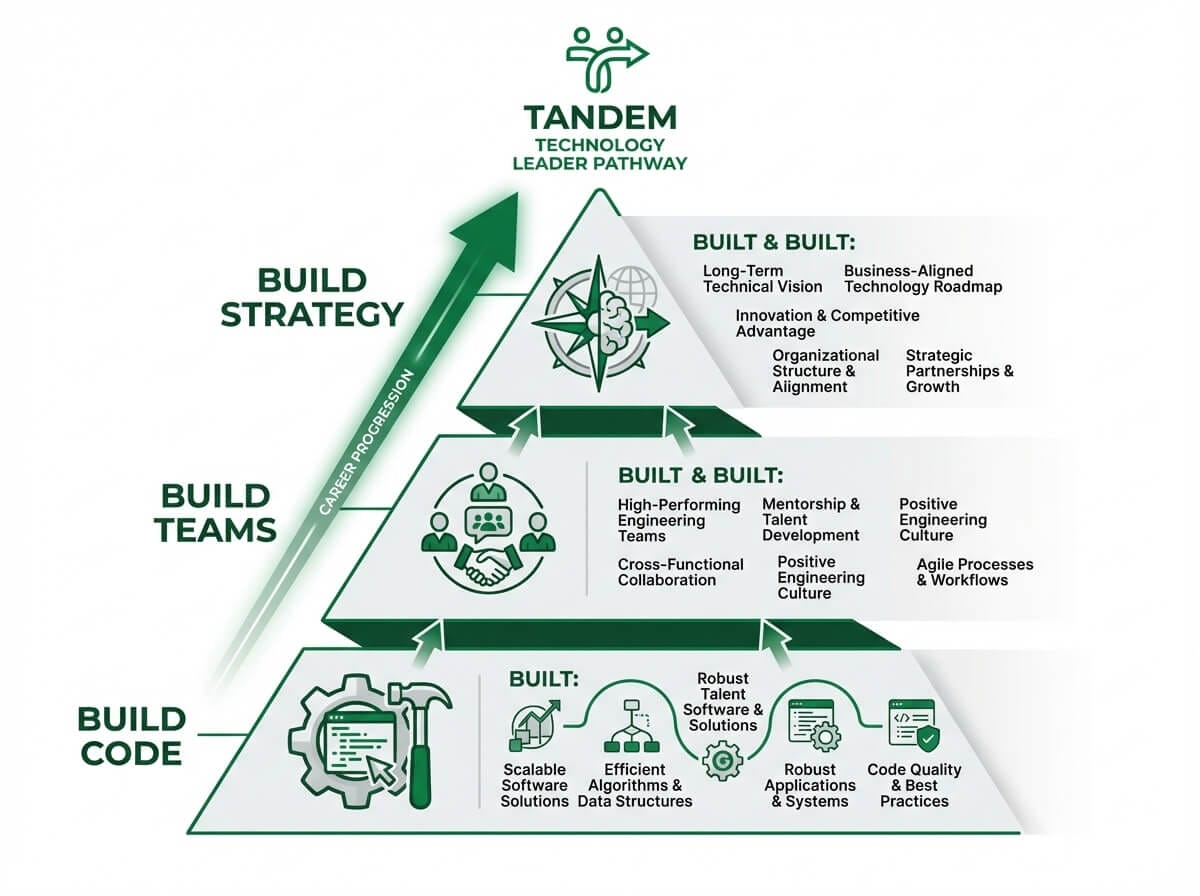
The shift from builder to architect is not about abandoning technical skill. It is about changing what you build. At IC, you built systems. At VP, you build teams. At C-suite, you build the organization’s technical future. The material changes. The builder identity does not have to.
Naming the time horizon split. The CTO says “I can’t get the board to care about technical debt.” A generic coach explores stakeholder management techniques. Better slide decks. Clearer communication. More business language.
A coach who understands what technology careers install recognizes something else entirely: your architecture decisions lock in for three to five years. Longer than most CFO investment decisions. Longer than most board members’ tenure. But those decisions get labeled “technical decisions,” not strategy. The coaching question isn’t “How do you get the board to care about tech debt?” It’s “What decision are you making this quarter that the organization will still be living with in three years? What would change if you treated that as a strategic bet rather than a technical one?”
That reframe doesn’t teach presentation skills. It surfaces something the CTO has never articulated: their technical decisions already are strategy. They just haven’t claimed them that way. The board doesn’t need to learn to care about tech debt. The CTO needs to stop calling their most strategic decisions “technical.”
Your technical decisions already are strategy. You just haven’t claimed them that way.
The patterns in this article connect to several related dynamics across careers and levels: when technical depth stops being the currency, the builder identity that persists after the promotion, why technical leaders keep solving the wrong problem, and the tension between engineering timelines and enterprise vision. For the coach’s side of these dynamics, see the coach’s preparation guide for CTO clients.
This connects to a related perspective: how purpose coaching intersects with formation-aware coaching.
A Different Kind of Conversation
You built something real. That’s not the problem. The problem is that the room you’re now in doesn’t reward building the way the room you came from did. What changes isn’t the builder. It’s what the builder builds. And whether you can see that the organization’s capability is the most important thing you’ll ever architect.
The challenge isn’t learning finance or practicing boardroom communication, though both may matter at the margins. The challenge is recognizing that the patterns your career installed are running in the background of every conversation, every decision, every moment of frustration when the room doesn’t see what you see. Those patterns got you here. They are also the ones keeping you stuck in a version of the role that’s smaller than what the organization needs from you now.
If something in this article described a pattern you’ve noticed but never named, that recognition is where the work starts. Not with a skills gap assessment or a leadership development plan. With a conversation where someone who understands what a career in technology does to a person asks the questions you haven’t been asking yourself. That’s what our coaching looks like.
Start With a Conversation That Gets Your World
A 30-minute call where your coach already understands what a career in technology does to how you lead. No assessment. No intake form. Just a conversation.
Book a Free Consultation →