
The Product Leader’s Identity Crisis: Builder, Business Person, or Both?
The quarterly portfolio review is fifteen minutes in and already fracturing. Three bets are on the table: a near-term feature expansion grounded in current user behavior, a mid-term platform play that requires engineering investment before revenue materializes, and a long-horizon market creation move. The third bet is the one she has the most conviction about and the least data to support. The CFO questions the second bet’s ROI timeline. Engineering pushes back on the third bet’s technical feasibility at the proposed pace. Marketing gets excited about the third bet but wants to lead the positioning, positioning the CPO has already sketched. Sales wants more of bet one.
Each function is evaluating the same portfolio through a different lens. Each lens is legitimate. And the CPO finds herself translating between all of them in real time, which is the job. But there’s a moment, after the CFO’s third question about attribution methodology, when something shifts. The room isn’t pushing back on the strategy. They’re pushing back on the fact that she’s the one setting it. Every other function controls its own domain. The CPO defines what goes into everyone else’s domain. That is either leadership or interference, depending on who is experiencing it.
If you’ve spent a career in product and this dynamic is familiar, this article is about the patterns that career installed, where they create a ceiling unlike any other C-suite role’s, and what changes when someone who understands those patterns is in the room with you.
Key Takeaways
- A career in product installs a composite lens: you process information through every other function’s perspective simultaneously. That’s not a broad skill set. It’s a specific cognitive architecture for weighing signals that don’t share a common unit of measurement.
- Your trust currency has the longest validation lag of any C-suite role. The market may not confirm your direction for a year or more. You must spend credibility before evidence arrives.
- The most dangerous blind spot in product leadership: you cannot distinguish data-backed conviction from identity-backed conviction, because both feel identical from inside.
- The identity question that defines this formation (builder, business person, or both?) is a false choice. Product leaders share the builder identity, but the thing you build is direction, not code. And direction doesn’t compile. It gets confirmed by a market that moves on its own schedule.
What a Career in Product Installs
A composite lens. You don’t think like a finance person, a marketing person, or an engineer. You think through all of them simultaneously. Your career trained your attention to notice customer need intersecting business viability, perceived through a composite feed from every other function. When engineering says “this will take six months,” marketing says “the window closes in three,” and finance says “the unit economics don’t work at that price,” you are the person who holds all three realities and prioritizes across them. That is the job. It is also why every other function periodically experiences you as doing their job for them.
The composite lens is not the same thing as being a generalist. Generalists know a little about each domain. Your lens is structural: a meta-framework for weighing incommensurable signals. Engineering speaks in technical feasibility. Finance speaks in ROI. Marketing speaks in positioning. Sales speaks in pipeline. Users speak in behavior. You read all of it through an integrated filter, dynamically reweighting which function’s signals matter most based on strategic priorities. No other role in the C-suite processes information this way. And no other role pays the specific tax you pay for it: the inability to show your work in any single function’s native language.
Conviction as identity. Your career rewarded you for reading markets correctly and having the conviction to act on what you saw. “I see where this is going and I’m willing to stake my credibility on it.” That conviction isn’t a preference or a habit. It’s identity-level. When someone challenges your product direction, they’re not challenging a recommendation. They’re challenging who you are. The identity is high enough rigidity to persevere against pushback, flexible enough to update when data genuinely shifts. But here is the blind spot: you cannot distinguish data-backed conviction from identity-backed conviction because both feel the same from inside.
Conviction and certainty are not the same thing. One reads the market. The other has stopped reading.
A two-dimensional time horizon. Most C-suite roles operate on distance: how far out you plan. Your temporal lens adds a second axis: velocity. Not just “where is the market going?” but “how fast is it arriving?” The most common product leadership failure is not wrong direction but wrong velocity: seeing the trend correctly and misjudging how fast it was arriving. At IC level, you were locked to iteration cycles. At VP, you added domain-level planning and started sensing velocity shifts. At CPO, you operate across all four temporal quadrants simultaneously: long landscape assessment, velocity prediction, immediate reaction to acceleration, continuous iteration oversight. No other formation has to hold all four at once.
Where Vision Becomes a Ceiling
The currency that earns trust shifts at every career level. For product leaders, that shift has a feature no other function shares: each new level increases how long you wait for the market to tell you whether you were right.
Recognize the Pattern?
If that description landed with uncomfortable recognition, that’s what a first conversation feels like too. We start by naming what product installed—not asking you to stop building.
| Career Level | What Earns Trust | What You’re Proving |
|---|---|---|
| IC / Manager | Delivery by proxy | “Teams trust I know what I’m talking about.” |
| Director / VP | Strategic judgment | “I aimed the domain correctly.” |
| C-Suite | Market vision | “I define where this market is heading and why we’re positioned to win.” |
The delivery-to-judgment shift. As an IC product owner, the currency was delivery by proxy. Others execute your direction, and you’re measured by whether the thing shipped and users adopted it. At director and VP, the game changed. The currency became strategic judgment: not just whether features shipped but whether you chose the right bets. Nobody told you delivery was a proxy metric. You thought delivery was the job. You kept pointing to shipped features as evidence of performance when the new level was asking a different question: should we have built those things at all?
The judgment-to-vision shift. At C-suite level, the game changes into something no other formation faces at the same scale. The board doesn’t want your portfolio results. They want market vision: where the entire market is heading and why the company is positioned to win. The CFO can point to the forecast. The CTO can point to the shipped system. The CPO points to a future that hasn’t arrived yet and asks the organization to follow.
This is the longest validation lag of any C-suite role. At VP, bets validated within quarters. At CPO, the market may not confirm or deny the direction for a year or more. You must spend credibility before evidence arrives. A new CPO without a track record has almost no margin for error. And the pressure to demonstrate conviction (because conviction is the currency at this level) means you are incentivized to double down on direction even when the signals are ambiguous.
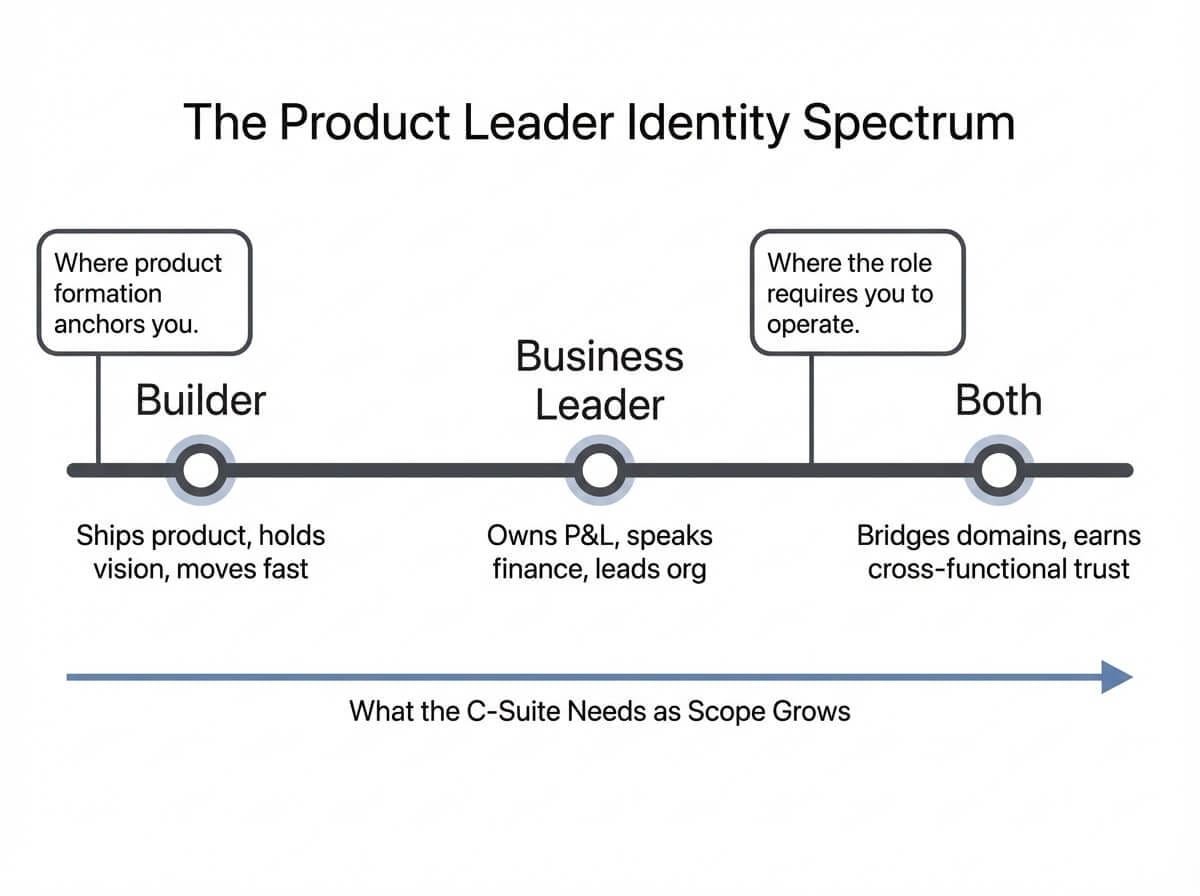
Product leaders share the builder identity with technology leaders, but the thing you build is direction. You share the business-case rigor with finance leaders, but your evidence standard is convergence across sources, not numerical precision. Builder or business person? Both. And neither, fully. The composite nature of the role means you never fit cleanly into any one identity, which is exactly what makes other functions unsure whether you’re leading their work or doing it for them.
What happens under pressure. Conviction hardens into certainty. The difference matters. Conviction holds a direction while remaining open to disconfirming signal. Certainty has stopped listening. Under stress, certainty takes over: you seek data that confirms current direction and filter contradictions. Customer conversations become performative. Cross-functional collaboration narrows to “I’ve already decided.” You ship faster without learning. The iteration cycle accelerates but the reflection cycle disappears. You spend the credibility reserve aggressively, burning through organizational goodwill to force direction. The pattern that defines you becomes the thing that isolates you. And then the market doesn’t confirm.
The Direction Nobody Can Verify Yet
You walk out of the portfolio review knowing the direction is right but unable to prove it. Bet three, the market creation move, is based on a pattern you see in user behavior, competitive moves, and technology shifts. The pattern is clear to you. It is not clear to anyone else in the room, because the signal you’re reading is composite: pieces from five different functions that only assemble into a picture when you hold them together. The CFO sees one piece and calls it insufficient evidence. Engineering sees another piece and calls it technically premature. You are the only person in the room who sees all the pieces at once, and you cannot transfer that perception without sounding like you’re asking them to take it on faith.
You see connections nobody else can see. That’s the job. It’s also the problem.
The coalition you held together through conviction is starting to fracture. For eighteen months, the organization followed your direction because your track record earned the credibility. But the market hasn’t validated yet. Engineering is questioning the architecture decisions. Finance is flagging the burn rate. Sales wants to know when the new direction produces pipeline. Each function is applying its own evaluation horizon to a bet whose validation lag is longer than any of them are accustomed to. You feel the credibility account depleting with each quarter that passes without confirmation. The temptation is to double down on conviction, to burn more credibility to buy more time. You’ve seen other product leaders do that and watched their coalitions fragment. You don’t know how to tell the difference between “the market hasn’t caught up yet” and “I was wrong.”
And the question nobody asks but everyone thinks: is the CPO seeing something real, or just more invested in this direction than anyone else? You feel it too. When you challenge your own conviction, the market pattern still looks clear. But you also know that identity-backed certainty feels identical to data-backed certainty from inside. The most important question in your professional life, “Am I right about where this market is going?,” is a question you cannot answer from inside your own formation. Because the formation rewards conviction. And conviction has a way of becoming unfalsifiable.
What Changes When Your Coach Gets This
The difference between generic executive coaching and coaching that understands what a product career installs shows up in specific moments. Two of them illustrate the gap.
See How Tandem Coaches Differently
Our approach starts with understanding what your career installed. Not personality assessments. Not generic executive presence frameworks. Your product formation—and where it runs out of road.
The conviction audit. A generic coach hears a CPO say “I keep getting pushback on my product direction from the executive team” and offers influence coaching: how to build alignment, how to present strategy more persuasively, how to manage resistant stakeholders. The same advice they’d give a CFO or a CMO.
A coach who understands product formation hears the same sentence and recognizes something specific: the pushback may be legitimate cross-functional concern, or it may be the structural friction that every CPO faces because their role tells other functions what to do. The coaching question isn’t “How could you build more alignment?” It’s “When you feel certain about a direction, what’s the difference between certainty that comes from reading the market well and certainty that comes from having invested your identity in being right?”
That question doesn’t challenge the CPO’s judgment. It surfaces the blind spot that the formation itself creates: the inability to distinguish between two kinds of conviction that feel identical from inside. The pause when that question lands is specific. The CPO realizes they cannot easily make the distinction. And that realization doesn’t weaken their conviction. It gives them a way to hold direction with genuine confidence rather than identity-driven certainty.
Generic coaching asks “How could you build more alignment?” A coach who understands what product careers install asks “What’s the difference between certainty that comes from reading the market and certainty that comes from having invested your identity in being right?” One teaches influence. The other surfaces the thing you can’t see from inside your own lens.
The validation lag navigation. A generic coach hears a CPO say “It’s been eighteen months and the market hasn’t confirmed my direction yet. The board is getting restless” and offers strategic communication advice: how to tell the story of the bet, how to frame the timeline, how to manage board expectations.
A coach who understands the product formation’s temporal architecture recognizes a different problem entirely. This is not a communication challenge. It’s the longest validation lag in any C-suite role: eighteen months of spending credibility on a direction that cannot be validated for another year. The coaching question: “You’re sensing something about the pace of change. What specifically would you lose by waiting another quarter? Is it the direction that’s at risk, or the timing of arrival?”
Is it the direction that’s at risk, or the timing of arrival? Until you separate those two questions, every board conversation is the wrong conversation.
That question separates the two temporal variables the CPO conflates under pressure: horizon and velocity. Is the direction right but the timing off? Or was the direction identity-backed rather than market-backed? The answer changes everything. If the direction is right but the timing was off, the CPO needs patience and coalition maintenance. If the direction was identity-backed, the CPO needs to update before the credibility runs out entirely. No amount of board communication coaching helps a CPO who hasn’t first answered that question.
The patterns in this article connect to several related dynamics across careers and levels: the builder-leader identity split every product leader faces, when product intuition stops being enough, how product framing shapes the problems a CPO solves, and the product leader’s roadmap instinct versus enterprise vision. For coaches preparing to work with product leaders, see the product formation: what coaches need to know.
A Different Kind of Conversation
That composite lens served you. It saw the connections nobody else could see—the customer need intersecting the technical possibility intersecting the market gap. It held five functions’ input in one head and turned it into direction. It’s also the reason the room can’t tell whether you’re seeing the future or just more invested in it than anyone else.
What changes isn’t the vision. It’s the ability to interrogate your own conviction—to know the difference between “the market hasn’t caught up yet” and “I need to update,” and to hold that uncertainty without either doubling down or giving up. That is not a skill you develop by reading about it. It’s a capacity that grows in conversation with someone who understands what a career in product does to how you see, how you decide, and how you hold direction when the evidence hasn’t arrived yet.
If something here described a pattern you’ve noticed but never named, that recognition is where the work starts. Not with a stakeholder alignment framework or a board communication playbook. With a conversation where someone who gets the composite lens, the conviction identity, and the validation lag asks the questions you haven’t been asking yourself. That’s what our coaching looks like.
A Conversation That Starts Where Product Shaped You
A 30-minute call where your coach already understands what product leadership installs and where vision becomes a ceiling. No assessment. No intake form. Just a conversation that starts where your career actually shaped you.
Book a Free Consultation →