
The Credibility Problem Nobody Tells Marketing Leaders About
The quarterly marketing review is almost over. The brand campaign launched eight weeks ago. Social engagement up 340%. Earned media coverage tripled. The sales team is reporting warmer inbound conversations, shorter discovery calls, prospects arriving already familiar with the positioning. You built the narrative slide by slide: the market is responding. The brand is gaining share of voice. The positioning is landing.
Then the CFO asks a single question: “What’s the revenue attribution?”
You have a slide for this. It shows the correlation between campaign launch and pipeline growth. The trend line is clear. The CFO looks at it for three seconds. “Correlation isn’t causation. What’s the incremental lift net of organic growth?”
The room shifts. You know the campaign worked. Every signal in your environment confirms it. But the signal that matters in this room, the one denominated in finance’s currency, is the one you cannot produce. Not because you are wrong about the impact. Because the evidence standard in this room and the evidence you were trained to gather are measuring different things, in different currencies, on different timescales. Nobody told you the credibility battle would be fought on someone else’s terrain.
If you have spent fifteen or twenty years in marketing and that scene produces something tighter than mere recognition, this article is for you. Not because you are failing at the credibility problem. Because the patterns your career installed are doing exactly what they were designed to do. And the room is asking for a currency you were never formed to carry.
Key Takeaways
- A career in marketing installs the most fluid identity of any function. That adaptive strength also means you never stop proving who you are in rooms full of leaders with fixed ones.
- The credibility problem is not a measurement gap. It is a formation collision between how marketing reads evidence and how finance reads evidence. Every time you speak finance’s language badly, you lose more credibility than you gain.
- The shift from creative execution to market creation requires a new currency, one your formation never taught you to carry but can learn to build on what you already see.
- A coach who understands what a career in marketing does to a person will recognize the structural credibility battle and stop treating it as a presentation skills gap.
What a Career in Marketing Installs
Every other leader in the C-suite has a fixed professional identity. The CFO is precision. The CTO is building. The general counsel is protection. You are whatever the market needs you to be this quarter.
That is not a criticism. Your identity is portfolio-based. It shifts with trends, campaigns, and market movements. Creative director one year, growth strategist the next, brand architect the year after. Less “I am a marketer” and more a rolling answer to the question of what the company needs marketing to be right now. The fluidity that lets you pivot when the market shifts under you is a genuine formation strength. It is also the reason you never stop proving yourself. Because who you are keeps changing, and a room full of leaders with fixed identities reads your adaptability as inconsistency rather than responsiveness.
You are the most adaptable leader in the room. You are also the one who never stops proving you belong in it.
Your career trained you to operate in the fastest signal environment of any C-suite function. Campaign performance arrives in hours. Social engagement is visible in real time. You can tell within a day whether a piece of creative is landing. But the thing you read with perfect fidelity, audience resonance, is the thing the organization least trusts as evidence. The channel you read (did this connect?) and the channel the CFO reads (what was the return?) are measuring different things in different currencies on different timescales. Performance marketing gives you data in three-to-seven-day cycles. Brand building requires eighteen months of patience before the signal even becomes legible. You live in both timescales simultaneously, and the organization only rewards the short one.
Notice how you process a room. You catch audience opportunity and narrative gaps before anyone else speaks. You organize what you hear into positioning, messaging, market narrative. The story of where the company sits and where it could go. What counts as evidence for you: market response, engagement metrics, whether the work got noticed, whether the audience moved. When someone asks you to “bring more data,” they are asking you to use a cognitive tool your formation never handed you. Your structuring logic is storytelling. That is not a weakness dressed up as a strength. It is how a career in marketing teaches a person to make sense of complexity. The trained blind spot it creates is specific: the possibility that the problem is structural (product, pricing, operations) rather than communicative. When sales says “leads aren’t converting,” your default read is “we need better messaging” rather than “the product doesn’t match what we promised.”
And then there is your relationship with risk. Marketing’s risk orientation is action-biased because the market rewards speed. “Launch and learn” is adaptive, not reckless. But the distinction between “move fast because the window is closing” and “move fast because slowing down feels uncomfortable” is one your formation does not always help you make. Speed is the water you swim in. It takes a different vantage point to see when it has become the current rather than the strategy.
Where Creativity Becomes a Ceiling
| Career Level | Currency | Identity | What Earns Standing |
|---|---|---|---|
| IC / Manager | Creative execution | “I make things that connect” | Craft, taste, campaign performance, engagement metrics that prove the work landed |
| Director / VP | Strategic positioning | “I shape how the market sees us” | Brand stewardship, cross-functional influence, connecting creative to business outcomes at scale |
| C-Suite | Growth strategy | “I define where we play and how we win” | Market creation, competitive moats, board-level narrative about enterprise growth |
Recognize the Pattern?
If that description landed with uncomfortable accuracy, that’s what a first conversation feels like too. We start by naming what marketing installed—not asking you to stop telling stories.
As an IC and early manager, the work spoke for itself. You made things that connected. The engagement numbers proved the value. Craft and taste were the currencies, and you had them in abundance.
At director and VP, the currency shifted. The question was no longer whether the campaign landed but whether the brand was positioned to win. Strategic positioning, cross-functional influence, connecting creative work to business outcomes that people outside marketing could measure. But you kept crafting the copy. Kept optimizing individual campaigns. Kept measuring success by engagement metrics when the new level measured success by market positioning and revenue influence. Creative identity had to yield to strategic identity, and that felt like selling out the thing that made the work meaningful in the first place.
At the C-suite level, the game changes once more. The board does not want your positioning strategy. They want growth strategy, market creation, a narrative about competitive positioning and where the company is heading that sounds like it came from someone running a business, not someone running a brand. The CMO who presents campaign results to the board has brought the wrong currency entirely. The shift is from competing for position in existing markets to defining new ones. From brand stewardship to enterprise growth architecture. And the language the board wants you to speak—market creation, competitive moats, sustainable advantage—belongs to finance and corporate strategy. Your formation never taught you to speak it natively. Every time you try to speak it badly, you lose more than you gain.
Under pressure, the portfolio identity accelerates rather than stabilizes. You pivot messaging more rapidly, launch more campaigns, test more creative directions simultaneously. The adaptive fluidity speeds up past coherence. You obsess over dashboards, refresh attribution reports constantly, narrow your entire focus to performance metrics while brand signals get ignored. The bimodal trap activates: performance numbers are immediate and addictive, brand metrics are slow and ambiguous. The CMO who cannot wean off the performance channel will chronically underinvest in the work that compounds.
The Language Nobody Taught You to Speak
You keep telling stories to a room that wants numbers. The brand investment proposal is compelling. The narrative about market positioning, competitive whitespace, and audience evolution is genuinely insightful. The CFO asks for a payback model. You present correlation. They ask for causation. You present a market narrative. They ask for incremental lift. You are both right. The brand investment probably will pay off. But the evidence standard in the room is not “probably” supported by narrative. It is “demonstrably” supported by auditable attribution. Your formation never prepared you for this translation, and every attempt that falls short costs more credibility than silence would have.
The signal that matters in this room is denominated in someone else’s currency.
The CEO keeps asking you to “think more strategically.” What that means for a CMO is different from what it means for anyone else at the table. For you, strategic means stopping the campaign-level thinking and starting the market-level thinking. It means the difference between “how do we position against the competitor” and “what market should we be creating that makes the competitive comparison irrelevant.” But your formation’s fastest signal loop, the performance metrics, the real-time engagement, the campaign results, keeps pulling you back to the terrain where you can prove value. The strategic work is slower, harder to attribute, and operates on an eighteen-month timescale that your formation finds physically uncomfortable. You know this. You keep choosing the dashboards anyway, because at least the dashboards show you something you can defend in the next meeting.
Your cross-functional credibility depends on a language you were never formed in. The CFO inherited strategic credibility from the function. Nobody questions whether finance belongs in the strategy conversation. You must actively construct strategic credibility in every interaction, in a language that is not your native tongue: financial analysis, ROI modeling, attribution methodology. The power dynamic is structural. Marketing is influence-dependent with almost no direct control over the levers that determine success: product, pricing, sales execution. You shape the narrative. Someone else shapes what the narrative is about. And the moment that narrative is challenged in the language of finance, the room defers to finance, because finance’s evidence standard carries institutional weight that marketing’s evidence standard does not.
The credibility problem is structural, not personal. Two formations whose evidence standards are fundamentally incompatible keep meeting in the same room. One sees unquantified potential. The other sees unverified claims. Both are doing exactly what their careers trained them to do. The fight is not about the budget. It is about two professional formations measuring value in currencies the other one cannot read.
Every time you speak their language badly, you lose more than you gain.
What Changes When Your Coach Gets This
Consider a CMO who tells their coach: “I can’t get the CFO to support my budget recommendations.”
See How Tandem Coaches Differently
Our approach starts with understanding what your career installed. Not personality assessments. Not generic executive presence frameworks. Your marketing formation—and where it runs out of road.
A coach working from a generic leadership playbook hears a stakeholder management problem. They offer techniques: how to build a business case, how to present data more persuasively, how to build pre-meeting coalitions. Useful for any leader in any function. And it misses what is actually happening underneath.
A coach who understands what a career in marketing does to a person hears something different. They recognize a specific collision: two formations whose evidence standards are fundamentally incompatible. The CMO’s formation trusts narrative, market signal, and audience behavior. The CFO’s formation trusts verifiable data and auditable methodology. The coaching question is not “How could you present your data more effectively?” It is: “If the messaging were perfect, exactly the right story to exactly the right audience, would the problem disappear? Or is there something structural about how marketing’s evidence and finance’s evidence standard don’t meet?”
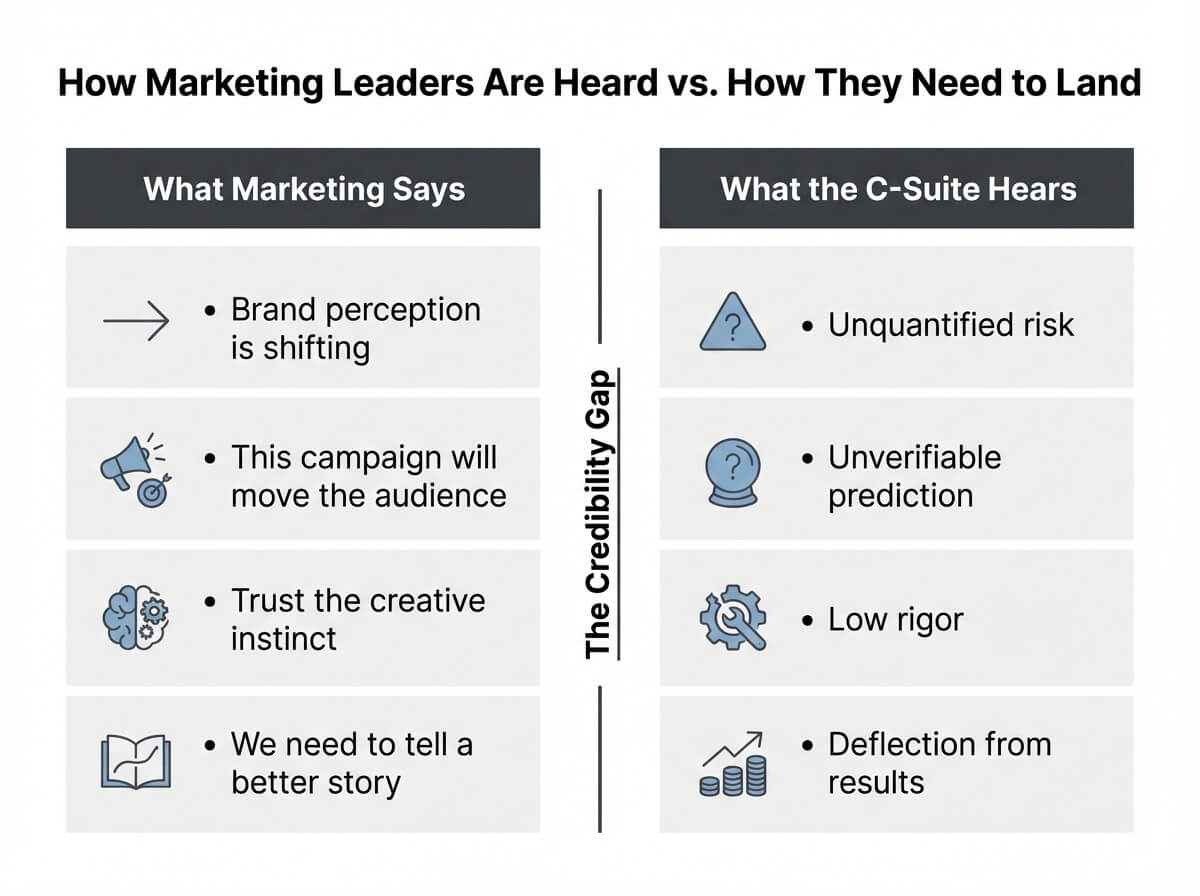
That question changes the room. The CMO stops trying to build a better deck. They start seeing the credibility battle for what it is: not a presentation skills gap, but a structural incompatibility between two legitimate evidence systems. The work is not better slides. The work is understanding that the gap is structural and finding a way to build bridges between what you see and what they can measure, without pretending to be a finance person. The relief is immediate. The proving anxiety drops by half when you realize the battle was never winnable on those terms.
Or consider the moment a coach says: “You need to develop a more stable leadership identity. You keep reinventing yourself with every new role.” The CMO hears: the thing that made you successful is a flaw.
A different coach recognizes that the portfolio identity is the adaptation. Marketing rewards constant reinvention. The fluidity is not instability. It is professional survival in a function where the market shifts under you every eighteen months. The question: “Your ability to reinvent is a genuine strength. What is the through-line across all those reinventions, what stays constant even as everything else changes?”
That question does not ask you to stop being fluid. It helps you find the stable core underneath the adaptive surface, the foundation that persists whether you are leading creative, growth strategy, or market creation. The identity does not need to be fixed. It needs to be found. And a coach who can tell the difference between instability and adaptive fluidity is a coach who will not accidentally pathologize the very thing that makes you effective.
Generic coaching treats the credibility gap as a communication problem and the fluid identity as a stability problem. Both prescriptions ask you to become less of what your career built. A coach who understands what marketing installs recognizes the credibility gap as a structural collision and the fluid identity as an adaptive strength. The path forward is not becoming someone else. It is building on what your career already taught you to see.
The patterns in this article connect to several related dynamics across careers and levels: when storytelling isn’t enough currency in the C-suite, the CMO’s credibility gap at the executive table, why the CFO and CMO tension runs deeper than budget, and the voice the leadership team isn’t hearing. For a deeper look at how these patterns develop and what coaches should prepare for, see what the marketing formation installs.
A Different Kind of Conversation
That creative instinct served you. It read the market when nobody else could see what was happening. It built brands that changed how people felt about your company. It is also the reason the board meeting ends with a question about attribution you cannot answer and a credibility gap that gets wider every quarter.
What changes is not the creative instinct. It is finding the language that lets the rest of the organization see what you already know. Not by speaking their language badly, but by building a bridge between what you see and what they can measure. That bridge does not require you to become a finance person. It requires you to find the strategic core underneath the creative surface, the through-line that makes your market insight legible to a room that trades in a different currency.
If you recognized yourself in this article, the patterns your career installed are specific, predictable once understood, and coachable once named. The next step is a conversation with someone who sees those patterns clearly, someone who will not try to fix your fluidity or teach you to build attribution models, but will help you see what your career built well enough to build on it. That conversation is available whenever you are ready for it.
A Conversation That Starts Where Marketing Shaped You
A 30-minute call where your coach already understands what marketing installs and where it creates a credibility ceiling. No assessment. No intake form. Just a conversation that starts where your career actually shaped you.
Book a Free Consultation →