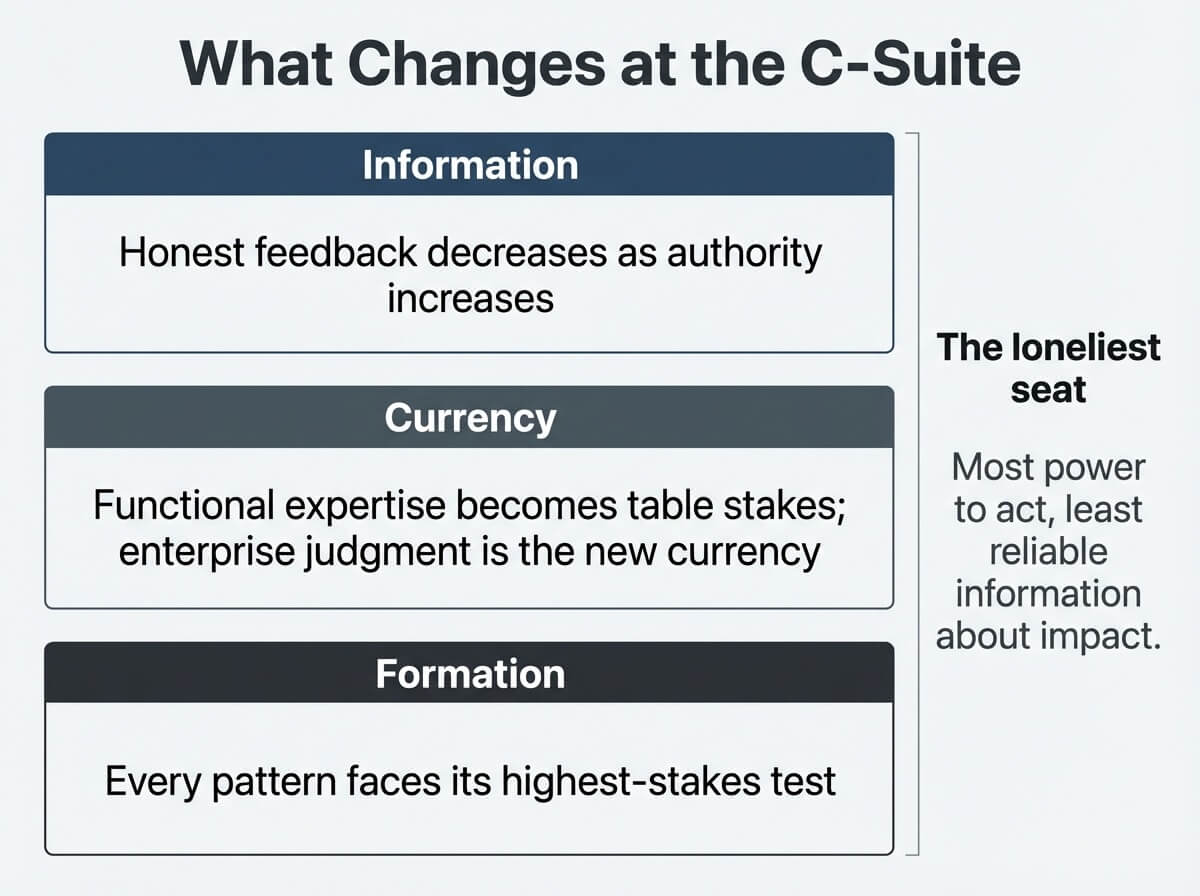
The information environment changes structurally. People who once gave honest feedback now calibrate what they share because you control budgets and careers. The currency that earned you the seat — output, execution, analytical rigor — becomes table stakes. Enterprise judgment, board presence, and strategic narrative become the new currency you have the least practice spending.
The first thing that changes when you reach the C-suite is the silence. Not the silence of a quiet office. The silence of realizing that the people who used to tell you what they really thought are now managing what they say around you. The feedback that used to come freely — from peers, from your manager, from the team — is filtered, strategic, or absent. You have more authority than you have ever had. You have less honest information than you have ever had. And nobody warned you that those two things would arrive together.
The C-suite transition is not a bigger version of the Director-to-VP transition. It is a qualitatively different challenge. The rules change. The isolation is structural. And the formation patterns that carried you through every previous level face their most demanding test — because at this altitude, what your career installed meets the full weight of enterprise leadership.
Key Takeaways
The C-suite transition is qualitatively different from every previous promotion. It is not a bigger version of the VP role. It is a different kind of leadership entirely.
Isolation is structural, not personal. Honest feedback decreases as authority increases. The leader with the most power to act has the least reliable information about how they are experienced.
Every formation pattern faces its highest-stakes test at the C-suite. The old currency is table stakes. The new currency — enterprise judgment, board presence, institutional stewardship — cannot be earned through the methods that always worked.
A coach at this level is often the only person in the leader’s life who has no agenda other than the leader’s own development.
What Changes at the Top
At Director and VP level, you learned to operate across functions, build alliances, and translate between strategy and execution. Those skills transfer. What does not transfer is the assumption that you can build trust the same way you always have.
At the C-suite, trust is not earned through output. It is earned through judgment — the willingness to make calls the data cannot fully justify, to hold positions under board scrutiny, to set direction for an enterprise where the consequences are existential and the timeline extends beyond your own tenure. The currency shift at this level is the most painful of the career because the new currency is the one you have the least practice spending.
The CTO who arrives at the C-suite with technical credibility discovers that the board does not evaluate technical credibility. They evaluate strategic narrative. The CFO who arrives with analytical rigor discovers that the board does not need better analysis. They need someone who says “here is what I believe we should do and why” with the kind of conviction that a career in finance never required. The CHRO who arrives with deep organizational trust discovers that trust at the individual level does not automatically translate into influence at the board level.
The loneliest seat in the organization is not lonely because nobody is around. It is lonely because everyone who is around has an agenda — and the leader is the only person in the room who is supposed to hold the whole.
The Isolation Problem
The isolation is not a failure of communication. It is a structural feature of the role. When you become the person who approves budgets, sets direction, and makes the calls that affect everyone’s career, the information environment changes. People manage what they tell you. Peers become competitors for board attention. Direct reports calibrate their candor to your mood. The higher you go, the more curated the information you receive.
This isolation hits every formation, but it hits differently:
Vertical diagram showing three things that change at the C-suite: information, currency, and formation
The CTO loses access to the technical community that used to provide honest feedback about their thinking. The engineering team now defers rather than debates. The builder identity that thrived on collaborative problem-solving has no collaborative space left.
The CFO loses the analytical sparring partners who used to challenge the model. The finance team presents conclusions, not arguments. The precision that was sharpened through debate now operates in an echo chamber.
The COO loses the operational feedback loop. The systems still run. The team still executes. But the strategic-level feedback — whether the operating model is right for where the organization is headed — only comes from the CEO and the board. Both have limited bandwidth and limited operational depth.
The GC loses the advisory dialogue. Legal is consulted after decisions are made, not before. The strategic counsel the role demands is offered in a context where the direction has already been set.
ℹ
Note
The isolation paradox: the leader with the most authority to change the organization has the least reliable information about how the organization experiences their leadership. This is not fixed by open-door policies or town halls. It is structural — and it is one of the primary reasons C-suite leaders seek coaching.
Formation Patterns at Maximum Altitude
Every formation pattern that operated at lower altitudes intensifies at the C-suite. The stress behaviors sharpen. The blind spots widen. The identity structures face their most demanding expansion.
The risk instinct faces enterprise-level uncertainty. The CFO who learned to quantify risk must now set the organization’s risk appetite — a qualitatively different task than modeling individual exposures. The CTO who learned to test and iterate must now make platform bets that cannot be tested at small scale. The GC who learned to prevent exposure must now advise on risks the organization should accept.
The signal environment becomes its most distorted. Board feedback is sporadic, politically loaded, and filtered through governance dynamics. Peer feedback is strategic. Direct report feedback is managed. The leader who relied on clear, functional signals to know whether they were doing well now operates in an environment where the most important signals are the hardest to read.
The time horizon extends to its maximum stretch. Decisions made now may not validate for three to five years. The CPO’s market bets may not confirm for longer. The CHRO’s culture investments compound slowly and invisibly. The leader must hold confidence in a direction the environment cannot yet confirm or deny.
Why Coaching at This Level
At the C-suite, a coach may be the only person in the leader’s professional life who has no agenda other than the leader’s own development. Not the board’s agenda. Not the team’s agenda. Not the organization’s performance agenda. The leader’s own understanding of who they are becoming in this role and what the role is asking them to leave behind.
A coach who understands the formation brings additional specificity. They know that the CTO’s sense of losing touch with the team is not about management style. It is about a builder identity mourning the loss of collaborative building. They know that the CFO’s hesitation to make a board recommendation without a complete model is not about confidence. It is about a formation that defined irresponsible as any call the data cannot justify. They know that the COO’s silence in strategy meetings is not about disengagement. It is about an operations formation that taught them the background is where they belong.
The coaching question at this level is not about skills or strategy. It is: who are you becoming in this role — and where is the formation that got you here creating the ceiling for what the role now asks?
The C-suite seat comes with authority, isolation, and a set of demands that no previous role prepared you for. The person who fills it carries a formation — a career’s worth of installed patterns about what good looks like, what risk feels like, what success sounds like, and who they are when they lead. The gap between what the seat demands and what the formation provides is the territory where the real leadership development happens.
Not through programs. Not through books. Through the sustained, honest, structurally-aware conversation that only happens when someone understands both the seat and the person sitting in it.
Why does honest feedback disappear when you reach the C-suite?
The reduction in candid feedback is structural, not personal. When a single person controls budgets, sets direction, and affects everyone’s career, people around them calibrate what they share. Direct reports manage their candor; peers compete for board attention; the result is that the leader with the most authority to act on feedback receives the most filtered version of it.
How is the C-suite transition different from the VP-to-executive promotion?
At the VP level, trust is built through output and cross-functional execution. At the C-suite, the currency shifts to enterprise judgment: making calls the data cannot fully justify, holding positions under board scrutiny, and setting direction with consequences that extend beyond one’s own tenure. The skills that earned the promotion are table stakes at the new level; the currency that actually matters there has had the least practice.
What does a coach actually do for a C-suite leader that peers or mentors cannot?
A coach is often the only person in a C-suite leader’s professional life whose sole agenda is the leader’s own development. Peers compete for board attention, direct reports manage what they say, and the board operates through governance dynamics. A coach who understands formation patterns can identify where the installed career habits — the risk instincts, identity structures, and success signals that worked at every previous level — are creating the ceiling the current role is pressing against.
Why do people perceive risk so differently?
Risk perception differs because careers install different definitions of the word itself. Finance trains leaders to quantify exposure before acting. Technology trains them to ship small and iterate. Legal trains them to prevent liability first. Marketing treats inaction as the real danger. Operations fears disruption above all. Same word, five distinct alarm systems.
Ask the CTO about risk and she describes a controlled experiment: ship a small version, see what breaks, iterate. Ask the General Counsel about risk and he describes a landscape of exposures to be mapped, assessed, and mitigated before any action occurs. Put them in the same room on the same project, and the CTO experiences the GC as someone who kills momentum. The GC experiences the CTO as someone who ignores consequences. Both are managing risk. They are managing it from formations that define the word differently.
This is not a communication problem. It is not fixed by better meetings or clearer decision-making frameworks. What risk means to you — what triggers the alarm, what counts as sufficient mitigation, what “responsible” sounds like — was installed by a career that rewarded one version of risk management and labeled every other version as either reckless or paralyzed. That installation is invisible until you sit across from someone whose career installed a different one.
Key Takeaways
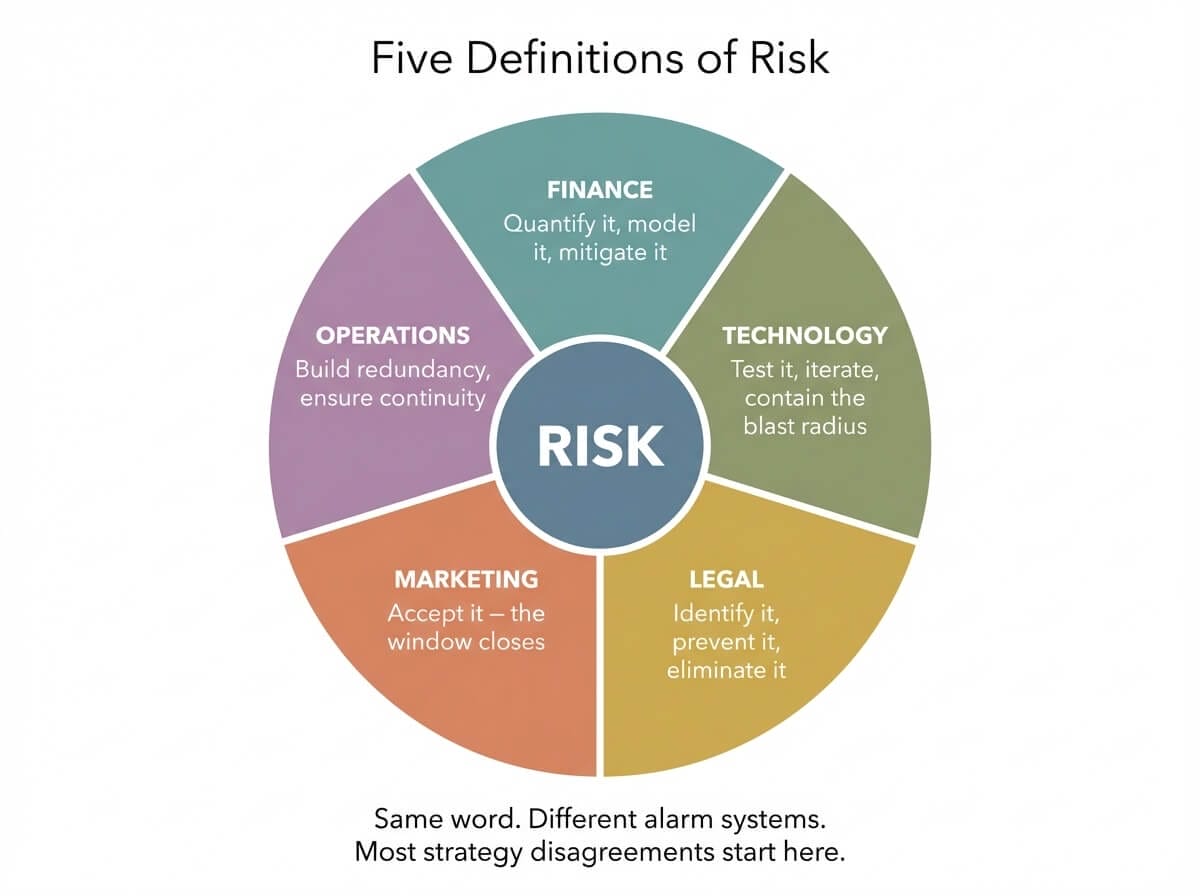
Every function defines risk differently. Finance quantifies it. Technology tests it. Legal prevents it. Marketing accepts it. Operations contains it. Each is a legitimate response to uncertainty.
Most “disagreements about risk” on leadership teams are actually collisions between formations that define the word differently. Neither side is wrong. Both are incomplete.
Your formation’s risk instinct is not your personality. It is trained. And it can be expanded without being abandoned.
A coach who understands what risk means to your specific formation helps you distinguish between formation-level caution and situation-level judgment.
Five Definitions, One Word
Risk is not an objective category. It is a formation-shaped perception. What the word activates — the alarm bells, the default response, the standard for “enough due diligence” — varies by function in predictable, specific ways.
Finance: risk as quantity. Risk is a number. It can be measured, modeled, probability-weighted, and hedged. The responsible response is to quantify exposure and build scenarios before committing. A decision without a model is a guess, and finance formations do not guess.
Radial diagram showing five functional definitions of risk — finance quantifies, technology tests, legal prevents, marketing accepts, operations contains
Technology: risk as experiment. Risk is an input to the learning process. Ship small, observe what breaks, iterate. The responsible response is to move fast but reversibly — contain the blast radius, learn from failure, never bet the entire system on an untested approach. An irreversible commitment without a prototype violates the engineering instinct.
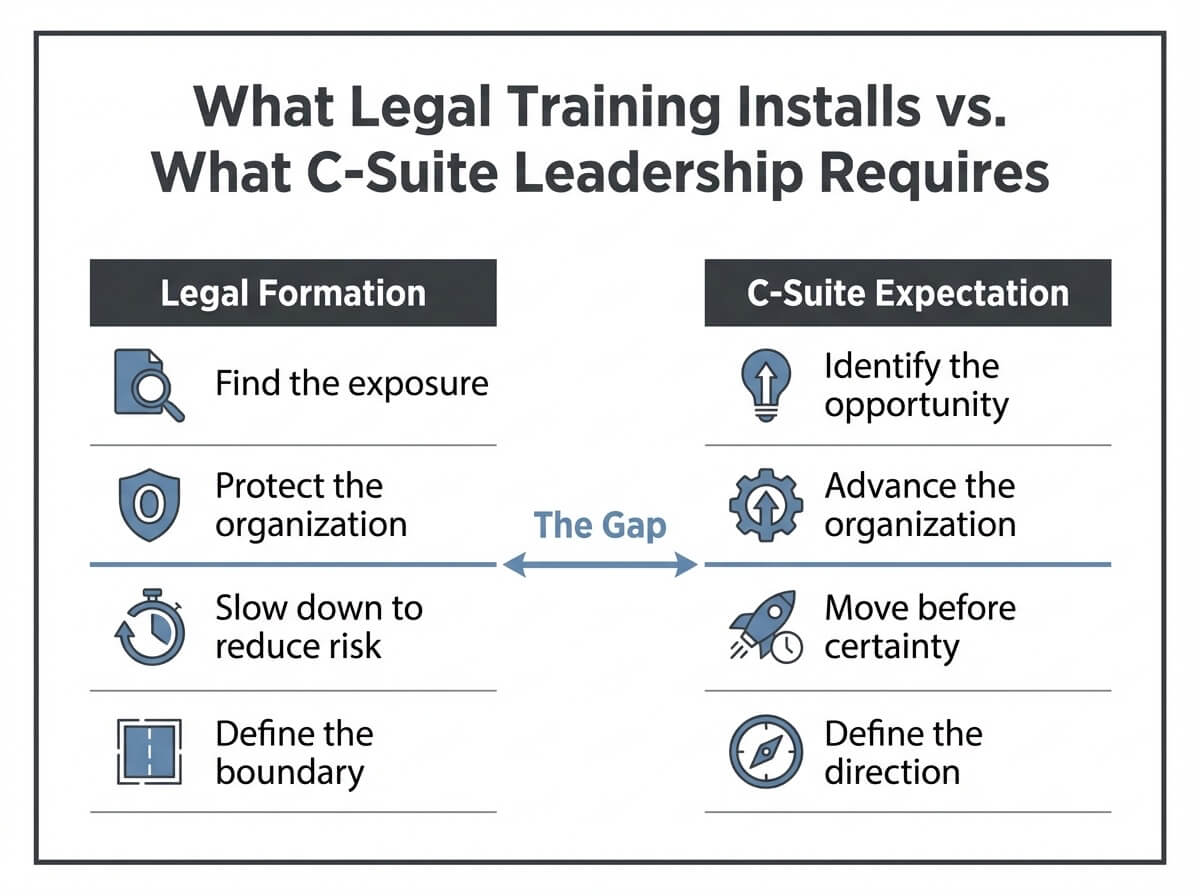
Legal: risk as exposure. Risk is a landscape of liabilities to be identified and eliminated before they materialize. The responsible response is prevention — no action until the exposure is mapped and mitigated. A decision that accepts known risk is, in the legal formation, not bold. It is negligent.
Marketing: risk as timing. Risk is the cost of inaction. Markets move, windows close, competitors establish positions. The responsible response is to act on conviction before the data is complete, because waiting for certainty means the opportunity has passed. Analysis paralysis is the risk the marketing formation fears most.
Operations: risk as disruption. Risk is anything that threatens continuity, reliability, or throughput. The responsible response is redundancy, fallback systems, and process resilience. Disrupting a working system for an unproven benefit is, in the operations formation, the definition of reckless.
Five leaders sit in the same room, hear the word “risk,” and five different alarm systems activate. Most strategy disagreements are not disagreements about strategy. They are disagreements about risk — which means they are disagreements about formation.
What Happens When Formations Collide on Risk
The product launch meeting. The CTO wants to ship. The product is ready, the team is energized, the market window is open. The General Counsel wants to review. The privacy assessment is incomplete, the terms of service need updating, the regulatory filing has not been confirmed. The CTO experiences the GC as a bottleneck. The GC experiences the CTO as a liability.
What neither sees is the formation logic driving the other’s behavior. Technology metabolizes risk through iteration: ship, learn, fix. Legal metabolizes risk through prevention: identify, mitigate, then proceed. Both are legitimate strategies for managing uncertainty. They cannot coexist in the same timeline without someone naming the structural tension.
The same collision plays out between the CFO and the CMO over investment decisions, between the COO and the CEO over transformation initiatives, between the CHRO and the CFO over talent investment. Each collision looks like a disagreement about the decision. Each collision is actually a disagreement about what “responsible” means. And because the word “responsible” feels like a moral category rather than a formation response, each leader experiences the other’s position not as a different perspective but as irresponsibility.
Collision
What Side A Sees
What Side B Sees
What Is Actually Happening
CTO vs. GC
Legal is killing momentum
Engineering is ignoring consequences
Iteration vs. prevention processing the same uncertainty
Quantification vs. conviction processing the same decision
COO vs. CEO
The CEO is disrupting what works
Operations resists all change
Continuity vs. transformation processing the same future
The Paradox
The paradox is that every formation’s risk instinct is both correct and incomplete. The CFO is right that unmeasured risk is dangerous. The CMO is right that unmoved-on risk is costly. The GC is right that unmitigated exposure can destroy an organization. The CTO is right that untested ideas never improve. The COO is right that disrupted systems fail before new ones work.
Each formation provides something the others do not. The organization needs all five risk responses operating simultaneously. The voice your leadership team is not hearing is usually the risk perspective that the room’s dominant formation has marginalized — not because it is wrong, but because it processes uncertainty in a way the majority finds uncomfortable.
ℹ
Note
The productive question is not “whose risk assessment is correct?” It is “what does this decision need that no single formation is providing on its own?” That reframe turns risk disagreements from personality conflicts into structural inputs — which is what they always were.
What Coaching Changes
For the individual leader, a coach who understands the risk formation helps distinguish between formation-level caution and situation-level judgment. “I am uncomfortable with this decision” can mean “this decision is genuinely dangerous” or it can mean “my formation is reacting to uncertainty the way it was trained to.” Both are real. They require different responses. The formation-aware coach helps the leader tell the difference.
The coaching question is not “Are you being too cautious?” The question is: “Is your discomfort about this specific situation, or about how your career taught you to process uncertainty in general?” That distinction — between the signal and the formation — is where the leader develops genuine risk judgment rather than either overriding their instinct or being captive to it.
For the team, a coach who understands all the formations in the room does not resolve the risk disagreement. They name it: “What I am hearing is two legitimate definitions of responsible that cannot both be satisfied simultaneously. What does this specific decision need?” That question moves the team from arguing about who is right to collaborating on what the situation requires.
What risk means to you is not what it means to your peers. That is not a limitation. It is a fact about what different careers install. The finance leader’s quantification instinct catches exposures the CMO’s timing instinct would miss. The engineering leader’s iteration instinct produces learning the legal leader’s prevention instinct would block. Each formation has a blind spot that another formation covers.
The question is not whether your risk instinct is correct. It usually is — for the domain that trained it. The question is whether you can see it as a trained response rather than an objective truth. That recognition — “my discomfort is formation, not fact” — does not make you less cautious or less rigorous. It makes you more accurate about when caution is serving you and when it is running you.
Why do leaders from the same organization reach opposite conclusions about the same risk?
Each function installs a different definition of risk through years of professional rewards and consequences. Finance is trained to quantify exposure before acting; technology is trained to ship small and iterate; legal is trained to prevent liability before proceeding. When these formations meet on the same decision, what looks like a disagreement about strategy is actually a collision between different but equally legitimate definitions of ‘responsible.’
Can a leader change how they process risk without abandoning the instincts their career built?
Yes, and the distinction matters: your formation’s risk instinct is trained behavior, not fixed personality. The goal is recognizing when it is responding to a specific situation versus running on autopilot. A leader who can tell the difference between ‘this decision is genuinely dangerous’ and ‘my formation is reacting to uncertainty the way it was trained to’ develops actual judgment rather than simply cycling between caution and override.
What does a coach actually do when a leadership team can’t agree on risk?
A formation-aware coach names the structural collision rather than trying to resolve whose position is correct. The question ‘What does this specific decision need that no single formation is providing?’ reframes a personality conflict as a structural input problem. That move stops the team from arguing about who is right and redirects them toward what the situation actually requires.
What does it mean to think more strategically?
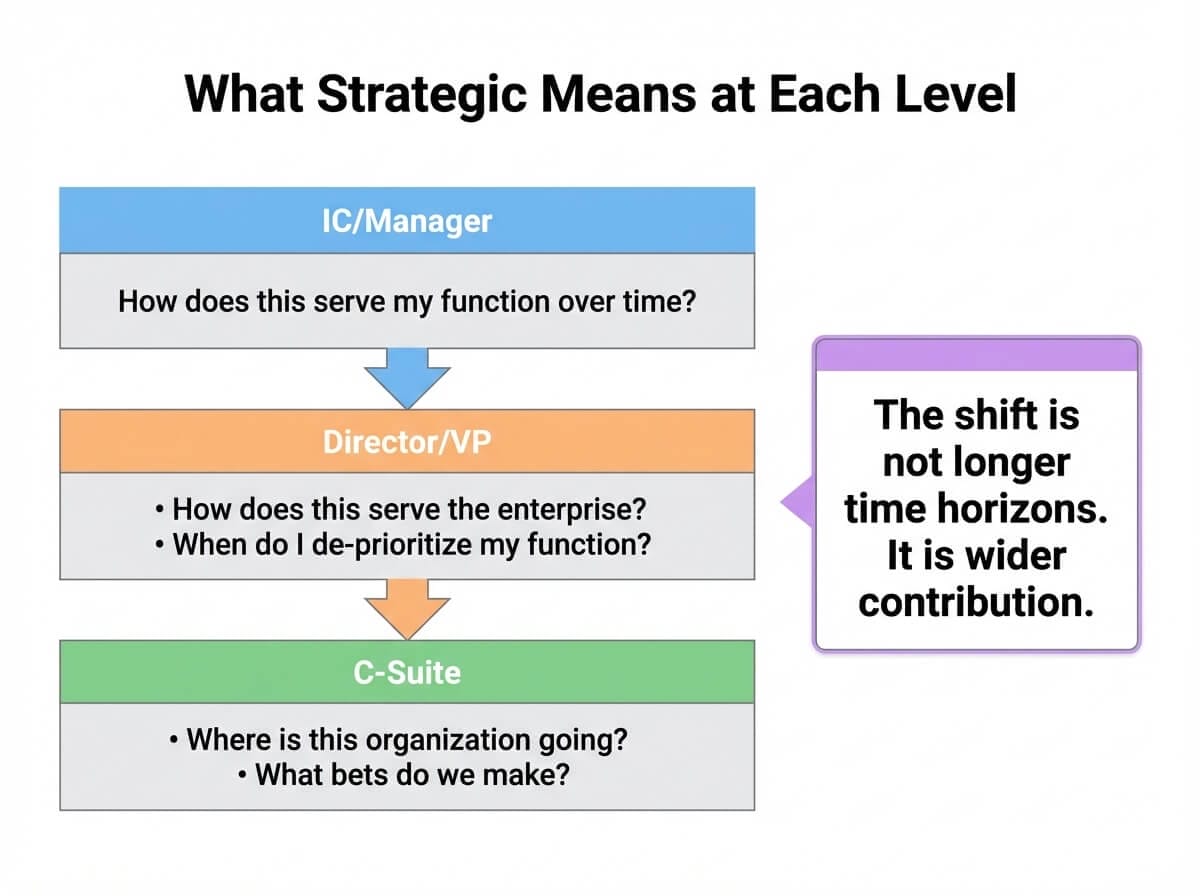
Strategic thinking shifts meaning with level. At IC and manager level, it means optimizing your function over time. At Director and VP level, it means contributing to enterprise decisions, sometimes de-prioritizing your own domain for the whole, forming positions before data is complete, and influencing decisions you do not control.
“Think more strategically.”
You have heard it in a review, a one-on-one, a passing comment from someone two levels above you. And your first response was probably to do the thing your career trained you to do — but harder. The finance leader builds a longer-horizon model. The engineer drafts a technology roadmap. The operations leader creates a three-year capacity plan. The marketing leader develops a competitive positioning framework. Each of these is strategic thinking. None of them is what the feedback is actually asking for.
The problem is not that you lack strategy. The problem is that “strategic” means something different at the level you occupy now than it did at the level where you learned it. And nobody defines the shift. They just keep saying the word and expecting you to hear something your formation never taught you to hear. The guide on how to think more strategically maps exactly what that shift demands at the Director and VP level.
Key Takeaways
“Think more strategically” is the most common piece of feedback at the Director/VP level — and the least defined. What it means depends entirely on which career shaped the person hearing it.
Every function installs a specific version of strategic thinking. Extending the time horizon within your domain is not the shift. The shift is extending your lens beyond your domain entirely.
The real strategic gap is not about vision. It is about operating in uncertainty — forming positions before the data is complete, influencing decisions you do not control, contributing to conversations where your functional expertise is not the point.
A coach who understands what “strategic” means to your specific formation can surface the gap between what you are doing and what the room needs without reducing the problem to “you need a broader perspective.”
What “Strategic” Means in Your Formation
Every career installs its own definition of strategic thinking. That definition works — at the level where it was installed.
In finance, strategic means scenario modeling: project forward, weight probabilities, stress-test assumptions. The finance leader who is told to think more strategically builds a better model. More variables, longer horizon, tighter sensitivity analysis. In technology, strategic means systems architecture: how does this decision affect the platform in eighteen months? The engineer who is told to think more strategically drafts a deeper roadmap. In operations, strategic means anticipating bottlenecks at scale: what will break when we grow? In marketing, strategic means market positioning: where do we play and how do we win the narrative?
Each version of strategic thinking is legitimate. Each version is also bounded by the function that installed it. The finance leader’s strategy is about the numbers. The technology leader’s strategy is about the systems. The operations leader’s strategy is about the process. The feedback — “think more strategically” — is not asking for a better version of functional strategy. It is asking for something the function never taught.
The feedback says “strategic.” What it means is: form a position on something outside your domain and defend it in a room where nobody shares your expertise.
The Actual Shift
At IC and manager level, the time horizon lives inside the function. The sprint, the quarter, the campaign cycle, the audit calendar. Strategic means: how does this decision serve the function over time? At Director and VP level, the time horizon must extend beyond the function. Strategic means: how does this decision serve the enterprise? And more uncomfortably: how does my function’s interest sometimes conflict with the enterprise’s interest, and what do I do when it does?
This is where the shift gets hard. The patterns your career installed trained you to optimize your domain. The new level asks you to sometimes de-prioritize your domain for the whole. The finance leader who recommends funding a marketing initiative that has no provable ROI — because the competitive positioning matters more than the model — is thinking strategically. It also feels, to their formation, like professional malpractice.
The real gap is not about extending the time horizon. It is about operating in uncertainty. Forming positions before the data is complete. Influencing decisions you do not control. Contributing to conversations where your functional expertise is not the point — where what matters is your judgment as a leader, not your credibility as a specialist. That is a fundamentally different kind of contribution than your career prepared you for.
Level
What “Strategic” Means
What Success Looks Like
IC / Manager
How does this serve my function over time?
The project delivers. The team performs. The work is excellent.
Director / VP
How does this serve the enterprise? When do I de-prioritize my function?
Cross-functional influence. Decisions shaped beyond your domain.
C-Suite
Where is this organization going and why? What bets do we make?
Enterprise direction set. Judgment expressed before data is complete.
Why Working Harder Does Not Fix It
The first response to “think more strategically” is almost always: work harder at the version of strategic thinking your career already installed. The finance leader builds a more rigorous model. The engineer creates a more comprehensive roadmap. The operations leader develops a more detailed capacity plan. Each effort is excellent. None of them answers the feedback.
This is the currency shift in action. The old currency — functional strategic excellence — has diminishing returns. The new currency — enterprise-level judgment expressed across functions — requires spending credibility in rooms where you are not the expert. That is deeply uncomfortable for a leader whose career taught them that credibility comes from expertise.
There is a predictable inflection point. Around month four or five after a major promotion, the leader realizes that working harder at the old approach is not producing the results it used to. The effort is the same or greater. The impact is less. This is when most leaders start questioning themselves. Not because they are failing, but because the one strategy they know — excellence through functional expertise — has hit diminishing returns, and they do not have a second strategy.
ℹ
Note
The identity problem is underneath the strategic problem. “Think more strategically” asks you to contribute in a space where your functional identity does not protect you. The discomfort is not about capability. It is about showing up in a conversation where you cannot rely on the thing that makes you feel credible.
What a Coach Who Gets This Asks
Generic coaching hears “I keep getting feedback to be more strategic” and offers frameworks: how to think in longer time horizons, how to present strategically, how to build a strategic narrative. These are useful. They are also surface-level — they address the output without addressing why the leader keeps defaulting to functional strategy despite knowing better.
A coach who understands the formation hears the same sentence and recognizes that “strategic” is a word the leader’s career defined one way and the organization is now defining another way. The coaching question is: “When they say ‘strategic,’ what do you think they are actually asking for?”
That question invites the leader to surface the gap themselves — to discover that the feedback is not about thinking bigger within their function but about contributing beyond it. And the follow-up — “What keeps you from offering a point of view in conversations outside your domain?” — opens the identity question: what happens when the room does not need your expertise and you have to lead with judgment instead?
The room does not need you to be less of a specialist. It needs you to be a specialist who can also step outside the specialty and add value as a leader. That is not a different person. It is a wider version of the person your career built. The analytical mind that serves the enterprise, not just the function. The operational instinct that shapes strategy, not just executes it. The technical depth that informs organizational bets, not just system architecture.
Diagram showing how the definition of strategic thinking changes from IC/Manager through Director/VP to C-Suite
If “think more strategically” has been following you from review to review, the issue is not your capability. It is the gap between the influence your role asks for and the version of strategic contribution your career installed. That gap does not close with more functional excellence. It closes when someone helps you see what the room is actually asking for — and what it costs you, at the level of identity, to give it.
Why does working harder at strategic thinking not satisfy the feedback?
The feedback is asking for something your function never taught, beyond a better version of functional strategy. Around four or five months after a promotion, most leaders hit the point where their existing approach produces diminishing returns precisely because the new level runs on a different currency: enterprise-level judgment exercised in rooms where your specialty is not the point.
What is the actual difference between strategic thinking at the Director/VP level versus IC and manager levels?
At IC and manager level, strategic means optimizing your function over time. At Director and VP level, it means contributing to enterprise decisions and sometimes de-prioritizing your own domain for the whole. The harder part is forming positions before the data is complete and influencing decisions you do not control, beyond simply working with longer time horizons.
How does executive coaching address this differently from strategic frameworks?
Generic coaching offers tools for thinking in longer time horizons or building a strategic narrative, which are useful but surface-level. A coach who understands your formation recognizes that the word ‘strategic’ was defined one way by your career and is now being defined another way by the organization. The real coaching work surfaces the identity question: what happens when the room does not need your expertise and you have to lead with judgment instead?
Are you more than your job title?
Your career installed an identity, not just a title. After enough years, the two fuse until you cannot find the line between them. The article is direct: your career called one version of excellence the only version. The role you occupy now asks for a wider definition, not a different one.
When was the last time you did something at work that had nothing to do with your function — and felt like an imposter the moment you opened your mouth?
Not imposter syndrome in the usual sense. Not “I do not belong here.” Something more specific: the feeling that once you step outside the domain your career built you in, the version of yourself that shows up is thinner. Less sure. Less credible. The CFO who contributes confidently on capital allocation but goes quiet when the conversation turns to culture. The CTO who commands the room on architecture but stumbles through a board narrative about business value. The General Counsel who can hold any courtroom but cannot hold a strategic conversation without it becoming a risk assessment.
That thinning is not a confidence problem. It is an identity architecture problem. And it starts with what your career installed long before you noticed it was installing anything.
Key Takeaways
Every function installs a specific professional identity — not just skills, but a definition of what it means to be good, credible, and yourself.
Identity Architecture is the most deeply fused dimension of professional formation. Other patterns can be adjusted with practice. Identity requires expansion, not correction.
The ceiling is not competence. It is repertoire. You may have the capability to lead beyond your function. You may not have a version of yourself that feels real doing it.
Releasing identity is not a skill problem. You cannot learn your way out of an identity that no longer fits — you have to build a new one alongside it.
A coach who understands what your career built into your sense of self asks different questions than one who treats the issue as a skill gap.
What Your Career Built Into You
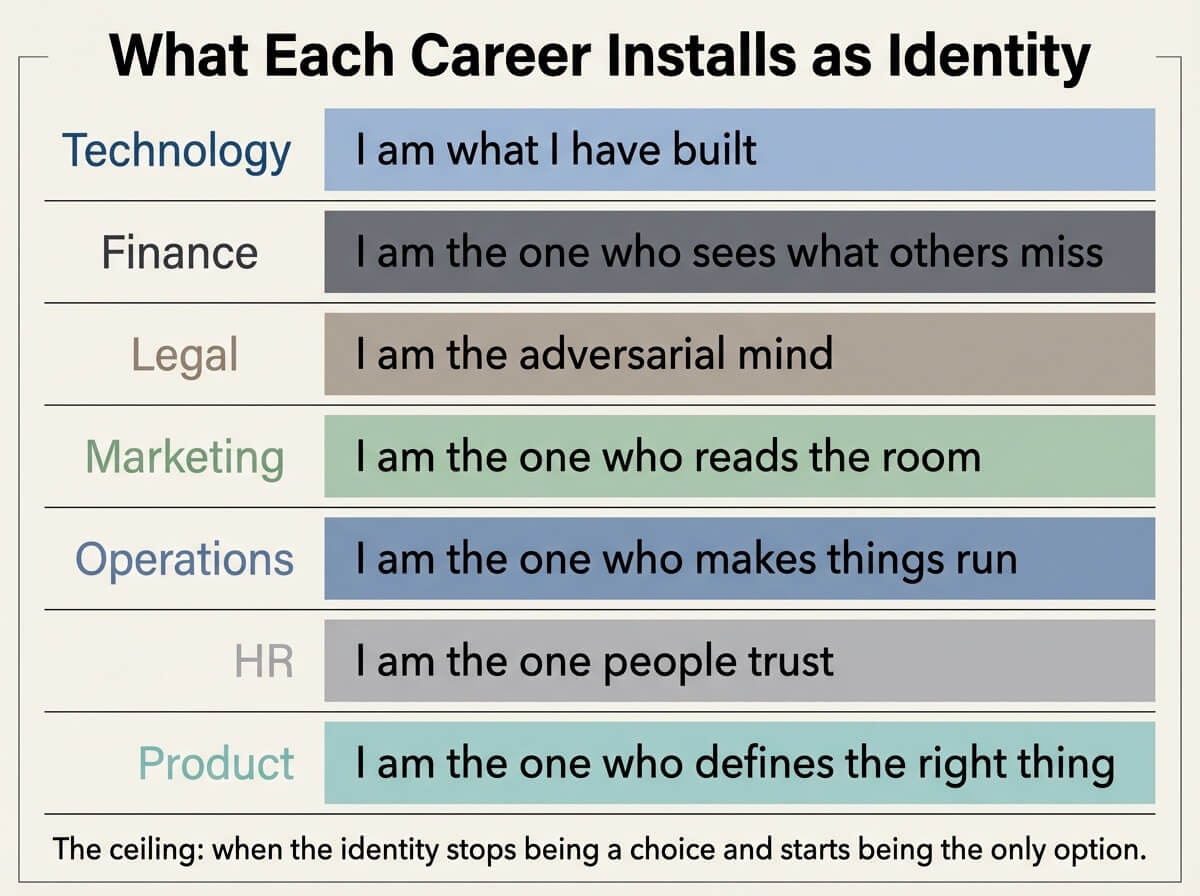
Every function installs an identity. Not a skill set. Not a perspective. An identity — a definition of what it means to be good that fuses with the person’s sense of who they are. After enough years, the identity and the person become inseparable. The career did not just teach you to do something. It taught you to be something.
In technology, the identity is the builder. You are what you have shipped. The system that scales, the architecture that holds, the elegant solution to the impossible problem — these are not just accomplishments. They are proof that you are who you think you are. When you stop building, you do not just change what you do. You lose access to the thing that tells you, every day, that you are competent.
Diagram showing the identity each career function installs and where it becomes a constraint
In finance, the identity is precision. You are the person who sees what others miss. The variance that does not fit. The assumption that was not tested. After fifteen years, this is not a skill you turn on and off. It is how you process the world. When someone pitches an idea without evidence, the finance-trained mind does not hear enthusiasm. It hears an unaudited claim.
In legal, the identity is the adversarial mind. Stress-testing every proposition is not a habit. It is how you define intelligence. The legal leader told to “be less adversarial” does not hear feedback about a behavior. They hear: think worse.
In marketing, the identity is the storyteller — the person who reads the room, crafts the narrative, and moves people. In operations, it is the person who makes things run — invisible when things work, noticed only when they break. In HR, it is the trusted person — the one everyone comes to. In product, it is the maker — the person who defines the right thing and gets it built.
Your career did not just teach you to do something. It taught you to be something. And the line between those two gets thinner every year until you cannot find it at all.
None of these identities are wrong. Each was earned. Each was adaptive — it matched what the environment rewarded. The problem is not what the identity is. The problem is that it was installed so deeply you stopped noticing it was a choice.
When Identity Becomes a Cage
The identity that defined excellence in one room constrains growth in the next. Not because the identity is wrong. Because it is too narrow for what the role now asks.
The CTO who cannot stop building does not have a delegation problem. They have an identity problem. Reviewing code is not about quality control. It is about staying connected to the part of themselves that feels real. When they delegate the architecture review and their senior engineer does it differently — maybe even well — the feeling that surfaces is not relief. It is loss. “If she can do it without me, what am I here for?” That question is not about the engineer. It is about who the CTO is if they are not the best builder in the room.
The CFO who cannot stop modeling does not lack strategic capacity. They lack a version of themselves that feels credible expressing judgment without data. “Here is what I think we should do” — said without a model behind it — violates everything their formation installed about what rigorous thinking sounds like. So they build one more scenario. Add one more sensitivity analysis. The model is excellent. The room is asking for something the model cannot produce.
The operations leader who cannot claim strategic space does not lack the strategic insight. They have it — they see more of the organization than almost anyone else at the table. But their identity says operations stays in the background. The career taught them that good work speaks for itself. It does not. Not at this level.
ℹ
Note
The ceiling is not competence. It is repertoire. These leaders have the capability to lead beyond their function. What they lack is a version of themselves that feels real doing it. That is a fundamentally different challenge than a skill gap — and it requires a fundamentally different kind of coaching.
The Hardest Part
You cannot learn your way out of an identity that no longer fits. Skills training addresses what you can do. Identity architecture addresses who you are when you do it. The distinction matters because the conventional response to a senior leader who is “stuck” is development: leadership programs, executive education, coaching on influence and presence. Those interventions build capability. They do not build a new version of the self that is willing to use the capability.
The engineer told to “think more strategically” does not lack strategy. They can think strategically when asked. What they cannot do is show up to a conversation about organizational direction and feel like themselves doing it. The strategic contribution feels like a performance. The technical contribution feels like home. Where this pattern starts — at the first major promotion — it is uncomfortable. By the time a leader reaches the C-suite, the identity architecture has twenty years of reinforcement behind it.
This is why the currency shift is so painful. It is not just that the old skill has diminishing returns. It is that the old skill was the source of professional self-worth. Releasing it does not feel like growth. It feels like giving up the thing that makes you, you.
The expansion required is not “become someone else.” It is: become someone who carries the old identity as one tool among several, rather than as the only definition of credibility. The builder who can also direct. The analyst who can also judge. The protector who can also navigate. Both/and rather than either/or. That expansion is the work. And it is harder than any skill acquisition because the resistance is not cognitive — it is existential.
Coaching That Gets This
Generic coaching hears “I feel like I am losing touch with what made me good” and offers reassurance or delegation frameworks. A coach who understands identity architecture hears the same sentence and recognizes a formation in the middle of an identity expansion that the leader experiences as an identity loss.
The coaching question is not “How can you let go of the technical work?” The question is: “What does ‘in touch’ mean for you at this level? What would it give you?”
That question does not argue with the identity. It invites the leader to examine what the old behavior is actually providing — and whether the new role offers another path to the same thing. The CTO who keeps reviewing code is not reviewing code. They are maintaining access to the feeling of competence. The coaching work is helping them find another source of that feeling at the level they now occupy.
The question is not whether you can let go of the old identity. The question is whether you can build a new one that feels as real as the one your career installed.
This is what formation-aware coaching changes. Not the advice. The recognition. The coach who understands what a career in technology does to a person’s sense of self will hear “I keep going back to the code” and know that the sentence is not about code. It is about identity. And the questions that follow from that recognition are different — deeper, more precise, more respectful of what the career built — than the questions that follow from hearing it as a time-management problem.
You read this because something about the title matched a pattern you have been noticing. The career built something real. The precision, the builder instinct, the protective reflex, the operational excellence, the trust people place in you — none of that was a mistake. It was adaptive. It worked.
It is also not everything you are. The career installed one version of excellence and called it the only version. The role you occupy now is asking for a wider definition. Not a different one. A wider one. The identity your career built is the foundation. The question is what you are willing to build on top of it.
If that question is live for you right now — if you have been sensing that the thing that made you credible is not the thing that will carry you forward — that is where coaching that understands professional formation begins. Not with a new skill. With a new relationship to the identity your career installed.
Frequently Asked Questions
Why can’t senior leaders just develop new skills to grow beyond their function?
Skills training addresses what you can do, while identity architecture addresses who you are when you do it. A leader can learn to think strategically, hold a board narrative, or delegate architecture decisions, and still feel like they are performing rather than being themselves. The capability is there; what’s missing is a version of the self that feels real using it.
What makes professional identity so hard to recognize as the source of the problem?
The identity gets installed gradually over years until it fuses with the person’s sense of self. A finance leader doesn’t experience precision as a habit they adopted; it becomes how they process the world. By the time the pattern shows up as a constraint, it has fifteen or twenty years of reinforcement behind it, and it no longer feels like a choice.
How does coaching that understands identity architecture differ from standard leadership development?
Generic coaching hears ‘I feel like I’m losing touch with what made me good’ and offers reassurance or delegation frameworks. Formation-aware coaching recognizes that sentence as an identity expansion the leader is experiencing as loss, and asks different questions: what does ‘in touch’ mean at this level, and what would it give you. The goal is helping the leader find another source of that feeling in the new role, while honoring the original behavior pattern.
Why isn’t technical credibility enough anymore?
Technical credibility earned every promotion until this one because the room below you trusted your hands, your math, your craft, your process. The room above runs on a different frequency. They reward translation, orchestration, judgment, strategy. Broadcasting on the old channel produces silence, not recognition. Two economies, different exchange rates.
You built this. Year by year, decision by decision, deliverable by deliverable. The thing you’re known for—the precision, the thoroughness, the craft, the reliability, whatever your career trained you to call excellence—earned you every promotion until this one.
And now you’re hearing a version of the same feedback from every direction: “We know you’re good at your thing. We need you to be good at something else.”
Nobody names what the something else is. Worse, the something else feels like a betrayal of the thing that got you here. Because your “technical credibility” isn’t just a skill. It’s who you are. And the results aren’t speaking for themselves because the room at the next level listens to a different frequency. You’re broadcasting on your career’s old channel and wondering why nobody’s picking up the signal.
Key Takeaways
“Technical credibility” is not a technology concept. Every function has its version: precision for finance, thoroughness for legal, craft for marketing, reliability for operations, trust for HR, delivery for product. Each one stops being sufficient at the same career inflection point.
The promotion to VP requires trading the credibility that earned you the role for a different currency—and the new currency is specific to your function. What finance must build is fundamentally different from what technology must build.
You keep doubling down on the old currency because it’s where you feel competent. The new currency gives slow, ambiguous feedback that your career didn’t prepare you to tolerate.
A coach who understands the patterns your career installed doesn’t give you generic “be more strategic” advice. They name the exact credibility trade your function demands.
Every Function Has a Version of “Technical Credibility”
“Technical credibility” in the leadership development market is treated as a technology concept. The advice is aimed at engineers: stop coding, start leading. But the engineer who built their career on elegant solutions is navigating the same structural challenge as the finance director who built their career on being right about the numbers. The credibility is different. The shift is the same.
Every function has a currency—the specific form of professional value that earned you standing, respect, and every promotion until this one.
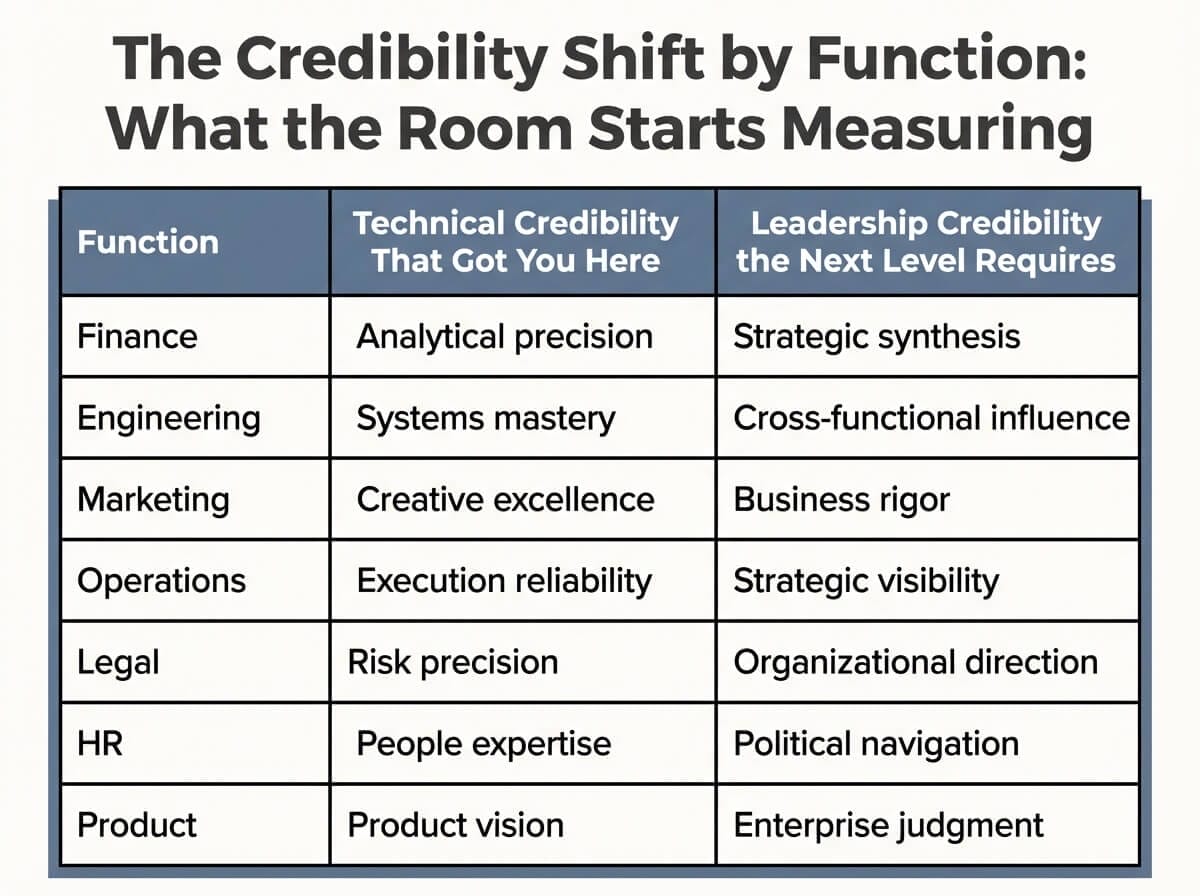
Table diagram showing the credibility shift by function, contrasting what technical credibility got each type of leader to their current level with what leadership credibility the next level requires
Technology: building. Code quality, elegant solutions, solving the hardest problems. “I solve hard problems.” When people trust you technically, they trust your hands. Your career taught you that shipping is identity.
Finance: precision. Accuracy, catching what others miss, building models that are right. “I see what others miss.” When people trust you technically, they trust your math. Your career taught you that being right is how you earn standing.
Legal: thoroughness. Airtight reasoning, finding every risk, preventing what others don’t see coming. “I find the problem before it finds us.” When people trust you technically, it means nothing gets past you.
Operations: reliability. Process excellence, efficiency, things running. “I make things run.” When people trust you technically, it means things work when you’re responsible for them. Your greatest contributions are things that didn’t happen.
Marketing: craft. Creative execution, campaign performance, making things that connect with audiences. “I make things that resonate.” When people trust you technically, it means the work lands. The idea, the copy, the campaign that moves the needle—that’s the currency.
HR: trust. Being the safe person, knowing the policy, holding confidences. “People come to me.” When people trust you technically, they trust you with what they can’t say to anyone else. Relational integrity is the currency.
Product: delivery. Features ship, users adopt, the thing works. “Teams trust I know what I’m talking about.” Getting the right things built is the currency. When people trust you technically, it means what you aimed at was worth aiming at.
Every one of these currencies is real. Every one of them earned you the promotion. And every one of them is about to become insufficient.
The Specific Shift Your Function Demands
The promotion to director or VP doesn’t ask you to stop being credible. It asks you to be credible in a way your career never trained you for. The old currency still matters—but it’s no longer enough. And the new currency feels, at first, like a betrayal of the thing that got you here.
Function
Old Currency (IC)
New Currency (VP)
The Painful Shift
Technology
Code quality, personal technical skill
Team output, architecture that serves business strategy
The hands-on identity must release
Finance
Accuracy, models that are right
Translation—making numbers mean something to non-finance stakeholders
Precision must yield to narrative
Legal
Thoroughness, finding every risk
Enabling—deciding which risks to accept, not just cataloging them
Strategy—brand stewardship, cross-functional influence on positioning
Creative identity subordinated to strategic identity
HR
Individual trust, being the safe person
Systems—talent strategy, organizational development at scale
Individual relationships yield to institutional capability
Product
Delivery, features shipped
Judgment—which bets to fund, which to kill, where to aim the domain
Delivery was a proxy metric nobody told you about
The technology VP’s hands itch to refactor the code. They review every PR. They solve the hardest bug instead of building a team that solves hard bugs without them. Building gave clean, immediate feedback: it works or it doesn’t. The new work gives slow, uncertain feedback about other people’s judgment. The gap between those two feedback loops is where the identity crisis lives.
The finance director keeps building the forty-slide deck that proves the point when leadership wants a three-slide narrative that shapes a decision. Being right stops being enough. Being understood becomes essential. And leading with judgment instead of proof feels imprecise, which for someone whose career was built on precision, feels dangerous.
The legal director keeps writing comprehensive risk memos that catalog every exposure when the room above wants a recommended path forward. Every risk left unflagged feels like professional negligence because their formation built its entire value on being the person whose thoroughness was never in question. The shift from “I prevent risk” to “I help the business take smart risks” can feel like abandoning the thing that made them essential.
The operations director keeps optimizing individual processes instead of designing cross-functional systems. “My process” must become “the organization’s operating model.” The optimizer who made one function run clean must now make multiple functions run together, and the feedback loop shifts from “nothing broke” to “the organization can do something it couldn’t do before.”
The marketing director keeps crafting the copy. Art must serve business—which can feel like selling out the thing that made the work meaningful. Campaign-level thinking must become market-level thinking: brand stewardship, strategic positioning, cross-functional influence over product direction and pricing. The creative identity doesn’t disappear, but it must be subordinated to a strategic identity that doesn’t produce the same satisfaction.
Nobody told you the exchange rate. They just stopped accepting the old currency.
The HR director keeps being the go-to person for individual employee issues rather than building the systems that handle those issues at scale. Individual relationships, the currency that made them the trusted person in the room, must yield to institutional capability. The old currency gave direct, relationship-level feedback: people come to you. The new currency requires reading organizational-level signals that are harder to feel and slower to confirm.
The product director keeps defining features rather than defining domains. They point to features shipped successfully as evidence of performance, not realizing the room above evaluates whether they aimed at the right problems. Nobody told them delivery was a proxy metric. They thought delivery was the job.
Why You Keep Doubling Down on the Old Currency
The reason you’re still spending old currency isn’t weakness. It’s that the old currency is the only place you feel competent, and the new currency feels risky in a way your career isn’t equipped to handle.
🔎
The competence trap
When you spend old currency, you feel competent immediately. The model you built personally: right. The code you reviewed: clean. The risk memo you drafted: comprehensive. The campaign you crafted: beautiful. The process you fixed: running. Each time you invest in the old currency, you get immediate, familiar confirmation that you’re good at what you do. Each time you try the new currency—leading with judgment instead of data, enabling instead of building, orchestrating instead of optimizing—the feedback is slow, ambiguous, and unrewarding.
The cruel part: you can’t just drop the old currency entirely. The VP of engineering who stops understanding the architecture loses technical credibility with the team. The finance director who stops engaging with the models loses the precision credibility that gives them a seat at the table. The legal director who stops reading the contracts loses the thoroughness that makes their judgment worth hearing. You need enough of the old currency to stay credible while building enough of the new currency to earn standing at the next level. Two economies, running simultaneously, with no one telling you the exchange rate.
And the deepest reason the shift is hard: the old currency isn’t just what you do. It’s who you are. For the builder, building is identity. For the precision person, being right is identity. For the protector, preventing harm is identity. For the optimizer, things running is identity. When someone asks you to spend less on the old currency, they’re not asking you to change a behavior. They’re asking you to release a piece of your professional self. That’s not a skills challenge. That’s an identity challenge. And the generic advice to “think more strategically” doesn’t begin to address it, because it’s operating at the wrong level of the problem.
The thing that earned you the promotion is not the thing the promotion asks you to do.
The people above you figured this out, eventually, through years of trial and error. But they can’t quite articulate what shifted because the pattern is invisible to the person inside it. They’ll tell you “be more strategic” the way someone who learned to swim at four tells you “just relax in the water.” The advice is technically correct and practically useless because it doesn’t name the currency exchange you’re navigating. It doesn’t name what you’re losing and why letting go feels like losing control.
What Changes When Your Coach Gets This
A generic coach hears a marketing director say “I keep getting pulled into the work—I can’t seem to stop writing the copy myself” and provides delegation coaching. How to let go. How to trust the team’s creative output. How to spend time on higher-level work.
A coach who understands what a career in marketing actually does to a person hears the same thing and recognizes the pattern underneath: “Writing the copy is where you feel like yourself. The creative execution that earned you every promotion until this one—the craft, the taste, the thing that connected with audiences—is the currency your career trained you to trust. Delegation isn’t the problem. The problem is that the new currency—strategic positioning, cross-functional influence, shaping how the market sees the whole company—doesn’t give you the same hit. It doesn’t feel like your work. It doesn’t feel like you.”
And then the question that shifts everything: “What would ‘your work’ need to become at this level for it to feel like it belongs to you?”
That reframe moves the conversation from behavioral—stop doing the work—to identity-level. Not “how do you delegate better?” but “what would the new currency need to feel like in order for you to own it?”
🔎
Inside the coaching room
An operations director says “nobody sees what I do until something breaks.” A generic coach works on visibility strategies: communicate impact proactively, quantify operational excellence, present to leadership more often. A coach who understands what a career in operations installs hears the pattern: “Your career trained you to read one success signal—nothing breaks. That signal is inherently invisible. Your greatest contributions are things that didn’t happen. The room above reads a different signal: strategic impact, organizational capability, transformation readiness. The shift isn’t about making your current work more visible. It’s about changing what counts as your work. From ‘I make things run’ to ‘I design how the organization works.’ That’s not a communication problem. It’s a currency shift.”
The difference between those two coaching conversations is not technique. It is whether the coach understands the specific credibility your career built and the specific credibility the next level demands. One approach gives you a framework. The other names the promotion that changed the game and the exact currency exchange you’re navigating.
The precision, the craft, the thoroughness, the reliability, the trust, the technical depth, the delivery instinct—none of that goes away. It’s the foundation. The question is whether you can build something on top of it: a form of credibility that the next level recognizes and rewards.
That form is different for every function. The finance director’s new currency—translation—is fundamentally different from the technology VP’s new currency—team output—is fundamentally different from the marketing director’s new currency—strategic positioning. The structure of the shift is universal. The content of the shift is specific to the career that formed you.
And figuring out what your specific new currency looks like—not “be more strategic” in the abstract, but what strategic actually means for someone whose career installed the patterns yours installed—is easier when someone who understands your formation is in the room with you. Not to tell you what to do. To help you see why the old currency keeps pulling you back, and what the new one might feel like once it’s yours.
If that specificity matters to you, if “think more strategically” has never been enough, the next conversation isn’t about strategy. It’s about the career that made strategy feel like someone else’s language.
Frequently Asked Questions
Why does advice like ‘think more strategically’ feel useless at the VP transition?
Because the credibility gap isn’t a strategy gap. It’s a currency gap. The people above you who made the transition can’t articulate what shifted because the pattern is invisible from inside it. ‘Think more strategically’ is technically accurate and practically useless because it doesn’t name the specific trade your function demands or explain why the old currency keeps pulling you back.
Do I have to abandon the technical credibility that got me here?
No, and you can’t rely on it exclusively either. The VP of engineering who stops engaging with the architecture loses technical credibility with the team; the finance director who steps away from the models loses the precision that earns them a seat at the table. The work is running two economies simultaneously: maintaining enough of the old currency to stay credible while building enough of the new one to earn standing at the next level.
What makes the credibility shift an identity problem rather than a skills problem?
For most functional leaders, the old currency isn’t just a set of behaviors. It’s how they understand themselves professionally. The builder’s identity is building; the precision person’s identity is being right; the optimizer’s identity is things running. When the next level stops rewarding that currency, it doesn’t feel like a feedback gap. It feels like being asked to stop being yourself. Skills coaching addresses behavior; formation-aware coaching addresses what the career actually installed.
Why are HR leaders everyone’s coach but nobody’s priority?
HR leaders build development infrastructure for everyone else — CEO coaching, senior leadership programs, high-potential mentoring — while receiving none of it themselves. The advocacy identity defines professional worth through being needed, so asking for help contradicts the professional self the entire organization depends on. The pattern doesn’t break itself.
The restructuring announcement is forty minutes old. You knew it was coming. The CEO consulted you two weeks ago on severance modeling, asked you to draft the communication plan, had you map which teams would lose headcount. You modeled the people cost of every scenario. But you learned the strategic rationale for which scenario they chose the same way every other executive did: in the meeting. The decision was made in a smaller room, a room you were not in. You had the data. You did not have the conversation.
Within an hour, three executives stop by your office. The CTO wants to talk through retaining key engineers. The CMO needs help messaging the change to their team. The CFO asks about the severance timeline. Everyone comes to you. Nobody asks what you think about whether the restructuring was the right call in the first place.
On the drive home, it settles. You are the most consulted person in the building and the least influential person in the room where it mattered. If you have spent fifteen or twenty years in HR and that sentence lands somewhere deeper than your head, this article is for you. Not because you lack strategic capability. Because the patterns your career installed are producing exactly this result. And the room you sit in now trades in a different currency than the one your formation taught you to spend.
Key Takeaways
A career in HR doesn’t just teach people skills. It installs advocacy as identity—a deep pattern where being needed by people is how you measure professional worth, and that pattern has diminishing returns at the enterprise level.
The empathy and relational attunement that made you trusted by individuals is the same thing making you marginal in the strategic conversation. The strength and the ceiling are the same pattern.
The shift from people advocate to enterprise strategist is not about “being more commercial.” It is about translating what you already see into a denomination the boardroom can act on.
A coach who understands what a career in HR does to a person will ask different questions than one working from a generic leadership playbook.
What a Career in HR Installs
You didn’t just learn to care about people. Caring about people became who you are. Somewhere between your first employee relations case and your thousandth difficult conversation, the belief that organizations succeed through people fused with your professional identity so completely that the two became indistinguishable. When the executive team makes a decision that ignores the people dimension, it doesn’t register as a difference of opinion. It registers as something closer to a moral failure. And when people come to you—for advice, for mediation, for a safe space to think through something they cannot say out loud to anyone else—that is when you feel most like yourself. “People come to me” is not a job description. It is an identity.
Your career trained you to read one signal channel with extraordinary sensitivity: how people are doing. Employee sentiment. Trust quality. Whether a team is fracturing beneath the surface or holding together through something hard. You can read a room’s emotional temperature before anyone has said a word. You know which leader’s team is quietly updating their résumés. You know which executive is about to lose their best people. You see things about the organization that nobody else in the C-suite can see.
But there is another channel your career never trained you to read with the same fidelity: whether that people insight is translating into business impact. Whether the leaders around you see you as strategic or supportive. Your default interpretation when you are excluded from a decision: “They don’t value people.” The alternative—that you haven’t yet learned to express people insight in the language the room trades in—is harder to see from inside the pattern.
Your career trained you to see what others miss about people. It also trained you to miss what others see about how influence works.
Notice how you process a room. When a restructuring is proposed, you are already mapping the second and third-order human consequences before anyone else has finished reading the slide. Who will leave. Which teams will lose trust. Where institutional knowledge will disappear. You organize what you hear through relational mapping: how will this affect the people, and how will the people’s response affect the system? That relational lens catches consequences other lenses miss entirely. It is also the reason the room sometimes hears your input as caution rather than strategy. Every change has too many human consequences. The people-impact analysis can expand until it becomes the case against doing anything at all.
And risk, for you, is distributed through relational networks. You do not manage uncertainty by eliminating disruption. You manage it by building the human system’s capacity to absorb it. That is not timidity. It is the professional adaptation of someone who has spent a career watching what happens when organizations move faster than their people can hold.
Where Advocacy Becomes a Ceiling
Career Level
Currency
What Earns Standing
The Identity
IC / Manager
Employee trust
Being the person people come to. Confidentiality. Policy expertise. Individual advocacy.
“People come to me”
Director / VP
Organizational development
Talent strategy. Data-informed people decisions. Systems that create trust at scale, not one conversation at a time.
“I shape the systems that shape how people work”
C-Suite
Culture architecture
Workforce strategy in enterprise-value language. How human capital decisions drive competitive advantage.
“I build the human capability the strategy requires”
As an HR generalist and manager, the currency was being the person people come to. Employee trust. Confidentiality. The ability to hold difficult conversations that nobody else in the organization would touch. “People come to me” was the measure of professional worth, and it was real. That trust takes years to build and is genuinely valuable.
At director and VP, the game changed. The currency became systems thinking: organizational development, talent strategy, data-informed people decisions. Not being the person everyone trusts, but building the systems that create trust at scale. But you kept being the go-to person for individual employee issues rather than building systems that handle those issues without you. Kept defining success as “people trust me” when the new level defined success as “the talent strategy is producing measurable business results.” The gap showed up as feedback you have heard a dozen times: “Think more commercially.”
At the C-suite level, the game changes again. The board does not want your organizational development programs or engagement scores. They want workforce strategy articulated in the language of enterprise value creation. How human capital decisions drive competitive advantage. How culture architecture enables or constrains the business strategy. The CHRO who still leads with people programs and sentiment data when the board needs a strategic partner who connects workforce decisions to enterprise outcomes has brought the wrong currency to the boardroom.
ℹ
Note
This is not about caring less about people. It is about recognizing that people advocacy and enterprise strategy are not opposites. The question is whether you are spending your people insight as individual trust—one relationship, one conversation, one crisis at a time—or converting it into the strategic currency the boardroom trades in. Same insight. Different denomination.
Under pressure, the advocacy identity hardens. You insert yourself into more situations as the “people voice.” You over-mediate conflicts that could self-resolve. You generate more process around every people decision. More check-ins, more pulse surveys, more “how are you doing” conversations. You over-protect people from organizational stress, shielding teams from hard truths, delaying difficult messages because the human cost feels too high. The pattern that defines you amplifies. It looks like caring until it becomes the thing slowing the organization down. In the worst version, you use the moral authority of the people-advocate position to slow or block decisions you cannot influence through other means. The people-impact assessment becomes a veto. And the room quietly concludes that HR is an obstacle rather than an ally.
Everyone’s Coach and Nobody’s Priority
You are the most trusted person in the building and the least powerful person in the room where decisions get made. Everyone comes to you after the meeting. Nobody invites you to the meeting before the meeting. The CEO consults you on how to communicate a decision, not on whether to make it. You have access to more organizational truth than anyone in the C-suite and less influence over what the organization does with it.
People come to you. That is both the source of your power and the shape of the ceiling.
Your cross-functional peers have learned to use your language against you. When you raise a concern about a restructuring, someone says “we need to balance people needs with business needs”—as though people needs were a nice-to-have and business needs were the real thing. You know the people dimension IS the business dimension. But you haven’t found the words that make the room hear it that way. You keep presenting in the language of empathy and advocacy. The room trades in the language of value creation and competitive advantage. Same insight. Wrong currency.
The feedback you keep getting is some version of “you need to be more commercial” or “think like a business leader, not an HR leader.” What nobody tells you is that you already think commercially. You know that a failing talent pipeline will destroy the strategy. You know that the culture problems in the engineering organization are a retention time bomb. You know that the leadership bench is thinner than the succession plan claims. You just keep saying it as “we’re losing good people” instead of “our human capital runway is eighteen months shorter than our strategic plan assumes.” The translation problem is linguistic, not conceptual. And nobody has helped you see it that way because the feedback always lands as “you’re not strategic enough” rather than “you’re spending the right insight in the wrong denomination.”
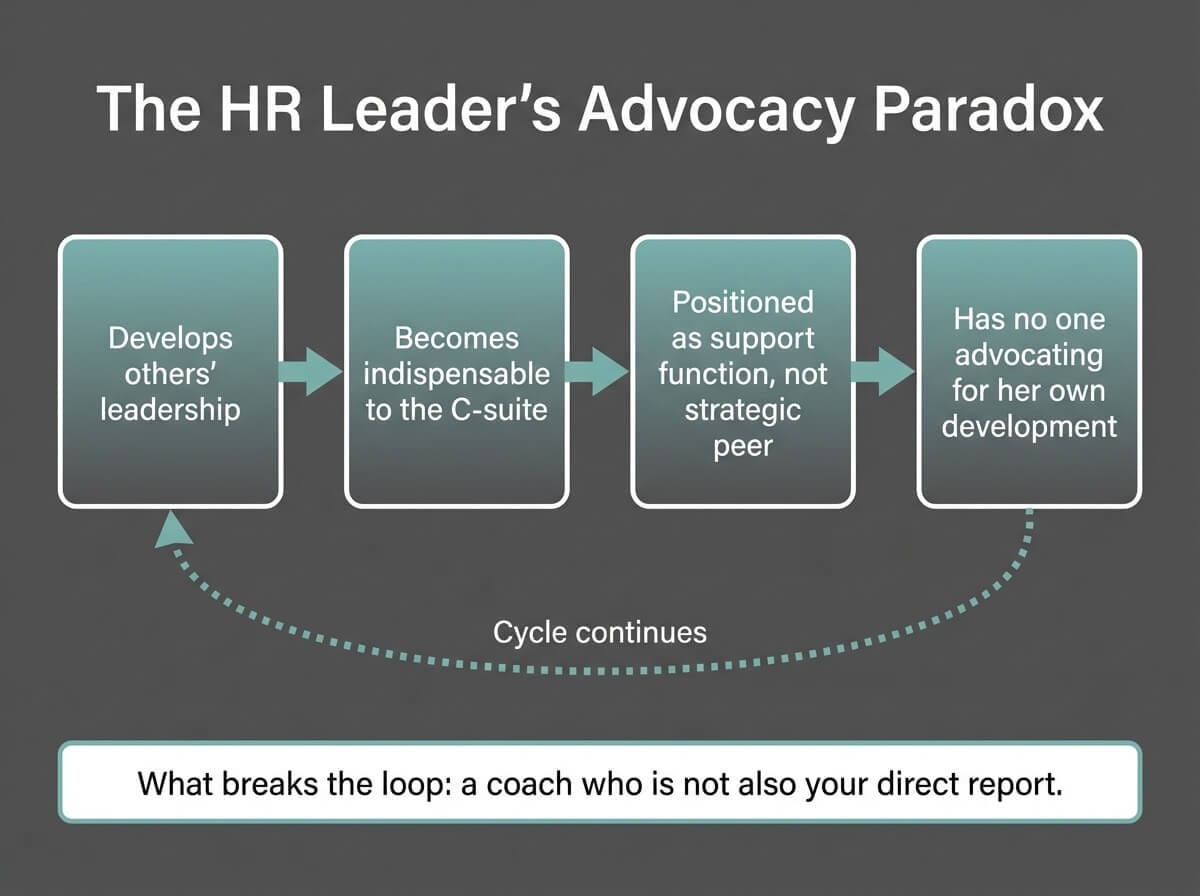
And here is the structural irony nobody names. You are the function that builds development for everyone else. You commission coaching for the CEO. You design leadership programs for the senior team. You create mentoring infrastructure for high-potentials. You are everyone’s coach and nobody’s priority. The person the entire organization comes to for development has no development infrastructure for themselves. That is not an oversight. It is the pattern completing itself. The advocacy identity defines worth through being needed, and asking for help feels like a contradiction of the professional self that everyone depends on.
Cycle diagram showing how HR leaders develop others into leadership while ending up without anyone advocating for their own advancement
What Changes When Your Coach Gets This
Consider an HR leader who tells their coach: “I can’t get the executive team to see HR as a strategic function. They treat us like a support function and it doesn’t matter how much data I bring.”
A coach working from a generic leadership playbook hears a positioning problem. They offer stakeholder management advice: build a business case for HR initiatives, present data on talent ROI, get a sponsor on the executive team. Useful, perhaps. But it misses the pattern underneath.
A coach who understands what a career in HR does to a person hears something different. They recognize a specific structural dynamic: a leader whose relational depth is both the source of their unique insight and the lens that prevents the room from hearing it as strategic. The coaching question is not “How can you position HR more strategically?” It is: “You see the people dimension that nobody else in that room sees. How do you translate that into language the board can act on?”
That question does not teach positioning skills. It surfaces the currency translation and the identity challenge embedded in making that shift. The CHRO does not lack strategic thinking. They lack the habit of expressing what they already know in the denomination the room trades in. The relief is specific: “I don’t need to become more strategic. I need to translate what I already see.” That is a fundamentally different starting point than “I need to be less of a people person and more of a business person,” which is what most coaching conversations for HR leaders accidentally become.
ℹ
Note
The difference between these two coaching approaches is not technique. It is whether the coach understands that people advocacy is a formation-level value system built over decades, not a “soft skill” that needs to be balanced with “hard skills.” Telling an HR leader to be tougher is like telling a CFO to care less about the numbers. It misreads the architecture.
Or consider the moment a coach says: “You need to stop being the people pleaser and make tougher calls.” The CHRO hears: your values are a weakness. Everything your career was built on is the problem.
A different coach says: “The tension between people advocacy and business alignment is not a weakness in you. It is the tension your function lives inside every day. When those two pull in opposite directions, how do you decide which way to go?” The distinction matters. One asks the client to abandon their identity. The other names the structural tension and invites the client to develop a more deliberate relationship with it. Not “stop caring about people” but “your people insight is the one dimension nobody else in that room can see. The question is whether you are spending it as individual trust, one conversation at a time, or converting it into strategic currency at the enterprise level.”
The CHRO who hears that question does not feel diagnosed. They feel recognized. The advocacy is honored. The ceiling is named. And the path forward builds on what they are rather than asking them to become someone they are not. That identity shift is the difference between coaching that feels like criticism and coaching that feels like expansion.
You have spent your career being the person everyone comes to. The empathy, the trust, the ability to read what is happening beneath the surface. That is real, and it got you here. It is also the reason you keep being consulted after the decision is made instead of before.
What changes is not the advocacy itself. It is whether advocacy stays the whole building or becomes the foundation you build on. Whether the person who understands people better than anyone in the C-suite gets to shape how the organization invests in its human capability at the enterprise level. That shift does not require you to stop caring. It requires a different denomination for the caring you already do.
If you recognized yourself in this article, that recognition is the starting point. The patterns your career installed are specific, predictable once understood, and workable once named. The next step is a conversation with someone who understands what a career in HR does to a person: the advocacy identity, the currency that stops converting, the structural invisibility of being everyone’s coach and nobody’s priority. That conversation is available whenever you are ready for it.
Frequently Asked Questions
Why do CHROs get feedback to ‘be more strategic’ when they already are?
The translation problem is linguistic, not conceptual. CHROs already think commercially: they know a failing talent pipeline destroys strategy, that culture problems in engineering are a retention time bomb, that the leadership bench is thinner than the succession plan claims. The gap is that they say it in the language of empathy and advocacy when the board trades in the language of value creation and competitive advantage. Same insight, different denomination.
What changes when an HR career reaches the C-suite?
At the manager level, the currency is employee trust. At the director and VP level, the currency shifts to organizational development and systems thinking. At the C-suite, the currency is culture architecture: workforce strategy in enterprise-value language, framing how human capital decisions drive competitive advantage. CHROs who still lead with people programs and engagement scores when the board needs a strategic partner have brought the wrong currency to the boardroom.
How is coaching for HR leaders different from general executive coaching?
A coach working from a generic playbook hears ‘I cannot get the executive team to see HR as strategic’ as a positioning problem and offers stakeholder management techniques. A coach who understands what a career in HR installs recognizes a specific structural dynamic: a leader whose relational depth is both the source of their unique insight and the lens that prevents the room from hearing it as strategic. The coaching question becomes how to translate that insight into language the board can act on, not how to be less of a people person.
Why are operations leaders invisible until something breaks?
Operations leaders define success as the absence of failure. When the system runs without drama, there is no signal the room can read. Peak performance produces the lowest organizational visibility because the greatest contributions are things that did not happen. The career installs a professional identity with no natural language for what it accomplished.
The weekly sync is ten minutes old and already winding down. Across the table, the CEO is scrolling through next quarter’s innovation priorities. You are sitting on a quarter where you rerouted an entire supply chain after a primary vendor collapsed, rebuilt the deployment pipeline when the old one started dropping orders during peak season, and navigated a warehouse staffing crisis that should have shut down fulfillment for a week. Zero customer impact. Zero revenue loss. Zero headlines. The CEO looks up: “Good quarter. Clean. Let’s talk about the innovation rollout timeline.” You nod and pull up the project plan. You do not mention that the reason the innovation team has a functioning infrastructure to innovate on is because you rebuilt it last month at two in the morning.
Operations is noticed when something breaks. This quarter, nothing broke. So you are invisible. And when the CEO asks the leadership team who is driving the company forward, your name does not come up. Because the answer to “what did you accomplish this quarter?” is “nothing went wrong,” and that is not a story anyone tells.
If you have spent fifteen or twenty years in operations and that silence lands somewhere deeper than your head, this article is for you. Not because you need to learn to speak up. Because the patterns your career installed are producing exactly this result. And the room you are sitting in now rewards a different kind of signal than the one your formation knows how to send.
Key Takeaways
A career in operations doesn’t just teach systems thinking. It installs a specific relationship with invisibility, accountability, and self-worth that defines success as the absence of failure.
The reliability that earned your credibility as a director is the same thing creating a ceiling in the C-suite. The strength and the limitation are the same pattern.
The shift from running the organization to designing it is not about “being more strategic.” It is about recognizing that a career built on invisible excellence now requires a new kind of signal.
A coach who understands what a career in operations does to a person will ask different questions than one working from a generic leadership playbook.
What a Career in Operations Installs
You didn’t just learn to think in systems. Systems became how you see the world. Process flows, dependencies, bottlenecks, throughput. Somewhere between your first capacity plan and your hundredth post-mortem, the ability to map how things work fused with your sense of self so completely that the two became indistinguishable. When the system runs, that’s you. When it breaks, that’s also you. Self-worth lives in operational excellence, and operational excellence is defined by what doesn’t happen. The crisis that was prevented. The outage that was avoided. The quarter where nothing went wrong because you made sure of it.
When someone says “you need to take more credit for your work,” they think they are offering helpful advice. You hear them asking you to perform rather than produce. Because your career defined success as the absence of signal. Visible self-promotion violates the code. The people who brag about their contributions are the people whose contributions require explanation. Yours shouldn’t.
Your greatest contributions are things that didn’t happen. That is an extraordinary professional achievement and a terrible communication strategy.
Your career also trained you to read one signal channel with continuous precision: whether things are running. System uptime. SLA compliance. Process throughput. You can tell at any moment whether the operation is healthy. But there is a channel you were never trained to read: whether your strategic perspective is valued. Whether leadership sees you as an operator or an architect. Your default interpretation when you are excluded from strategy conversations: “I’m too busy running things.” The alternative reading, that you haven’t made your strategic thinking visible because your formation trained you that visibility is the opposite of value, doesn’t occur.
Notice how you process a room. You catch process dependencies and bottlenecks before anyone else speaks. You map flows end to end. What counts as evidence: process metrics, SLA data, throughput numbers. What doesn’t count: aspirational timelines, untested assumptions, the product team’s optimistic resource estimate. When someone says “execution is too slow,” you hear “we need to optimize the process.” It rarely occurs to you that the process is fine and the strategy it serves is wrong. Your career trained you to fix the machine. Not to question whether the machine is building the right thing.
And then there is the accountability trap. Your authority is structurally paradoxical: direct authority over execution, advisory over strategy. You are accountable for the downstream results of upstream decisions you did not make. When product ships late, operations absorbs the impact. When sales overpromises, operations delivers on a commitment someone else made. When finance cuts mid-quarter, operations loses the resources for work already underway. Your career trained you to absorb these failures quietly and fix them, because that is operational excellence. It also means your professional life has been defined by cleaning up messes created by functions that get more strategic credit than you do.
Where Reliability Becomes a Ceiling
Career Level
Currency
What Earns Standing
The Identity
IC / Manager
Process excellence
Reliability, efficiency gains, SLAs met, fires put out fast
“I make things run”
Director / VP
Cross-functional orchestration
Scaling systems across business units, leading change management, aligning operations with business strategy
“I make things run at scale”
C-Suite
Organizational architecture
Org design, transformation leadership, operating model innovation, deciding how the company works
“I design how the organization works”
Every career level has a currency. As a manager and early director, yours was process excellence and reliability. You kept things running. You hit SLAs. You optimized for efficiency and built contingency into every plan. “I make things run” was both your reputation and your identity. It worked.
At director and VP, the game changed. The currency became cross-functional orchestration: scaling systems across business units, coordinating between functions that each think their timeline is the only one that matters, leading change management rather than optimizing the current process. “My process” must become “the organization’s operating model.” But you kept optimizing individual processes rather than designing cross-functional systems. Kept being the person who fixes things when they break rather than the person who builds resilience so things break less. Kept defining success by SLA compliance when the new level defined success by organizational capability. The gap showed up as feedback you could not quite decode: “think more strategically.”
At the C-suite level, the game changes again. The board does not want your operational metrics. They want organizational design. Transformation leadership. Operating model architecture. The COO who keeps the trains running perfectly but never questions where the tracks go has reached the ceiling of the old currency. The shift requires you to stop scaling what exists and start designing what the organization needs to become. That often means dismantling systems you built and are proud of. Operational excellence is the floor, not the destination.
Under pressure, the pattern hardens. More processes. More checkpoints. More standard operating procedures. “I make things work” becomes “I control how things work.” You monitor more intensely. Dashboards hourly instead of daily. Status reports that nobody reads but you cannot stop producing. You tighten execution, add approval layers, volunteer for more operational scope to prove indispensability. The pattern that defines you amplifies. It looks like leaning into your strengths. It burns out the person maintaining the currency while the room quietly concludes that you are an exceptional operator who is not ready for the strategic conversation.
The Voice the Room Doesn’t Hear
The leadership team is discussing the three-year strategy. Each function presents their vision. Technology talks about platform evolution. Marketing talks about market positioning. Finance talks about capital allocation. When it is your turn, you talk about operational capacity to deliver on the vision. The CEO nods and moves on. You provided the most realistic assessment in the room, the one that actually accounts for whether the organization can execute what everyone else imagined, and it registered as logistics, not strategy. Nobody asked “What should we build the organization to become?” They asked “Can you deliver what we’ve decided?”
The career that trained you to be invisible is now asking you to be visible. And every piece of executive presence advice feels like it was written for someone whose success is measured by how much noise they make, not how little.
You have long-horizon capability that nobody knows about. You resist long-term strategic planning not because you cannot do it, but because experience taught you that long-term plans are the first casualty of other functions’ failures. You have watched three-year infrastructure investments get cut mid-quarter because sales missed a number. You have seen transformation roadmaps dismantled when a new CPO arrives with a different vision. So when the CEO asks for your ten-year view, you give a cautious answer. Not because you lack vision. Because every time you have invested in a long-horizon idea, someone else’s short-term crisis has overwritten it. The caution is not a weakness. It is earned.
And here is the paradox nobody names. Your career trained you to succeed in silence. Systems that work without drama. Problems solved before anyone notices. Quiet reliability as professional identity. And then the organization asks you to have executive presence and strategic voice. The skills that made you promotable, invisible excellence, operational discipline, the 2 AM rebuild nobody knows about, are the opposite of what gets rewarded in the room you now sit in. The room wants articulation, vision, strategic narrative. Your formation trained you to produce results, not to narrate them. And the gap between producing and narrating is not a communication skill. It is a structural contradiction between what your career installed and what leadership now requires.
What Changes When Your Coach Gets This
Consider a COO who tells their coach: “I never get the recognition I deserve. The biggest wins of my career are things nobody saw.”
Matrix diagram illustrating the operations visibility paradox where peak performance produces the lowest organizational visibility
A coach working from a generic leadership playbook hears a visibility problem. They offer personal branding advice: how to communicate your contributions, how to tell the story of your impact, how to make your work visible to leadership. The COO hears: stop producing and start performing.
A coach who understands what a career in operations does to a person hears something different. They recognize a structural paradox: this leader’s entire career defines success as the absence of signal. Asking them to “make contributions visible” is asking them to violate the professional code their career was built on. The coaching question is not “How could you be more visible?” It is: “Your success is defined by things not happening. How does anyone, including you, know when you are doing exceptional work versus adequate work? What is the difference signal?”
That question does not ask for self-promotion. It asks the COO to develop a new kind of signal, one that registers impact without requiring them to perform visibility in a way that feels inauthentic. Not “tell people how great you are” but “build a language for operational contribution that the room can actually hear.” The distinction matters because the first approach makes the COO feel like a fraud. The second one builds on the operational identity rather than asking them to abandon it.
ℹ
Note
The difference between these two coaching approaches is not technique. It is whether the coach understands that operational excellence is structurally invisible, and that asking an operations leader to self-promote is asking them to betray the very instinct that made them excellent.
Or consider the moment a coach says: “You need to carve out time for strategic thinking. Work on the business, not in the business.” The COO hears time management advice. Delegate more. Say no. Create a “strategic block” on the calendar. Useful perhaps, but it misses what is actually happening.
A different coach hears the COO say “the CEO wants me to think more strategically but I’m too busy keeping things running” and recognizes something specific. Not a time management problem. A learned defensiveness. This leader has long-horizon capability. They resist it because their experience taught them that long-horizon plans get overwritten by other functions’ short-term crises. The resistance is earned, not innate. The coaching question: “You’ve seen long-term plans fail when other functions export their problems into your timeline. What would a long-horizon plan look like that accounts for that reality instead of pretending it won’t happen?”
That question honors the operational reality rather than dismissing it. It does not say “think bigger.” It says “build strategy that is as resilient as your operations—strategy designed to survive the chaos your career taught you is always coming.” The COO does not need permission to be strategic. They need a way to be strategic that does not require them to pretend the organization is more stable than they know it to be.
The difference between those two approaches is whether the coach understands what twenty years of absorbing other functions’ failures actually does to a person’s relationship with the long term. A coach who gets this will not try to fix your caution. They will help you see it as earned wisdom that needs a new expression, not a limitation that needs to be overcome.
That systems mind served you. It kept the organization running when everything around it was breaking. It built the infrastructure that everyone else’s strategy depends on. It is also the reason the room sees you as the person who keeps the lights on rather than the person who decides where the building goes.
What changes is not the operational excellence. It is the relationship between running the organization and designing it. Whether the person who knows how things actually work gets to shape what they become. That shift does not require you to become someone louder, more political, more visible in the way your formation finds inauthentic. It requires a different kind of signal, one the room can hear without asking you to stop being the person who rebuilt the infrastructure at two in the morning.
If you recognized yourself in this article, that recognition is the starting point. The patterns your career installed are specific, predictable once understood, and workable once named. The next step is a conversation with someone who understands what a career in operations does to a person: the systems identity, the accountability trap, the invisibility. Someone who can help you build on it rather than apologize for it. That conversation is available whenever you are ready for it.
Frequently Asked Questions
Why do COOs so often feel overlooked even after a strong quarter?
Operations gets noticed when something breaks. When nothing breaks, there is no signal, which means peak performance produces the lowest organizational visibility. A career in operations installs a professional identity built on preventing failure, and that identity has no natural language for describing what it accomplished.
What does ‘think more strategically’ actually mean at the C-suite level?
At the director and VP levels, the currency is cross-functional orchestration. At the C-suite, it shifts again to organizational architecture: org design, transformation leadership, and decisions about how the company works. ‘Think more strategically’ is feedback that the old currency of process excellence and reliability is no longer sufficient, and the room has started accepting a different one.
How is coaching for a COO different from generic leadership coaching?
A generic playbook treats the COO’s invisibility as a personal branding problem and recommends communicating contributions more visibly. A coach who understands operations recognizes that the COO’s entire career defines success as the absence of signal, so asking them to self-promote asks them to violate the professional code their formation was built on. The more productive question is how to build a language for operational contribution that registers impact without requiring them to perform visibility in a way that feels inauthentic.
Why do legal leaders lead differently and what are the costs?
Legal training rebuilds cognition itself – adversarial reasoning stops being a technique and becomes the definition of rigorous thought. Legal leaders identify every risk before others finish their opening sentence, dismiss gut instinct as insufficient evidence, and define success as exposure prevented. The cost: colleagues stop including them in strategic discussions, and their greatest contributions are things that never happened.
The acquisition conversation happened last Tuesday. You find out Thursday, in your one-on-one with the CEO, when she mentions it in passing: “The team felt good about the direction. We’ll need your diligence before we go to the board.” You nod. You open your notebook. You do not say what you are thinking, which is: I could have told you three things about that target’s regulatory exposure that would have changed the conversation entirely. But you were not in the room. You are never in the room until after the direction is set. Your job begins when the decision has already been made and someone needs to make sure it doesn’t blow up.
If you have spent fifteen or twenty years in law and that scene lands somewhere deeper than your intellect, this article is for you. Not because something is wrong with your leadership. Because the patterns your career installed are doing exactly what they were designed to do. And the room you built your career to protect has learned to work around you.
Key Takeaways
Legal training doesn’t just teach analytical skills. It reshapes cognition itself. Adversarial reasoning stops being a technique and starts being how you define intelligence.
Your greatest contributions are things that didn’t happen. The crisis averted, the exposure caught, the liability that never materialized. That invisibility is structural, not a communication problem.
The shift from risk prevention to strategic counsel is not about being “less legal.” It is about pointing the adversarial lens at pathways, not just at risks.
Advisory-track power means your counsel can be heard and then ignored. That structural dynamic creates a specific kind of leadership anxiety that generic coaching rarely names.
A coach who understands what a legal career does to how a person thinks will redirect the adversarial mind rather than trying to soften it.
What Legal Training Installs
You didn’t just learn to stress-test propositions. Adversarial reasoning became how you define smart. Somewhere between your first moot court argument and your thousandth contract review, the habit of finding the flaw in every position fused with your sense of intelligence so completely that the two became inseparable. When a colleague says “try being less adversarial in leadership meetings,” they think they are offering feedback. You hear something closer to: think worse. Because in your formation, the ability to dismantle a proposition is not a style. It is the standard for rigorous thought.
This is the highest identity rigidity of any professional background. Higher than finance’s attachment to precision. Higher than technology’s attachment to building. A financial leader told to “worry less about the numbers” can intellectually separate the skill from the self, even if the separation is painful. A legal leader told to “stop playing devil’s advocate” cannot locate the line between the technique and their own cognition. The technique is the cognition. Legal training didn’t give you a tool. It rebuilt how you think.
When someone asks you to be less adversarial, they think they’re asking you to change a behavior. You hear them asking you to be less intelligent.
Your signal environment compounds the problem. Silence equals success. You know when something went wrong. You track case outcomes, compliance status, regulatory actions. But the channel that tells you how you are experienced as a colleague and leader goes unread. Whether people bring you problems early because they trust you, or late because they want to limit the conversation. Whether the room treats your input as counsel or as obstacle. Your default interpretation when you are excluded from a strategic discussion: “They didn’t understand the risk.” The alternative reading—that they experienced your presence as the thing that turns every exploration into an audit—doesn’t surface, because your signal attunement was trained on liability detection, not on how you land in a room.
Notice how you process a conversation. Exposure and liability register before anyone else has finished their opening sentence. You construct arguments from precedent. What counts as evidence: documented authority, verifiable legal analysis, established case law. What does not count: instinct, gut feeling, the CEO’s read on the market. Your formation dismisses that as insufficient evidence. What you may not see is that your own pattern recognition—the thing you dismiss as “just a hunch”—is built on decades of case analysis running faster than a brief. It is evidence. It just doesn’t come with footnotes.
Diagram comparing what legal training installs against what C-suite leadership requires, illustrating the gap between protection and direction
And then there is your relationship with risk. Risk, to you, is exposure to be identified and eliminated. Not quantified, as it is for your CFO. Not tested and iterated against, as it is for your CTO. Eliminated. Prevented from materializing. Your formation was built on preventing harm. Every “no” is an act of protection rooted in real liability analysis. The organization sees a gatekeeper. You see a guardian. Both readings are accurate. Neither is complete.
Where Protection Becomes a Ceiling
Every career level trades in a different currency. What earned your standing as an associate and senior counsel is not what earns it now, and the shift happened without anyone telling you the exchange rate had changed.
Career Level
Currency
What Earns Standing
The Posture
IC / Senior Counsel
Airtight reasoning
Risk identification, thoroughness, catching exposure before it materializes
“I find the problem before it finds us.”
Director / VP
Risk prioritization
Business partnership, deciding which risks matter, navigating rather than blocking
“I help the organization navigate complexity with confidence.”
As an associate and senior counsel, every risk you flagged was proof of value. Every exposure caught early was a contribution. “I find the problem before it finds us” was both your reputation and your self-concept. It worked.
At director and VP, the game changed. The currency became risk prioritization: not finding every risk, but deciding which ones matter. Helping the business take smart risks rather than preventing all risk. But you kept cataloging every possible exposure without ranking them. You kept writing memos that documented liability rather than recommending a path forward. You defined success as “I identified the problem” when the new level defined success as “I helped navigate through the problem.” The shift is similar to what analytical leaders in other functions encounter, but the legal version has a specific edge: you were trained to believe that missing a risk is malpractice. Prioritizing means accepting that some risks will go unaddressed. That feels, to your formation, like professional negligence.
At C-suite level, the game changes again. The board does not want your risk assessment. They want strategic counsel. Organizational risk appetite. Board governance. How the institution navigates regulatory and competitive complexity as a whole. That shift—from best lawyer in the room to best strategic counselor in the room—requires you to spend a currency you have never fully trusted: judgment that goes beyond what the case law can justify. The CLO who still builds the legal analysis personally rather than trusting the team’s analysis and adding strategic perspective on top has brought the wrong currency to the boardroom.
ℹ
Note
The gatekeeper-to-enabler-to-strategist progression is not about becoming less rigorous. It is about expanding what rigor gets applied to. At IC level, rigor means finding every risk. At C-suite, rigor means determining which risks the organization should accept, which it should mitigate, and which it should ignore entirely. The analytical engine is the same. The target changes.
Under pressure, the adversarial thinking intensifies rather than flexes. “Let me play devil’s advocate” becomes exhausting for colleagues who have heard it in every meeting for three years. Risk language escalates: what was “moderate risk” becomes “significant exposure.” Memos get longer and more conservative. You block more initiatives, expand compliance documentation. “I can’t approve this” replaces “Here’s how we could structure this.” The cognitive style that defines your identity runs at higher speed and volume until it becomes the thing isolating you from the very decisions you should be shaping.
The Room You’re Not In
You keep providing counsel nobody asked for. The CEO shares an early-stage idea in a hallway conversation. You immediately identify three regulatory exposures and a potential contractual conflict. The CEO stops sharing early-stage ideas with you. Not because they don’t respect your legal judgment. Because every exploratory conversation becomes a risk assessment. You were right about the exposures. And now you learn about strategic initiatives from the board deck, not from the conversation where you could have shaped them.
You were right about the risk. And now you learn about the strategy from the board deck.
Your cross-functional peers have developed a specific cadence around you. They bring you in late, after the direction is set, with a narrow request: “Tell us if this is going to be a problem.” They do not ask “How should we think about this?” because experience has taught them that the question will produce a comprehensive risk memo rather than a navigable recommendation. The door that is closed to you is not locked by politics or disrespect. It is locked by pattern: every time you enter a conversation, the conversation becomes about what could go wrong.
The feedback you keep receiving is some version of “be a strategic partner.” What nobody tells you is that “strategic” for a legal leader does not mean thinking bigger about risk. It means offering a pathway, not just a warning. It means sitting in a room where the decision has already been made and finding the way to make it work within legal constraints, rather than explaining why it should not have been made. The hardest shift: your formation trained you to protect the organization by saying no. The new level needs you to protect the organization by saying “yes, and here is how.”
This is not the same as the COO’s invisibility, where operational excellence becomes the background hum that nobody notices. Your invisibility has a sharper edge. Your greatest contributions are things that did not happen. The crisis that was averted. The exposure that was caught before it materialized. The contract clause that saved the company eight figures in a dispute three years later. And then the organization asks you to demonstrate strategic value in a language that only recognizes what did happen. You are being measured in a currency your function was designed not to produce.
💡
Tip
The question is not whether you have strategic value. It is whether the room can access it. If every conversation you enter becomes about what could go wrong, the organization will route around you to have conversations about what could go right. Not because they are reckless. Because they need space to explore before they need space to evaluate.
What Changes When Your Coach Gets This
Consider a General Counsel who tells their coach: “They keep making decisions without consulting me, and then I have to clean up the legal mess.”
A coach working from a generic leadership framework hears a stakeholder management problem. They offer relationship-building techniques: how to position yourself as approachable, how to frame legal input as supportive rather than obstructive, how to get invited to the table earlier. Potentially useful. But it misses the formation underneath.
A coach who understands what a legal career does to how a person thinks hears something different. They recognize a specific structural dynamic: an advisory-track leader whose cognitive mode—adversarial reasoning—is so deeply installed that it shapes every interaction, including the ones where the GC is trying to be collaborative. The coaching question is not “How could you be more approachable?” It is: “Your ability to stress-test propositions is rare. What would it look like to apply that same skill to finding pathways rather than finding risks?”
That question does not teach stakeholder management. It takes the GC’s strongest capability—the adversarial lens—and redirects it. Instead of using it to find what is wrong, use it to find what could work. Instead of stress-testing the proposition to destruction, stress-test the pathway to viability. The identity stays intact. The application expands. The GC does not have to become less rigorous. They have to become rigorous about something new.
They are not asking you to think less. They are asking you to point that thinking somewhere new.
Or consider a second moment. The GC tells their coach: “I never get credit for the work I do. The biggest wins in my career are things nobody knows about.”
A generic coach hears a visibility problem. They offer self-promotion techniques: how to communicate contributions, how to frame risk prevention as value creation, how to make invisible work visible. For a legal leader, this advice lands as a request to perform rather than produce—a fundamental violation of how their formation defines excellence.
A coach who understands the legal formation hears the structural paradox: this leader’s success is literally defined by the absence of signal. Silence equals success. The signal environment is negative-only. The coaching question shifts entirely: “Your success is defined by things not happening. How do you distinguish between ‘everything is running fine’ and ‘I am doing exceptional work that nobody can see’?” That question does not ask them to self-promote. It helps them develop a new signal channel—one that can register their own impact without requiring them to perform visibility in a way that contradicts everything their career taught them about what excellence looks like.
The difference between those two approaches is not technique. It is whether the coach understands what twenty years of legal practice actually does to how a person thinks, what they dismiss, and what they cannot see about their own effect on a room. That distinction shows up in what the coach hears underneath the presenting complaint.
That adversarial mind served you. It caught the exposure nobody else saw. It built the argument nobody could break. It kept the organization safe when safe was what the organization needed most. It is also the reason the room goes quiet when you start talking. And the reason the strategy conversation happened on Tuesday without you.
What changes is not the reasoning itself. It is what you point it at. Whether the lens that finds every risk can also find the pathway through. Whether the mind that was trained to protect by preventing can learn to protect by enabling. That shift does not require you to become someone different. It requires you to become more of what you already are, applied to a question your formation never trained you to ask: not “What could go wrong?” but “What could go right, and how do we get there safely?”
If you recognized yourself in this article, that recognition is the starting point. The patterns your legal career installed are specific, predictable once understood, and coachable once named. The next step is a conversation with someone who sees those patterns clearly and knows the difference between redirecting a strength and trying to remove it. That conversation is available whenever you are ready for it.
Frequently Asked Questions
Why do C-suite colleagues route around the General Counsel on strategic decisions?
The pattern is structural, not political. When every exploratory conversation with the GC becomes a risk assessment, colleagues learn to bring legal counsel in late, after direction is set, with a narrow request to flag problems. The door closes because of repeated experience, not disrespect. The adversarial reasoning that defines legal competence reads to others as turning every exploration into an audit.
How is coaching for a General Counsel different from generic executive coaching?
Legal training rebuilds cognition itself; adversarial reasoning stops being a technique and becomes the standard for rigorous thought. A coach working from a generic leadership framework treats exclusion from strategic conversations as a stakeholder management problem and offers relationship-building techniques. A coach who understands legal formation works with the adversarial lens directly, redirecting it toward finding viable pathways rather than trying to soften or remove it.
What does the shift from legal counsel to strategic partner actually require?
At C-suite level the currency changes from risk identification to strategic counsel, which means determining which risks the organization should accept, mitigate, or ignore entirely. The analytical engine stays the same; the target changes. The hardest part for most GCs is that their formation defined protection as saying no, while the new level needs protection delivered as ‘yes, and here is how we structure this safely.’
How do I prepare for my next promotion?
The article does not address preparation before promotion, but it supports this: identify which currency your function rewards now and name the currency the next level demands. The gap between those two is your actual preparation work. Skills follow. The identity shift, releasing what currently defines your excellence, is what takes longest.
You got promoted because you were the best executor on the team. You shipped. You solved. You delivered. And now, six months in, your boss says “think more strategically” and you nod like you understand. On the drive home, you realize you have no idea what that means for someone whose entire career has been defined by getting things done.
The worst part: nobody can explain it. Not your boss, who got the same vague feedback a decade ago and figured it out through years of trial and error. Not your peers, who are navigating the same transition but won’t talk about it. You’re not failing. You’re succeeding at a game that ended two levels ago.
You are playing the previous game at a higher volume and wondering why the score stopped going up.
Key Takeaways
The director-to-VP transition is not a skill gap. It is an identity shift: the strength that earned the promotion becomes the constraint at the new level.
“Think more strategically” means something completely different depending on which function shaped you. For finance, it means tolerating ambiguity. For technology, it means abandoning the elegant solution. For operations, it means redesigning the system you optimized.
Every function has a currency that earns professional standing. At the VP level, the old currency still works within your function but no longer earns standing across functions or upward.
The transition feels exhausting because you are running two economies at once: maintaining enough of the old currency to stay credible while building a new one you don’t yet trust.
The people above you can’t explain the rules because the patterns their careers installed are invisible to them. They adjusted through trial and error without fully understanding what shifted.
What You Were Promoted for Is Not What You Were Promoted to Do
Every function experiences the same structural pattern: the strength that earned the promotion becomes the shadow at the next level. You were the best analyst, the best engineer, the best campaign manager, the best case builder. Now the job is different, but nobody gave you new rules. The old playbook didn’t fail because you stopped being excellent. It failed because excellence in the new role means something your old role never taught you.
The promotion rewarded you for a specific kind of excellence—then asked you to stop practicing it.
And “think more strategically” is the most common piece of feedback in corporate leadership and the least useful. Because it means something completely different depending on where you came from.
For someone from finance, strategic means tolerating ambiguity. Offering judgment when the model can’t give you a clean answer. Acting on 70% certainty when every instinct, every year of training, every performance review that rewarded you for catching the error others missed demands 95%. The discomfort isn’t intellectual. It’s physical. Presenting a recommendation you can’t fully prove feels like professional negligence to someone whose career was built on being right about the numbers.
For someone from technology, strategic means abandoning the elegant solution for the politically viable one. You can see the better architecture. You can explain why it’s better. And the room doesn’t care, because “obviously better” isn’t enough when you need buy-in from people who evaluate proposals on criteria your engineering training never taught you to read.
For someone from operations, strategic means accepting that the system you spent years optimizing is about to be redesigned. And you need to be the one redesigning it, not the one protecting it. The stability you built, the efficiency you earned, the reliability that nobody noticed because nothing broke: all of it might need to change. And your instinct to protect what works is the instinct you have to override.
For someone from marketing, strategic means connecting creative intuition to business outcomes at scale. Not better campaigns. A narrative about where the company plays and how it wins. The leap from “this work resonates with audiences” to “this is why the board should fund our market position” is a translation problem that nobody in your creative career prepared you for.
For someone from legal, strategic means deciding which risks to accept, which to mitigate, and which to ignore entirely. After a career spent finding every exposure, every gap, every vulnerability, the new role asks you to rank them and let some go. Deliberately. That feels like malpractice to someone whose value was defined by thoroughness.
For someone from HR, strategic means stopping being the go-to person for every individual issue and building systems that create trust at scale. The one-on-one relationships that made you indispensable are the same ones keeping you anchored at the wrong altitude.
The word “strategic” is the same. The work is not.
The Currency That Stopped Working
Every function has a currency. A specific form of professional value that the ecosystem recognizes and rewards. In technology, the currency is building things that work. In finance, being right about the numbers. In legal, preventing harm before it arrives. In marketing, making things that connect. In operations, keeping things running. In HR, being the person people trust.
You earned your way to this level by being excellent at your function’s currency. The problem is that the level you just entered trades in a different one. And nobody told you the exchange rate.
Function
What Earned the Promotion
What the New Level Demands
The Painful Shift
Technology
Shipping quality code
Architectural decisions, team output
Letting others build what you designed
Finance
Accurate analysis
Translating data into cross-functional insight
Leading with judgment, not models
Legal
Preventing risk
Enabling strategy within guardrails
Saying “here is how we can” not just “here is why we can’t”
Operations
Reliable execution
System design for scale
Accepting others will redesign your systems
Marketing
Creative execution
Portfolio strategy, attribution clarity
Defending ROI in the language of finance
The promotion didn’t change what you’re good at. It changed what “good” means.
The transition isn’t a clean swap. You can’t just stop spending the old currency. The VP of Engineering who stops reviewing architecture decisions loses the technical standing that gives her a voice in the room. The finance director who stops building models loses the precision credibility that earned his seat at the table. You still need the old currency to retain the credibility that got you here. But the old currency alone will not earn you standing at the new level.
That’s why letting go feels like losing control. You’re not choosing between the old work and the new work. You’re running both economies simultaneously, and the effort is relentless. Maintaining enough technical depth to stay credible with your team while building enough cross-functional influence to be taken seriously by your peers. Still delivering within your function while learning to translate your function’s value to people who measure success differently than you do.
That dual investment is why the transition feels like more work, not different work. And why working harder at the old game keeps producing diminishing returns. There is a predictable inflection point, usually around month four or five. You have been applying the old approach at higher volume: more hours, more intensity, more of the behavior that earned the promotion. And then the realization surfaces. The effort is not producing the results it used to. The one strategy you know, excellence through effort, has stopped compounding. You don’t have a second strategy. That inflection is where most rising leaders start asking whether something structural has changed. It has.
What the new level actually rewards is influence across functions, not personal output. Upward management, not execution. Translation, not doing the work. But the specific version of the new currency depends on where you came from. The finance leader needs to shift from “I see what others miss” to “I help others see what the numbers mean.” The technology leader needs to shift from “I solve hard problems” to “my team solves hard problems.” The legal leader needs to shift from “I find the problem before it finds us” to “I help the business take smart risks.”
Each of those shifts sounds simple on paper. None of them are. Because the old currency is not just a skill. It’s an identity. And the transition is not a skill problem. It’s a grief problem.
Why Nobody Explains the Rules
The patterns your career installed feel like intelligence, not training. The finance director who leads with data doesn’t think “I’m deploying my precision instinct.” She thinks “I’m being rigorous.” The technology leader who decomposes every problem into components doesn’t think “I’m running my systems logic.” He thinks “I’m being thorough.” The patterns are so fully integrated into how you think that they’re indistinguishable from who you are.
That’s why your boss can’t explain the rules. They figured them out the way everyone does. By bumping into the ceiling, adjusting, bumping again, and eventually operating differently without fully understanding what shifted. The transition knowledge they carry is tacit. It lives in their reflexes, not in anything they can hand you as a playbook.
The people above you aren’t withholding the rules. They can’t see them either.
“Think more strategically.” “Be more executive.” “Have more presence.” “Get out of the weeds.” These phrases proliferate because the people giving the feedback can see the symptom but not the cause. They can see that you’re operating at the wrong altitude. They cannot see that the patterns your function installed over ten or fifteen years are creating that mismatch. So the feedback stays vague, you try harder at the old game, and the gap widens.
The currency shift is function-specific. “Think more strategically” means tolerating ambiguity for a finance leader, abandoning elegant solutions for a technology leader, accepting system redesign by others for an operations leader. Generic leadership advice treats these as the same challenge. They are not.
And not everyone enters this transition at the same point. Some leaders have just been promoted and are still in the sharpest phase of the identity shift: “I was valued for what I personally produced. Now I’m valued for what others produce.” Some are past that initial crisis but struggling with scope: building through layers, making decisions with incomplete information because they can no longer be close enough to the work to verify it themselves. Some are navigating the political phase: representing their function to other functions, building cross-functional influence, learning to operate in rooms where technical expertise alone doesn’t determine the outcome.
Each phase has different pressure. Each phase reveals different limitations in the old playbook. And each phase is harder to navigate when you can’t name what’s actually happening. You end up solving for the wrong variable. The leader in identity crisis who takes a delegation course. The leader in the scope-expansion phase who hires an executive coach to work on “presence.” The leader in the political phase who doubles down on functional expertise when the room needs cross-functional translation. The fix keeps missing because the diagnosis was never accurate.
What Changes When Your Coach Gets This
Consider a VP of Engineering who tells her coach she’s struggling with delegation. A career coach hears “delegation” and provides a framework: what to delegate, when to delegate, how to follow up. Useful, maybe. But it treats delegation as a task management problem.
A coach who understands what a technology career actually does to a person hears something different. “You’re spending the only currency you know is reliable. Technical execution gives you immediate, unambiguous feedback. The code works or it doesn’t. The system handles the load or it breaks. Delegation gives you slow, uncertain feedback about other people’s judgment. The discomfort isn’t about control. It’s about moving from a currency you’ve mastered to one you can’t yet trust yourself to read.”
That reframe changes the conversation. The client stops trying harder at delegation techniques and starts examining what the old currency gave her that the new one hasn’t yet replaced. The answer is usually certainty. And the real work becomes: how do you lead when the feedback is slow and ambiguous and you can’t be close enough to the work to know whether it’s right?
Or consider a finance director whose boss tells him he needs “more executive presence.” A generic coach works on communication skills: how to structure a presentation, how to project authority, how to speak with more confidence. All reasonable.
A coach who understands what a career in finance installs recognizes a different pattern. “You’re still presenting like an analyst. Leading with what you want people to know rather than what you want them to feel. That isn’t a communication gap. It’s the precision instinct doing exactly what it was trained to do. The question isn’t how to present differently. It’s what it would mean for you to lead with judgment. To offer what you think, not just what you can prove.”
The finance director goes quiet. Because “offer what you think without proof” sounds, to someone whose entire career rewarded being right about the numbers, like being asked to be reckless. That tension is the coaching territory. Not presentation skills. Not executive presence as performance. The specific way a career in finance makes it genuinely threatening to lead with anything other than certainty.
The difference isn’t technique. It’s that the coach can name the thing underneath the frustration. And that naming is what turns a confusing transition into a recognizable one.
You didn’t fail the promotion. The promotion changed the game, and nobody told you the rules. The strength that got you here isn’t a weakness. It’s a foundation. But only if you can see where it ends and what comes next.
You have been telling yourself you need new skills. You probably do. But the harder adjustment isn’t learning something new. It’s releasing something old: the version of excellent work that your function defined for you years ago, the one that still feels like the only real measure of whether you’re doing a good job. The skills will come. The identity shift is the actual work.
That visibility, the ability to see the pattern your career installed and choose when to use it and when to set it aside, is what changes when someone who understands your specific transition is in the room with you. Not a career coach who teaches frameworks. Not a leadership program that treats every function the same. Someone who knows what “think more strategically” actually means for someone who came up through your world. If that distinction matters to you, here is what that conversation looks like.
Frequently Asked Questions
Why does ‘think more strategically’ feel so vague, even from people who’ve already made the transition?
Because they navigated the shift through years of trial and error without understanding what actually changed. The patterns their career installed feel like intelligence, not training. So they can see that you’re operating at the wrong altitude but can’t identify the underlying cause or hand you a usable explanation.
Why does letting go of my old work feel like losing something, not just changing roles?
The old currency of accuracy, execution, and technical depth isn’t just a skill set. It’s the identity your function built over years of performance reviews and recognition. Releasing it feels like grief because it is: you’re being asked to stop practicing the specific form of excellence that defined your professional standing.
What does running ‘two economies at once’ actually look like day to day?
You still need enough of the old currency to stay credible within your function. The engineering VP who stops reviewing architecture decisions loses the technical standing that gives her a voice. At the same time, you’re building cross-functional influence and learning to translate your function’s value to people who measure success differently. The effort is relentless because neither economy can be abandoned while you’re in transition.
How can financial rigor become a leadership ceiling?
Financial rigor becomes a ceiling when the room shifts currency. Precision earns standing as an analyst. Judgment earns it in the boardroom. The CFO still building the analysis personally instead of adding strategic interpretation has brought the wrong currency to the right room. Strength and limitation are the same pattern.
The board meeting ended forty minutes ago. You are on the train home, scrolling through the same forty-slide deck for the third time. Every assumption documented. Every sensitivity tested. Three scenarios with probability weights. The analysis was airtight. And the board went with the CEO’s instinct.
You are not looking for the error. You already know there isn’t one. You are trying to understand how a perfect deck became a liability. How you won the argument on the facts and lost the room on something you can’t quite name. The numbers were right. They have always been right. That used to be enough.
If you have spent fifteen or twenty years in finance and that scene lands in your chest rather than your head, this article is for you. Not because something is wrong with you. Because the patterns your career installed are doing exactly what they were designed to do. And the room changed.
Key Takeaways
A career in finance doesn’t just teach analytical skills. It installs a specific relationship with precision, evidence, and risk that becomes part of how you define yourself as a professional.
The rigor that earned your credibility as an analyst is the same thing creating a ceiling in the boardroom. The strength and the limitation are the same pattern.
The shift from analyst to strategist is not about acquiring “soft skills.” It is about recognizing that the currency that earned your seat has changed, and building on what you already have rather than abandoning it.
A coach who understands what a finance career does to a person will ask different questions than one working from a generic leadership framework.
What a Career in Finance Installs
You didn’t just learn to be precise. Precision became who you are. Somewhere between your first variance analysis and your hundredth board deck, accuracy fused with self-worth so completely that the two became indistinguishable. When someone says “worry less about the numbers,” they think they are offering practical advice. You hear them challenging your intelligence. Because in your world, the numbers are not a tool you use. They are the reason you are in the room.
Precision is not something you do. It is something you became.
Your career also trained you to read one signal channel with extraordinary fidelity: were the numbers right? Forecast accuracy. Audit outcomes. Budget variance. You can tell within basis points whether your work landed. But there is another channel you were never trained to read: how you are experienced as a collaborator. Whether people seek your input or avoid it. Whether the room leans in when you speak or braces for a forty-minute walkthrough of the model. Your default interpretation when something goes sideways in a meeting: “They don’t understand the data.” It rarely occurs to you that the data is not the problem.
Notice how you process a room. You catch cost implications and margin impact before anyone else speaks. You organize what you hear into scenario models. What counts as evidence: verifiable data, auditable methodology. What doesn’t count: hunches, narratives, the CEO’s gut feeling about market direction. Your career trained you to see what others miss. It also trained you to miss what others see. The emotional undercurrent your analytical precision creates in the people around you sits outside your frame entirely.
And then there is your relationship with risk. Risk, to you, is variance from forecast. Uncertainty is something you manage by making it legible, by modeling it until it becomes a number you can work with. This is not personality. This is the professional adaptation of someone who has been rewarded, for their entire career, for making the unknown quantifiable. When someone asks you to “get comfortable with ambiguity,” they are asking you to let go of the thing that has kept you safe and valued for twenty years. No wonder it feels dangerous.
There is also what finance did to your sense of time. You think in quarters. Monthly close is the heartbeat. Three-to-five-year scenario models sit in the background, but the quarterly reporting cycle anchors everything. You maintain multiple probabilistic futures simultaneously, which is a genuine form of strategic thinking. But the board does not see it that way. What they see is someone who seems fixated on this quarter’s results when they are asking about the next three years. The planning horizon is there. The language you use to express it keeps collapsing into the reporting cadence, and the reporting cadence sounds operational, not strategic.
None of this is a flaw. Every one of these patterns served you. They got you promoted, got you trusted, got you into the room where capital allocation decisions are made. The question is not whether they are strengths. They are. The question is what happens when the room starts asking for something your strengths were never designed to deliver.
Turning data into cross-functional insight, making the numbers mean something to non-finance peers
Enabling decisions beyond your own function
C-Suite
Judgment
Capital allocation wisdom, risk appetite framing, strategic narrative about where the business is heading
Shaping the bets the organization makes
Every career level has a currency. As an analyst and early manager, yours was accuracy. You caught errors others missed. You built models that held up under scrutiny. “I see what others miss” was both your reputation and your self-concept. It worked.
At director and VP, the game changed. The currency became translation: turning data into insight for people who do not read spreadsheets. Making the numbers mean something to the CMO, the head of product, the CEO. But you kept leading with the model. You kept presenting forty slides when the room wanted three. You kept defining success as “the forecast was accurate” when the new level defined success as “the forecast changed a decision.” You were spending old currency at a level that traded in something else, and the gap showed up as feedback you couldn’t quite decode: “be more strategic.” This is the moment the old playbook stops working, and nobody hands you a new one.
You kept spending accuracy in a room that had started trading in judgment.
At the C-suite level, the game changes again. The board does not want your analysis. They want your judgment. Capital allocation wisdom. Risk appetite framing. A compelling narrative about where the business is heading and why this bet, not that one. Strategy requires judgment and narrative, both of which feel imprecise and therefore dangerous to someone whose career was built on being right about the numbers. The CFO who still builds the analysis personally rather than trusting the team’s analysis and adding strategic judgment on top has brought the wrong currency to the boardroom. It is the same pattern that traps rising leaders who cannot let go, except at the C-suite level, the cost is not just your time. It is your standing. The deck is perfect. The room has already decided.
Under pressure, the pattern hardens rather than flexes. More decimal places. Longer analysis cycles. Additional validation steps. “The numbers aren’t clean enough yet.” You demand more data across every channel but only read the accuracy channel. You flood your team with requests for backup while ignoring the qualitative signals about trust, influence, and whether people want you in the room. The pattern that defines you amplifies. It looks like leaning into your strengths. It is also the formation-driven overextension that leads to burnout. Until it becomes the thing isolating you from the very peers whose buy-in you need.
The Arguments Nobody Asked You to Win
You keep winning arguments nobody asked you to have. You present irrefutable data to a room that was not having a data conversation. The CEO wanted to know whether the acquisition felt right. You showed them a DCF model with five scenarios. Both of you left dissatisfied.
Your cross-functional peers have stopped bringing you into conversations early. Not because they do not respect you. Because the precision lens turns every exploratory conversation into an audit. The CMO stopped sharing early-stage ideas with you after you responded to their brand investment proposal with a twelve-month attribution analysis. You were right about the attribution gap. And now you are excluded from the strategic conversations where influence actually lives.
ℹ
Note
This pattern is not about personality. Two finance leaders in different organizations will recognize the same dynamic because the formation itself produces it. It is specific enough to predict, general enough to name, and coachable once understood.
The feedback you keep getting is some version of “be more strategic.” Nobody tells you what that actually means for a finance leader. It does not mean thinking bigger. It means tolerating ambiguity. It means offering judgment when the model cannot give you an answer. It means sitting in a room where 70% certainty is enough to act and not insisting on 95%. It means the most valuable thing you could give the board is not the model itself but your read on what the model implies. And that feels like guessing. Which, in your formation, is the one thing you were never allowed to do.
Your career trained you to see what others miss. It also trained you to miss what others see.
This is not a skill gap. You do not need a presentation workshop or an influence bootcamp. What is happening is structural: the patterns that a career in finance installs are doing exactly what they were trained to do, in a room that has started asking for something different. The precision is not the problem. Your relationship with it is. And that distinction matters, because the path forward is not to become less precise. It is to recognize that precision is the foundation, not the whole building.
What Changes When Your Coach Gets This
Consider a CFO who tells their coach: “I can’t get the executive team to take my recommendations seriously.”
A coach working from a generic leadership framework hears an influence problem. They offer techniques: how to structure a persuasive presentation, how to build coalitions before the meeting, how to read the room. Useful, perhaps. But it misses what is happening underneath.
A coach who understands what a career in finance does to a person hears something different. They recognize a specific dynamic: a leader whose analytical depth is the barrier to influence, not the tool for it. The coaching question is not “How could you be more influential?” It is: “You built your career on being the most precise person in the room. What happens when precision alone is not what the room needs from you?”
That question does not teach influence skills. It surfaces the transition that matters: from accuracy to judgment. And it names the identity threat embedded in making that shift. Because for a finance leader, “lead with your judgment instead of your model” is not a minor adjustment. It asks you to offer something that cannot be audited, in a career where everything you have offered has been auditable. The question honors precision as the foundation while opening the possibility that the building needs another floor.
Or consider the moment a coach says: “Could you try leading with the story rather than the data?” The CFO hears: your strength is not enough.
A different coach says: “What would it look like to lead with the insight first and let the data support it, rather than the other way around?” The distinction matters more than it appears to. One asks you to abandon your identity. The other asks you to build on it. Not “tell stories instead of showing data” but “the most valuable thing you could give the board is your judgment about what the model implies, not the model itself.” That reframe does not threaten the precision. It elevates it. The data is still there. It moves from being the argument to being the evidence supporting a bigger argument: your strategic read on what the numbers mean.
The difference between those two coaching approaches is not technique. It is whether the coach understands what fifteen or twenty years in finance actually does to a person.
A coach who gets this will not try to fix your precision. They will help you see it clearly enough to build on it. They will know that “be more strategic” sounds different to a finance leader than it does to anyone else in the room. They will know that when you insist on more data before committing, you are not being rigid. You are requesting the level of evidence your career trained you to require before putting your name on something. The question worth exploring is not “why can’t you just decide?” but “what level of certainty do you actually need here? Is it 95%, or would 70% be enough? What is the cost of waiting for the last 25%?”
And they will know that the path from analysis to judgment is not a skill acquisition. It is a shift in what you allow yourself to offer when the model runs out of answers. That shift is specific to what finance installs. It is not the same transition a technology leader makes, or a legal leader, or an operations leader. Each of those careers creates its own version of the ceiling. Yours is the precision trap. And a coach who can name it without pathologizing it, who can honor what it built while helping you see where it ends, is a coach worth talking to.
That precision served you. It got you here. It is also the reason the room goes quiet when you talk for more than ninety seconds.
What changes is not the precision itself. It is the relationship you have with it. Whether it is the whole building or the foundation you build on. Whether you are the person who delivers the model or the person whose judgment the model supports. That shift does not require you to become someone different. It requires you to become more of who you already are, in a way the room can actually use.
If you recognized yourself in this article, that recognition is the starting point, not the destination. The patterns your career installed are specific, predictable once understood, and coachable once named. The next step is a conversation with someone who sees those patterns clearly. That conversation is available whenever you are ready for it.
Frequently Asked Questions
Why do CFOs struggle to be seen as strategic despite strong analytical skills?
The currency that earns standing in the C-suite is judgment, which includes risk appetite framing and narrative about where the business is heading. A career in finance trains leaders to lead with precision and evidence, which earned them credibility as analysts and directors. At the C-suite level, the board wants a read on what the model implies, and the model itself becomes secondary. The strength that built the career becomes the ceiling when the room has shifted to a different form of currency.
What does it mean when a CFO keeps ‘winning arguments nobody asked for’?
This happens when the precision lens is applied to conversations that were never about data. A CEO asking whether an acquisition ‘feels right’ is seeking strategic judgment, and presenting five DCF scenarios answers a different question entirely. Over time, cross-functional peers stop bringing CFOs into early-stage conversations because exploratory discussion turns into an audit. The result is exclusion from the informal strategic conversations where organizational influence actually operates.
How is coaching for CFOs different from general executive coaching?
A coach working from a generic leadership framework typically hears an influence problem and offers techniques around persuasion or coalition-building. A coach who understands what a finance career installs recognizes a specific formation: a leader whose analytical depth is functioning as the barrier to influence rather than the tool for it. The coaching work is less about skill acquisition and more about helping the leader see that their precision is the foundation. The building needs another floor built on judgment they are not yet allowing themselves to offer.