
Agile Team Coaching & ICF Credentials: Bridging the Gap
If you've facilitated fifty retrospectives, coached three Scrum teams through conflict, and helped a delivery organization redesign its workflow, you already know something about team dynamics. The question is whether you know it as a coach or as a facilitator. That distinction determines whether your next credential is an ICF certification or more facilitation practice.
Most agile coaches land somewhere in the middle. You've done real coaching work with teams. You've watched dynamics shift, helped people find their own solutions, stepped back when you wanted to step in. That instinct is valuable. But if you're honest with yourself, you've probably also spent more sessions running the process than sitting with what the team is avoiding.
The ICF team coaching credential pathway exists for people in exactly this position. Not beginners. Not career-changers. Practitioners who already work with teams and want to formalize the coaching dimension of what they do. The gap between agile coaching and ICF team coaching is real, but it's smaller than most people assume and different from what they expect.
Key Takeaways
- Agile coaches already hold real coaching competencies — team dynamics awareness, conflict navigation, organizational context — that most ICF-trained individual coaches never develop.
- The gap between agile coaching and ICF team coaching is not about learning to work with teams. It’s about shifting from managing the process to coaching the entity.
- Facilitation and coaching are different professional skills. If the team talks to you instead of to each other, you’re facilitating regardless of what you call it.
- The PCC+ACTC combination pathway lets agile coaches formalize both individual and team coaching credentials in one integrated program — without starting from scratch.
What Agile Coaches Already Have
Agile coaches bring a set of skills that most ICF-trained individual coaches never develop. You work with intact teams over months and years, not one-hour sessions with individuals. You read room dynamics in real time. You understand how organizational structures shape team behavior because you've fought impediments at the system level.
The specific advantages are worth naming.
You already understand iterative learning. Every sprint cycle teaches teams something, and you've guided that reflection process through hundreds of retrospectives. You've developed comfort with ambiguity and emergence because agile methodology requires it. You've built the muscle of asking questions instead of prescribing answers, at least some of the time. And you know how to hold space for a team that's struggling without immediately prescribing a framework or practice to fix them.
Team dynamics awareness comes naturally to experienced agile coaches. You notice when one person dominates planning. You see the sidelong glances when someone's idea gets dismissed. You've learned to read the energy shifts that signal unspoken conflict. These are real coaching competencies, even if they weren't called that in your Scrum Master training.
You also bring something ICF-trained coaches rarely have: organizational context. You understand what happens when three teams share a single Product Owner, when a department reorganization fragments an established team, when a company's promotion structure rewards individual heroics over collective outcomes. That organizational lens is critical for team coaching at the enterprise level.
Systems thinking at the delivery level is another genuine strength. You trace how decisions in one team ripple through dependencies. You understand that a team's performance is shaped by the organizational environment it operates in. Both Tandem founders built their coaching practices on this same foundation: 15-20+ years in technology leadership before becoming coaches, holding credentials that span both worlds. The bridge from agile coaching to ICF is a path they walked themselves.
The Gap Between Agile Coaching and ICF Team Coaching
Agile coaching and ICF team coaching share a core belief: the people doing the work are capable of figuring out their own solutions. The disciplines diverge in how you position yourself relative to the team, whom you treat as the client, and the competency framework you work within.
Where Are You Slipping into Facilitation?
Talk through a recent team session and get a clear read on client focus, presence, and whether the team is talking to each other—or to you.
Gap 1: Facilitation vs. Coaching
Agile coaches are trained to facilitate. You run the meeting, manage the process, produce the output. A well-facilitated retrospective generates action items. A coaching conversation generates awareness. These are different skills serving different purposes.
The tell is where you stand. In facilitation, you're at the center: you ask, someone answers, you ask the next person. The team talks to you. In ICF team coaching, the goal is for the team to talk to each other. The coach steps to the outside of the conversation, intervening only when the team gets stuck. The moment everyone is looking at you waiting for the next question, you've slipped back into facilitation, not coaching.
This isn't a failure of agile coaching. Running great retrospectives requires genuine skill. But if your primary mode is designing and running structured team processes, you're facilitating. Coaching starts where facilitation ends.
The practical test: in your last three team sessions, how many times did the team talk to each other without you asking the next question? If the answer is rarely, you're still the hub of the conversation. A team coaching session might have ten-minute stretches where the coach says nothing because the team is doing the work among themselves.
Running a great retrospective takes real skill. But the moment you reach for the next exercise instead of sitting with the team’s discomfort, you’ve chosen facilitation over coaching.
Gap 2: Individuals vs. Team-as-Entity
Agile coaches often coach team members individually. You have 1:1s with developers about career growth, work with the Product Owner on stakeholder management, mentor the Scrum Master on meeting facilitation. Each conversation is valuable. None of it is team coaching.
ICF team coaching treats the team as a single client. Not the individuals who happen to be on the team. The team itself, or more precisely, the relationship that makes those people a team. When one person shares something vulnerable, the instinct of an individual coach is to go deeper with that person. The team coach's skill is bringing what that person said back into the team conversation without singling them out.
This shift from "helping each person" to "coaching the entity" is the hardest part of the transition for most agile coaches. It requires changing where you literally stand. In individual coaching, you're across from the person. In team coaching, you're outside the circle, watching the team interact. When they all turn to face you, that's the signal you've pulled them back into individual coaching with an audience.
Gap 3: Working Without a Competency Framework
Agile coaching has no standardized competency model equivalent to the ICF team coaching competencies. You may be doing excellent coaching work, but without a shared framework, there's no common language for what "coaching" means at the team level versus what "facilitating" means versus what "consulting" means.
The ICF framework provides that structure. It defines specific competencies: establishing agreements with the team (not just the sponsor), evoking awareness at the system level, maintaining coaching presence when things get uncomfortable. For agile coaches accustomed to working intuitively, the framework feels constraining at first. Most report it becomes liberating once internalized because it gives precision to instincts that were previously unnamed.
What Transfers and What Doesn’t
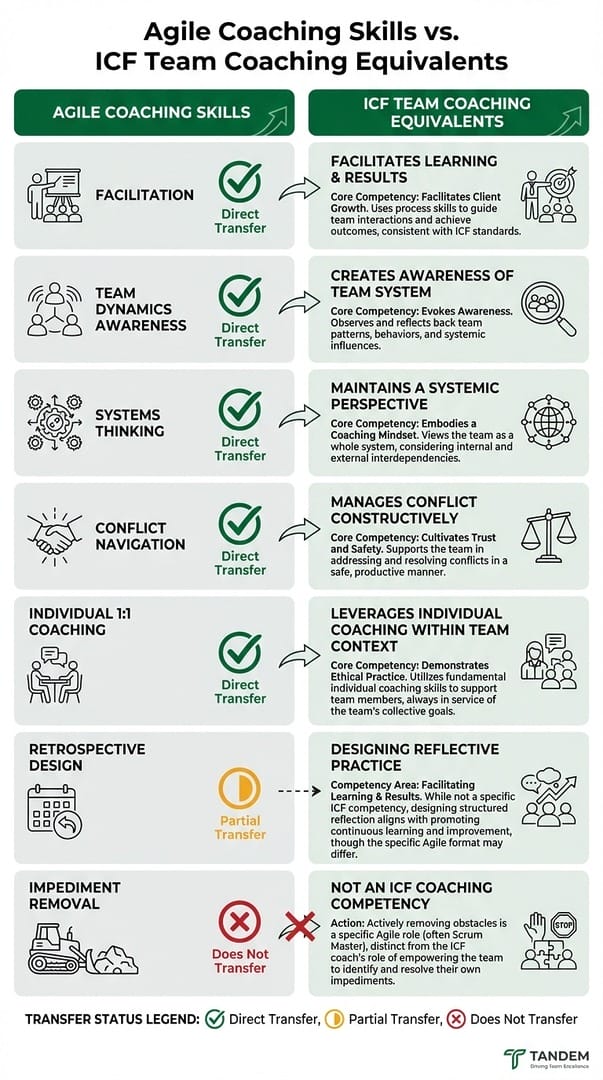
The mapping between agile coaching skills and ICF team coaching competencies is more specific than “some things overlap.” Some capabilities transfer directly, others need reframing for a team-as-entity context, and a few do not carry over because they belong to a different professional discipline entirely.
| Agile Coaching Skill | Transfer Status | ICF Team Coaching Equivalent |
|---|---|---|
| Team dynamics awareness | Transfers directly | Core of team coaching presence. You already read rooms. |
| Conflict navigation | Transfers directly | Directly applicable. The skill is the same; the context expands. |
| Facilitation | Partial | Foundation for coaching, but coaching requires going beyond process management into generative conversation. |
| Systems thinking (delivery) | Partial | ICF requires a broader organizational system lens that includes stakeholder relationships, culture, and incentive structures. |
| Retrospective design | Partial | Useful skill, but retrospectives are facilitation events. The coaching happens in what you do with the insights after. |
| Individual 1:1 coaching | Does not transfer | Must shift from coaching individuals to coaching the team entity. Different relationship, different contract. |
| Impediment removal | Does not transfer | Coach does not remove impediments. The team develops its own capacity to address organizational barriers. |
The "does not transfer" items are not deficiencies in agile coaching. Impediment removal is a legitimate and important Scrum Master responsibility. It is not a coaching behavior. Different role, different tools, different professional discipline.
The partial transfers are where the real learning happens. Your facilitation instincts give you a head start because you already know how to create structured conversation. The coaching layer adds something different: the ability to stay with a team's discomfort long enough for them to generate their own insight, rather than reaching for the next exercise to move things along. That patience is a skill agile coaches build once they stop managing the process.
The direct transfers are your strongest advantage over coaches who come from a pure individual coaching background. A team coaching session where nobody reads the room, where nobody notices the energy shift when the manager speaks, where nobody sees the pattern behind the same person volunteering for everything, that session misses the material that matters. Agile coaches already see this. The ICF framework gives you language and structure for what to do with what you see.
The Bridge: PCC+ACTC Pathway for Agile Coaches
The ACTC (Advanced Certification in Team Coaching) is ICF's credential for team coaching. The PCC (Professional Certified Coach) is ICF's mid-level individual coaching credential. Most training programs treat these as separate pursuits, requiring coaches to earn them sequentially through different programs.
Tandem's PCC+ACTC combination program integrates both into a single training experience. This matters for agile coaches because it means you don't have to choose between learning individual coaching fundamentals and developing team coaching expertise. The curriculum covers ICF core coaching competencies alongside team coaching competencies in an integrated program. You learn how individual coaching skills serve team coaching contexts and vice versa.
The structural requirements are real. PCC requires 125 hours of coach-specific training and 500 hours of coaching experience. ACTC adds team-specific supervision and mentored coaching hours. Agile coaches often have thousands of hours working with teams, but those hours count toward ICF requirements only when they meet specific criteria for what constitutes a coaching conversation versus a facilitation or consulting session.
This is where most agile coaches underestimate the transition. The ICF competency framework is not a rubber stamp on existing practice. It's a different operating model for how you engage with teams. Establishing coaching agreements, evoking awareness through questions rather than exercises, active listening at a level that goes beyond gathering information for the next process decision. These are distinct professional capabilities, not agile coaching skills renamed.
The program doesn't ask you to abandon your agile identity. The approach integrates ICF coaching credentials with agile and organizational coaching experience. Most competitors offer either ICF team coaching training or agile coaching development. The integrated pathway exists because the founders built it after living the gap themselves.
For experienced agile coaches, the mentoring and supervision components are where the transition accelerates. You bring recorded team sessions from your actual work. A mentor coach examines those sessions against the ICF competency model and shows you specifically where you were coaching, where you were facilitating, and where you were consulting without realizing it. That level of feedback on your existing practice is worth more than another certification course.
Both Worlds: Why the Bridge Matters
Organizations increasingly want coaches who understand both delivery systems and human dynamics. An agile coach with ICF credentials brings technical context to coaching engagements that a pure ICF coach cannot. A pure ICF team coach brings coaching discipline that an agile coach without formal training often lacks. Holding both gives you access to work that neither credential alone opens.
This is the direction the market is moving. Corporate buyers who once hired "agile coaches" for delivery improvement now ask about coaching methodology. HR and L&D departments evaluating team coaching vendors look for ICF credentials as a quality signal. The dual-credentialed professional fills a role that's hard to hire for: someone who can coach a leadership team through strategic alignment in the morning and then work with a delivery team on flow optimization in the afternoon, speaking both languages natively rather than translating between them.
Both Tandem founders embody this bridge. Alex holds MCC, CEC, CTC, and PST. Cherie holds MCC and was among the first agile coaches to achieve ICF's highest credential. Their book Enterprise Agile Coaching bridges organizational change with coaching methodology. The practical guide to coaching teams they built reflects both traditions.
The business case for the bridge isn't about collecting credentials. It's about expanding what you can offer to organizations that need both operational improvement and human development. The agile coach who also holds PCC and ACTC can walk into a leadership offsite, coach the executive team on decision-making patterns, and then work with the delivery teams on how those decisions land at the operational level. That range of engagement, from boardroom to team room, is what organizations are willing to pay premium rates for.
Starting the Transition
The transition from agile coaching to ICF team coaching doesn’t require a sabbatical or a career pause. Most agile coaches begin while continuing their current work, applying ICF competencies to their existing team engagements as the development ground for building new coaching skills. Four practical steps to start.
1. Observe your own practice. In your next team session, notice where you manage process versus where you surface awareness. When you ask a question, are you gathering information to design the next exercise, or are you helping the team see something about itself? The ratio tells you where you are on the facilitation-to-coaching spectrum.
2. Read the ICF team coaching competency model. Identify which competencies you already demonstrate in your agile coaching work and which ones are genuinely new. Pay attention to the competencies around coaching agreements and ethical practice. These are the areas where agile coaching culture and ICF coaching practice differ most significantly.
3. Seek coaching supervision. Find an ICF-credentialed supervisor who can examine your agile coaching sessions through a coaching lens. Supervision reveals blind spots that self-reflection misses, particularly the moments where you slip from coaching into consulting or facilitation without noticing.
Organizations hire agile coaches for delivery and ICF coaches for people. The professional who holds both credentials gets hired for the problems that live at the intersection — which is where most real problems actually are.
4. Explore the PCC+ACTC pathway. If you're an agile coach who wants to formalize what you've been doing with an ICF credential, the PCC+ACTC combination program is designed for exactly this transition. It builds on what you already bring rather than asking you to start over.
The transition from agile coaching to ICF team coaching is professional development, not a career change. You're not abandoning one discipline for another. You're adding the coaching structure and credential recognition that makes your existing team work more rigorous, more portable, and more valuable.
Your agile coaching experience isn't a liability on this path. It's an asset that most ICF candidates don't have. The question isn't whether you can coach teams. You already do. The question is whether you're ready to do it with the structure, the ethics framework, and the credential recognition that the ICF provides. If you are, the bridge is shorter than you think.
Clarify Your Path: Agile Coach or ICF Team Coach
In a free consult, map your work to ICF criteria and pinpoint where you’re facilitating, coaching, or consulting—so you choose the right next step.
Book a Free Consultation →