
Active Listening in Coaching: Three Levels That Change Sessions
In every ACC cohort I teach, there's a moment around week four when a student coaches a peer and then says: "I thought I was a good listener until I tried Level 3." They're not wrong. They were a good listener in the normal sense - attentive, warm, responsive. What they hadn't done was listen without tracking their own reactions, forming opinions, or planning what to say next.
That's a different discipline. And the gap between social listening and coaching-level listening is wider than most new coaches expect. The read-to-practice gap for listening is wider than for any other coaching competency, because everyone arrives believing they already have it.
Active listening is one of the foundational coaching skills practitioners develop, and it is also the one most likely to be overestimated on entry and underestimated in depth. This guide covers what coaching-level listening actually requires - the three levels, what you're tracking beyond words, what causes your listening to degrade mid-session, and how to recover when it does.
Key Takeaways
- Coaching-level listening operates across three distinct modes (Internal, Focused, Global) - skilled coaches move between them deliberately, not in a fixed hierarchy.
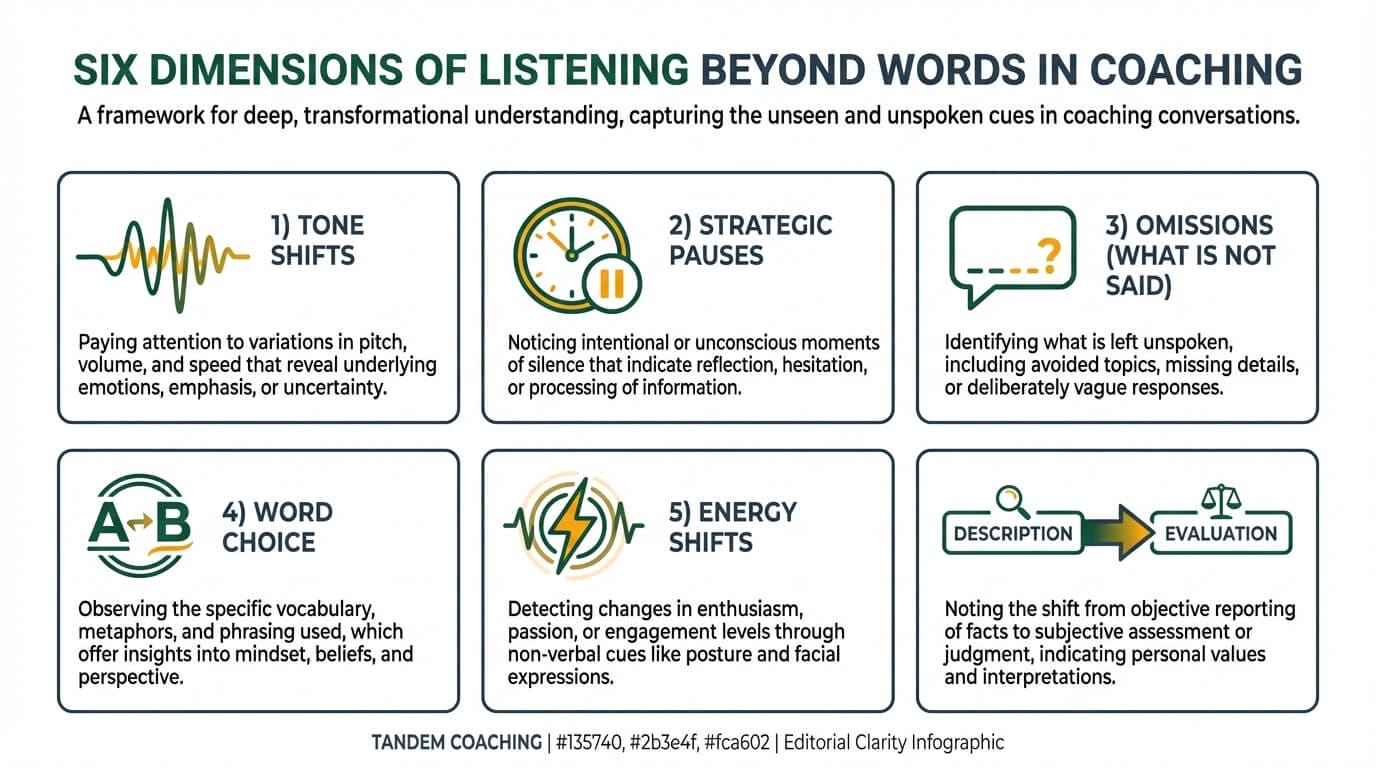
- Active listening means tracking six dimensions beyond words: tone shifts, pause quality, omissions, avoided language, energy changes, and the transition from description to evaluation.
- Every coach's listening degrades mid-session through three predictable patterns - planning while listening, self-referencing, and content fatigue - and the skill is catching it early.
- Recovery is not about trying harder; it is about releasing effort and returning to presence with whatever the coachee is saying right now.
- Listening at ACC, PCC, and MCC levels is qualitatively different - each credential demands a fundamentally different relationship with attention and awareness.
Active Listening in Coaching
Active listening in coaching is the practice of attending to the full range of a coachee's communication - spoken content, emotional subtext, body language, energy, and silence - in order to understand not just what they are saying but what they mean and what remains unsaid. It is the skill measured by ICF Core Competencies under Competency 6: Listens Actively.
The ICF defines this as the ability to focus on what the client is and is not saying to fully understand what is being communicated in the context of the client's systems. That phrase - "is and is not saying" - is where coaching listening separates from everyday attentiveness. Social listening asks: did I hear you? Coaching listening asks: what are you not telling me, and do you know you're not telling me?
PCC Marker 6.1 makes the standard behavioral: it asks assessors to evaluate whether the coach "explores beyond what the client says in order to understand the client's thinking, perspective, feelings, needs, wants, meaning, or belief systems." Explore is the operative word. A coach who hears well but doesn't explore what they hear is demonstrating attentiveness, not active listening. The gap between hearing and exploring is where the skill lives.
New coaches read about this competency, think "this seems easy," then go into a session and freeze. The concept is simple. The practice is not.
Three Levels of Listening
Coaching uses a three-level listening framework that describes where a coach's attention sits during a session. These are not a hierarchy where Level 3 is always the right answer. They are modes - each serves a different function, and a skilled coach moves between them deliberately based on what the coachee needs in a given moment.
Level 1: Internal Listening
At Level 1, the coach's attention is split between the coachee and their own internal processing. The coach hears the words but is simultaneously forming reactions, opinions, memories, and responses. Everyone starts here. It is the default mode of human conversation.
In coaching, Level 1 shows up when a coachee is describing a critical career decision and the coach is already composing a question about it. The coachee is still speaking, but the coach's attention has moved ahead. This isn't failure - it's the gravitational pull of normal cognition. The work is noticing when it happens.
Level 2: Focused Listening
Focused listening is where full attention shifts to the coachee. The coach's own reactions fade to background. Content, tone, word choice, hesitation, pace - all of it registers. At Level 2, a coach notices that a coachee used the word "fine" three times in describing their relationship with a direct report. The repetition is the signal, not the word itself.
This is the level ACC students are building automaticity in. A new ACC student might hold Level 2 for five minutes before reverting to Level 1. By hour 75-100 of coaching practice, most can sustain it through a full session. The shift from Level 1 to Level 2 feels effortful at first - like holding a camera steady with no tripod. Over time, it becomes how you listen when you're coaching.
The moment you start composing your next question, you have left the conversation. Your coachee is still talking, but you are somewhere else.
Level 3: Global Listening
Level 3 extends awareness beyond the individual coachee to what is happening in the field between coach and client. Energy shifts. The thing that was almost said but wasn't. A change in the room's emotional temperature when a topic is mentioned. The coachee's body settling or tensing around a particular word.
This is where coaching presence and listening skill overlap. At Level 3, the coach is not working harder - they are holding less, present to whatever emerges rather than tracking toward understanding. A coach at Level 3 might notice that the coachee's energy drops every time they mention their team, even though the words are positive. That gap between words and energy is data that Level 2 alone wouldn't catch.
A common misunderstanding: Level 3 is always superior. It is not. A coach who stays at Level 3 may miss specific content the coachee needs reflected back. A coach who tracks energy patterns but can't recall what the coachee said about their Tuesday meeting has drifted too far. The skill is knowing which level serves the coachee right now.

What You're Listening For
Active listening at the coaching level means tracking six dimensions of communication beyond a coachee's words. Each produces different coaching moves, and each becomes more accessible as the coach develops fluency across the three listening levels.
Tone shifts mid-sentence. A coachee starts a statement with confidence and their voice drops halfway through. The content didn't change, but the relationship to the content did. A reflective observation ("Your voice just shifted") opens more than any question about the content itself.
The pause before an answer. Not all pauses carry the same weight. A pause where the coachee is thinking sounds different from a pause where the coachee is deciding what not to say. Experienced coaches learn to distinguish between productive silence and protective silence.
What the coachee doesn't say when you'd expect them to. A leader describes a major organizational change and mentions everyone affected except one person. The omission is the signal. Asking "Who haven't we talked about?" is a Level 3 coaching move that requires hearing the absence, not just the presence.
The word they use versus the word they avoid. A coachee says "frustrated" repeatedly but never says "angry." A coachee describes a role as "challenging" when their body language says "overwhelming." The gap between the chosen word and the avoided word tells you where the coachee's self-editing is active.
Energy elevation when a topic lands. A coachee mentions something in passing and their whole bearing changes - they lean forward, their eyes sharpen, their speech quickens. The topic they presented as minor is where their energy actually lives. Following that energy rather than the stated agenda requires listening beyond the words.
The moment they move from description to evaluation. A coachee describes what happened in a meeting, then shifts to explaining why it happened. That transition - from narrative to interpretation - is where the coaching question lives. When a coachee says "and so obviously the real problem was..." the word "obviously" is doing heavy lifting. It is closing a door that coaching might want to reopen.
These six dimensions are how powerful questions work in tandem with active listening. The question doesn't come from a list. It comes from what the coach heard in these dimensions that the coachee hasn't yet articulated for themselves.
How Listening Degrades
Every coach's listening degrades during sessions. The question is how quickly you notice. Three patterns account for most listening degradation, and each has observable internal symptoms a coach can learn to catch.
Planning While Listening
The most common pattern. The coachee says something that sparks a question in the coach's mind - a good one, the kind that opens doors. The coach grabs hold of it. From that moment, they are no longer listening. They are managing their own agenda, holding their question while scanning for a pause to deliver it.
The tell is physical. You notice yourself waiting rather than receiving. Your attention is pointed forward - when can I ask this? - rather than staying with what's happening now. The question you held for thirty seconds has cost you thirty seconds of the coachee's actual experience. Often, by the time you ask it, the conversation has moved past the moment that generated it.
A brilliant question asked thirty seconds late is not brilliant. It is a souvenir from a conversation you were no longer in.
Self-Referencing
The coachee describes a conflict with a board member or a decision about restructuring, and the coach's own experience with something similar surfaces. The coach starts processing their own reaction rather than staying with the coachee's experience.
The internal symptom: you catch yourself thinking "that happened to me too" or "here's what I would do." The moment your own story enters the conversation, even silently, you've shifted from coaching to consulting in your head. This is where engaged neutrality - the stance that enables deep listening - becomes a real practice. Caring about the person without importing your own material into their session requires continuous attention.
Content Fatigue
After the fourth or fifth session in a day, listening changes character. You can still track what the coachee is saying - the topic, the narrative, the presenting issue. But you've lost contact with how they're relating to it. You are summarizing in your head rather than being present. The coachee's words land on the surface of your attention instead of entering it.
This is the hardest degradation to catch because it looks like good coaching from the outside. The session is progressing. But nothing is opening. The coachee is answering your questions rather than discovering something through them. The difference between a productive-seeming session and an actual coaching session often comes down to whether the coach had enough listening capacity left to be genuinely curious.
Restoring Listening Mid-Session
Recovery happens inside the session. There is no pause button. You need to re-enter the conversation from wherever the coachee is now, not from where you last had full contact.
The first recovery move is the noticing itself. The moment you recognize you've been planning a question or processing your own material, that recognition shifts your attention. You are already partially back. The noticing is the beginning of the return.
Keep a water glass within reach during sessions. Taking a sip is a natural, non-disruptive pause that buys you two seconds to reset your listening without the coachee noticing a shift. It's the most common recovery tool experienced coaches use and no one talks about it.
A practical recovery technique: silently repeat the coachee's last sentence to yourself before you respond. Not to use it as a reflection (though you can), but to force your attention back to their actual words. This takes two seconds and resets your listening position from wherever you drifted to wherever they are.
Another approach: brief silence. If you've noticed you are no longer tracking, don't rush to fill the space. Let a beat of silence land. The coachee will continue, and that continuation is your re-entry point - fresh material rather than trying to recover a lost thread.
The counterintuitive piece: recovery is not trying harder to listen. Effort tightens attention and pushes you back toward Level 1, tracking your own performance rather than the coachee's experience. Recovery is releasing. Stop trying to do anything for a moment and be present with whatever they are saying right now.
Listening Across Credential Levels
Listening at each ICF credential level is not more of the same thing. What the coach listens for, what it produces, and the internal shift required are qualitatively different.
Ready to Build ACC-Level Listening?
Every credential level demands a different relationship with attention. Tandem's ACC program gives you the practice hours and mentor coaching to make Level 2 automatic.
| Credential Level | Listening Focus | What It Produces | Key Shift |
|---|---|---|---|
| ACC | Content - what the coachee says, reflected back accurately | The coachee feels heard and understood; rapport builds | From Level 1 to sustained Level 2 - staying with the coachee instead of drifting to own reactions |
| PCC | Meaning underneath the content - patterns, beliefs, assumptions the coachee hasn't named | The coachee discovers what they meant, not just what they said; insight emerges | From hearing what was said to exploring what wasn't - PCC Marker 6.1 in action |
| MCC | The unarticulated - what the coachee cannot yet say, not just what they have not said | The coachee accesses awareness they did not have before the session; the conversation itself becomes generative | From active exploration to receptive presence - the coach holds less and allows more |
At ACC, the work is building automaticity in Level 2. The coach learns to hold focused listening for a full session without reverting to Level 1 every few minutes. This feels like a physical discipline at first. Most ACC students report it becomes natural around hour 75-100 of accumulated coaching practice.
At PCC, the shift is from "I heard what you said" to "I heard what you meant and what you didn't say." PCC candidates in mentor coaching begin noticing patterns - when a coachee speeds up, uses hedging language, or answers a question they weren't asked. The listening itself becomes a diagnostic instrument.
At MCC, listening becomes lighter rather than more intense. The coach has released the need to understand everything in the moment, present to what emerges rather than tracking toward a destination. This is the hardest transition to teach because it involves unlearning the effortful attention that worked at ACC and PCC.
The paradox of mastery in listening: the further you develop, the less you do. ACC learns to focus. MCC learns to release.
Wherever you are in this progression, structured training accelerates development. Tandem's ICF ACC program builds listening skill through mentor coaching and observed practice where these shifts become visible and workable.
Frequently Asked Questions
What are the three levels of listening in coaching?
The three levels are Level 1 (Internal) where the coach's attention is split between the coachee and their own thoughts, Level 2 (Focused) where full attention is on the coachee's content and meaning, and Level 3 (Global) where awareness extends to energy, what's unsaid, and the dynamic between coach and client. These are not a hierarchy - they are modes a coach moves between deliberately depending on what the session requires.
How do you improve active listening as a coach?
Build awareness of when your listening degrades. The three most common causes are planning your next question while the coachee speaks, being triggered by your own related experience, and content fatigue across multiple sessions. When you notice you've drifted, silently repeat the coachee's last sentence to yourself before responding. Mentor coaching where someone observes your listening patterns accelerates development faster than solo practice.
What is ICF Competency 6?
ICF Competency 6, Listens Actively, is defined as the ability to focus on what the client is and is not saying to fully understand what is being communicated in the context of the client's systems. PCC Marker 6.1 makes it behavioral: the assessor evaluates whether the coach explores beyond what the client says in order to understand the client's thinking, perspective, feelings, needs, wants, meaning, or belief systems. The emphasis is on exploration, not just attentiveness.
How do you practice Level 3 listening?
Level 3 develops through deliberate attention to what is happening beyond words - energy shifts, omissions, changes in the emotional field. One practice: at the end of each session, note one thing you noticed that was not said in words. Over time, this trains your awareness to register nonverbal channels alongside content. Understanding how these listening skills apply in a full coaching session gives the practice structural context.
The next session you coach, notice when you shift from listening to planning your next question. You don't need to stop it. Just notice it. That moment of noticing is the beginning of Level 2. Everything else builds from there.
Practice Listening With Feedback
Mentor coaching is where listening gaps become visible and workable. Tandem's ICF ACC program builds Level 2 automaticity through observed practice and structured feedback.
Learn About the ACC Program →