Worker Wellness Is a Leadership Development Problem
Two announcements landed within a day of each other this week, six thousand miles apart. In Harare, a government minister opened Zimbabwe’s first National Workers Wellness Summit by telling employers that a healthy, resilient workforce is the precondition for the country’s economic ambitions. In Manila, the leadership of a large outsourcing firm reported that what keeps people from leaving is connection, contribution, and community, not access to the newest technology.
Different economies, different stakes, the same conclusion. Worker wellness and human connection drive productivity, and the people at the top are now saying so plainly.
Underneath both stories sits the same gap. Organizations are getting good at funding wellness. They are far less good at developing the leaders who decide whether any of that funding produces a result. A budget buys a program. It does not buy a manager who notices when someone on the team is quietly running out of road.
Why Wellness Stopped Being an HR Footnote
Worker wellness matters for productivity because tired, anxious, disconnected people make worse decisions, solve problems slower, and leave sooner. Governments and large employers now treat workforce health as an economic input rather than a perk, because the cost of ignoring it shows up directly in output, retention, and growth.
The Harare summit is worth attention precisely because of who convened it. When a labour minister stands up and ties workplace wellness, mental health, and occupational safety to national economic targets, the conversation has moved well outside the HR department. Minister Edgar Moyo framed a healthy and motivated workforce as something a developing economy cannot reach its goals without. Wellness, in that framing, is infrastructure.
That reframing matters for anyone who develops leaders. For years, wellness lived in a side budget: an employee assistance line, a meditation app, a wellness week in spring. Useful, easy to cut, and disconnected from how the business actually ran. Treating it as an economic input changes the question. The issue stops being how much to spend and becomes who is accountable for the outcome.
Accountability for wellness lands, whether or not anyone names it, on leaders. A frontline manager sets the tone for a team of eight. A director shapes the working conditions of a hundred people. When wellness counts as an economic input, the leaders who shape daily experience become the people responsible for protecting that input. Most of them were never developed for that part of the job. They were promoted for technical results, handed a team, and left to assume the human side would sort itself out. It does not. Left unmanaged, the slow grind of overload turns into executive burnout and the quiet attrition that follows.
None of this means wellness programs are wasted. It means a program is only as good as the leadership around it. A counseling benefit no one feels safe using, a flexible-hours policy a manager quietly punishes people for taking, a wellness week followed by a brutal quarter: in each case the budget was spent and the outcome never arrived. The missing piece was always the same, a leader who could turn intent into daily reality.
The Connection Gap AI Widened
As artificial intelligence absorbs routine task work, the part of a leader’s job that cannot be automated grows more important: building connection, contribution, and a sense of community on a team. Employees increasingly stay or leave based on that relational experience, not on the tools their employer adopts.
The Manila story makes the point with numbers. TELUS Digital Philippines, a large player in the outsourcing industry, reported that it cut attrition by roughly 15 percent year on year while holding an engagement rate near 91 percent across two years. Its own explanation, drawing on a 2025 State of HR report, is blunt. People stay because of connection, contribution, and community, and technology by itself does not produce any of the three.
That assessment comes from an industry being reshaped by AI faster than almost any other. The company is not anti-technology. It pairs AI adoption with structured upskilling and engagement programs. The lesson its leaders drew is that technology alone does not build a company people want to stay inside. As one executive put it, AI is reshaping the industry, but technology on its own does not build sustainable companies.
When software absorbs the routine parts of the work, what is left for leaders is the human part. That was always the hard part. Now it is most of the job.
For leadership development, this is the uncomfortable arithmetic. As AI takes over scheduling, drafting, summarizing, and routine analysis, the work that stays distinctly human moves to the center of every leadership role. Reading a room. Sensing when someone has checked out. Holding a hard conversation without flinching. Making people feel that their contribution is seen. These were once the soft edge of the job. They are becoming its core.
Yet most leadership development still treats them as secondary. A manager gets days of training on tools, metrics, and process, and a single afternoon, if that, on the relational work. The result is a generation of leaders fluent in systems and underdeveloped in connection, stepping into an era that rewards the opposite balance. An engagement plan for leadership teams that ignores this shift is planning for the last decade instead of the next one.
Wellness Rises and Falls With the Leader
Worker wellness is a leadership capability because the daily experience of a job is shaped by a leader’s behavior: how they notice strain, how safe they make it to raise problems, how honestly they manage workload. These are learnable skills, and they decide whether a wellness budget produces anything at all.
Same Benefits, Different Outcomes?
If one team is steady and another is fraying, the lever is leadership behavior. A consult can help you pinpoint what to develop first—and who needs support now.
Picture two teams inside the same company, covered by the same wellness benefits, the same flexible policies, the same employee assistance program. One team is steady and productive. The other is fraying, with people quietly polishing their resumes. The benefits did not differ. The leadership did.
This is the part the budget conversation misses. A wellness program is a set of resources. Whether those resources ever reach a stressed employee depends almost entirely on the person they report to. A manager who notices early, who has built enough trust that someone will say “I am underwater” before they break, who adjusts a workload before it becomes a crisis: that manager produces wellness outcomes no app can match. A disengaged manager can quietly neutralize every benefit on the menu.
Naming this as a capability matters, because capabilities can be developed. Too often the leaders who are good at the human side get described as naturally warm, as if it were temperament. Some of it is. Most of it is practice. Noticing strain is a trainable habit of attention. Psychological safety is built through specific, repeatable behaviors. Honest workload conversations follow patterns a leader can learn and rehearse.
Once wellness is understood as a capability, the organizations serious about it stop asking only what to buy and start asking how to develop the leaders who carry it. That is a leadership development question, and it has answers.
The Capabilities Worth Developing
Four leadership capabilities do most of the work in protecting team wellness: attention and presence, psychological safety, workload calibration, and connection-building. Each shows up as a concrete daily behavior, and each can be developed deliberately rather than left to personality or luck.
Start with attention and presence. A leader who is genuinely present in a one-on-one, not glancing at a screen, not three meetings ahead in their head, gives a team member the experience of being seen. It sounds small. It is the foundation, because a distracted leader misses every early signal that something is wrong. Leadership presence works like a discipline, and it can be practiced like one.
Psychological safety is the second. On a team with real safety, people raise problems early, admit mistakes, and disagree with the boss without first calculating the cost. That changes wellness directly, because the alternative is a team that hides strain until it surfaces as a resignation letter. Building trust and safety on a team takes more than being nice. It comes from specific behaviors a leader can practice: responding well the first time someone brings bad news, owning your own mistakes out loud, keeping the problem separate from the person.
The third is workload calibration. One brutal week rarely causes burnout. It builds slowly, when a leader keeps saying yes to demands without adjusting what the team carries underneath. A leader with this capability tracks real capacity, names limits honestly to their own boss, and protects the team from the slow accumulation that grinds people down over months.
The fourth is connection-building. Distributed teams, hybrid schedules, and AI-mediated workflows have stripped out the incidental contact that used to build belonging. A leader now has to create it on purpose: real conversations, recognition that is specific rather than generic, moments where a team feels like a group of people instead of a set of calendar invitations.
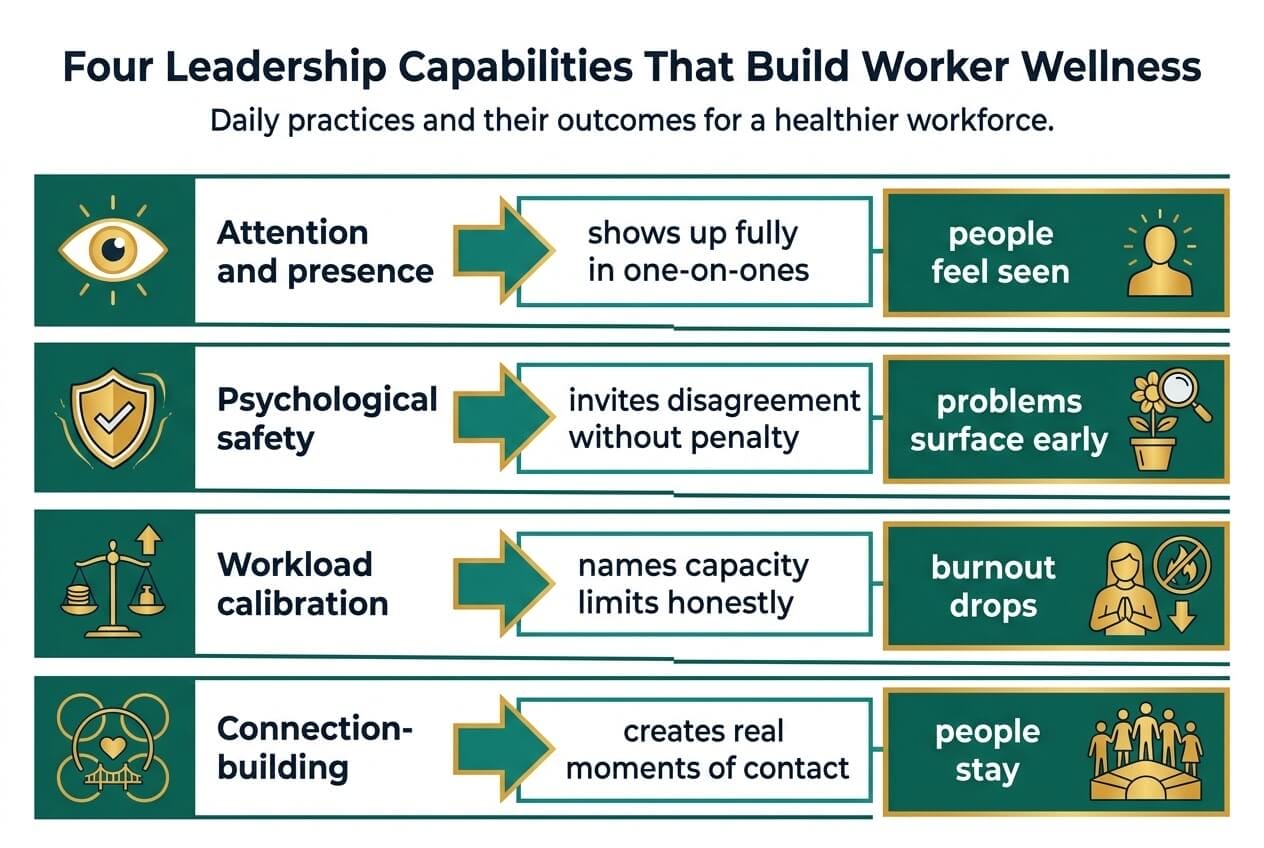
None of these four is exotic. What is rare is treating them as a development priority instead of assuming leaders will absorb them by osmosis. Each one is concrete enough to coach, observe, and improve. An organization that builds them deliberately is building wellness into how it operates rather than bolting it on afterward.
Why Coaching Builds What Training Can’t
Coaching develops wellness-relevant leadership capabilities because they are practiced, not memorized. A workshop can explain psychological safety in an afternoon, but it cannot change how a leader reacts under real pressure. Coaching works on the actual patterns, in real situations, over time, which is where behavior shifts.
Work the Real Conversation, Not a Framework
Coaching turns psychological safety, workload calibration, and connection-building into practiced habits—especially under deadline pressure.
Send a manager to a half-day workshop on supporting their team and they will leave with a tidy model and good intentions. Two weeks later, under deadline pressure, they revert to the habits they have always had. The workshop did not fail. The problem is a mismatch between what training does and what the situation actually requires.
The capabilities that protect wellness are behavioral, and behavior changes through practice and feedback rather than through information. A leader already knows, in the abstract, that they should check in with a struggling team member. What stops them is rarely ignorance. The block is the small avoidance, the hard conversation that keeps getting pushed to next week, the discomfort of asking a real question and hearing a real answer.
This is the work coaching does well. A coach helps a leader see their own pattern, the one place they consistently look away, and stays with them while they try something different in a real situation. The leader brings an actual team member, an actual stuck conversation, and works it in the room. That is how a capability moves from idea to habit. It is also why coaching accelerates change leadership in a way that classroom training, on its own, never has.
For anyone designing a leadership development program, the implication is practical. Keep training for what training is good at: shared language, frameworks, awareness. But when the goal is leaders who behave differently with their teams, pair it with coaching. The workshop plants the idea. The coaching grows it into something a team can feel.
Where to Start This Quarter
Start by treating wellness as a leadership development question. An individual leader can begin with the next one-on-one. An organization can begin by adding the four capabilities to how it develops and evaluates managers, then pairing that development with coaching for the leaders it matters most for.
If you lead a team, the most useful move is also the least dramatic. Look hard at your one-on-ones. Are they happening, or do they get cancelled the moment the week gets busy? Are you present in them, or processing email behind your eyes? The one-on-one is the single most reliable place to catch strain early, and for most leaders it is badly underused.
Protect the one-on-one before you protect anything else on your calendar. Thirty unhurried minutes where a person has your full attention will surface more about a team’s wellness than any survey, and it is the cheapest intervention you have.
If you set leadership strategy, the move is structural. Add the four capabilities to how managers get developed and evaluated. Make “builds psychological safety” and “calibrates workload honestly” as legible in a performance conversation as hitting a number. Stop assuming the human side of leadership will sort itself out, and resource it the way you resource technical skill.
Then pair that development with coaching for the leaders who carry the most weight. Workshops set the language. Coaching is where leaders practice the harder behaviors against their real teams and real pressure, and where the change actually holds.
The Harare summit and the Manila numbers point at the same future. The economies and the companies that pull ahead will be the ones that understood wellness early and acted on it where it actually lives, in the daily behavior of leaders. Funding the program is the easy half. Developing the leaders who make it real is the half that decides whether any of it works.
Make Wellness a Leadership Capability—Not a Perk
If one-on-ones get cancelled and overload goes unnamed, let’s map a practical plan for your leaders to protect wellness and performance at the same time.
Book a Free Consultation →