Innovative Coaching Methods Are Multiplying. Here’s How Executives Should Choose.
Three different coaching methods landed in coaching publications inside a single 30-day window. ICF Global covered virtual and augmented reality coaching environments. Coaching at Work ran a feature on coaching outdoors. The same publication, days later, profiled a specialized tool called the Relationship Graph for working with leaders through loss and transition.
Each piece is serious. Each is written by practitioners. Together, they signal something the executives I talk with already sense: the menu of coaching methods just got noticeably wider, and most leaders don’t have a buyer’s framework to choose between them.
This is not a piece arguing that any one of these methods will replace traditional executive coaching. It’s a piece for the senior leader, board member, or head of people who has to decide whether the next engagement happens in a conference room, a forest, a headset, or with a tool none of them have seen before. The question worth asking is not “is this method good?” The question is “does this method serve the outcome I’m actually buying?”
Key Takeaways
- Three new coaching modalities landed in coaching publications in one month. The trend is real; the question is what to do with it.
- Methods are means, never ends. Without a clear outcome, no method works and every method “fails” the same way.
- Three questions cut through the noise: what outcome am I buying, what is the active ingredient, and what’s the failure mode if this method does not work.
- Vendors that lead with the method instead of the outcome are signaling a problem. Pilot before scaling.
- Traditional in-person and video coaching is the baseline. Deviations need a reason that ties back to the outcome.
The Coaching Menu Just Got Wider
For most of the last two decades, executive coaching looked roughly the same from the buyer’s seat. You found a coach. You met in an office, on a video call, or sometimes over a working breakfast. The conversation was the technology.
That picture is shifting. The April-to-May 2026 issue of the coaching trade press carried serious coverage of three modalities that did not exist as mainstream offerings five years ago. ICF Global wrote about VR and AR coaching as a near-term practice rather than a curiosity. Coaching at Work covered outdoor coaching with the kind of how-to depth reserved for established disciplines. The same outlet wrote up specialized tools like the Relationship Graph for working through loss and transition. Three different active ingredients, three different settings, all positioned as legitimate options for paying clients.
What this means for the executive commissioning coaching is straightforward: more choices, less guidance on how to make them. Vendors will pitch what they sell. Internal champions will recommend what worked for them. The board will ask whether you considered alternatives. None of those inputs is a framework. The risk isn’t that you pick the wrong method. The risk is that you pick a method without a clear picture of what you’re actually trying to change. That’s a buyer problem, not a vendor problem, and it shows up most acutely at the C-suite coaching level where the cost of a mismatched engagement is highest.
What Virtual and Augmented Reality Actually Change
VR and AR coaching gets covered in two ways. The first reads like a vendor brochure. The second, like the ICF Global piece on the future of VR and AR in coaching practice, is more measured. The honest read on these methods comes down to two claims, one expansive and one constraining.
Considering VR/AR Coaching for Rehearsal?
Let’s map your scenario to the right active ingredient—and confirm what must stay in-person for true presence.
The expansive claim is that virtual environments remove geography and add rehearsal. A leader in Singapore can sit across from a coach in Toronto inside a shared virtual space that feels more present than a video call. A senior executive can rehearse a difficult board presentation in a simulated room with simulated stakeholders before the real one. For high-stakes scenarios where the actual rehearsal is impossible or too costly, that’s a real capability.
The constraining claim is harder. The active ingredient in coaching is presence, and presence is hard to fake. A headset can deliver visual fidelity. It cannot deliver the felt sense of being in a room with another person who notices the moment your shoulders dropped or your breath shortened. For some kinds of work, that loss is acceptable. For others, it removes the very thing the engagement was meant to develop.
The leader’s test is situational. Use a virtual environment when the outcome is rehearsal, exposure, or distance compression. Be cautious when the outcome is reading a real room or sitting with discomfort that the headset filters out. There’s a reason mature virtual executive coaching practices treat video as a default and physical presence as the standard against which everything else is measured.
Outdoor Coaching as Pattern Disruption
Coaching at Work’s outdoor coaching feature treats walking sessions as a craft, not a marketing angle. The mechanics matter. Walking sessions move at roughly the pace of unforced thought. The body changes posture, the breath deepens, the eyes look outward instead of across a desk. The brain follows.
What outdoor coaching does well is disrupt the patterns of indoor conversation. The performance posture an executive carries into every conference room loosens. The defensive triangulation of seated meetings, where two people negotiate eye contact and the table holds the tension, dissolves. Side-by-side, walking, looking at the same horizon, the conversation tends to land somewhere else than it would in the office.
For executives, outdoor coaching is most useful when the office context is itself part of the problem. When every meeting room evokes the same loop, when the building has come to represent the role rather than the person, a deliberate change of setting can break a pattern that more meetings will not. The same applies to leaders working through identity-level questions, the kind of work that informs coaching the person, not just the problem.
The caution is symmetrical to the VR caution. A forest does not make a coach. The work is still the work, and a competent coach in a conference room will out-coach a mediocre one on a hiking trail every time. Treat the venue as an instrument, not a credential. If the coach can’t articulate what the outdoor setting is meant to do for your specific outcome, the setting is decoration.
Specialized Tools for Specialized Moments
The Coaching at Work piece on the Relationship Graph belongs in a different category from VR or outdoor coaching. It’s not a modality. It’s a tool, designed for a specific kind of moment: working with someone through loss, transition, or the closing of a chapter.
For senior leaders, that category of moment is more frequent than the org chart suggests. Succession into the top role means letting go of the role beneath it. A merger means the leader who built one company now leads something that is not quite the same company. The departure of a co-founder, a long-tenured chief of staff, or a board chair changes the leader’s daily reality in ways that don’t fit cleanly into a strategy review. Executive coaching for career transitions exists because these moments are technical and emotional simultaneously, and most boards underweight the second half.
A specialized tool earns its keep when the situation is specialized. Picture this: a CEO is preparing to hand over the company she built to a successor she chose. The deal is structured. The communications plan is drafted. Then she sits in her first session with a coach and discovers she is grieving a chapter that hasn’t closed yet. A general-purpose conversation can hold that. A targeted tool, used by a coach who knows when to bring it out, can name and structure what she’s feeling so that the handoff lands cleanly and she walks into whatever comes next with her ground beneath her.
The honest counter to specialized tools is the same as for any specialized instrument: they fail in the wrong hands. A leader doesn’t need to know the tool’s name. They need to trust that the coach knows when to reach for it.
The Method-Shopping Trap
Here is a pattern I see often enough to call a pattern. A senior leader is six months into a coaching engagement that is not producing the change they wanted. Instead of examining the engagement, they switch coaches. The new coach uses a different approach. Six months later, same result. So they switch again.
Stop Swapping Methods—Name the Real Change
If the engagement isn’t moving, the missing piece is often outcome clarity. Our MCC coaches help leaders define what shifts—and measure it.
By the third method, the issue is rarely the method. The issue is that no one has ever named, in clear language, what the leader is actually trying to change. Without that, every coach delivers their best version of generic work, and the leader experiences a sequence of disappointments that all feel like the coach’s fault.
Most of the time, a leader switching coaching methods is not solving the problem. They are avoiding the work the current method was about to ask them to do.
The mirror question for any executive considering a method change is uncomfortable. Are you choosing a method, or are you avoiding the work? A new modality, a new venue, a new tool, all of it can become a sophisticated way to stay in motion without committing to movement. The coach changes. The setting changes. The person at the center of the engagement, the one who actually has to do something different, doesn’t.
How to Decide Which Method Fits Your Situation
Before agreeing to any non-traditional coaching modality, three questions cut through the noise.
What outcome am I buying, in language a board would accept? If you cannot finish the sentence “at the end of this engagement, I will be able to…” in concrete business language, the method is the wrong starting point. Define the outcome first, then evaluate methods against it. This is the same discipline behind well-formed outcomes in executive coaching: vague targets produce vague engagements, regardless of how innovative the method looks.
What is the active ingredient I’m relying on? Every method has one. For VR, it’s rehearsal and exposure. For outdoor coaching, it’s context disruption and physiological shift. For specialized tools, it’s structured access to a particular kind of work. If you can’t name the active ingredient, you don’t know what you’re paying for.
What’s the failure mode if this method does not work? A traditional in-office engagement that fails is recoverable. A two-day immersive in a different country with three executives and a celebrity coach that fails is harder to course-correct. Bigger, novel methods carry bigger blast radius. That’s not a reason to avoid them. It’s a reason to scope them carefully.
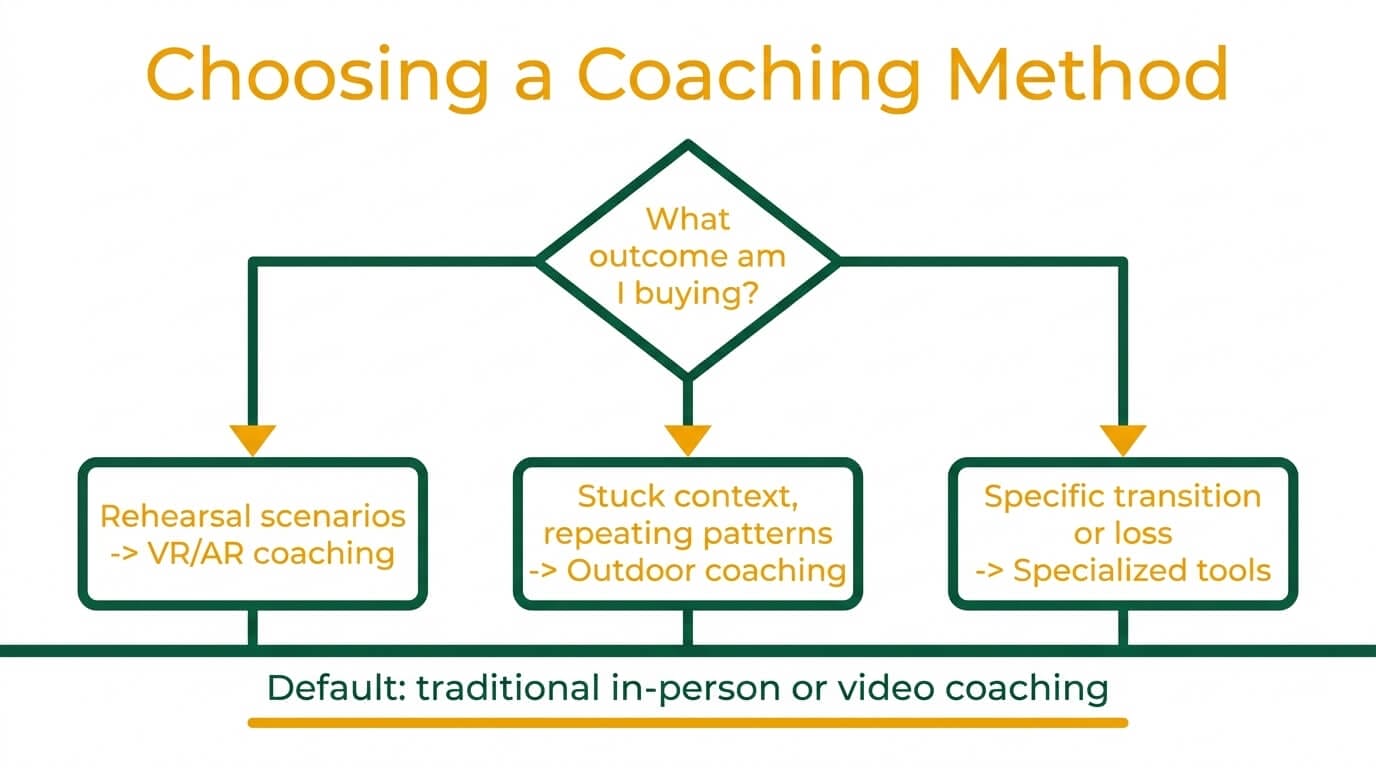
Below is a quick map of the most common method types against the executive challenges they fit best.
| Method Type | Active Ingredient | Best-Fit Executive Challenge |
|---|---|---|
| Traditional in-person or video | Sustained relationship and reflection | Most engagements; the baseline |
| VR / AR coaching | Rehearsal, exposure, distance compression | High-stakes scenario practice; distributed teams |
| Outdoor coaching | Context disruption, physiological shift | Stuck patterns tied to office context; identity-level work |
| Specialized tools (e.g., transition tools) | Structured access to a specific kind of work | Succession, M&A, departure of a key person, role exit |
What Hiring Organizations Should Watch For
For HR leaders and CHROs evaluating coaching vendors, the signals worth watching are mostly about how the vendor talks before the engagement begins.
A vendor leading the pitch with the method is signaling something. A vendor leading with the outcome the executive is trying to reach, then explaining how their method serves that outcome, is signaling something else. The first sells delivery. The second sells results. Choosing an executive coaching firm well comes down to insisting on the second conversation, even when the first one is more polished. The same logic shapes the difference between coaching firms versus coaching platforms: a platform optimizes for delivery scale; a firm or a senior solo practitioner can structure the conversation around the executive’s actual outcome.
Coach competence still matters more than modality. A coach who is good in person tends to be good on video. A coach who is mediocre in person does not become better by adding a headset. When you evaluate a method, evaluate the coach inside it. Ask for two reference conversations: one with someone whose engagement worked, one with someone whose engagement didn’t. The asymmetry of how the vendor responds to that request will tell you more than any case study.
Pilot before you scale. One executive, one engagement, one defined outcome. Measure against the outcome you defined, not against the satisfaction survey. If the pilot produces movement on the outcome, broaden carefully. If it produces only motion, the method does not get a second cohort, regardless of how well the participants liked it.
The Method Is the Servant, Not the Sovereign
Underneath every successful coaching engagement, regardless of method, sits the same pair: a competent coach and a clear outcome. Take either away and no method will save the work. Bring both, and most methods will deliver.
The executive’s job in this market is not to chase what is new. It is to define what they need clearly enough that any reasonable method can be evaluated against it. That is not glamorous work. It does not produce a story to tell at the next executive offsite. But it is the work that turns coaching from an expense into an investment, and it is the work no vendor will do for you.
If you are a senior leader sitting with a brochure for the latest innovative method, the most useful question you can ask yourself is the one no salesperson wants you to ask: what would have to change for this engagement to be worth what it costs? Answer that first. Then choose the method.
Common Questions Executives Ask About New Coaching Methods
A few questions come up consistently when senior leaders evaluate non-traditional coaching modalities.
Does VR coaching actually work for executives?
It works well for rehearsal, exposure, and distance compression. It works less well when the outcome depends on the coach reading subtle in-person signals or the executive sitting with discomfort the headset can filter out. Use it as a tool inside a broader engagement, not as a replacement for the engagement itself.
Is outdoor coaching a serious modality or just a walk?
It is a serious modality when the coach can articulate what the setting is meant to do for the outcome. Walking sessions disrupt office patterns, lower defensive posture, and shift the physiological state of the conversation. If the coach treats the venue as a marketing angle rather than an instrument, treat it as a marketing angle.
When does a specialized tool earn its place in an engagement?
When the situation is specialized. Succession, merger integration, the departure of a co-founder, role exit, or other transitions that are technical and emotional at once benefit from tools designed for that work. The leader does not need to know the tool’s name. They need to trust the coach to bring it out at the right moment.
How do I know if I am method-shopping instead of doing the real work?
If you have switched coaches more than twice in two years and the issue you are trying to change has not moved, the method is unlikely to be the problem. Define the outcome you want in concrete language a board would accept. Then ask whether you have actually done the work the previous engagements were asking of you.
Should we standardize a single coaching method across our leadership team?
Standardize the outcome discipline, not the method. Different leaders, working on different challenges, will be best served by different modalities. What should be consistent across the team is the rigor with which outcomes are defined, vendors are evaluated, and engagements are reviewed.
Audit Your Coaching Options Before You Buy
In a free consult, we’ll clarify the outcome, name the active ingredient, and pressure-test failure modes—so you don’t pay for a mismatch.
Book a Free Consultation →