
What Leadership Transitions Reveal About Succession Depth
Four leadership transitions made headlines this week. A new university president used his first board meeting to announce a direct-admission partnership. An electric vehicle company lost three board members in 48 hours. OpenAI’s CTO and two senior executives walked out the door. And an 81-year-old television producer admitted on camera that he won’t retire because he believes his network will destroy the show without him.
Different industries. Different scales. Same underlying question: did these organizations build the leadership depth to handle what just happened?
For coaches and leadership development professionals, weeks like this one are diagnostic. They reveal whether an organization invested in succession as a living practice or filed a plan in a drawer and hoped for the best.
When Leadership Changes Hit All at Once
Eastern Michigan University offers the clearest example of a planned transition done well. Brendan Kelly kicked off his first Board of Regents meeting as president on April 16 with concrete moves already in motion: a direct-admission partnership with Ann Arbor Public Schools, parking policy changes on day one, and a strategic planning process with a completion target by year-end. He didn’t wait for permission to lead. He arrived with a playbook.
Faraday Future tells a different story. Within two days, director and co-CEO Matthias Aydt resigned for personal reasons, director Jie Sheng stepped down, and executive director Chui Tin Mok left the board to focus on Middle East operations. The company responded by appointing three new directors, including the head of human resources and an independent director. When three people leave a board in 48 hours, the organization is in triage mode - backfilling, not building.
OpenAI’s departures carry a different weight. CTO Srinivas Narayanan, VP of Product Kevin Weil, and VP Bill Peebles all announced their exits as the company recalibrates priorities ahead of a potential IPO. Narayanan reflected publicly on his three years, calling them “an incredible journey that felt more like ten.” When senior leaders leave during strategic pivots, the question isn’t whether the company will survive. It’s whether the people who remain can execute a strategy they didn’t design.
And then there’s Lorne Michaels. In a new documentary, the 81-year-old Saturday Night Live creator told Steve Martin he can’t retire because NBC will “run the show into the ground” without him. After 51 seasons, the organization and the leader are so intertwined that succession feels less like a plan and more like an extinction event.
Three patterns emerge: planned transition (EMU), reactive scramble (Faraday Future and OpenAI), and avoided transition (SNL). Most organizations fall into the second or third category.
The Succession Depth Problem
Most organizations have a succession plan. Fewer have succession depth.
Is Your Bench Built for “48 Hours” Moments?
If multiple exits would trigger triage like Faraday Future or OpenAI, a consult can help you assess readiness and build real succession depth.
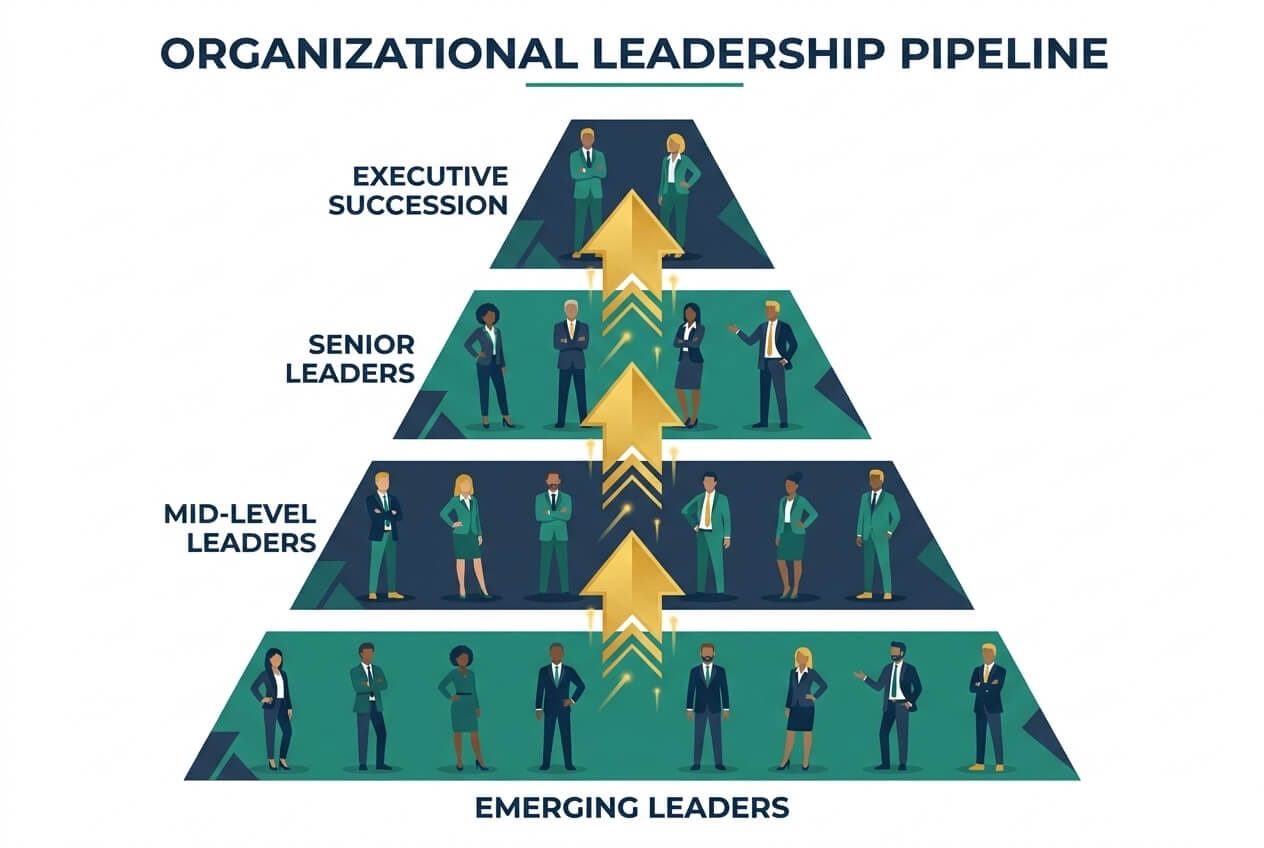
The difference matters. A succession plan names who replaces whom. Succession depth means multiple leaders at multiple levels are ready to step into expanded roles before anyone needs them to. The plan is a document. Depth is a capability.
Faraday Future had a board. What it didn’t have was enough leadership bench strength to absorb three simultaneous departures without scrambling for replacements. The response - appointing the head of HR and a previously uninvolved independent director to fill board seats - signals that the pipeline was thin.
OpenAI faces a variation of the same problem. When a CTO, a VP of Product, and a VP all leave within days of each other, the organization doesn’t just lose roles. It loses institutional knowledge, relationship networks, and strategic context that took years to build. No succession plan accounts for that kind of concentrated loss.
For leadership development professionals, the pattern here is familiar. Organizations invest heavily in developing people for their current roles and under-invest in preparing them for roles that don’t exist yet. The result: when change comes fast, the bench is empty.
Building succession depth requires a different approach. It means identifying high-potential leaders two and three levels below the C-suite and giving them exposure to strategic decisions, cross-functional challenges, and leadership coaching before they need it. The organizations that handle transitions well aren’t the ones with the best plan on paper. They’re the ones where someone is always ready to step up because they’ve been developing in that direction for years.
What Founder Dependency Really Costs
Lorne Michaels has led Saturday Night Live for all 51 of its seasons. When he says NBC will destroy the show without him, he may be right. But that’s the problem, not the defense.
An organization that cannot function without one person has a leadership development failure, not a leadership strength. Michaels built something extraordinary. He also built something fragile - a creative institution whose identity, standards, and institutional knowledge live inside one person’s head.
Consider what this looks like from a coaching perspective. Say you’re working with a founder who has been at the center of every major decision for three decades. The organization has learned to route everything through them. People defer. Processes assume their involvement. The founder’s identity and the organization’s identity have merged.
The coaching work isn’t about retirement planning. It’s about separating organizational capability from individual presence. Can the values, standards, and creative instincts be distributed across a team rather than concentrated in one person? Can the organization develop its own identity - one that honors the founder’s legacy but doesn’t depend on their daily involvement?
Director Morgan Neville suggested that two or three people - perhaps Tina Fey, Seth Meyers, and Steve Higgins - could co-lead SNL after Michaels. That’s not a succession plan. That’s a hypothesis. And the difference between a hypothesis and a plan is years of deliberate leadership development that, by Michaels’ own admission, hasn’t happened.
Transition as a Leadership Development Accelerator
Transitions aren’t just risks to manage. They’re the highest-leverage moments for leadership development.
EMU’s Brendan Kelly demonstrates this. His first moves as president were strategic and visible: a direct-admission partnership that signals accessibility, parking changes that show he listens, and a strategic planning process that invites participation. These aren’t just good PR. They’re leadership development in action - a new leader building credibility through early wins that demonstrate values and judgment.
For coaches working with leaders in transition, the first 90 days represent a compressed learning cycle. Every decision carries outsized signal value. The team is watching. The board is watching. The new leader’s choices in this window establish the norms, priorities, and cultural tone that will define their tenure.
Transition coaching at its best doesn’t just help the incoming leader survive. It helps them use the transition itself as a development accelerator. What assumptions do they carry from their previous role? What do they need to unlearn? Where should they listen before acting, and where should they act quickly to build momentum?
The same applies to outgoing leaders. Transitions are also development moments for the person leaving. How they hand off relationships, knowledge, and authority shapes their legacy and models leadership maturity for the rest of the organization.
Organizations that treat transitions as development opportunities rather than disruptions to be minimized get a double return: stronger incoming leaders and more resilient organizations.
Building Transition-Ready Organizations
What does leadership development look like when it takes succession seriously? Four practices separate transition-ready organizations from ones that scramble.
Pipeline development at multiple levels. Succession depth doesn’t start at the C-suite. It starts with directors and senior managers who are getting exposure to strategic decision-making, cross-functional collaboration, and executive coaching. When organizations develop leaders only for their current role, they guarantee a gap when the next role opens.
Transition coaching for both incoming and outgoing leaders. The incoming leader needs support navigating a new context, building relationships, and making high-signal early decisions. The outgoing leader needs support transferring knowledge, letting go of control, and managing the identity shift that comes with stepping away from a role they’ve held for years.
Organizational identity beyond the founder. This is the hardest work and the most important. It means articulating the organization’s values, standards, and ways of working in terms that don’t reference a specific person. It means building systems and culture that can hold those standards even when the original leader is gone.
Early-win strategy design. New leaders benefit from entering with a 90-day plan that includes 2-3 visible, achievable wins. These wins build credibility, demonstrate judgment, and create momentum. Kelly at EMU did this instinctively. It can also be designed deliberately as part of transition coaching.
What is succession depth and why does it matter?
Succession depth refers to having multiple leaders at multiple organizational levels who are prepared to step into expanded roles. Unlike a succession plan, which names specific replacements for specific positions, succession depth is an organizational capability. It means the bench is deep enough to absorb unexpected departures, simultaneous transitions, or rapid growth without scrambling for external candidates.
How can executive coaches support leaders during organizational transitions?
Coaches support transitions in several ways: helping incoming leaders identify early wins that build credibility, supporting outgoing leaders through the identity shift of stepping away, facilitating knowledge transfer between predecessors and successors, and helping organizations develop transition playbooks that turn leadership changes into development accelerators rather than disruptions.
What is the difference between a succession plan and succession readiness?
A succession plan is a document that identifies who replaces whom in key roles. Succession readiness is the organizational condition where those replacements are actually prepared - they have the skills, relationships, strategic context, and leadership presence to step into expanded roles effectively. Many organizations have plans but lack readiness because they under-invest in developing leaders before they are needed.
Make Leadership Transitions a Repeatable Capability
Let’s map your biggest succession risks—bench gaps, founder dependency, and the first 90 days—and choose a practical coaching path.
Book a Free Consultation →