

Reflective Practice in Coaching: How Coaches Develop Skills Between Sessions
How do coaches develop skills between sessions?
Reflective practice after every session closes the gap between intention and action. The five-question framework — tracking attention, noticing pulls, distinguishing following from leading, naming what went unsaid, and examining the opening ten minutes — takes ten minutes and builds precision that volume alone never produces. Writing answers forces specificity mental review skips.
Key Takeaways
- A five-question after-session review framework - what you tracked, where you felt pulled, where you led vs. followed, what you withheld, and what you would change in the first ten minutes - turns every session into a structured development opportunity.
- Skill atrophy is invisible from inside the session: presence, neutrality, and listening depth narrow without the coach noticing because the sessions still feel competent.
- Volume builds fluency; reflection builds precision. A coach with 150 reviewed sessions develops faster than one with 300 unreflected ones.
Why Practice Alone Is Not Enough
Reflective practice is the structured habit of reviewing your coaching sessions to close the gap between what you intended and what actually happened. Without it, practice confirms existing patterns rather than building new skill. Coaches who reflect deliberately after sessions develop faster than those who rely on volume alone - because volume produces fluency, not precision.
A coach with 300 sessions and no reflective practice is not more skilled than a coach with 150 sessions who reviews each one. They are more comfortable. Sessions flow, clients leave satisfied, and the coach develops strong opinions about their own coaching without any evidence to support them. They believe they listen well because they intend to listen. They believe they follow the client because that is their philosophy. But ask them to describe a specific moment in yesterday's session - what the client said, what they chose to do, why - and there is a gap.
That gap between intention and action is where all the development lives. And you cannot see it without stopping to look.
The problem is not that coaches lack intelligence or motivation. The problem is that the skills that reflective practice maintains erode quietly. Presence narrows. Listening becomes pattern-matching. Neutrality hardens into a familiar stance that feels balanced but is actually a well-worn preference. None of this shows up in session flow. It only shows up when someone examines the session after it ends.
The Practice-to-Reflection Arc
Coaching skill develops through a three-stage arc: conceptual knowledge (reading and training), applied attempt (practicing in sessions), and reflective learning (examining what happened and why). Most coaches complete the first two stages repeatedly but skip the third. Without reflection, the arc stops at attempt - and attempt without examination just grooves existing habits deeper.
The ICF recognized this pattern when it built reflection into its credentialing requirements. Mentor coaching and supervision are not bureaucratic checkboxes. They exist because the profession learned that practice without structured review does not reliably produce growth. An ICF ACC program introduces coach training hours, but the hours after training - the ones spent reviewing your own sessions - are where the credential becomes competence.
What makes the arc generative rather than circular is the quality of the reflection stage. Vague self-assessment ("that session felt good") does not count. The reflection needs structure, specific questions, and ideally another set of eyes. A five-minute review with the right questions after every session will develop your coaching faster than a weekend workshop once a year. That structured reflection stage is also where our course on choosing and sequencing coaching tools gives coaches a shared vocabulary for naming what they are actually reaching for in a session.
The rest of this article gives you that structure.
The After-Session Review Framework
This five-question framework is designed for the ten minutes after a coaching session ends. Each question targets a different dimension of coaching craft. Used consistently, these questions surface patterns you cannot detect in real time - the subtle drifts in presence, listening, and neutrality that accumulate across sessions without anyone noticing.
Write your answers. Brief notes are fine. The act of writing forces specificity that mental review skips over.
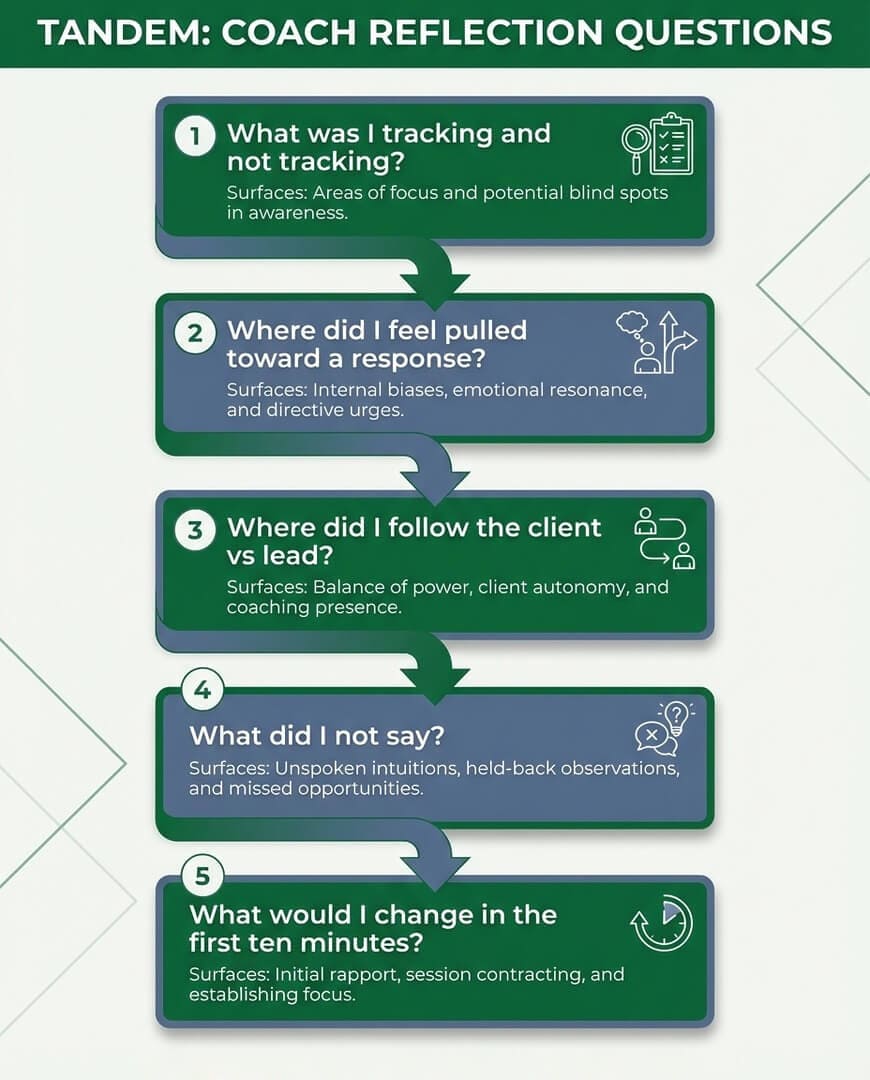
1. What was I tracking - and what was I not tracking?
This question surfaces your attentional habits. Every coach develops default channels of attention: some track emotion, others track language, others track energy shifts. The valuable information lives in what you were not tracking. If you consistently notice what clients feel but miss what they avoid saying, that blind spot shapes every session you run. Name what you tracked. Then ask what else was happening that you missed.
2. Where did I feel pulled toward a response?
The pull is the signal. Every coach experiences moments where a client says something and the coach's internal response arrives before any deliberate thought. Maybe it was the urge to reassure. Maybe an interpretation formed instantly. This question is not about whether you acted on the pull - it is about noticing that it happened. The pulls you do not notice are the ones that run your sessions.
3. Where did I follow the client - and where did I lead?
Following and leading are both valid coaching moves. The development question is whether you chose deliberately or defaulted unconsciously. Coaches under caseload pressure tend to lead more, especially when they recognize a familiar pattern in the client's story. "I have seen this before" becomes a shortcut that replaces curiosity with efficiency. Track where you followed and where you led. Notice whether the leading was a choice or a habit.
4. What did I not say?
The unsaid observation, the withheld reflection, the question you considered and swallowed. Sometimes holding back is the right call - not every observation serves the client's agenda. But when you consistently withhold the same kind of intervention across multiple clients, that is not discretion. That is avoidance wearing a professional mask. Name what you held back and examine why.
5. What would I change about the first ten minutes?
The opening of a coaching session sets the trajectory for everything that follows. How you contracted, where you focused attention, what you chose to explore first - these early moves constrain the entire conversation. This question asks you to look at session structure with fresh eyes. Not "what went wrong" but "what different first move might have opened a different path."
Getting started: You do not need all five questions every time. Start with whichever question feels most uncomfortable. That discomfort is the signal that this question is touching something your current practice avoids. After two weeks, you will know which questions consistently reveal the most useful patterns for you.
Using the Framework in Peer Groups
Peer supervision groups turn a solo practice into a shared development tool. The five after-session review questions work as a group reflection lens that structures peer feedback around craft rather than opinion.
The format is simple. One coach presents a recent session in two to three minutes - not the full story, just the moments that stood out or felt uncertain. The group then uses the five questions as their listening framework. Instead of offering advice ("you should have asked about the relationship with her manager"), each person names what they noticed through a specific question's lens: "I heard you tracking emotion but not tracking the avoidance pattern around deadlines."
The first two questions - what was I tracking and where did I feel pulled - surface the coach's inner game. These are the hardest to see alone because they involve the habits of attention and reaction that feel transparent to the person inside them. Having three other practitioners listen for your pulls and blind spots is qualitatively different from trying to catch them yourself.
The last three questions - following versus leading, what went unsaid, and the first ten minutes - surface session craft. These are easier to self-assess but benefit from peer perspective because other coaches bring different defaults. A coach who tends to lead early will notice when the presenting coach did the same thing. A coach who avoids direct observations will recognize that pattern in someone else before recognizing it in themselves.
One rule makes this work: the group describes what they noticed, not what they would have done differently. The goal is to expand the presenting coach's awareness, not to replace their judgment with the group's.
Which Skills Atrophy First
Not all coaching skills erode at the same rate. Three skills atrophy fastest without deliberate maintenance, and each has a different trigger that accelerates the decline.
Coaching presence is the first skill to narrow under caseload pressure. When a coach runs five sessions in a day, presence contracts from full open awareness to a reliable but limited baseline. The coach shows up, stays attentive, responds appropriately - but the wide-angle awareness that catches what is happening beneath the client's words shrinks to a narrower focus on getting through the session. Presence atrophy is invisible to the coach because the sessions still feel competent.
Engaged neutrality erodes first when client content resonates personally. A coach whose own leadership experience mirrors the client's situation stops holding the neutral stance and starts subtly guiding from personal history. The shift is incremental. It starts as empathy, becomes identification, and eventually replaces the client's exploration with the coach's map of the territory. The coach still feels neutral because the resonance makes their guidance feel natural rather than imposed.
Listening depth atrophies first under fatigue and familiarity. When a coach has heard variations of the same client struggle dozens of times, listening shifts from genuine curiosity to pattern-matching. The coach hears the first thirty seconds and internally categorizes: "confidence issue," "boundary problem," "role transition." From that point forward, they are listening for confirmation rather than discovery. The session still works. The client still gets value. But the coach has stopped learning from what the client is actually saying and started hearing what they expected to hear.
All three atrophy patterns share one feature: they are invisible from inside the session. The after-session review questions are designed to catch these specific drifts before they become permanent features of your coaching.
The skills that erode first are always the ones that felt most solid. That is what makes the erosion so hard to catch.
When Peer Reflection Is Not Enough
Peer reflection and formal supervision serve different developmental functions. Peer groups are a session-level tool - they help you examine specific moments, specific choices, specific sessions. Supervision is a pattern-level tool - it helps you see the recurring dynamics across sessions that peer reflection cannot reach.
ACC Certification — $3,999
60+ training hours, mentor coaching, and supervision included. Everything ICF requires for your Associate Certified Coach credential.
Bring a session to your peer group. Bring a pattern to your supervisor.
If you notice through your after-session reviews that you consistently avoid confrontation across three different clients, that is not a session problem. That is a pattern. A peer group might help you see it, but they lack the developmental authority and training to help you work with it. A mentor coach or supervisor can help you trace where the avoidance originates, how it serves you, and what it costs your clients.
The practical boundary: if the same theme appears in your after-session review notes three or more times across different clients, it has graduated from session-level to pattern-level. That is when formal supervision earns its investment. Understanding how reflective practice feeds learning loops at both levels - session and pattern - is what separates coaches who plateau from coaches who continue developing across their entire career.
A peer group helps you see a moment differently. A supervisor helps you see why you keep arriving at the same moment.
Frequently Asked Questions
How long does a reflective practice session take?
Ten minutes after each coaching session is enough if you use structured questions. The five-question framework is designed for brevity. Writing brief notes - even single sentences per question - is more valuable than an hour of unstructured mental review. The constraint of time forces specificity.
Can I do reflective practice alone or do I need a group?
Both work, and they develop different things. Solo reflection builds self-awareness habits and catches your own patterns between sessions. Peer group reflection adds perspectives you cannot generate alone - other coaches see your blind spots because they have different ones. Start solo with the five questions. Add a peer group when you notice the same themes recurring and want external perspective on them.
Is reflective practice the same as coaching supervision?
No. Reflective practice is a self-directed habit you do after every session. Supervision is a formal developmental relationship with a trained mentor coach or supervisor. Reflective practice is a session-level tool that helps you examine individual moments and choices. Supervision is a pattern-level tool that helps you work with recurring dynamics across your entire practice. Most coaches benefit from both - daily reflection and periodic supervision.
ACC Certification — $3,999
60+ training hours, mentor coaching, and supervision included. Everything ICF requires for your Associate Certified Coach credential.
See the ACC Program →