Maintaining Coaching Presence: What Erodes It and How to Recover
What erodes coaching presence and how do I recover?
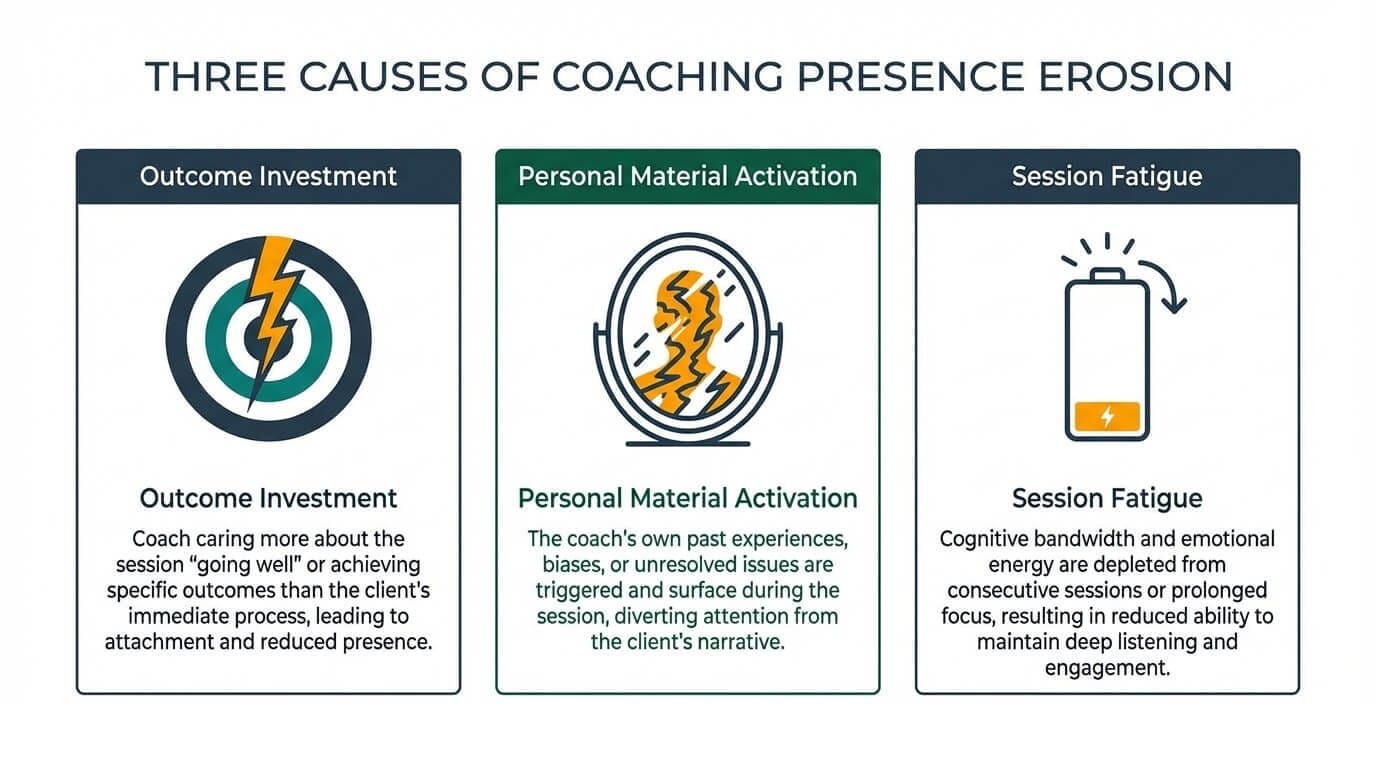
Three causes erode presence: outcome investment, where the coach starts steering toward desired insights; personal material activation, when the client's words trigger the coach's own experience; and session fatigue, which flattens curiosity by the third or fourth session. Recovery happens mid-session through physical grounding, silently repeating the client's last phrase, and pausing instead of compensating.
In every PCC mentor coaching group I lead, there comes a moment when someone describes a session that technically went well. The questions were good. The client reached an insight. There was forward motion. And then they say, "but it felt hollow."
What they are describing is a session they conducted rather than a session they were in. The questions landed because they were well-constructed, not because they emerged from genuine contact with the client. The insight happened because the structure worked, not because the coach was present when it arrived.
That distinction between conducting and being present sits at the center of the coaching skills and the presence they rest on. It is the difference between a session that produces outcomes and a session where the coach and client are actually in the room together. ICF Competency 5 measures this. But what it measures is harder to develop than most coaches expect, because presence is not a personality trait. It is a capacity that erodes under predictable conditions and recovers through specific moves.
Key Takeaways
- Coaching presence is a measurable skill that erodes under predictable conditions, not a fixed personality trait.
- Three causes drive presence erosion mid-session: outcome investment, personal material activation, and session fatigue.
- Recovery happens during the session, not between sessions, through body grounding, client-language re-entry, and deliberate pauses.
- Session count does not predict presence development; the quality of reflection between sessions does.
- At ACC level presence is effortful; at PCC it becomes reliable; at MCC it is the baseline rather than the aspiration.
What Coaching Presence Is
Coaching presence, as described in the ICF Core Competencies, asks the coach to be "fully conscious and present with the client, employing a style that is open, flexible, grounded, and confident." The language sounds clear enough. In practice, coaches often reduce it to attentiveness: I am paying attention, so I must be present.
Attentiveness is necessary but insufficient. A coach can track every word, follow every thread, and still not be present. Presence requires that the coach's own agenda, predictions, and evaluative machinery go quiet enough for the client's experience to register without distortion.
PCC Marker 5.3 describes this as "dancing in the moment." When coaches in mentor coaching groups are asked what dancing in the moment looks like in their body, in the pacing of their questions, in the quality of silence they hold, most go quiet. Not because they lack experience. Because the question asks them to describe something they have felt but never examined.
The coach who is truly present is not tracking the session's direction. They are responding to what the client just said, just showed, just avoided. Their next question does not come from a mental queue. It comes from what is alive in the room right now. That quality of responsiveness cannot be performed. It can only happen when the coach's internal noise drops low enough for the client's signal to come through clearly.
This is why presence resists technique. You cannot follow a protocol for it the way you can follow a protocol for a GROW session. Presence is a condition you create and maintain, and the moment you start monitoring whether you are maintaining it, you have already partially left. Presence itself cannot be trained as a checklist, but the judgment about which tool to set aside so presence can happen can be, and that is what our coaching tools course develops.
What Presence Produces
When a coach is genuinely present, the session finds its own level. The client stops performing competence or explaining context and starts thinking out loud. Questions arrive at the right moment not because the coach planned them but because the coach heard something the client barely said and followed it.
Clients experience this as being seen. Not evaluated, not guided, not supported in a therapeutic sense. Seen. The coaching relationship shifts from transactional to developmental, and that shift does not come from the coach's skill with models or questions. It comes from the quality of the coach's attention.
The sessions coaches remember for years are never about a brilliant question. They are about a moment when someone was fully in the room.
ICF assessors look for specific markers of this quality. PCC Marker 5.1 evaluates whether the coach "acts in response to the whole person of the client," meaning the coach's interventions reflect not just what the client said but how they said it, what they skipped, what their energy did when they approached certain topics. A coach running their session from a mental plan cannot do this. A coach who is present does it without trying.
The sessions coaches remember years later almost always involved this quality. Not brilliant questions. Not perfect timing. A coach who was fully in the room when the room needed them to be.
What Erodes Presence
Presence does not disappear all at once. It erodes, usually from one of three specific causes that operate below the coach's conscious awareness. Recognizing these causes is the first step toward recovering presence before the session is over.
Outcome Investment
The coach starts caring whether the session goes well. This sounds counterintuitive, because coaches are trained to care about their clients. But caring about the client is different from caring about the session's trajectory. A coach who is invested in the outcome starts steering. Their questions develop a slight directional pull. They lean toward insights the client "should" reach. The internal experience is subtle: a flicker of satisfaction when the client moves in a productive direction, a flicker of anxiety when they do not.
Outcome investment often intensifies with high-stakes clients or during mentor coaching assessments. The sessions that matter most are the ones where presence erodes fastest, because the coach's internal evaluator comes online.
Personal Material Activation
The client says something that touches the coach's own experience. A leadership struggle that mirrors the coach's own. A relationship pattern the coach recognizes from their life. A decision the coach has strong feelings about. The coach's awareness splits: part of them is with the client, part of them is with their own material. The split may last only a few seconds. But those seconds are enough to change the quality of the next question from one that serves the client to one that serves the coach's need to resolve their own reaction.
This is not countertransference in the clinical sense. It is the ordinary reality of coaching. The issue is not that it happens. The issue is that coaches often do not notice when it has happened.
Session Fatigue
Cognitive bandwidth depletes over a coaching day. The third session is not the same as the first. By session four or five, the coach's capacity for genuine presence has narrowed. They can still ask good questions. They can still track the conversation. But the quality of attention has thinned. The coach is present enough to function, not present enough to be responsive in the way Marker 5.3 describes.
Fatigue does not announce itself. It arrives as a slight flattening of curiosity, a preference for familiar questions, a tendency to let the client's narrative run longer than necessary because intervening requires energy the coach does not currently have.
Each of these causes links to engaged neutrality as a presence discipline. When presence erodes, neutrality is usually the first thing to go. The coach who has lost presence has already started forming opinions about what the client should do.
Losing Presence from the Inside
Knowing the three causes is useful. But the more practical question is: what does presence erosion feel like from inside the session, in real time, while it is happening? There are three internal signs worth learning to recognize.
Evaluating the session while you are in it. You catch yourself assessing: is this going well? Did that question land? Are we making progress? This evaluative stance means you have split your attention between being in the conversation and watching the conversation. You are now both coach and audience, and neither role is getting your full capacity.
Forming your next move before the client finishes speaking. The client is still talking and you already know what you are going to ask. Your question might even be a good one. But it was generated from three sentences ago, not from what the client is saying right now. You have moved from responsive to anticipatory, and the client will feel the difference even if they cannot name it.
Relief when the client provides direction. The client says something like "so I think I should probably just talk to her directly" and you feel a small wave of relief. Not because that is the right move for the client. Because it resolves your own cognitive load. The client just told you what to coach toward, which means you no longer have to hold the open space where you did not know what was coming next. That relief is a signal that you had already started to struggle with being present.
If you notice you have left the room, that noticing is the skill. Everything after it is just coming back.
None of these signs mean the session is failing. They mean you have partially left the room. The question is whether you notice before the session ends or only during reflection afterward.
Recovery During a Live Session
The most useful thing about presence as a skill is that it recovers. Not between sessions. During them. Three moves help a coach come back to full presence once they notice they have drifted.
Deliberate return to the body. This is not meditation advice. It is a specific technique: when you notice you have left, bring your awareness to your feet on the floor, your back against the chair, the weight of your hands. Two seconds. The physical grounding interrupts the cognitive loop that pulled you away. Mentor coaches teach this because it works in real time without disrupting the conversation.
Client's last words as re-entry point. Instead of reaching for your planned question, repeat the client's last phrase silently to yourself. Not as a listening technique, but as a way to re-enter the conversation where you left it. How listening quality signals presence level is well documented in the ICF markers. When your listening drops, your presence has already dropped. Returning to the client's exact language pulls you back into their world instead of your own.
Create space instead of filling it. When you notice you have lost presence, your instinct will be to compensate. Ask a sharp question. Make a strong observation. Do something that demonstrates you are still engaged. Resist that instinct. Instead, create a pause. "I want to sit with what you just said for a moment." That pause is not performative. It is the time you need to actually come back. The client will experience it as depth. You will experience it as recovery.
These three moves share a common principle: they work because they are honest. You are not pretending you were present the whole time. You are returning to presence with the tools you have in the moment. Over time, the return gets faster. The drift gets shorter. That is the skill.
Presence Across Credential Levels
At ACC level, presence is effortful. The coach is managing multiple cognitive demands: remembering the competencies, tracking session structure, formulating questions, monitoring time. Presence competes with these demands for bandwidth, and it often loses. ACC coaches frequently report that their best presence moments happen by accident, not by design.
Structured Presence Development
ACC through MCC - our programs build presence as a deliberate skill, not a side effect of experience. Mentor coaching includes specific presence observation and feedback.
At PCC level, presence becomes more reliable. PCC Marker 5.1 evaluates whether the coach responds to the whole person, which requires a steadier baseline of presence than ACC assessment demands. The PCC coach has internalized enough of the structural elements that they can release some cognitive bandwidth toward actually being in the room. But PCC presence still erodes under the three conditions described above. The difference is that PCC coaches notice the erosion more quickly.
At MCC level, presence is the baseline rather than the aspiration. MCC coaches describe presence not as something they achieve during sessions but as something they notice when it is absent. The skill has shifted from "how do I become present" to "what pulled me away and how quickly do I return." This is a development arc, not a personality difference.
If you are working toward PCC or preparing for assessment, your PCC certification program should include specific work on presence as a measurable skill, not just a concept you understand.
Developing Presence
A coach with 500 sessions who has never examined their presence patterns is not more present than a coach with 100 sessions who has brought this question to supervision repeatedly. Volume does not produce presence. Reflection does.
The coaches who develop fastest at the PCC-to-MCC transition are not the ones with the most hours. They are the ones with regular supervision relationships where presence is a standing topic. Understanding how reflective practice rebuilds presence is what separates coaches who accumulate experience from coaches who develop from it.
Five hundred sessions without examining your presence patterns will not teach you what ten sessions with honest supervision will.
If you want to work on this, start with the simplest question: in your last five sessions, when did you leave? Not whether you left. When. That question, asked regularly in supervision, does more for presence development than any technique or framework.
Frequently Asked Questions
Can coaching presence be learned or is it a personality trait?
Presence is a skill, not a trait. It develops through deliberate practice and honest self-observation, particularly in supervision. Some coaches start with a natural ease in being present, but every coach can develop presence over time. The three-cause erosion model applies regardless of personality. What matters is learning to notice when you have left and how to return.
How does coaching presence differ from mindfulness?
Mindfulness is awareness of your own internal state. Coaching presence includes that awareness but extends it outward: you are present to the client, to the relationship, and to what is happening in the space between you. A mindful person in a coaching session might be deeply aware of their own breath and thoughts. A present coach is aware of what the client just did with their voice, their posture, their silence. Presence is relational, not solitary.
What is the difference between ICF Competency 4 and Competency 5?
Competency 4 (Cultivates Trust and Safety) is about the relationship conditions the coach creates. Competency 5 (Maintains Presence) is about the coach's own internal state during the session. You can have strong trust without full presence, and you can be present without having fully established trust. In practice, presence deepens trust because clients feel the quality of the coach's attention. But they are measured separately for good reason: one is relational architecture, the other is moment-to-moment awareness.
How many coaching sessions does it take to develop strong presence?
Session count is less predictive than reflection quality. A coach who accumulates 500 hours without examining their presence patterns may not develop the skill at all. A coach who brings presence questions to supervision after every 10 sessions will develop noticeably within a year. The variable is not volume but the quality of self-observation between sessions.
This is worth bringing to your next peer supervision group: in your last five sessions, were there moments where you noticed yourself conducting rather than being present? What triggered the shift? What brought you back?
Develop Presence From Day One
Our ACC program treats presence as a measurable skill from the first module. You will practice recovery moves in live sessions with MCC-level feedback on what your attention actually does.
Learn About the ACC Program →