The GROW Model in Coaching: A Practitioner’s Guide to Sessions That Actually Move Forward
How do I use the GROW Model in coaching?
Treat GROW as conversation architecture, not a checklist. Move between Goal, Reality, Options, and Will based on what the client says, not a preset sequence. When Reality reveals a deeper goal, cycle back and re-contract. Each phase serves the conversation. The conversation does not serve the phases.
The GROW model has four letters and about forty different ways to use it wrong.
Most coaches learn GROW as a sequence: set a Goal, explore Reality, generate Options, establish Will. Move through them in order. Check each box. Session complete. The problem is that coaching sessions do not move in order. Clients circle back. Goals shift mid-conversation. Reality reveals something the stated goal did not account for. A coach who treats GROW as a checklist will hit all four phases and still miss the client entirely.
Experienced coaches use GROW differently. They treat it as a conversation architecture - a structure they can move through, return to, and reshape in real time. The difference between these two approaches shows up in session recordings. One sounds like an interview with four sections. The other sounds like a conversation that goes somewhere. Building that real-time judgment across a full toolkit, not just one model, is what our self-paced ICF CCE course on coaching tools develops.
This distinction matters for coaches working toward the broader coaching skill set that ICF credentials measure. GROW is not just a model to learn. It is a structure to practice until it becomes invisible.
Key Takeaways
- GROW is a recursive structure, not a linear checklist - experienced coaches cycle between phases as the session demands
- Each GROW phase maps to a specific ICF competency, and PCC assessors evaluate the behaviors each phase produces, not the labels
- When a client’s goal shifts during the Reality phase, cycling back to Goal is not a failure - it is the session working correctly
- Resistance looks different at each phase: hedged goals, over-extended reality exploration, single-option declarations, and vague commitments
What the GROW Model Is (and Is Not)
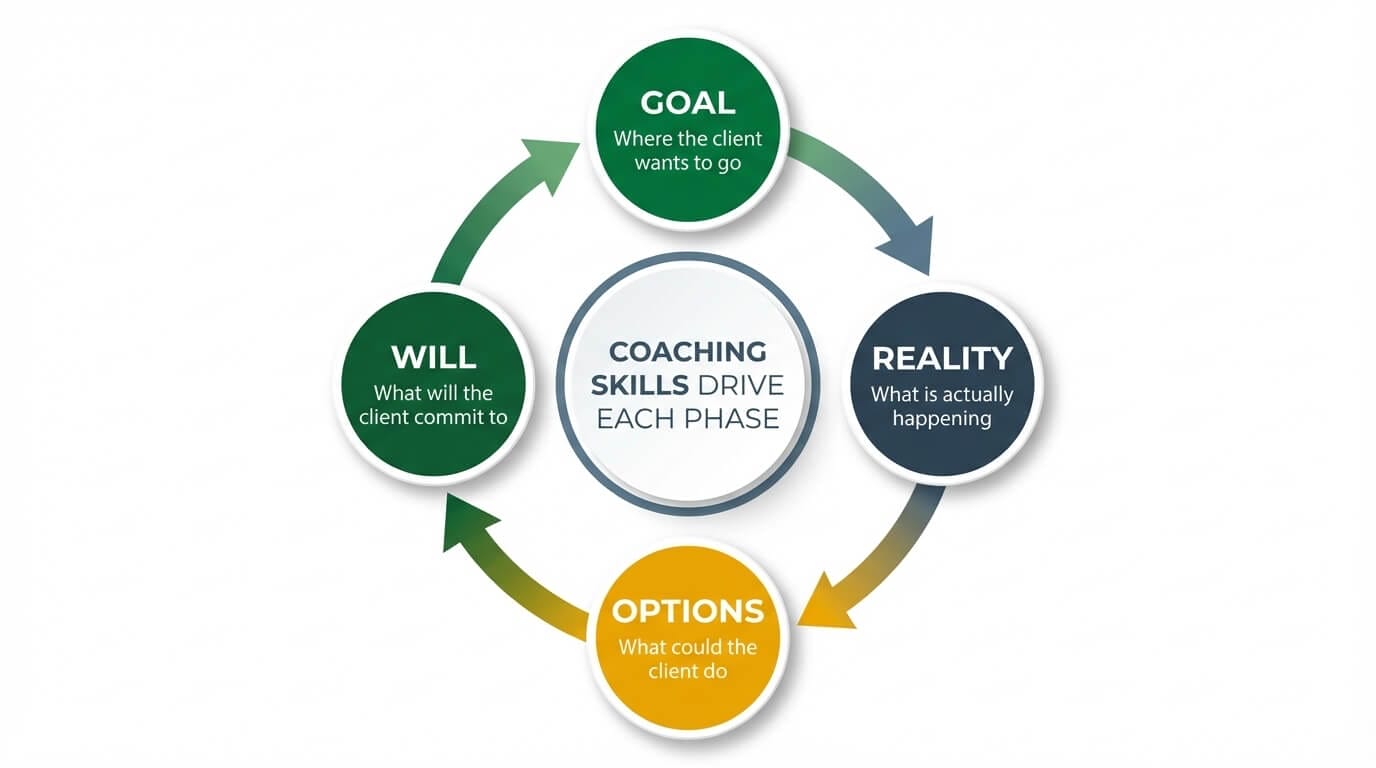
The GROW model is a coaching framework that maps a conversation into four phases: Goal (what the client wants to achieve), Reality (what is actually happening), Options (what the client could do), and Will or Way Forward (what the client commits to doing). John Whitmore formalized GROW in his 1992 book Coaching for Performance, building on work with Graham Alexander and Alan Fine. The framework was designed to support goal setting within coaching conversations - not to replace the coach’s judgment about where a conversation needs to go.
That last point gets lost in most training. GROW as a coaching model is taught as a sequence to complete, and coaches internalize it that way. They learn to move from G to R to O to W, in order, one pass. The session becomes a form to fill out. This is GROW as a checklist.
GROW as a conversation architecture works differently. The phases are not steps. They are regions of a conversation that a coach can enter, leave, and return to based on what the coachee is actually saying. A coach using GROW structurally might start in Goal, move to Reality, hear something that reframes the goal, return to Goal, then move through Options and Will with a different target. The phases serve the conversation. The conversation does not serve the phases.
The behavioral difference is audible. In a recorded session where GROW operates as a checklist, you hear the coach managing transitions: “So now that we’ve talked about where you are, what options do you see?” In a session where GROW operates as a structure, transitions happen because the client moved there - and the coach followed. One version sounds like an interviewer working through a script. The other sounds like a practitioner who knows where the conversation is and where it needs to go.
The Four GROW Phases
Each GROW phase is designed to produce a specific outcome in the coaching session. Each phase also has a characteristic error that coaches make - not because they are bad coaches, but because the error is the natural consequence of using the model mechanically. Understanding both the intent and the failure mode of each phase is what separates a coach who knows GROW from a coach who can use it.
Goal: Where the Client Wants to Go
The Goal phase establishes what the client wants to work on in this session. Not the engagement goal from the coaching agreement - the session goal. What do you want to walk out of here with today?
The most common error is rushing this phase. Coaches move to Reality before the client has named a goal they actually hold. The client says “I want to work on my communication with my direct reports” and the coach accepts it and moves on. But that goal was the first thing the client thought of, not necessarily the thing they most need to explore.
ICF Competency 3 (Establishes and Maintains Agreements) anchors this phase. PCC Marker 3.6 is specific: the coach “partners with the client to identify or reconfirm what they want to accomplish in this session.” The word reconfirm matters. It means the goal gets checked more than once. A coach who accepts the first stated goal and never revisits it has completed the Goal phase mechanically. A coach who checks the goal against what emerges later in the session is using GROW structurally.
Reality: What Is Actually Happening
The Reality phase maps the client’s current situation. Not what they think about their situation - what is actually occurring. Who said what. What happened. What the data shows.
The characteristic error here is asking “What have you tried?” too early. This question collapses Reality into retrospective evaluation. The client stops describing what is happening and starts assessing what they have already done about it. The session shifts from exploration to analysis, and the coach is now facilitating a post-mortem rather than coaching.
Consider this scenario: a coachee begins describing a conflict with a peer. Two sentences in, the coach asks “What approaches have you taken so far?” The coachee pivots from describing the conflict to cataloging their failed interventions. The emotional texture of the situation disappears. The session becomes a strategy review.
The correction is to let Reality breathe. Ask what is happening before asking what has been tried. Active listening at Level 2 and Level 3 - hearing not just the words but the patterns and the unsaid - is what makes the Reality phase productive rather than procedural. ICF Competency 6 (Listens Actively) is the anchor here.
The fastest way to kill a Reality phase is to ask “What have you tried?” before the client has finished describing what is actually happening. You get a strategy review when you needed a map.
Options: What the Client Could Do
The Options phase expands the solution space. The goal is for the client to generate multiple possible paths forward - not to find the one right answer.
This is where directive coaching sneaks in most often. A coach hears the situation, sees an obvious option, and frames it as a question: “Have you thought about having a direct conversation with them?” That is not an Options question. That is advice wearing a question mark.
The difference matters. When a coach offers an option disguised as a question, the client evaluates the coach’s suggestion instead of generating their own. The solution space narrows to one. If that option does not work, the client returns to the next session having failed at the coach’s idea rather than having learned from their own.
Powerful questions in the Options phase sound different: “What else could you do?” “If your current approach were not available, what would you try?” “What would someone you admire do in this situation?” The coach’s job is to expand, not narrow. ICF Competency 7 (Evokes Awareness) measures this - the coach helps the client see what they could not see before, not what the coach already sees.
If the client leaves having executed your idea instead of discovering their own, you ran a consulting session with a coaching label on it.
Will: What the Client Commits To
The Will phase - sometimes called Way Forward - is where the client articulates what they will do, when, and how they will know they did it.
The characteristic error is treating this as a to-do list. The coach generates an action plan for the client, checks each item, and asks “Does that work for you?” The client nods. They leave with a list they did not create and a commitment they did not own.
Will is not the coach’s plan for the client. It is the client’s articulation of what they choose and why. The commitment must be specific enough that the client knows by Friday whether they followed through. “I’ll have a conversation with my manager” is not specific. “I will ask my manager for 15 minutes on Thursday to discuss project priorities” is. ICF Competency 8 (Facilitates Client Growth) anchors this phase - the client must own the forward motion.
When the Goal Shifts Mid-Session
Halfway through Reality, a client says something that changes everything. They walked in wanting to talk about a team conflict. Three minutes into describing the situation, they say: “The real problem is I don’t know if I want this role anymore.”
Build These Skills with ICF Training
Tandem's ACC program develops these competencies through structured practice with MCC-level mentors.
The stated goal - resolving the team conflict - was a surface goal. The emerging goal - evaluating their fit in the role - is what the session actually needs to address. This happens more often than most coaches expect, and it is not a problem. It is the session working correctly. The Reality phase did its job: it revealed something the Goal phase could not yet see.
The coach now has three choices:
- Ignore it and continue toward the original goal. This is the most common error. The coach has a plan. The session is moving. Cycling back feels like starting over.
- Pivot to the new goal without re-contracting. This creates drift. The session follows the new thread but without explicit agreement. The coachee may not even realize the goal shifted.
- Explicitly cycle back to Goal and re-contract. This is the correct move.
Option three sounds like this: “Before we go further - what you just described sounds different from what we set out to explore today. Which one do you want to work on?”
The client pauses. That pause is the signal. They are choosing between the safe goal (the one they walked in with) and the real goal (the one that just surfaced). Whichever they choose, the session now has an honest target.
Most coaches do not do this because they are tracking the session arc, not the goal. They measure progress by how far through GROW they have moved. Cycling back to Goal from Reality feels like regression - like the session has failed its original agenda.It has not. Cycling back is the recursive quality that separates structural GROW from checklist GROW. The model was designed for this. Whitmore did not describe a linear process. He described a framework where phases inform each other. A Reality exploration that changes the Goal is not a detour. It is the framework operating at full capacity.Coaches who use GROW as a one-pass sequence are using a version of the model that training created, not the one Whitmore intended.
A session where the goal shifts mid-conversation has not failed. A session where the goal should have shifted but the coach kept moving forward - that one failed.
The coaching agreement from session one is a starting point, not a contract that locks the conversation in place for twelve weeks. Goals develop as the client develops. A coach who can cycle back mid-session without losing the client’s trust or the session’s momentum is demonstrating the kind of structural flexibility that PCC assessors recognize.
Resistance at Each Phase
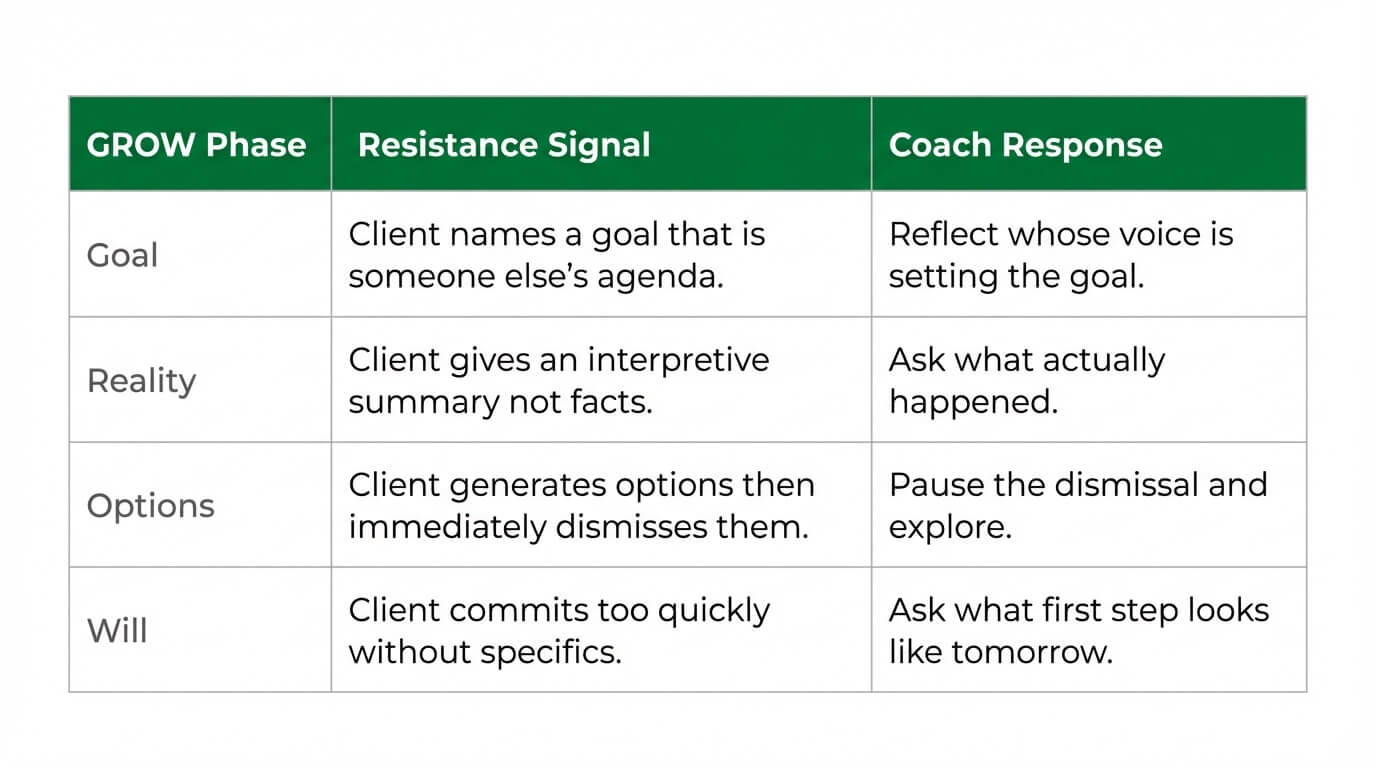
Resistance in a GROW session is not about difficult clients. It is about what avoidance looks like from the coaching side of the conversation at each specific phase. Each phase produces its own pattern, and recognizing the pattern early changes what the coach does next.
Goal Phase Resistance
The client states a goal they think they should want. The language gives it away: “I suppose I should work on my delegation skills” or “My manager says I need to be more strategic.” The goal is framed as someone else’s agenda or as an obligation rather than a desire. The coach move: explore whose goal this actually is before proceeding. “That sounds like something that matters to your manager. What matters to you about it?”
Reality Phase Resistance
Over-extension. The client keeps adding context, qualifications, and history. The session gets richer in detail but never moves forward. The coaching diagnostic: have you asked “What else?” more than twice without new information emerging? If so, Reality is functioning as avoidance. The client is staying in analysis because moving to Options means confronting what they might need to do. The coach move: name the pattern. “We’ve covered a lot of ground here. What stands out as most important?”
Options Phase Resistance
The client generates one option and declares it the answer. Or they generate three options that are all the same option with different labels. The solution space has not actually expanded. The coach move: “If that option were not available, what else could you do?” or “What would a completely different kind of solution look like?” The resistance breaks when the client stops evaluating options and starts generating them.
Will Phase Resistance
The commitment sounds right but has no specificity. “I’ll talk to my team about this.” When? About what exactly? What will you say? The coach move is not to interrogate - it is to test whether the client can describe the action concretely enough that both of you will know on Friday whether it happened.Vague commitments are usually commitments the client does not actually intend to keep. The specificity test surfaces this before the session ends rather than at the next session when the client reports that “it didn’t happen.” A Will phase that produces a concrete, time-bound action the client chose for themselves has done its job. A Will phase that produces a polite list of intentions has not.
GROW and ICF Competencies
Each GROW phase maps to a specific ICF Core Competency. This mapping is not theoretical. It is how PCC assessors evaluate recorded coaching sessions - and understanding it changes how coaches use the model.
| GROW Phase | ICF Competency | What Assessors Evaluate | Key PCC Marker |
|---|---|---|---|
| Goal | 3: Establishes and Maintains Agreements | Does the coach partner with the client to define session focus? | 3.6: Reconfirms session goal |
| Reality | 6: Listens Actively | Does the coach hear beyond words - patterns, emotions, the unsaid? | 6.1-6.3: Reflects what client communicates |
| Options | 7: Evokes Awareness | Does the coach expand the client’s thinking without directing? | 7.4-7.5: Shares observations that provoke new insight |
| Will | 8: Facilitates Client Growth | Does the client own the forward action? | 8.3-8.4: Client-generated accountability |
The critical insight for coaches working toward PCC: assessors are not looking for the GROW phases by name. They are looking for the behaviors each phase is designed to produce. A coach can use GROW’s labels correctly - “Let’s look at your options now” - and fail the PCC markers because they asked leading questions during the Options phase. A coach who never mentions GROW at all can demonstrate all four competencies because they listened, partnered, expanded awareness, and supported client-owned action.
The model is a scaffold. The competencies are what you are building. In our ACC curriculum, coaches practice GROW across 60+ supervised coaching hours, recording sessions and receiving mentor coaching feedback on the behaviors - not the labels - that each phase produces.
When GROW Is Not the Right Model
GROW works when the client can state a goal clearly enough to begin. That covers a large percentage of coaching sessions. But not all of them.
When the client’s issue is primarily relational - “I want to feel differently about how my team interacts with me” - GROW’s goal-first structure can force premature clarity. The CLEAR model (Contracting, Listening, Exploring, Action, Review) front-loads the relational dynamic through its Contracting phase. A coach working with relational complexity might find CLEAR opens the conversation more naturally than GROW’s “What do you want to achieve?”
This is not a criticism of GROW. It is a use-case boundary. Every coaching model has situations where it fits and situations where it does not. Knowing when GROW is the right tool and when a different structure serves the client better is itself a coaching skill - one that develops through experience with multiple frameworks, not through loyalty to one.
There is also the question of coaches who abandon GROW entirely and call it “intuition.” Some of them are MCC-level practitioners whose model is so internalized it has become invisible - they are using GROW (or something structurally equivalent) without naming it. Most of them, though, are coaches who have not internalized any model and are improvising. The difference shows in session recordings: the first group produces sessions with clear structure and natural flow. The second group produces sessions that meander. For a full comparison of GROW, CLEAR, OSCAR, and other frameworks, see how GROW compares to other coaching models.
Frequently Asked Questions
What does GROW stand for in coaching?
GROW stands for Goal, Reality, Options, and Will (sometimes called Way Forward). The acronym maps four phases of a coaching conversation, from establishing what the client wants to achieve through to committing to specific action. John Whitmore formalized the model in his 1992 book Coaching for Performance.
Is the GROW model only for professional coaching?
GROW is used in professional coaching, manager coaching conversations, mentoring, and self-reflection. The framework is adaptable. However, the practitioner depth described in this article - cycling back, reading resistance, mapping to ICF competencies - applies specifically to professional coaching contexts where the coach is developing session-level skill.
How long should a GROW coaching session take?
A full GROW-structured coaching session typically runs 30 to 60 minutes. The phases are not equal in length. Reality and Options usually take the most time. Goal and Will can be brief when the client arrives with clarity. In manager coaching conversations, a GROW-structured check-in can be as short as 10 to 15 minutes.
What is the difference between GROW and SMART goals?
GROW is a conversation framework that structures an entire coaching session across four phases. SMART (Specific, Measurable, Achievable, Relevant, Time-bound) is a goal-setting criteria set that applies within the Goal and Will phases of GROW. They are complementary, not competing. A coach might use SMART criteria to sharpen the goal inside a GROW-structured session.
In your next three coaching sessions, track one thing: how often you move into Reality before the client has fully named their goal. Do not change anything about how you coach. Just notice. Count the sessions where the goal you started with was the goal you ended with, and the sessions where it shifted.
That tracking exercise maps directly to the distinction between checklist GROW and structural GROW. A coach who notices the shift is already operating structurally. A coach who does not notice has found their development edge.
For coaches working toward PCC, here is a supervision question worth sitting with: describe a session where you used the GROW structure and a session where you deviated from it. What drove the deviation? Was it intentional? The answer reveals whether your use of GROW is conscious or habitual - and that difference is what structuring a coaching conversation well actually requires.
Start Your Coaching Journey
60+ training hours, mentor coaching, and supervision included. Everything ICF requires for your Associate Certified Coach credential.
See ACC Program Details →