Formation Collision in Team Coaching: Why Friction Is Structural
Why is friction structural in team coaching?
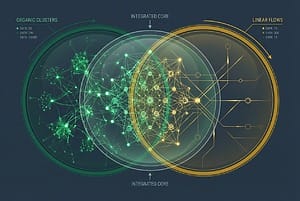
Friction is structural because two professional formations doing their jobs well will produce predictable tension. The CFO earning trust through precision and the CMO earning trust through resonance are each trained to protect something the organization needs. Formation collision is generated by specific IMPRINT dimensions, not personality, making the friction both predictable and map-able.
Key Takeaways
- Friction between leadership team members is almost always structural, not personal - two professional formations doing their jobs well will produce predictable tension
- Four IMPRINT dimensions generate most team collisions: Trust Currency mismatch, Information Processing mismatch, Natural Time Horizon mismatch, and Risk & Uncertainty mismatch
- The coaching opportunity is not to resolve the tension but to help the team metabolize it - the friction gives the team access to perspectives a single formation cannot generate
- Three coaching moves for formation collision: name the structural dynamic without pathologizing either side, surface what each formation is protecting, and build translation capacity rather than agreement
- Maintaining presence (ICF Competency 5) in a multi-formation room requires specific awareness of which formations pull the coach's attention and which exhaust it
You are facilitating a leadership team session. The CFO and CMO are in a familiar pattern - the CMO presents a brand investment proposal, the CFO asks for the ROI model, the CMO says the value is in long-term brand equity that resists quantification, and the CFO says she cannot approve what she cannot measure. The CEO turns to you. Both leaders are frustrated. Both feel misunderstood. Both are right. You are not watching a communication problem. You are watching two professional formations - precision-as-trust-currency and resonance-as-trust-currency - collide in a room that needs both.
This is the moment that separates the team coach who mediates arguments from the team coach who surfaces structural dynamics. The phrase "personality conflict" is almost always a misread. What the team is navigating is formation collision - and the coach who cannot see the formation underneath the friction will spend sessions mediating symptoms instead of surfacing the dynamic that produces them.
The insight is straightforward: two professional identities doing their jobs well will produce friction. That friction is not a bug. It is the mechanism by which the team accesses perspectives it could not generate from a single formation. The CFO's insistence on quantified justification and the CMO's insistence on narrative momentum are both correct - and the team's capacity depends on its ability to hold both without collapsing into one. The coach who understands formation collision patterns can name the dynamic without pathologizing either side, surface what each formation is protecting, and help the team build the translation capacity that turns predictable friction into productive tension.
This chapter - Chapter 24 in the formation-aware coaching cluster - opens Part V: Formation in Teams. Everything the coach learned about individual IMPRINT dimensions and functional formations now enters the team room. The formation collision layer complements the team coaching models you already use - PERILL, Hawkins' systemic frame, Clutterbuck's developmental model. It adds something they do not provide: the why underneath the friction they describe. The framework maps this territory through three lenses that the next chapters develop in detail:
- Bilateral collision patterns (this chapter + Ch 25): the specific dynamics between formation pairs
- Formation center of gravity (Ch 26): which formation the team structurally amplifies - and which it suppresses
- Coach formation bias (Ch 27): the coach's own blind spots in multi-formation rooms
Anatomy of a Formation Collision
Before mapping specific collision pairs, it helps to understand the structural anatomy. Formation collisions are not random personality clashes. They are generated by specific IMPRINT dimensions operating as designed across different professional identities. Four dimensions do most of the work.
Identify the IMPRINT Dimension Driving the Heat
If the team keeps reliving the same fight, let’s quickly diagnose whether it’s Trust Currency, Information Processing, Time Horizon, or Risk—and what to do next.
Trust Currency mismatch. Each formation earns credibility differently. The Trust Currency dimension explains why: finance earns trust through precision (being right about the numbers), marketing earns trust through resonance (having the idea that moves people), legal earns trust through prevention (catching what could go wrong). When one formation's currency is invisible or illegible to another, neither trusts the other's judgment. The CFO who cannot see brand equity as evidence and the CMO who cannot see scenario modeling as vision are each asking the other to lead with a currency the other does not carry.
Information Processing mismatch. Different epistemic standards determine what counts as evidence. The Information Processing dimension maps these differences: finance processes through quantitative models, marketing through narrative pattern recognition, legal through precedent analysis, technology through systems architecture. When a CFO presents a risk analysis and the CMO experiences it as suffocation of an idea that has not yet had room to breathe, neither is being difficult. They are processing the same decision through structurally different cognitive tools - and each experiences the other's tool as inadequate.
Natural Time Horizon mismatch. Different temporal clocks create urgency misalignment. The Time Horizon dimension reveals why "urgent" means something different to every formation. Finance plans in fiscal quarters and annual cycles. Marketing moves in campaign windows of days to months. Legal evaluates risk on timelines spanning years to decades. When the CFO says "we need to see returns," they mean within the fiscal planning horizon. When the CMO says "this will pay off," they may mean in brand equity terms that do not crystallize on any timeline finance recognizes as valid. They are not just disagreeing about what to invest in. They are evaluating against different clocks, and neither realizes it.
Risk & Uncertainty mismatch. Different risk orientations produce different evaluations of the same decision. The Risk dimension traces how formations relate to uncertainty: finance hedges variance from forecast, legal prevents exposure, technology iterates through failure, marketing experiments toward resonance. "Responsible" means something different to every formation in the room. When legal says "we need to think about this carefully" and technology says "we need to move now," they are not disagreeing about the importance of the decision. They are evaluating it against risk orientations that differ by structure, not by judgment.
The CFO and CMO collision is not two people who cannot communicate. It is two professional identities, each trained to protect something the organization needs, experiencing each other's competence as obstruction. The coach who sees the formation underneath the frustration is coaching a different problem than the coach who sees two executives who need better communication skills.
Not all collisions activate the same dimensions or at the same intensity. Seven functional roles produce twenty-one unique pairings. Some are high-frequency leadership team dynamics - Finance and Marketing, Legal and Technology - that surface in nearly every executive team session. Others emerge primarily in cross-functional projects or during specific organizational events. Chapter 25 details the four highest-impact collision patterns. This chapter teaches the coach how to read any collision by identifying which dimensions are generating the friction.
What the Coach Does with the Collision
Reading the formation collision is the private awareness. What follows are the three moves that translate that awareness into coaching work - the above-the-waterline interventions that the team coach can deploy without ever naming the framework.
Name the structural dynamic without pathologizing either side. Not: "You two have a communication problem." Not: "The CFO is too rigid." Not: "The CMO needs more data." Instead: "You are each asking the other to lead with your trust currency. What would a decision framework look like that honors both the narrative and the numbers?" The structural naming removes the personal charge. It surfaces the pattern without assigning blame - and it gives the team something to work with rather than something to defend against.
Surface what each formation is protecting. Every formation's position in a collision is protecting something the organization needs. The CFO protecting measurement rigor is protecting the organization from undisciplined investment. The CMO protecting narrative freedom is protecting the organization from data-paralysis. The legal leader insisting on review cycles is protecting against liability the team will not feel for years. The technology leader pushing for deployment speed is protecting against competitive windows that close permanently. The coach helps both sides see what the other is protecting - not just what the other is blocking.
Build translation capacity, not agreement. The goal is not consensus between formations. It is the team's ability to translate between them - to hear precision as care, to hear narrative as vision, to hear caution as stewardship, to hear urgency as competitive awareness. Translation capacity is the structural competence that formation collision develops. The coach who pushes for agreement between fundamentally different professional orientations will get either false consensus (one formation suppresses its perspective) or endless negotiation (neither formation yields because neither should). The better question: "What would it cost you to translate into their language first?"
What not to do. Mediate for resolution. Side with the formation that matches the coach's own IMPRINT patterns - the most common error, and the subject of Chapter 27. Treat the collision as a problem to fix rather than a dynamic the team learns to metabolize. The distinction matters: fixing implies there is a correct state where the friction disappears. Metabolizing means the team builds the capacity to use the friction productively - to access what each formation sees that the others cannot.
When Collision Signals a Real Problem
Not all team friction is productive formation collision. The coach must differentiate three sources - and all three can be present simultaneously.
Formation collision (productive). Two competent formations operating from their professional lenses. Friction is structural and predictable from the formations involved. The coaching work is translation capacity. The signal: both leaders are performing well individually, the tension surfaces around decisions that require their different perspectives, and the pattern repeats across different topics.
Interpersonal conflict (personal). Genuine mistrust, historical grievance, political maneuvering. Formation may be a contributing factor, but the personal dynamic is the primary driver. The signal: the friction persists even when the topic changes, the emotional charge is disproportionate to the decision at stake, or the tension is asymmetric - one person carrying substantially more than the other.
Organizational dysfunction (systemic). The collision is amplified by structural incentives that make formation translation impossible. Finance controls the budget and is measured on cost reduction. Marketing is measured on spend and cannot get approval for the investment its metrics require. The formations are not just colliding - the organizational structure is making the collision worse. The signal: the same collision recurs regardless of who holds the roles, the incentive structures pit the formations against each other by design, and individual goodwill cannot bridge the systemic gap.
Formation awareness helps the coach ask the right diagnostic question: "Is this friction structural (formations doing their jobs), personal (the people involved), or systemic (the organization making this collision worse)?" The formation lens is one layer of reading, not the only one. A collision that appears to be formation-based may have a personal history underneath. An interpersonal conflict may be amplified by formation dynamics that neither party recognizes. The coach who holds all three possibilities simultaneously is reading the full picture.
Preparing for the Multi-Formation Room
This is where ICF Competency 5 - Maintains Presence - takes on specific meaning for team coaches. In a multi-formation room, presence means something particular: the coach must stay present with formation dynamics they may find uncomfortable or unfamiliar. A coach whose own formation gravitates toward narrative will find the CFO's insistence on numbers exhausting. A coach whose formation gravitates toward precision will find the CMO's insistence on unquantified value frustrating. A coach with a people-oriented formation will find legal's binary risk language cold. Maintaining presence across formations is a specific skill this lens develops - and Chapter 27 addresses the self-awareness work that supports it.
Before the session:
- Map which formations are in the room. Which collision pairs are likely to activate? The four collision generators above tell you where to look.
- Identify the highest-impact collision pattern for this team. Chapter 25 provides the four detailed patterns - Finance and Marketing, Legal and Technology, Marketing and Operations, HR and Finance - and the IMPRINT dimensions each activates.
- Check your own formation bias: which formations will you find easier to listen to? Which will exhaust you? Which will you unconsciously privilege?
In the session, listen for:
- "They just don't get it" - a formation currency that is illegible to another formation
- "We've been over this" - the same collision surfacing repeatedly because the structural dynamic has not been named
- "Can we just agree on..." - premature convergence that suppresses one formation's legitimate perspective
- "That's not realistic" - one formation's time horizon or risk orientation dismissing another's
Each of these phrases is a formation collision signal. The coach who hears "they just don't get it" and responds with a communication exercise is coaching the symptom. The coach who hears the same phrase and asks "What is it that you need them to see - and what might make that invisible from where they sit?" is coaching the structural dynamic.
The formation collision lens does not replace the team coaching models you already carry. It sits underneath them - explaining why the dynamics those models describe keep recurring, why certain team members predictably clash on certain decisions, and why some tensions in the room resist resolution no matter how skillfully the coach facilitates. The next chapters develop each of the three lenses in depth: the four highest-impact bilateral collision patterns, the formation center of gravity that determines which voices the team structurally amplifies, and the coach's own formation bias that shapes what the coach notices and misses. For coaches building team coaching certification, Tandem's ACTC program provides the team coaching foundations these chapters build upon.
Coaching a CFO–CMO Collision Right Now?
Bring your live scenario. We’ll map the structural dynamic and outline 1–2 moves to build translation capacity in the room.
Book a Free Consultation →