
Why Smart Leaders Keep Solving the Wrong Problem
Why do leaders keep solving the wrong problem?
Leaders solve the wrong problem because their career-installed filter shows them a real problem — just not the only problem the situation requires. The CFO solves the financial model while the strategic narrative goes unwritten. The filter is perceptual, not cognitive. You see what formation trained you to see, and the rest becomes background noise.
Two leaders sit in the same presentation. The CFO notices the revenue projection that does not reconcile with the expense assumptions on slide twelve. The CTO notices the architectural dependency that nobody has accounted for in the timeline. The CMO notices that the positioning narrative contradicts the brand promise made to the market last quarter. The COO notices that the implementation plan assumes a capacity the operations team does not have. Each leader heard the same presentation. Each leader heard a different presentation.
What you notice first — the number that does not fit, the system that will not scale, the narrative that will not land, the process that will break — was not chosen. It was installed by a career that trained your attention on specific signals and made everything else background noise. Your career did not just teach you what to think about. It taught you what to see.
Key Takeaways
- Every function installs a specific information processing filter — what you notice first, what counts as evidence, how you structure problems, and what your trained blind spot is.
- The filter is not a preference. It is perceptual. You literally see different information in the same situation depending on which career shaped you.
- At senior levels, the information processing filter becomes both the leader’s greatest asset and their primary constraint — because the room needs processing capacity the filter cannot provide.
- A coach who understands your information processing pattern helps you see the filter itself, not just what it shows you.
What Your Career Taught You to See
Information processing is the most invisible formation dimension. Identity is felt. Risk instincts are triggered. Time horizons are debated. But the way you process information — what your attention selects, what your mind does with it, and what it discards — operates below conscious awareness. It is not a thinking style. It is the architecture of the thinking itself.
Finance: the number that does not fit. The attentional filter notices variances, inconsistencies, and unvalidated assumptions. Information is structured through models — quantified, scenario-tested, sensitivity-analyzed. What counts as evidence: documented data, verifiable assumptions, defensible methodology. The trained blind spot: information that cannot be quantified is processed as noise rather than signal. The executive intuition that comes from pattern recognition across decades of deals is dismissed because it does not come with footnotes.
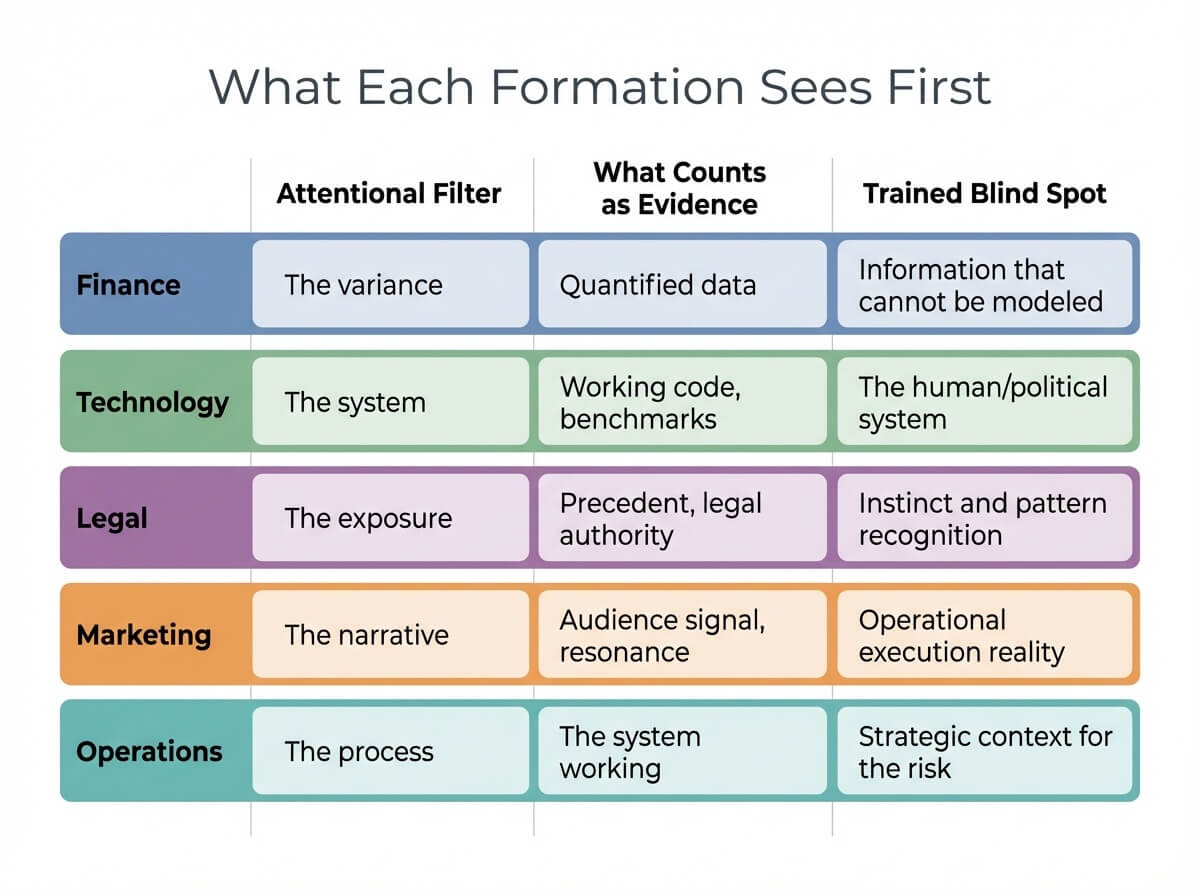
Technology: the system underneath. The attentional filter notices architecture, dependencies, and scalability constraints. Information is structured through systems thinking — how components interact, where the bottleneck lives, what scales and what breaks. What counts as evidence: working code, performance benchmarks, technical validation. The trained blind spot: the human system. The CTO who can see every technical dependency in an architecture diagram may not see the political dependency that will actually determine whether the project ships.
Legal: the exposure waiting to happen. The attentional filter notices liability, regulatory risk, and contractual gaps. Information is structured through precedent and argumentative logic. What counts as evidence: documented authority, legal analysis, established case law. The trained blind spot: “instinct” is not trusted. The pattern recognition that runs faster than a legal brief is dismissed as insufficient evidence — even when it is built on decades of case analysis.
Marketing: the narrative arc. The attentional filter notices audience resonance, competitive positioning, and story coherence. Information is structured through narrative — what will land, what the market is ready to hear, how this positions against the competition. What counts as evidence: audience signal, market movement, creative resonance. The trained blind spot: the operational reality underneath the narrative. The campaign that will land perfectly with the audience may be impossible to execute at scale.
Operations: the process that will break. The attentional filter notices throughput, capacity constraints, and execution dependencies. Information is structured through workflow — what happens first, what depends on what, where the bottleneck lives. What counts as evidence: the process working. The trained blind spot: the strategic context. The operations leader who can see every execution risk may not see the market opportunity that justifies accepting the risk.
You do not just think differently from your peers. You see differently. The same presentation, the same data, the same conversation — and five different leaders walk away having processed five different realities.
When Filters Collide
The strategy review. The CEO presents a growth initiative. The CFO’s filter activates: where is the financial model? What are the assumptions? What is the sensitivity to a delayed launch? The CTO’s filter activates: can the platform support this? What are the architectural dependencies? The CMO’s filter activates: does this narrative work for the market? Will customers care? The COO’s filter activates: can we actually execute this? Do we have the capacity?
Solving the Problem You Can See?
If you have been suspecting there is a problem in the room that your filter is not showing you, that suspicion is where coaching starts.
Each leader asks a question from their filter. Each question is legitimate. And the meeting devolves into four parallel conversations that never converge — because each leader is processing different information from the same input and no one realizes they are not talking about the same thing.
This is why leadership teams have blind spots. The room’s collective filter — shaped by its center of gravity — determines which information gets processed and which gets treated as noise. In a technology-dominated room, the operations leader’s capacity warning gets filtered out. In a finance-dominated room, the marketing leader’s narrative insight gets filtered out. The filter is collective, and the room does not know it is filtering.
The “smart leaders solving the wrong problem” pattern is almost always an information processing collision. The leader is solving the problem their filter shows them — which is a real problem. It is just not the problem the situation requires. The CTO solves the architecture problem while the adoption problem goes unaddressed. The CFO solves the financial model while the strategic narrative goes unwritten.
The Filter as Asset and Constraint
The information processing filter is the leader’s most valuable asset at the functional level. The CFO who notices the variance that nobody else caught. The CTO who sees the scalability constraint that would have killed the project. The GC who identifies the regulatory exposure that would have become a crisis. Each filter saves the organization from problems that other filters would miss.
At the senior level, the filter becomes a constraint — not because it stops working, but because the role demands processing capacity the filter cannot provide. The CTO who needs to evaluate a market opportunity cannot rely on the technical filter alone. The CFO who needs to assess a talent strategy cannot rely on the quantitative filter alone. The role asks for multi-dimensional processing, and the formation provides single-dimensional depth.
The response under pressure is predictable. The leader defaults to their filter — solves the problem they can see with the tools they have — and the problem they cannot see goes unaddressed. The strength that earned the promotion becomes the lens that constrains what the leader can perceive at the new level.
What Coaching Changes
You cannot turn off the filter. It is perceptual, not cognitive. But you can learn to see it — to notice when your filter is active, what it is selecting for, and what it is discarding. That metacognitive awareness is the difference between a leader who is captive to their processing pattern and one who uses it deliberately.
A coach who understands information processing helps the leader notice the filter in real time. “You have described three technical risks. What is the non-technical risk you have not mentioned?” That question does not criticize the technical filter. It activates a complementary channel. The leader does not stop seeing architecture. They start also seeing the human system, the narrative, the market timing — the dimensions their filter was trained to background.
The coaching is not about processing information differently. It is about processing more of it — expanding the bandwidth of what the leader perceives without abandoning the depth the formation provides. The CFO who notices the variance and notices the room’s emotional response to the variance. The CTO who sees the architecture and sees the political dynamics that will determine adoption. Same filter. Wider aperture.
Seeing the Filter
The problem that smart leaders keep solving is real. It is just not the only problem in the room. The filter your career installed shows you the problem it was trained to see — with remarkable precision and speed. That precision is your asset. The narrowness of the aperture is your constraint.
The expansion is not about thinking differently. It is about noticing what you are not thinking about. That awareness — the ability to see the filter rather than just seeing through it — is what separates leaders who are excellent within their formation from leaders who can operate across formations.
If you have been solving the problem you can see while suspecting there is another problem the room needs you to see, a coach who understands your information processing pattern is where the aperture starts to widen.
Frequently Asked Questions
Why do leaders trained in the same company still walk out of the same meeting with different takeaways?
Each function installs a distinct attentional filter: what counts as a signal, what counts as evidence, and what gets treated as background noise. A CFO notices the variance on slide twelve; a CTO notices the architectural dependency; a CMO notices the narrative contradiction. They are choosing what to focus on through years of trained perception, beyond a conscious decision in the room.
At what point does a leader's information processing strength become a liability?
The filter is an asset at the functional level, where depth matters most. It becomes a constraint at senior levels, where the role demands multi-dimensional processing the formation was never designed to provide. Under pressure, the leader defaults to the problem they can see: the CFO solves the financial model while the strategic narrative goes unwritten, and the gap goes unaddressed.
What does coaching actually change about how a leader processes information?
The filter is perceptual, not cognitive, so you cannot simply decide to turn it off. Coaching builds metacognitive awareness: the capacity to notice the filter operating in real time, what it is selecting for, and what it is discarding. The goal is processing more information through the same formation depth with wider aperture.
A Conversation About What You Are Not Seeing
A 30-minute call where your coach understands your processing filter and helps you notice what it selects for and what it discards.
Book a Free Consultation →