The Strength That Got You Promoted Is the One Holding You Back
Why is my greatest strength holding me back?
Your greatest strength earned the promotion precisely because it delivered clear, fast feedback — it told you daily that you were competent. The new role offers slower, ambiguous feedback, so the reflex is to retreat to the old strength. The stronger the skill, the harder the release, because it is fused with your professional identity.
You were promoted because of a specific strength. The precision that caught what others missed. The technical depth that solved what others could not. The operational instinct that kept things running when everything else was falling apart. The creative vision that moved people. That strength was not one skill among many. It was the skill — the thing your career was built on, the thing the organization noticed, the thing that earned the title you now hold.
And it is the thing holding you back.
Not because it was wrong. Not because it is no longer valuable. Because the room that promoted you for it now needs something else from you, and the patterns your career installed keep pulling you back to the strength like a reflex. The paradox is structural: the stronger the skill that earned the promotion, the harder it is to release — and the more the new role needs you to.
Key Takeaways
- The skill that earned the promotion is not the skill the new role rewards. The paradox is universal, but the specific way it manifests depends on which career shaped you.
- The strongest professional skills are the hardest to release because they are fused with professional identity. Letting go does not feel like delegation. It feels like losing yourself.
- Working harder at the old strength is the default response to the new role’s challenges — and it is the one response that will not work.
- A coach who understands the paradox does not tell you to stop doing the thing you are best at. They help you see what the old strength is substituting for.
The Pattern
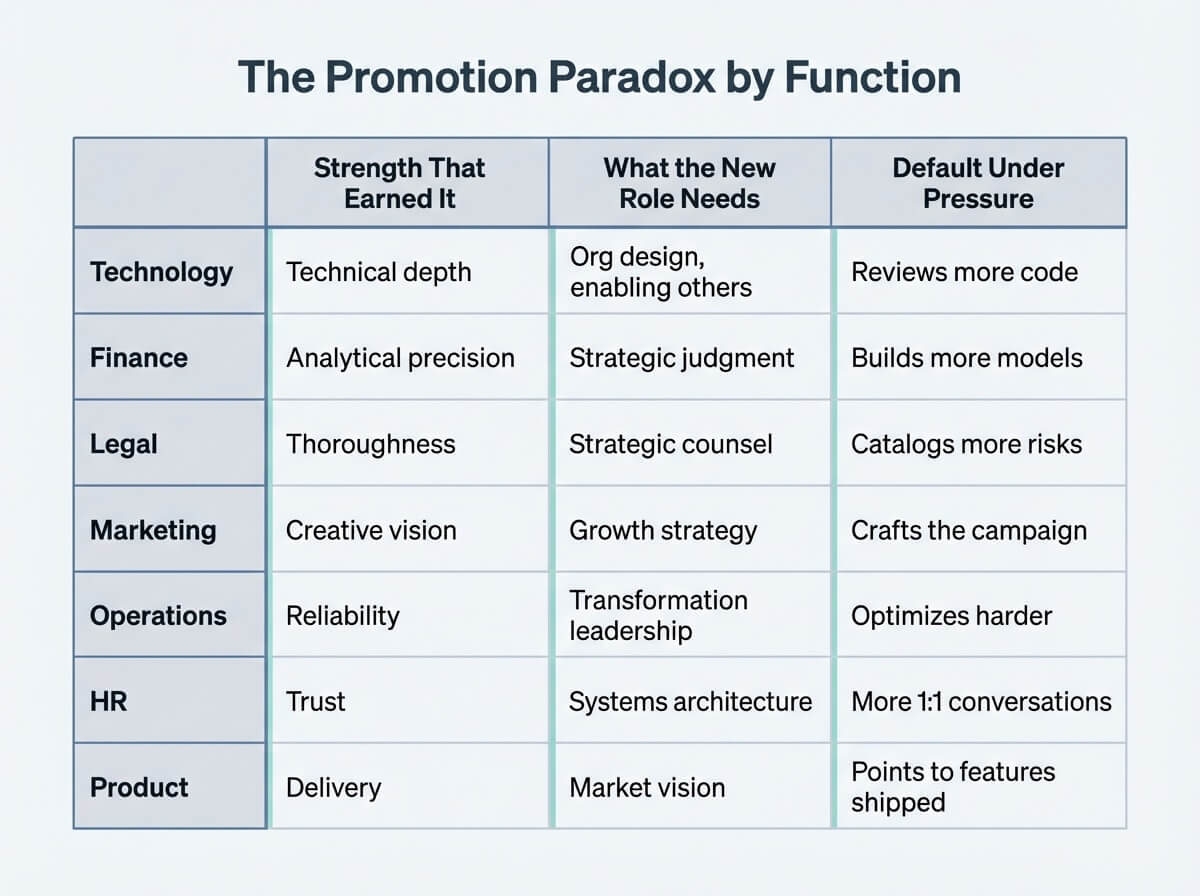
The promotion paradox follows the same structure across every function. Three elements. First: the strength that earned the promotion. Second: the new demand the role creates. Third: the default behavior under pressure, which is always a return to the strength — executed harder, faster, or more intensely — because it is the only proven strategy the leader has.
| Formation | The Strength That Earned It | What the New Role Needs | The Default Under Pressure |
|---|---|---|---|
| Finance | Analytical precision — sees what others miss | Strategic judgment the data cannot fully justify | Builds a more rigorous model |
| Technology | Technical depth — solves what others cannot | Organizational design, enabling others to build | Reviews more code, solves harder bugs personally |
| Legal | Thoroughness — finds every risk | Strategic counsel, helping the org navigate through risk | Catalogues more risks without prioritizing |
| Marketing | Creative vision — makes things that resonate | Growth strategy, connecting creativity to business outcomes | Crafts the campaign personally rather than building the narrative |
| Operations | Reliability — keeps things running | Transformation leadership, designing what the org needs to become | Optimizes existing processes harder |
| HR | Trust — the person everyone comes to | Systems architecture, connecting people strategy to enterprise value | Takes on more individual coaching conversations |
| Product | Delivery — defines the right thing and gets it built | Market vision, spending credibility before evidence arrives | Points to features shipped as evidence of contribution |
Read your row. The third column is where you go when the new role feels uncertain. And the new role almost always feels uncertain — because the currency shifted and the old strategy is the only one you have.
Why the Strongest Skills Are Hardest to Release
If the strength were ordinary, releasing it would be uncomfortable but manageable. The promotion paradox is sharpest when the strength is exceptional — when it is the thing the leader is genuinely better at than almost anyone around them. The CTO who really is the best engineer on the team. The CFO who really does build the most reliable models. The GC whose legal analysis really is the most thorough in the organization.
The excellence is not imagined. It is real. And that reality makes the release harder, not easier, because the leader is not just letting go of a habit. They are letting go of the thing that provides the clearest evidence, every day, that they are good at what they do. The code review is not about quality control. It is about the feeling of competence. The model is not about accuracy. It is about the feeling of being the person who sees what others cannot.
The paradox is not that the strength stops working. It is that the strength works so well at the old level that the leader cannot stop spending it — even when the new level is asking for a completely different investment.
Under pressure, the reflex intensifies. The CTO reviews more code. The CFO builds more scenarios. The COO optimizes harder. The GC documents more risk. Each behavior feels like contribution. Each behavior is a retreat to the formation’s home ground — the place where the leader knows they are excellent — and a withdrawal from the new territory where excellence has not yet been established.
The Inflection Point
There is a predictable moment, usually four to six months after the promotion, when the leader realizes the old strategy has hit diminishing returns. The effort is the same or greater. The impact is less. The feedback — “think more strategically,” “delegate more,” “step back from the details” — keeps arriving. And the leader’s first instinct is to try the old strategy one more time, with more intensity, because the alternative is stepping into a space where they do not yet feel competent.
In the Window?
If you are four to six months past a promotion and the old strategy is producing less than it used to, that inflection is where coaching creates the most movement.
This inflection is where most leaders either break through or settle in. Breaking through means accepting that the strength is no longer the primary contribution — that it has become table stakes rather than currency — and beginning to invest in the new capability the role demands. Settling in means continuing to do the old work at a higher level, producing excellent functional output while the leadership contribution the organization actually needs goes undelivered.
Most leaders who “plateau” after a promotion have not failed. They have settled in to the old strength at the new level. The organization gets a very competent senior individual contributor rather than the leader it promoted them to become. Both the leader and the organization sense something is missing. Neither can quite name it.
What Coaching Surfaces
Generic coaching hears the promotion paradox and offers delegation frameworks, time management strategies, and prioritization tools. A coach who understands the formation hears the same pattern and asks a different question: “What is the old work giving you that the new work does not yet provide?”
That question goes beneath the behavior to the identity. The answer is almost always a version of: certainty. Competence. The feeling of knowing I am good at this. The old work provides clear, fast feedback. The new work provides slow, ambiguous feedback. The leader retreats to the old work not because they lack the capability for the new — but because the new work does not yet tell them they are doing well.
The coaching that follows from that recognition is not about giving up the strength. It is about understanding what the strength is substituting for — and finding another way to meet the need it serves. The CTO who needs the feeling of competence can find it in building a high-performing engineering organization. The CFO who needs the feeling of being right can find it in making strategic calls that prove out over time. The path forward is not abandonment. It is redirection.
The patterns in this article connect to several related dynamics across careers and levels: where this pattern starts, one of the most visible expressions of this paradox, and what this paradox looks like at the highest level.
The Strength Stays
The strength that got you promoted is not the problem. It is the foundation. A CTO without technical credibility, a CFO without analytical rigor, a GC without legal precision — none of these is a better leader. The strength stays. It becomes table stakes — the thing the room assumes you have, not the thing it rewards you for.
The paradox resolves not by releasing the strength but by expanding what you build on top of it. The precision becomes the foundation for judgment. The technical depth becomes the foundation for organizational design. The operational excellence becomes the foundation for transformation. The same engine. A different target.
If you are in the four-to-six-month window after a major promotion and the old strategy is producing less than it used to, a conversation with a coach who understands the paradox is where the foundation starts becoming the launch pad rather than the ceiling.
Frequently Asked Questions
Why do high performers struggle most after promotion?
The stronger the skill that earned the promotion, the harder it is to release, because exceptional ability fuses with professional identity. The CTO reviewing code or the CFO building another scenario isn't acting out of habit; they're seeking the daily confirmation that they're still good at what they do. The new role offers slower, more ambiguous feedback, so the old strength becomes the default way to feel competent.
What does 'settling in' look like after a promotion?
It looks like excellent functional output delivered by someone the organization promoted to lead rather than to execute. The leader continues doing the old work with high quality (more code reviews, more detailed models, more risk catalogs) while the leadership contribution the role actually calls for goes undelivered. Both the leader and the organization sense something is missing, while neither can quite name it.
Does coaching mean giving up the strength that earned the promotion?
No. The strength stays as table stakes, the foundation the room assumes you have. Effective coaching asks what the old work is substituting for, and the answer is almost always certainty or the feeling of competence. The work is redirecting that need: the CTO finds competence in building a high-performing engineering organization rather than in reviewing individual code, and the precision that defined the individual contributor becomes the foundation for strategic judgment at the executive level.
A Conversation About What the Old Work Is Giving You
A 30-minute call where your coach understands the paradox and helps you see what the strength is substituting for at the new level.
Book a Free Consultation →