The Loneliest Seat: What Changes When You Reach the C-Suite
What happens when you reach the C-suite?
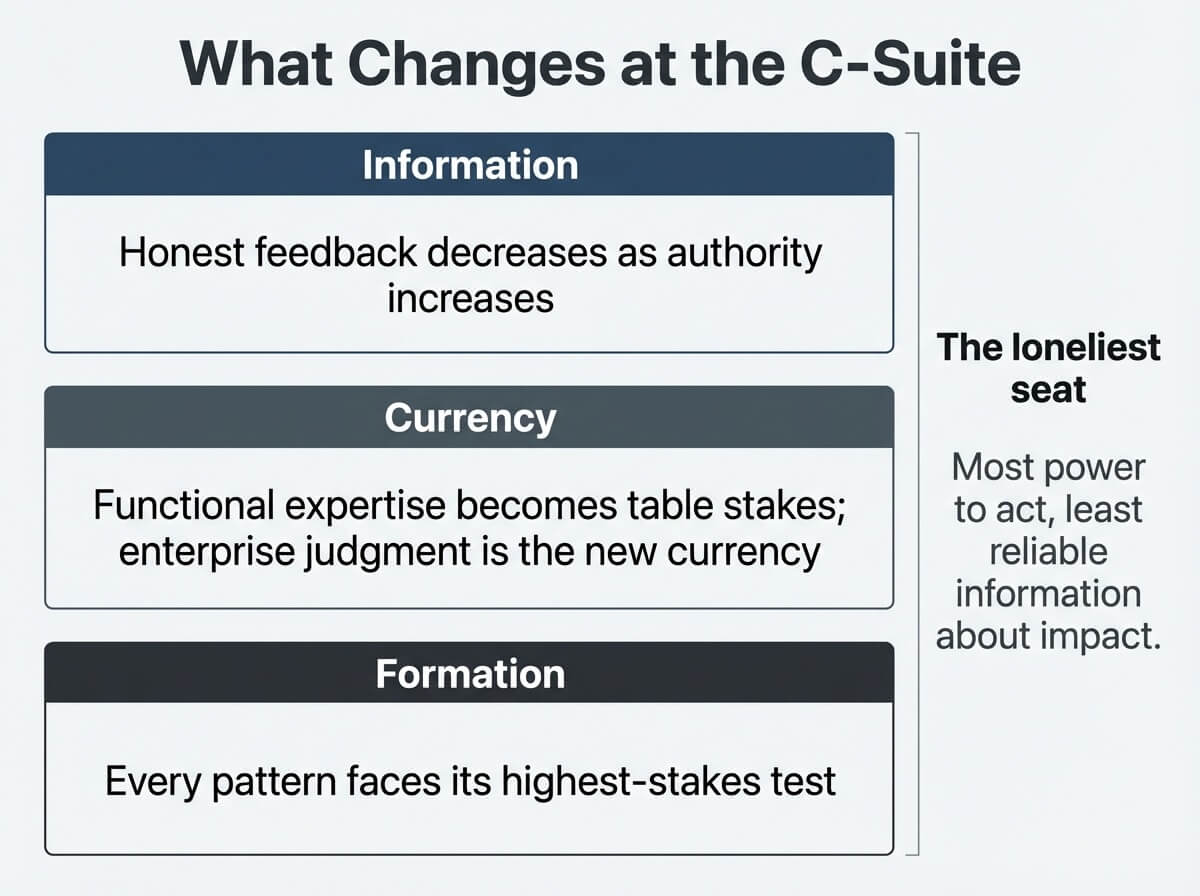
The information environment changes structurally. People who once gave honest feedback now calibrate what they share because you control budgets and careers. The currency that earned you the seat — output, execution, analytical rigor — becomes table stakes. Enterprise judgment, board presence, and strategic narrative become the new currency you have the least practice spending.
The first thing that changes when you reach the C-suite is the silence. Not the silence of a quiet office. The silence of realizing that the people who used to tell you what they really thought are now managing what they say around you. The feedback that used to come freely — from peers, from your manager, from the team — is filtered, strategic, or absent. You have more authority than you have ever had. You have less honest information than you have ever had. And nobody warned you that those two things would arrive together.
The C-suite transition is not a bigger version of the Director-to-VP transition. It is a qualitatively different challenge. The rules change. The isolation is structural. And the formation patterns that carried you through every previous level face their most demanding test — because at this altitude, what your career installed meets the full weight of enterprise leadership.
Key Takeaways
- The C-suite transition is qualitatively different from every previous promotion. It is not a bigger version of the VP role. It is a different kind of leadership entirely.
- Isolation is structural, not personal. Honest feedback decreases as authority increases. The leader with the most power to act has the least reliable information about how they are experienced.
- Every formation pattern faces its highest-stakes test at the C-suite. The old currency is table stakes. The new currency — enterprise judgment, board presence, institutional stewardship — cannot be earned through the methods that always worked.
- A coach at this level is often the only person in the leader’s life who has no agenda other than the leader’s own development.
What Changes at the Top
At Director and VP level, you learned to operate across functions, build alliances, and translate between strategy and execution. Those skills transfer. What does not transfer is the assumption that you can build trust the same way you always have.
At the C-suite, trust is not earned through output. It is earned through judgment — the willingness to make calls the data cannot fully justify, to hold positions under board scrutiny, to set direction for an enterprise where the consequences are existential and the timeline extends beyond your own tenure. The currency shift at this level is the most painful of the career because the new currency is the one you have the least practice spending.
The CTO who arrives at the C-suite with technical credibility discovers that the board does not evaluate technical credibility. They evaluate strategic narrative. The CFO who arrives with analytical rigor discovers that the board does not need better analysis. They need someone who says “here is what I believe we should do and why” with the kind of conviction that a career in finance never required. The CHRO who arrives with deep organizational trust discovers that trust at the individual level does not automatically translate into influence at the board level.
The loneliest seat in the organization is not lonely because nobody is around. It is lonely because everyone who is around has an agenda — and the leader is the only person in the room who is supposed to hold the whole.
The Isolation Problem
The isolation is not a failure of communication. It is a structural feature of the role. When you become the person who approves budgets, sets direction, and makes the calls that affect everyone’s career, the information environment changes. People manage what they tell you. Peers become competitors for board attention. Direct reports calibrate their candor to your mood. The higher you go, the more curated the information you receive.
Recognize the Silence?
If honest feedback has decreased as your authority increased, that structural isolation is where coaching creates the most value.
This isolation hits every formation, but it hits differently:
The CTO loses access to the technical community that used to provide honest feedback about their thinking. The engineering team now defers rather than debates. The builder identity that thrived on collaborative problem-solving has no collaborative space left.
The CFO loses the analytical sparring partners who used to challenge the model. The finance team presents conclusions, not arguments. The precision that was sharpened through debate now operates in an echo chamber.
The COO loses the operational feedback loop. The systems still run. The team still executes. But the strategic-level feedback — whether the operating model is right for where the organization is headed — only comes from the CEO and the board. Both have limited bandwidth and limited operational depth.
The GC loses the advisory dialogue. Legal is consulted after decisions are made, not before. The strategic counsel the role demands is offered in a context where the direction has already been set.
The isolation paradox: the leader with the most authority to change the organization has the least reliable information about how the organization experiences their leadership. This is not fixed by open-door policies or town halls. It is structural — and it is one of the primary reasons C-suite leaders seek coaching.
Formation Patterns at Maximum Altitude
Every formation pattern that operated at lower altitudes intensifies at the C-suite. The stress behaviors sharpen. The blind spots widen. The identity structures face their most demanding expansion.
The risk instinct faces enterprise-level uncertainty. The CFO who learned to quantify risk must now set the organization’s risk appetite — a qualitatively different task than modeling individual exposures. The CTO who learned to test and iterate must now make platform bets that cannot be tested at small scale. The GC who learned to prevent exposure must now advise on risks the organization should accept.
The signal environment becomes its most distorted. Board feedback is sporadic, politically loaded, and filtered through governance dynamics. Peer feedback is strategic. Direct report feedback is managed. The leader who relied on clear, functional signals to know whether they were doing well now operates in an environment where the most important signals are the hardest to read.
The time horizon extends to its maximum stretch. Decisions made now may not validate for three to five years. The CPO’s market bets may not confirm for longer. The CHRO’s culture investments compound slowly and invisibly. The leader must hold confidence in a direction the environment cannot yet confirm or deny.
Why Coaching at This Level
At the C-suite, a coach may be the only person in the leader’s professional life who has no agenda other than the leader’s own development. Not the board’s agenda. Not the team’s agenda. Not the organization’s performance agenda. The leader’s own understanding of who they are becoming in this role and what the role is asking them to leave behind.
A coach who understands the formation brings additional specificity. They know that the CTO’s sense of losing touch with the team is not about management style. It is about a builder identity mourning the loss of collaborative building. They know that the CFO’s hesitation to make a board recommendation without a complete model is not about confidence. It is about a formation that defined irresponsible as any call the data cannot justify. They know that the COO’s silence in strategy meetings is not about disengagement. It is about an operations formation that taught them the background is where they belong.
The coaching question at this level is not about skills or strategy. It is: who are you becoming in this role — and where is the formation that got you here creating the ceiling for what the role now asks?
The patterns in this article connect to several related dynamics across careers and levels: what the CFO transition feels like from the finance track, the CHRO who was everyone’s confidant, what isolation looks like in a leadership team context, and the earlier version of this identity challenge.
This connects to a related perspective: C-suite coaching as a response to formation-shaped constraints.
The Seat and the Person
The C-suite seat comes with authority, isolation, and a set of demands that no previous role prepared you for. The person who fills it carries a formation — a career’s worth of installed patterns about what good looks like, what risk feels like, what success sounds like, and who they are when they lead. The gap between what the seat demands and what the formation provides is the territory where the real leadership development happens.
Not through programs. Not through books. Through the sustained, honest, structurally-aware conversation that only happens when someone understands both the seat and the person sitting in it.
If you have recently reached the C-suite — or you are about to — and the transition feels qualitatively different from anything before, a conversation with a coach who understands what changes at this altitude is where the seat and the person start to align.
Frequently Asked Questions
Why does honest feedback disappear when you reach the C-suite?
The reduction in candid feedback is structural, not personal. When a single person controls budgets, sets direction, and affects everyone's career, people around them calibrate what they share. Direct reports manage their candor; peers compete for board attention; the result is that the leader with the most authority to act on feedback receives the most filtered version of it.
How is the C-suite transition different from the VP-to-executive promotion?
At the VP level, trust is built through output and cross-functional execution. At the C-suite, the currency shifts to enterprise judgment: making calls the data cannot fully justify, holding positions under board scrutiny, and setting direction with consequences that extend beyond one's own tenure. The skills that earned the promotion are table stakes at the new level; the currency that actually matters there has had the least practice.
What does a coach actually do for a C-suite leader that peers or mentors cannot?
A coach is often the only person in a C-suite leader's professional life whose sole agenda is the leader's own development. Peers compete for board attention, direct reports manage what they say, and the board operates through governance dynamics. A coach who understands formation patterns can identify where the installed career habits — the risk instincts, identity structures, and success signals that worked at every previous level — are creating the ceiling the current role is pressing against.
A Conversation With No Agenda But Yours
A 30-minute call where your coach understands the C-suite transition and has no agenda other than your development. No assessment. No prescriptions.
Book a Free Consultation →