
What Risk Means to You Is Not What It Means to Your Peers
Why do people perceive risk so differently?
Risk perception differs because careers install different definitions of the word itself. Finance trains leaders to quantify exposure before acting. Technology trains them to ship small and iterate. Legal trains them to prevent liability first. Marketing treats inaction as the real danger. Operations fears disruption above all. Same word, five distinct alarm systems.
Ask the CTO about risk and she describes a controlled experiment: ship a small version, see what breaks, iterate. Ask the General Counsel about risk and he describes a landscape of exposures to be mapped, assessed, and mitigated before any action occurs. Put them in the same room on the same project, and the CTO experiences the GC as someone who kills momentum. The GC experiences the CTO as someone who ignores consequences. Both are managing risk. They are managing it from formations that define the word differently.
This is not a communication problem. It is not fixed by better meetings or clearer decision-making frameworks. What risk means to you — what triggers the alarm, what counts as sufficient mitigation, what “responsible” sounds like — was installed by a career that rewarded one version of risk management and labeled every other version as either reckless or paralyzed. That installation is invisible until you sit across from someone whose career installed a different one.
Key Takeaways
- Every function defines risk differently. Finance quantifies it. Technology tests it. Legal prevents it. Marketing accepts it. Operations contains it. Each is a legitimate response to uncertainty.
- Most “disagreements about risk” on leadership teams are actually collisions between formations that define the word differently. Neither side is wrong. Both are incomplete.
- Your formation’s risk instinct is not your personality. It is trained. And it can be expanded without being abandoned.
- A coach who understands what risk means to your specific formation helps you distinguish between formation-level caution and situation-level judgment.
Five Definitions, One Word
Risk is not an objective category. It is a formation-shaped perception. What the word activates — the alarm bells, the default response, the standard for “enough due diligence” — varies by function in predictable, specific ways.
Finance: risk as quantity. Risk is a number. It can be measured, modeled, probability-weighted, and hedged. The responsible response is to quantify exposure and build scenarios before committing. A decision without a model is a guess, and finance formations do not guess.
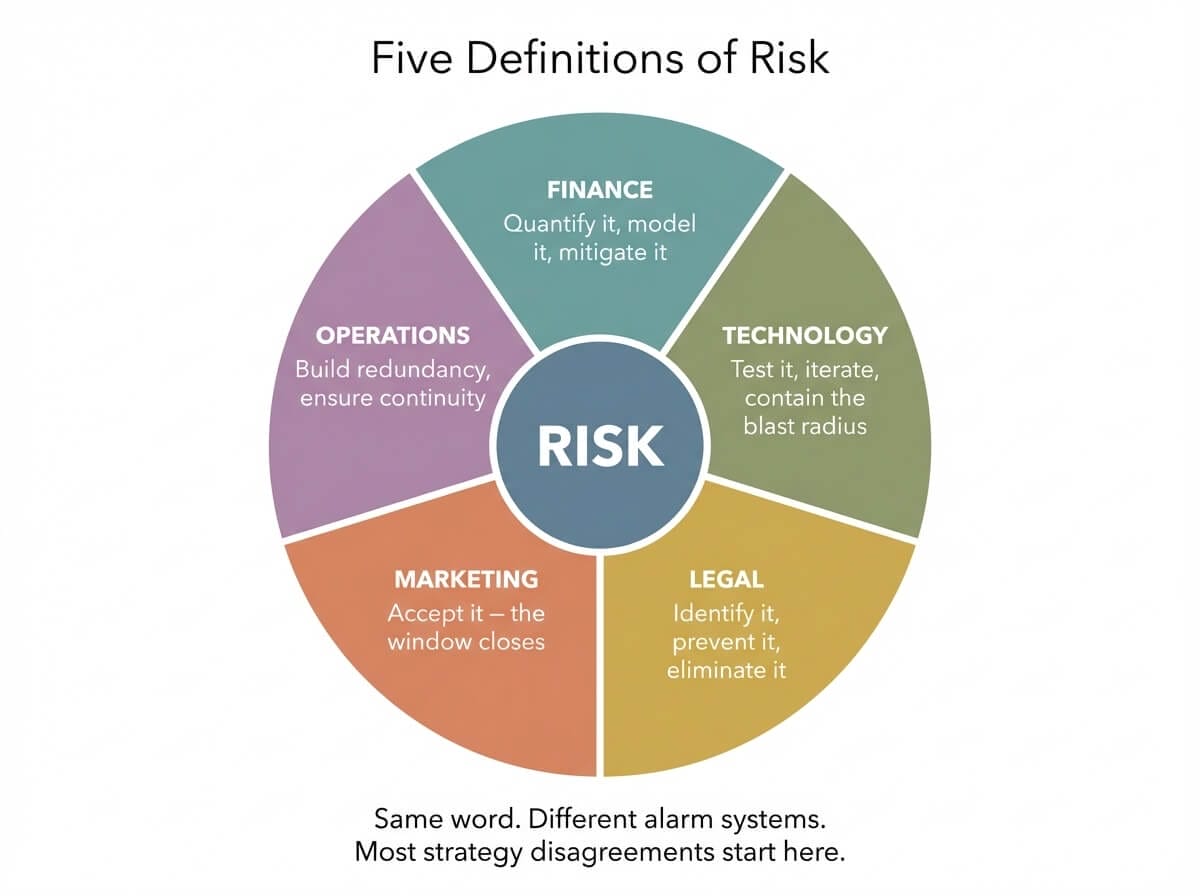
Technology: risk as experiment. Risk is an input to the learning process. Ship small, observe what breaks, iterate. The responsible response is to move fast but reversibly — contain the blast radius, learn from failure, never bet the entire system on an untested approach. An irreversible commitment without a prototype violates the engineering instinct.
Legal: risk as exposure. Risk is a landscape of liabilities to be identified and eliminated before they materialize. The responsible response is prevention — no action until the exposure is mapped and mitigated. A decision that accepts known risk is, in the legal formation, not bold. It is negligent.
Marketing: risk as timing. Risk is the cost of inaction. Markets move, windows close, competitors establish positions. The responsible response is to act on conviction before the data is complete, because waiting for certainty means the opportunity has passed. Analysis paralysis is the risk the marketing formation fears most.
Operations: risk as disruption. Risk is anything that threatens continuity, reliability, or throughput. The responsible response is redundancy, fallback systems, and process resilience. Disrupting a working system for an unproven benefit is, in the operations formation, the definition of reckless.
Five leaders sit in the same room, hear the word “risk,” and five different alarm systems activate. Most strategy disagreements are not disagreements about strategy. They are disagreements about risk — which means they are disagreements about formation.
What Happens When Formations Collide on Risk
The product launch meeting. The CTO wants to ship. The product is ready, the team is energized, the market window is open. The General Counsel wants to review. The privacy assessment is incomplete, the terms of service need updating, the regulatory filing has not been confirmed. The CTO experiences the GC as a bottleneck. The GC experiences the CTO as a liability.
What neither sees is the formation logic driving the other’s behavior. Technology metabolizes risk through iteration: ship, learn, fix. Legal metabolizes risk through prevention: identify, mitigate, then proceed. Both are legitimate strategies for managing uncertainty. They cannot coexist in the same timeline without someone naming the structural tension.
The same collision plays out between the CFO and the CMO over investment decisions, between the COO and the CEO over transformation initiatives, between the CHRO and the CFO over talent investment. Each collision looks like a disagreement about the decision. Each collision is actually a disagreement about what “responsible” means. And because the word “responsible” feels like a moral category rather than a formation response, each leader experiences the other’s position not as a different perspective but as irresponsibility.
| Collision | What Side A Sees | What Side B Sees | What Is Actually Happening |
|---|---|---|---|
| CTO vs. GC | Legal is killing momentum | Engineering is ignoring consequences | Iteration vs. prevention processing the same uncertainty |
| CFO vs. CMO | Marketing is spending without evidence | Finance is analyzing until the window closes | Quantification vs. conviction processing the same decision |
| COO vs. CEO | The CEO is disrupting what works | Operations resists all change | Continuity vs. transformation processing the same future |
The Paradox
The paradox is that every formation’s risk instinct is both correct and incomplete. The CFO is right that unmeasured risk is dangerous. The CMO is right that unmoved-on risk is costly. The GC is right that unmitigated exposure can destroy an organization. The CTO is right that untested ideas never improve. The COO is right that disrupted systems fail before new ones work.
Each formation provides something the others do not. The organization needs all five risk responses operating simultaneously. The voice your leadership team is not hearing is usually the risk perspective that the room’s dominant formation has marginalized — not because it is wrong, but because it processes uncertainty in a way the majority finds uncomfortable.
The productive question is not “whose risk assessment is correct?” It is “what does this decision need that no single formation is providing on its own?” That reframe turns risk disagreements from personality conflicts into structural inputs — which is what they always were.
What Coaching Changes
For the individual leader, a coach who understands the risk formation helps distinguish between formation-level caution and situation-level judgment. “I am uncomfortable with this decision” can mean “this decision is genuinely dangerous” or it can mean “my formation is reacting to uncertainty the way it was trained to.” Both are real. They require different responses. The formation-aware coach helps the leader tell the difference.
The coaching question is not “Are you being too cautious?” The question is: “Is your discomfort about this specific situation, or about how your career taught you to process uncertainty in general?” That distinction — between the signal and the formation — is where the leader develops genuine risk judgment rather than either overriding their instinct or being captive to it.
For the team, a coach who understands all the formations in the room does not resolve the risk disagreement. They name it: “What I am hearing is two legitimate definitions of responsible that cannot both be satisfied simultaneously. What does this specific decision need?” That question moves the team from arguing about who is right to collaborating on what the situation requires.
These patterns connect to broader dynamics: what your career installed and the risk your formation says don’t.
Risk as Formation, Not Personality
What risk means to you is not what it means to your peers. That is not a limitation. It is a fact about what different careers install. The finance leader’s quantification instinct catches exposures the CMO’s timing instinct would miss. The engineering leader’s iteration instinct produces learning the legal leader’s prevention instinct would block. Each formation has a blind spot that another formation covers.
The question is not whether your risk instinct is correct. It usually is — for the domain that trained it. The question is whether you can see it as a trained response rather than an objective truth. That recognition — “my discomfort is formation, not fact” — does not make you less cautious or less rigorous. It makes you more accurate about when caution is serving you and when it is running you.
If the collisions in this article describe dynamics you encounter regularly, a conversation with a coach who understands the formations in the room is where the pattern starts becoming visible — and useful.
Frequently Asked Questions
Why do leaders from the same organization reach opposite conclusions about the same risk?
Each function installs a different definition of risk through years of professional rewards and consequences. Finance is trained to quantify exposure before acting; technology is trained to ship small and iterate; legal is trained to prevent liability before proceeding. When these formations meet on the same decision, what looks like a disagreement about strategy is actually a collision between different but equally legitimate definitions of 'responsible.'
Can a leader change how they process risk without abandoning the instincts their career built?
Yes, and the distinction matters: your formation's risk instinct is trained behavior, not fixed personality. The goal is recognizing when it is responding to a specific situation versus running on autopilot. A leader who can tell the difference between 'this decision is genuinely dangerous' and 'my formation is reacting to uncertainty the way it was trained to' develops actual judgment rather than simply cycling between caution and override.
What does a coach actually do when a leadership team can't agree on risk?
A formation-aware coach names the structural collision rather than trying to resolve whose position is correct. The question 'What does this specific decision need that no single formation is providing?' reframes a personality conflict as a structural input problem. That move stops the team from arguing about who is right and redirects them toward what the situation actually requires.
A Conversation About What Risk Means to You
A 30-minute call where your coach understands the risk instinct your career installed and where it serves you versus where it runs you.
Book a Free Consultation →