The Promotion Nobody Prepares You For
How do I prepare for my next promotion?
The article does not address preparation before promotion, but it supports this: identify which currency your function rewards now and name the currency the next level demands. The gap between those two is your actual preparation work. Skills follow. The identity shift, releasing what currently defines your excellence, is what takes longest.
You got promoted because you were the best executor on the team. You shipped. You solved. You delivered. And now, six months in, your boss says “think more strategically” and you nod like you understand. On the drive home, you realize you have no idea what that means for someone whose entire career has been defined by getting things done.
The worst part: nobody can explain it. Not your boss, who got the same vague feedback a decade ago and figured it out through years of trial and error. Not your peers, who are navigating the same transition but won’t talk about it. You’re not failing. You’re succeeding at a game that ended two levels ago.
You are playing the previous game at a higher volume and wondering why the score stopped going up.
Key Takeaways
- The director-to-VP transition is not a skill gap. It is an identity shift: the strength that earned the promotion becomes the constraint at the new level.
- “Think more strategically” means something completely different depending on which function shaped you. For finance, it means tolerating ambiguity. For technology, it means abandoning the elegant solution. For operations, it means redesigning the system you optimized.
- Every function has a currency that earns professional standing. At the VP level, the old currency still works within your function but no longer earns standing across functions or upward.
- The transition feels exhausting because you are running two economies at once: maintaining enough of the old currency to stay credible while building a new one you don’t yet trust.
- The people above you can’t explain the rules because the patterns their careers installed are invisible to them. They adjusted through trial and error without fully understanding what shifted.
What You Were Promoted for Is Not What You Were Promoted to Do
Every function experiences the same structural pattern: the strength that earned the promotion becomes the shadow at the next level. You were the best analyst, the best engineer, the best campaign manager, the best case builder. Now the job is different, but nobody gave you new rules. The old playbook didn’t fail because you stopped being excellent. It failed because excellence in the new role means something your old role never taught you.
The promotion rewarded you for a specific kind of excellence—then asked you to stop practicing it.
And “think more strategically” is the most common piece of feedback in corporate leadership and the least useful. Because it means something completely different depending on where you came from.
For someone from finance, strategic means tolerating ambiguity. Offering judgment when the model can’t give you a clean answer. Acting on 70% certainty when every instinct, every year of training, every performance review that rewarded you for catching the error others missed demands 95%. The discomfort isn’t intellectual. It’s physical. Presenting a recommendation you can’t fully prove feels like professional negligence to someone whose career was built on being right about the numbers.
For someone from technology, strategic means abandoning the elegant solution for the politically viable one. You can see the better architecture. You can explain why it’s better. And the room doesn’t care, because “obviously better” isn’t enough when you need buy-in from people who evaluate proposals on criteria your engineering training never taught you to read.
For someone from operations, strategic means accepting that the system you spent years optimizing is about to be redesigned. And you need to be the one redesigning it, not the one protecting it. The stability you built, the efficiency you earned, the reliability that nobody noticed because nothing broke: all of it might need to change. And your instinct to protect what works is the instinct you have to override.
For someone from marketing, strategic means connecting creative intuition to business outcomes at scale. Not better campaigns. A narrative about where the company plays and how it wins. The leap from “this work resonates with audiences” to “this is why the board should fund our market position” is a translation problem that nobody in your creative career prepared you for.
For someone from legal, strategic means deciding which risks to accept, which to mitigate, and which to ignore entirely. After a career spent finding every exposure, every gap, every vulnerability, the new role asks you to rank them and let some go. Deliberately. That feels like malpractice to someone whose value was defined by thoroughness.
For someone from HR, strategic means stopping being the go-to person for every individual issue and building systems that create trust at scale. The one-on-one relationships that made you indispensable are the same ones keeping you anchored at the wrong altitude.
The word “strategic” is the same. The work is not.
The Currency That Stopped Working
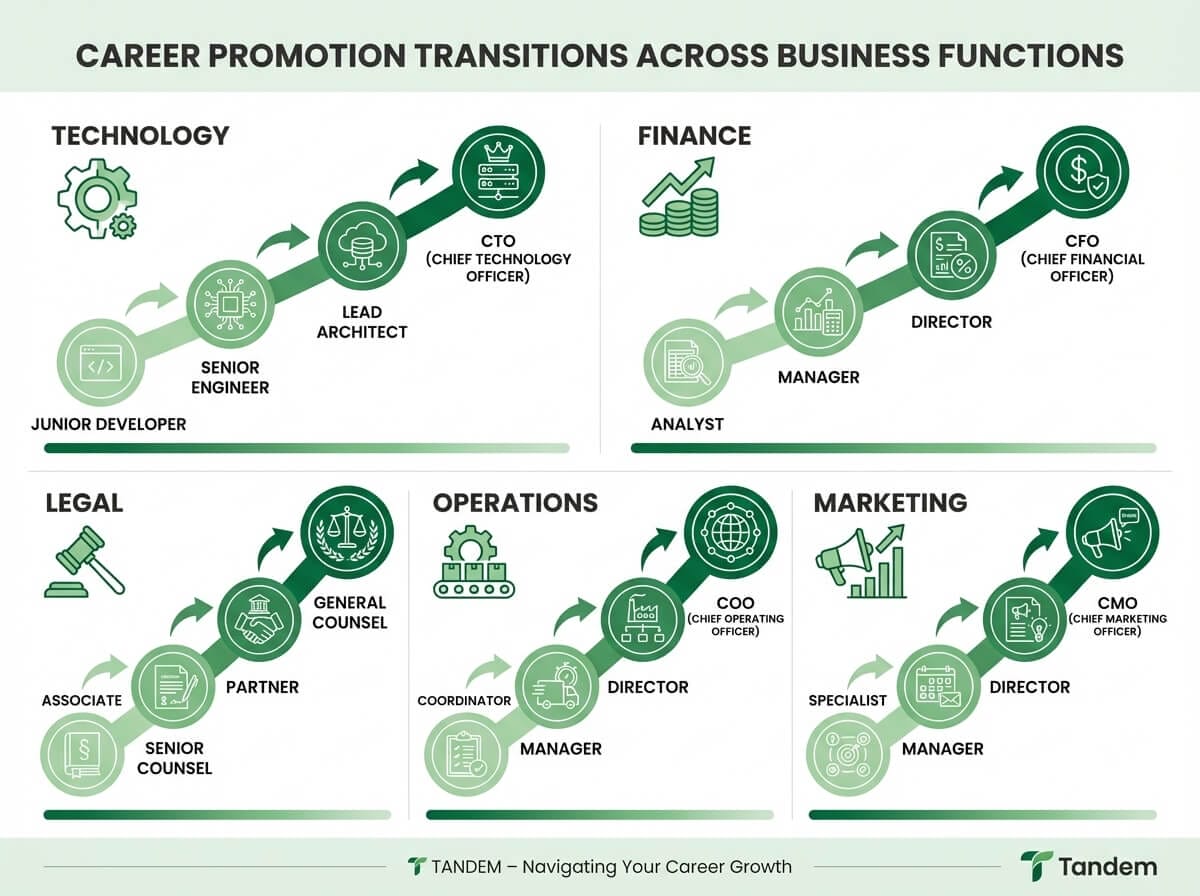
Every function has a currency. A specific form of professional value that the ecosystem recognizes and rewards. In technology, the currency is building things that work. In finance, being right about the numbers. In legal, preventing harm before it arrives. In marketing, making things that connect. In operations, keeping things running. In HR, being the person people trust.
Recognize This Pattern?
If this description landed with uncomfortable precision, that’s exactly what a first coaching conversation feels like. We start where the promotion left you.
You earned your way to this level by being excellent at your function’s currency. The problem is that the level you just entered trades in a different one. And nobody told you the exchange rate.
| Function | What Earned the Promotion | What the New Level Demands | The Painful Shift |
|---|---|---|---|
| Technology | Shipping quality code | Architectural decisions, team output | Letting others build what you designed |
| Finance | Accurate analysis | Translating data into cross-functional insight | Leading with judgment, not models |
| Legal | Preventing risk | Enabling strategy within guardrails | Saying “here is how we can” not just “here is why we can’t” |
| Operations | Reliable execution | System design for scale | Accepting others will redesign your systems |
| Marketing | Creative execution | Portfolio strategy, attribution clarity | Defending ROI in the language of finance |
The promotion didn’t change what you’re good at. It changed what “good” means.
The transition isn’t a clean swap. You can’t just stop spending the old currency. The VP of Engineering who stops reviewing architecture decisions loses the technical standing that gives her a voice in the room. The finance director who stops building models loses the precision credibility that earned his seat at the table. You still need the old currency to retain the credibility that got you here. But the old currency alone will not earn you standing at the new level.
That’s why letting go feels like losing control. You’re not choosing between the old work and the new work. You’re running both economies simultaneously, and the effort is relentless. Maintaining enough technical depth to stay credible with your team while building enough cross-functional influence to be taken seriously by your peers. Still delivering within your function while learning to translate your function’s value to people who measure success differently than you do.
That dual investment is why the transition feels like more work, not different work. And why working harder at the old game keeps producing diminishing returns. There is a predictable inflection point, usually around month four or five. You have been applying the old approach at higher volume: more hours, more intensity, more of the behavior that earned the promotion. And then the realization surfaces. The effort is not producing the results it used to. The one strategy you know, excellence through effort, has stopped compounding. You don’t have a second strategy. That inflection is where most rising leaders start asking whether something structural has changed. It has.
What the new level actually rewards is influence across functions, not personal output. Upward management, not execution. Translation, not doing the work. But the specific version of the new currency depends on where you came from. The finance leader needs to shift from “I see what others miss” to “I help others see what the numbers mean.” The technology leader needs to shift from “I solve hard problems” to “my team solves hard problems.” The legal leader needs to shift from “I find the problem before it finds us” to “I help the business take smart risks.”
Each of those shifts sounds simple on paper. None of them are. Because the old currency is not just a skill. It’s an identity. And the transition is not a skill problem. It’s a grief problem.
Why Nobody Explains the Rules
The patterns your career installed feel like intelligence, not training. The finance director who leads with data doesn’t think “I’m deploying my precision instinct.” She thinks “I’m being rigorous.” The technology leader who decomposes every problem into components doesn’t think “I’m running my systems logic.” He thinks “I’m being thorough.” The patterns are so fully integrated into how you think that they’re indistinguishable from who you are.
That’s why your boss can’t explain the rules. They figured them out the way everyone does. By bumping into the ceiling, adjusting, bumping again, and eventually operating differently without fully understanding what shifted. The transition knowledge they carry is tacit. It lives in their reflexes, not in anything they can hand you as a playbook.
The people above you aren’t withholding the rules. They can’t see them either.
“Think more strategically.” “Be more executive.” “Have more presence.” “Get out of the weeds.” These phrases proliferate because the people giving the feedback can see the symptom but not the cause. They can see that you’re operating at the wrong altitude. They cannot see that the patterns your function installed over ten or fifteen years are creating that mismatch. So the feedback stays vague, you try harder at the old game, and the gap widens.
The currency shift is function-specific. “Think more strategically” means tolerating ambiguity for a finance leader, abandoning elegant solutions for a technology leader, accepting system redesign by others for an operations leader. Generic leadership advice treats these as the same challenge. They are not.
And not everyone enters this transition at the same point. Some leaders have just been promoted and are still in the sharpest phase of the identity shift: “I was valued for what I personally produced. Now I’m valued for what others produce.” Some are past that initial crisis but struggling with scope: building through layers, making decisions with incomplete information because they can no longer be close enough to the work to verify it themselves. Some are navigating the political phase: representing their function to other functions, building cross-functional influence, learning to operate in rooms where technical expertise alone doesn’t determine the outcome.
Each phase has different pressure. Each phase reveals different limitations in the old playbook. And each phase is harder to navigate when you can’t name what’s actually happening. You end up solving for the wrong variable. The leader in identity crisis who takes a delegation course. The leader in the scope-expansion phase who hires an executive coach to work on “presence.” The leader in the political phase who doubles down on functional expertise when the room needs cross-functional translation. The fix keeps missing because the diagnosis was never accurate.
What Changes When Your Coach Gets This
Consider a VP of Engineering who tells her coach she’s struggling with delegation. A career coach hears “delegation” and provides a framework: what to delegate, when to delegate, how to follow up. Useful, maybe. But it treats delegation as a task management problem.
See How Tandem Coaches the Transition
Our approach starts with understanding what your career installed and what the promotion is actually asking you to release. Not personality assessments. Not generic leadership frameworks. Your specific transition.
A coach who understands what a technology career actually does to a person hears something different. “You’re spending the only currency you know is reliable. Technical execution gives you immediate, unambiguous feedback. The code works or it doesn’t. The system handles the load or it breaks. Delegation gives you slow, uncertain feedback about other people’s judgment. The discomfort isn’t about control. It’s about moving from a currency you’ve mastered to one you can’t yet trust yourself to read.”
That reframe changes the conversation. The client stops trying harder at delegation techniques and starts examining what the old currency gave her that the new one hasn’t yet replaced. The answer is usually certainty. And the real work becomes: how do you lead when the feedback is slow and ambiguous and you can’t be close enough to the work to know whether it’s right?
Or consider a finance director whose boss tells him he needs “more executive presence.” A generic coach works on communication skills: how to structure a presentation, how to project authority, how to speak with more confidence. All reasonable.
A coach who understands what a career in finance installs recognizes a different pattern. “You’re still presenting like an analyst. Leading with what you want people to know rather than what you want them to feel. That isn’t a communication gap. It’s the precision instinct doing exactly what it was trained to do. The question isn’t how to present differently. It’s what it would mean for you to lead with judgment. To offer what you think, not just what you can prove.”
The finance director goes quiet. Because “offer what you think without proof” sounds, to someone whose entire career rewarded being right about the numbers, like being asked to be reckless. That tension is the coaching territory. Not presentation skills. Not executive presence as performance. The specific way a career in finance makes it genuinely threatening to lead with anything other than certainty.
The difference isn’t technique. It’s that the coach can name the thing underneath the frustration. And that naming is what turns a confusing transition into a recognizable one.
These patterns connect to broader dynamics: how the currency of success changes with the title and the identity your career handed you before you could choose.
This connects to a related perspective: how career transition coaching connects to formation-aware work.
This Isn’t a Skills Problem
You didn’t fail the promotion. The promotion changed the game, and nobody told you the rules. The strength that got you here isn’t a weakness. It’s a foundation. But only if you can see where it ends and what comes next.
You have been telling yourself you need new skills. You probably do. But the harder adjustment isn’t learning something new. It’s releasing something old: the version of excellent work that your function defined for you years ago, the one that still feels like the only real measure of whether you’re doing a good job. The skills will come. The identity shift is the actual work.
That visibility, the ability to see the pattern your career installed and choose when to use it and when to set it aside, is what changes when someone who understands your specific transition is in the room with you. Not a career coach who teaches frameworks. Not a leadership program that treats every function the same. Someone who knows what “think more strategically” actually means for someone who came up through your world. If that distinction matters to you, here is what that conversation looks like.
Frequently Asked Questions
Why does 'think more strategically' feel so vague, even from people who've already made the transition?
Because they navigated the shift through years of trial and error without understanding what actually changed. The patterns their career installed feel like intelligence, not training. So they can see that you're operating at the wrong altitude but can't identify the underlying cause or hand you a usable explanation.
Why does letting go of my old work feel like losing something, not just changing roles?
The old currency of accuracy, execution, and technical depth isn't just a skill set. It's the identity your function built over years of performance reviews and recognition. Releasing it feels like grief because it is: you're being asked to stop practicing the specific form of excellence that defined your professional standing.
What does running 'two economies at once' actually look like day to day?
You still need enough of the old currency to stay credible within your function. The engineering VP who stops reviewing architecture decisions loses the technical standing that gives her a voice. At the same time, you're building cross-functional influence and learning to translate your function's value to people who measure success differently. The effort is relentless because neither economy can be abandoned while you're in transition.
Ready to Talk With a Coach Who Gets This?
A 30-minute call where you don’t have to explain the tension. We start with what the promotion actually changed — and what it didn’t.
Book a Free Consultation →