
Team Coaching for Remote and Hybrid Teams: What Changes, What Does Not
How does team coaching change for remote and hybrid teams?
Virtual team coaching replaces body language with camera behavior, mute-button tells, and participation patterns. Hybrid is harder than fully remote because in-room members develop a sub-dynamic that structurally excludes remote participants. Sessions run 60-90 minutes at higher frequency. Virtual forces explicit communication, which accelerates a team's awareness of its own patterns faster than physical rooms allow.
Three members of a leadership team sit in silence after someone raises an uncomfortable truth. In person, the coach would read crossed arms, averted eyes, the physical tension that fills the room. On screen, three of the four cameras switch off. The chat sidebar lights up with a message the coach cannot see.
This is not a failed session. This is team coaching in a virtual context, and the data is still present. It arrives through different channels.
Virtual team coaching is not in-person coaching minus the room. It is a different coaching context with distinct observation skills, failure patterns, and unique possibilities. What follows covers what changes when coaching teams through screens, what stays the same, and where virtual delivery creates opportunities that physical rooms cannot.
Key Takeaways
- Virtual team coaching requires a different observation toolkit: camera behavior, participation patterns, mute-button tells, and chat activity replace body language and spatial dynamics.
- Hybrid coaching is harder than fully remote because the in-room group develops a sub-dynamic that structurally excludes remote members.
- Effective virtual sessions run 60–90 minutes with higher frequency rather than replicating long in-person formats.
- The forced explicitness of virtual communication can accelerate a team’s awareness of its own patterns faster than in-person settings.
What Changes and What Does Not
The core principles of team coaching hold in virtual settings. The team remains the client, the coach works from outside the system, and the goal is team-generated development rather than coach-directed instruction. What changes is the medium through which the coach observes and the team expresses its dynamics. Working from outside the system is the whole premise our team coaching CCE course is organized around, virtual or in person.
In a physical room, the coach reads body language, spatial dynamics, micro-expressions, and who gravitates toward whom during breaks. Virtually, that information channel narrows. The coach reads voice tone, participation patterns, camera behavior, and chat activity instead. This is not a net loss. Virtual platforms allow the coach to see every face simultaneously, something physically impossible in a room of eight. The observation toolkit adapts. The observation orientation does not.
Trust develops differently in virtual settings. In person, trust builds partly through physical co-presence: shared space, direct eye contact, the informal conversation before the session starts. Virtual trust requires more explicit work. The coach must verbalize what presence would otherwise communicate: checking in directly, naming observations aloud, inviting feedback, and creating deliberate space for members to respond rather than relying on the natural rhythm of a physical room.
Communication becomes the primary medium of the coaching engagement. In person, much goes unsaid but understood through proximity and body language. Virtually, the team must say what it means. This changes the texture of collaboration and the pacing of sessions but does not reduce the depth of the work.
Time zones add an operational challenge that in-person coaching rarely confronts. A team spanning three time zones faces scheduling constraints that limit session windows and may require rotating who joins at inconvenient hours. These logistics surface real dynamics about whose time the organization values and how the culture handles geographic distribution. The coach who notices these patterns has found coaching material before asking the first question.
The skills transfer. The signals change.
The coach who stops looking for in-person signals and starts reading virtual ones stops feeling deprived. The data was never missing. The vocabulary was.
Reading the Virtual Room
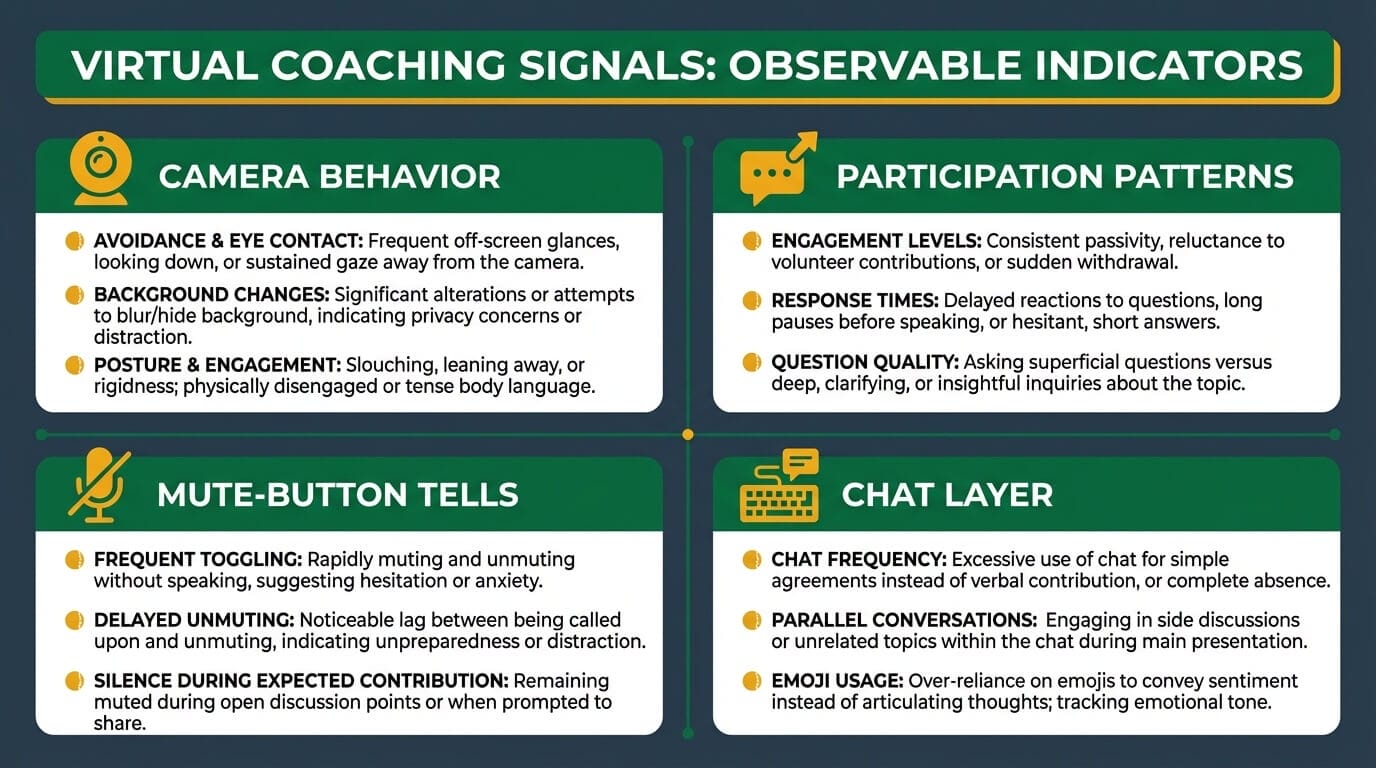
Virtual coaching produces a different set of observable signals than in-person sessions. Camera behavior, participation patterns, the pause between unmuting and speaking, and chat activity give the coach data that a physical room cannot provide. Learning to read these signals is a core skill for effective virtual team coaching.
Camera behavior is the most visible signal. Camera-off during a difficult conversation is the virtual equivalent of turning away from the circle. Selective presence, where a member turns camera on only when speaking and off otherwise, signals engagement on the speaker’s terms, not the team’s. A sudden cluster of cameras switching off after a particular comment tells the coach something happened that the team is not ready to address openly.
Participation patterns reveal relational structure. Track who speaks after whom. Track who never speaks unless directly invited. Track who consistently responds to leadership but not to peers. Virtual platforms make this tracking easier than in-person settings because every face is visible at once, and the patterns of engagement become data the coach can reference back to the team.
The mute-button tell is underappreciated. The moment between someone unmuting and speaking contains information. A long pause followed by a careful statement suggests a response edited before delivery. Repeated unmute-remute cycles without speaking suggest something unsaid. The coach who watches the participant panel, not just the active speaker, catches these signals.
These signals require practice to read. Coaches accustomed to coaching teams in person may initially feel data-deprived on video. The signals are not absent. They are encoded differently, and the coach learns the new vocabulary through sustained attention and deliberate feedback from the team about what the coach is seeing.
The Hybrid Challenge
Hybrid team coaching is harder than fully remote coaching. The in-room group develops a sub-dynamic within the first five minutes that excludes remote participants, regardless of intent. This structural imbalance is the central challenge of hybrid delivery and the most common source of engagement failure.
ACTC Team Coaching — $2,499
ICF-accredited team coaching certification. Learn to facilitate team dynamics, group coaching, and organizational development.
The pattern is consistent. In-room members share physical space, eye contact, side conversations, and a collective energy that remote members cannot access. The coach responds to the room’s energy because it is more immediate. Remote participants mute, check email, and disengage. Nobody intends this. The physical space creates it structurally.
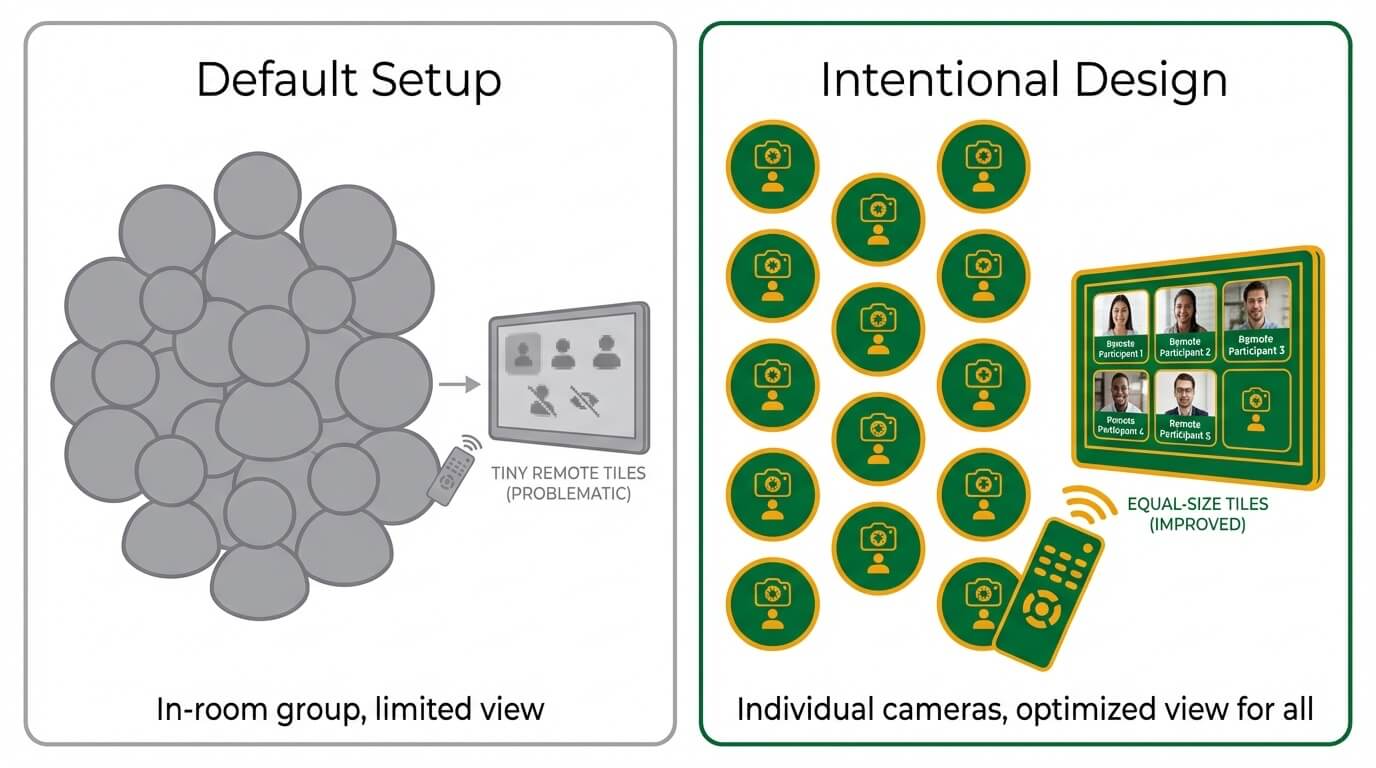
Consider a leadership team of eight where three sit in a conference room and five join remotely. The coach addresses the room. Within ten minutes, the remote members have mentally disengaged, not because the content is irrelevant but because the format has excluded them from the team’s working dynamic.
This is the focal-point trap adapted for hybrid settings. In team coaching, the goal is team-to-team dialogue rather than coach-to-individual exchange. Hybrid makes this harder because in-room members naturally talk to each other while remote members respond to them, not to the team as a whole. Countering this requires deliberate design: call on remote voices first, redirect in-room side conversations back to the full group, and equalize screen presence so that remote faces appear the same size as in-room faces.
A deeper challenge surfaces when the hybrid arrangement is not the team’s choice. Some teams are distributed because the organization decided it. Promotion structures, informal hallway conversations, and performance review norms may still privilege the office culture. The coach practicing coaching rather than facilitation may need to surface this environmental tension before any team development goals can take hold. Recognizing that the team’s challenges are not only interpersonal but environmental is what distinguishes team coaching from a meeting improvement exercise.
Virtual Session Design
Effective virtual team coaching sessions run 60 to 90 minutes with weekly or bi-weekly frequency. Shorter, more frequent sessions compensate for the attention limits of screen-based engagement and build continuity that longer intervals cannot match. Regular contact also allows developmental threads to carry forward between sessions rather than requiring extensive re-orientation at the start of each meeting.
Teams that attempt to replicate their three-hour in-person session format on video lose engagement by the 90-minute mark. Sustained screen attention demands different cognitive skills than in-person presence. A team meeting for 75 minutes every two weeks builds more sustained development and trust than a quarterly half-day on video where attention fades and collaboration suffers in the final hour. Frequent sessions also build working familiarity faster. Members who see each other on screen regularly develop the kind of trust that supports honest feedback and genuine challenge.
Platform selection matters less than how the coach uses whatever tools the team already has. Breakout rooms serve coaching goals when they create space for small-group reflection that returns to the full team. Shared documents support real-time collaborative reflection on team patterns. Polling tools surface anonymous input before open discussion, which is especially useful when members hold back in group settings. When a team consistently avoids a topic in open conversation, an anonymous poll asking each member to rate satisfaction with a team process can break the silence without forcing public vulnerability.
Virtual tools should serve coaching goals, not replace coaching with technology-mediated facilitation. A breakout room that fills dead air rather than creating needed space loses momentum - and credibility.
The principle behind these choices: technology is the delivery channel, not the coaching method. Coaches familiar with common team coaching failure patterns will recognize that virtual settings amplify several of them. The focal-point trap is harder to avoid when the platform UI centers the active speaker. Effective session design distributes attention deliberately across the full team rather than following the path of least resistance.
What Remote Coaching Makes Possible
Remote coaching is not in-person minus the room. Virtual delivery creates coaching possibilities that do not exist in physical settings, from equalized participation to a forced communication explicitness that accelerates team self-awareness. When coaches treat the medium as an instrument rather than a constraint, distributed teams can develop more quickly than those relying on occasional in-person gatherings.
Geographic reach is the most obvious advantage. Team members across time zones can be coached together without travel. Cross-functional teams, department liaisons, and project-based groups that would never gather in one physical room can access team coaching when delivery is virtual. This matters for organizations with distributed leadership teams spanning multiple offices or working remotely by design.
Equalized presence shifts group dynamics in ways that support quieter voices. Introverts and lower-status team members often find it easier to contribute through structured virtual turn-taking and chat participation than in physical rooms where extroverts and senior leaders dominate the space. The coach can use platform features like raised hands, round-robin speaking order, and chat prompts to redistribute voice more deliberately than any physical room arrangement allows. Over time, this redistribution can shift the team’s culture toward more inclusive communication norms that persist outside of coaching sessions.
With consent, session recordings allow teams to review their own interactions for pattern recognition. A team working on its decision-making process can watch how it actually makes decisions: who defers, who dominates, where the conversation loses focus. The feedback loop this creates is unavailable in traditional settings. Rather than relying on the coach’s observations alone, the team has direct evidence of its own performance patterns, which builds support for development goals that would otherwise remain abstract.
A team that has never had to say what it means out loud has never had to examine what it actually thinks. Virtual coaching removes the escape hatch of implicit understanding. That discomfort is the work.
The coach who treats virtual constraints as coaching instruments rather than obstacles discovers approaches that a physical room could never produce. This is the reframe that distinguishes effective virtual team coaching from in-person coaching reluctantly adapted for screens.
The question is not whether team coaching works through screens. The question is whether coaches are willing to learn a new observation vocabulary, design sessions for the medium rather than despite it, and recognize that virtual contexts create possibilities alongside their constraints.
The team entity expresses itself differently through technology. The coach’s task remains the same: see the team, not just the individuals on the call. For coaches ready to develop these skills, Tandem’s ACTC team coaching certification program provides the methodology foundation for coaching teams in any delivery format.
ACTC Team Coaching — $2,499
ICF-accredited team coaching certification. Learn to facilitate team dynamics, group coaching, and organizational development.
See ACTC Program Details →